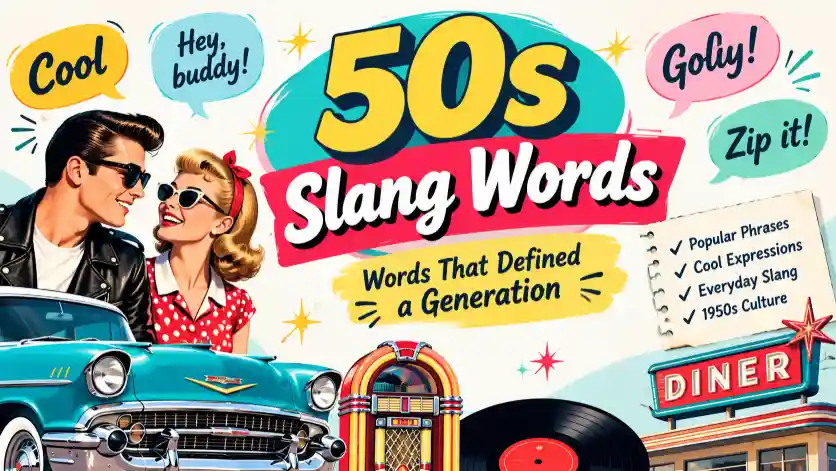
50’s slang is the fun, colorful language American teenagers used in the 1950s words like “daddy o,” “cool cat,” and “cruisin’.” If someone said “that car is boss, daddy o,” they meant the car was great, my friend.
If you searched for “50’s slang,” you probably heard one of these words in an old movie, a song, or from your grandparents and wondered what it means.
This guide to 50’s slang covers the most popular 1950s words, their meanings, where the slang came from, and which words survived.
You will also find real life examples and answers to the questions people search most on Google all in plain, simple words.
Quick Answer: 50’s Slang
50’s slang is the informal language of 1950s American teens playful words like “daddy o” (dude), “square” (a boring person), and “bread” (money). It grew from jazz clubs, rock and roll, and car culture. Most of it faded away, but a few words like “cool” survived and are still used today.
What Is 50’s Slang?
50’s slang was the everyday vocabulary of teenagers in the 1950s. After World War II, America entered a prosperous decade: rock and roll exploded, drive in movies and diners became teen hangouts, and cars gave young people freedom. Teens built their own culture with its own music, clothes, dances, and words.
Who Used 50’s Slang?
Three groups shaped it most. Jazz musicians and beatniks artsy nonconformists gave us “cool,” “hip,” “dig,” and “daddy o.” Greasers leather jacketed teens who loved rock and roll and hot rods spread car and street slang. And ordinary high school teens at sock hops and malt shops carried these words into daily life.
Popular 50’s Slang Words and Meanings
Here are the most famous 50’s slang words, grouped so they are easy to learn.
For People
| Word | Meaning | Example |
| Daddy o | A friendly way to address a guy, like “dude” | “Hey daddy o, what’s buzzin’?” |
| Cool cat | A stylish, confident person | “Jimmy is such a cool cat.” |
| Square | A boring, old fashioned person | “Don’t be such a square come dance!” |
| Greaser | A rock and roll teen with slicked back hair | “The greasers hang out by the drive in.” |
| Beatnik | An artsy nonconformist who loved jazz and poetry | “She dresses like a beatnik.” |
| Doll | An affectionate word for a woman (dated today) | “He took his doll to the dance.” |
| Ankle biter | A small child | “The ankle biters are asleep.” |
Words for Fun, Style, and Attitude
| Word | Meaning | Example |
| Cool / Hip | Stylish, impressive, in the know | “That jacket is so cool.” |
| Dig | To understand or enjoy | “Do you dig this song?” |
| Boss | Great, excellent | “That guitar solo was boss!” |
| Blast | A great time | “We had a blast at the hop.” |
| Nifty | Neat, clever, cool | “That’s a nifty car.” |
| Flip your lid | To get very excited or angry | “Mom flipped her lid when she saw my grades.” |
| Made in the shade | Successful, in a great situation | “With that job, he’s made in the shade.” |
Words for Money, Cars, and Daily Life
| Word | Meaning | Example |
| Bread | Money | “I need more bread for gas.” |
| Pad | Your house or apartment | “Come over to my pad later.” |
| Threads | Clothes | “Nice threads, man!” |
| Hot rod | A fast, customized car | “His hot rod wins every drag.” |
| Cruisin’ | Driving around slowly for fun | “We spent Saturday cruisin’ downtown.” |
| Cruisin’ for a bruisin’ | Looking for trouble | “Keep teasing him and you’re cruisin’ for a bruisin’.” |
| Knuckle sandwich | A punch in the face | “One more word and you’ll get a knuckle sandwich.” |
Where Did 50’s Slang Come From?
50’s slang bubbled up from three cultural springs. Jazz clubs came first: 1940s musicians coined “cool,” “hip,” “dig,” and “cat,” and beatniks carried them into 50s coffeehouses. Then rock and roll exploded with Elvis Presley and Chuck Berry, giving teens anthems and attitude. Finally, car culture hot rods, drag races, and drive ins gave teens freedom and a vocabulary for it.
Movies and television spread the words far beyond the teens who invented them, and later films set in the 50s (like Grease, made in 1978) kept the slang alive for new generations.
Real Life Examples of 50’s Slang
Here is how a 1950s conversation at a sock hop might have sounded:
- Buddy: “Hey daddy o, what’s buzzin’?”
Al: “Nothin’ much. Just cruisin’ by your pad. You coming to the hop tonight?” - Buddy: “You bet! Is Betty wearing her new threads?”
Al: “Yeah, she’s all decked out. Don’t be a wet rag let’s have a blast!” - Buddy: “Cool, cool. I dig it. Let’s agitate the gravel!”
Translation: “Hey dude, what’s up? Let’s get going and have fun!” Every strange word had a simple meaning that was the whole point.
Is 50’s Slang Still Used Today?
Most 50’s slang faded as the decade ended. Words like “daddy o,” “ginchy,” and “agitate the gravel” now sound like costumes fun at a theme party, but nobody says them seriously.
A few survivors made it, though. “Cool” is the biggest born in jazz clubs, raised in the 50s, still going strong. “Hip” survived too, and “pad” (for home) and “dig it” are still understood. Slang has a life cycle: most words burn bright and fade, while a lucky few become permanent parts of the language.
Is 50’s Slang Rude or Offensive?
Almost all 50’s slang is harmless and playful. Words like “daddy o,” “nifty,” and “blast” were never insults they were teen fun.
Two honest notes, though. Some words for women, like “chick” and “doll,” were affectionate in the 50s but can sound dated or disrespectful today best to leave them in the past. And one word needs a clear warning: “or lose control“ meant an uncooperative person in the 50s, but today it is considered an offensive slur. Do not use it, even when quoting old slang.
When Should You Avoid Using 50’s Slang?
- In serious or formal settings. Job interviews, essays, and business emails need modern, clear language.
- When the words for people feel dated. “Chick,” “doll,” and “or lose control” do not belong in modern conversation.
- When talking to older adults. Some may love the nostalgia; others may find it mocking. Read the room.
- When you want to be understood. If your listener was not raised on old movies, “agitate the gravel” will only confuse them.
50’s slang shines at retro parties, in creative writing, and when bonding with grandparents over shared memories everywhere else, use it sparingly and with a smile.
Common Misunderstandings About 50’s Slang
“The cat’s pajamas” is 50’s slang.
It sounds like it fits, but this phrase actually comes from the 1920s. The 50s borrowed plenty from earlier decades, and this is one of them.
“Far out” is 50’s slang.
Close, but “far out” peaked in the 1960s with hippie culture. The 50s had “cool” and “boss” for the same job.
Everyone in the 50s talked like this.
No this was teen slang. Most adults in the 50s spoke formally and found the teen vocabulary puzzling, just as parents do in every generation.
50’s slang was invented by Hollywood.
Hollywood spread it, but teens, jazz musicians, and car clubs created it. Movies like Grease came decades later.
“Daddy o” means father.
No despite the “daddy” inside it, “daddy o” was simply a cool way to say “dude” or “man.” It had nothing to do with fathers.
Frequently Asked Questions About 50’s Slang
What are some 50s slang words?
The most famous include “daddy o” (dude), “cool cat” (stylish person), “square” (boring person), “bread” (money), “pad” (home), “threads” (clothes), “cruisin'” (driving for fun), “dig” (understand), “boss” (great), and “blast” (a great time). Most described people, cars, fun, and attitude the center of 50s teen life.
What did “cool” mean in the 50s?
In the 50s, “cool” meant stylish, calm, and impressive someone who stayed relaxed under pressure. It came from 1940s jazz culture, where “cool jazz” described a smooth, laid back sound. Teens adopted it for anything admirable, from music to clothes to people. Unlike most 50s slang, “cool” never died and means nearly the same thing today.
What does “daddy o” mean?
“Daddy o” was a friendly way to address a guy in the 1950s the equivalent of today’s “dude” or “man.” Beatniks and jazz fans used it most. It had nothing to do with fathers, despite how it sounds. Saying it today sounds deliberately retro, like wearing a costume made of words.
What does “square” mean in 50s slang?
A “square” was someone boring, old fashioned, or out of touch the opposite of “cool” or “hip.” If you did not like rock and roll, hated dancing, and followed every rule, teens might call you a square. The insult was mild and playful, more teasing than cruel.
What is 1950s slang for money?
The classic 50s word for money was “bread,” as in “I need more bread for the jukebox.” It came from jazz musician slang of the 1930s and 40s and stayed popular through the 50s. “Dough” was used the same way. Both treated money as something basic and everyday like bread on the table.
What does “cruisin’ for a bruisin'” mean?
It means looking for trouble acting in a way that is going to get you hurt, scolded, or punched. “Keep mouthing off and you’re cruisin’ for a bruisin'” was a classic warning. The phrase rhymes, which made it fun to say, and it is one of the most quoted 50s expressions today.
Is 50s slang still used today?
Mostly no with a few famous exceptions. “Cool,” “hip,” “pad,” and “dig it” survived into modern English. The rest, like “daddy o” and “ginchy,” faded decades ago and now sound intentionally old fashioned. People use them today mainly for humor, retro parties, or creative writing, not in real conversation.
What does “the cat’s pajamas” mean?
It means something or someone outstanding the best of the best. But here is the twist: it is actually 1920s slang, not 50s slang. The 1950s borrowed it and kept it alive, which is why people mix up the decades. In the 50s, teens were more likely to say “boss” or “nifty” for the same idea.
Conclusion
50’s slang was the voice of a generation discovering rock and roll, cars, and freedom playful words like “daddy o,” “cool cat,” “bread,” and “cruisin’.” Most faded with the decade, but a few, like “cool,” became permanent.
Use 50’s slang today for fun: at retro parties, in stories, or to make your grandparents smile. Just leave the dated words in the past, and remember that every generation invents its own language the 50s teens were simply doing what teens still do now
Read More:
- BGG Mean in Text? The Quick Guide to Its Meaning and Use
- Heater Meaning Slang: Gun, Winning Streak, or Something Else?
- What Does BHT Mean in Text: A Quick Guide for 2026

Hi, I’m Sophia Turner, a writer at SlangRise with 7 years of experience researching English slang, internet abbreviations, and modern vocabulary.