BK in text can mean “back” in casual conversations, especially when someone returns to a chat. You may see it in text messages, TikTok comments, Snapchat, Instagram, or WhatsApp. However, its meaning depends on the context.
People use text abbreviations to communicate quickly without typing complete words. For example, someone might write “im bk” instead of “I’m back” when they return after a short break.
Still, BK does not have one universal meaning. It can also refer to Burger King, a person’s initials, or another context-specific term. Understanding the surrounding conversation helps you identify the intended meaning.
In this guide, you’ll discover the possible meanings of BK, how people use it online, real texting examples, and the best ways to reply when someone sends it.
BK Meaning in Text
BK may stand for “back” in informal texting. People can use it to tell someone that they have returned, are available again, or want to continue a conversation.
For example:
“im bk now”
This means “I’m back now.” The sender is letting the other person know that they have returned.
However, BK is not as universally recognized as abbreviations such as IDK or BRB. Some people understand it immediately, while others may need more information.
What Does BK Stand For?
When someone uses BK to mean “back,” they are using a shortened form of the word.
Here are some examples:
- “im bk” : I’m back.
- “bk now” : Back now.
- “ill b bk” : I’ll be back.
- “bk in 5” : Back in five minutes.
- “im bk home” : I’m back home.
These examples show how BK might appear in casual messages. The exact wording and meaning can vary between people.
Is BK Slang or an Abbreviation?
BK is best described as an informal abbreviation when it stands for “back.”
Slang refers to informal language used within particular groups or communities. An abbreviation is a shortened form of a word or phrase.
People sometimes use these terms interchangeably when discussing internet language. However, BK is not a standardized abbreviation with one guaranteed meaning.
Always consider the context before assuming that BK means “back.”
Where Do People Use BK?
BK may appear in different messaging apps and online communities. Its meaning generally depends on the conversation rather than the platform itself.
BK Meaning on TikTok
On TikTok, someone might use BK in a comment or direct message to indicate that they are back.
For example:
“bk after dinner”
This could mean that the person will return after dinner.
However, BK may also refer to Burger King when people discuss food, restaurants, or advertisements. In other situations, it could represent initials or a name.
BK Meaning on Snapchat
Snapchat conversations often include short messages between friends. Someone might write “im bk” after leaving a conversation for a while.
Example: “bk now, send me a snap.”
The sender is saying they have returned and are ready to continue chatting.
If someone sends only “BK,” check the previous messages to understand what they mean.
BK Meaning on Instagram
On Instagram, BK may appear in direct messages or comments.
For example:
“im bk, check ur dm”
In this example, the sender means they are back and wants the other person to check their direct messages.
If the conversation concerns a restaurant, brand, or person’s name, BK may have a different meaning.
BK Meaning on WhatsApp
On WhatsApp, people may use BK in individual chats or group conversations.
For example:
“went outside, bk soon”
This could mean that the person expects to return shortly.
However, not everyone recognizes informal abbreviations. If you are messaging someone who may not understand BK, writing “back soon” is clearer.
BK Meaning in SMS Text Messages
In ordinary SMS messages, BK may be used as a shortcut for “back.”
For example:
“ill b bk in 10 mins”
The sender means they will return in ten minutes.
Although abbreviations can make messages shorter, clear communication is more important than saving a few characters, especially when the message contains important information.
10 Real Chat Examples of BK
These examples demonstrate how someone might use BK to mean “back” in a casual conversation. They are illustrative examples, not proof that every person uses BK the same way.
Example 1: Returning to a Chat
A: where did u go?
B: had to answer a call
A: oh okay
B: im bk now
Meaning: B has finished the call and returned to the conversation.
Example 2: After Dinner
A: wanna play a game?
B: eating rn
A: okay text me later
B: ill be bk in 20 mins
Meaning: B expects to return in about 20 minutes.
Example 3: Snapchat Message
A: u there?
B: helping my sister
A: no worries
B: bk now, send a snap
Meaning: B is available again and wants to continue exchanging Snaps.
Example 4: School Homework
A: did u finish the assignment?
B: not yet
A: lmk when ur done
B: okay, im bk after this page
Meaning: B plans to return to the conversation after finishing the current task.
Example 5: Gaming Chat
A: ready to play?
B: my internet stopped working
A: oh no lol
B: bk now, invite me
Meaning: B has returned and wants to join the game.
Example 6: Busy Afternoon
A: can we talk?
B: busy rn
A: okay
B: bk later tonight
Meaning: B expects to return to the conversation later.
Example 7: Instagram Direct Message
A: did u see the photos?
B: give me a minute
A: sure
B: im bk, looking now
Meaning: B has returned and is ready to look at the photos.
Example 8: Group Chat
A: are u coming back?
B: yeah
A: when?
B: bk in 5
Meaning: B expects to return in five minutes.
Example 9: Weekend Plans
A: movie starts soon
B: getting snacks
A: hurry 😂
B: ill b bk soon
Meaning: B is saying they will return shortly.
Example 10: Asking for Clarification
A: what does BK mean?
B: i meant back lol
A: ohh got it
B: yeah just a shortcut
Meaning: B confirms that BK means “back” in this conversation.
How to Reply When Someone Says BK
Your response depends on the conversation and your relationship with the sender. If BK means “back,” you can reply naturally without making the exchange complicated.
Funny Replies
If you are talking to a close friend, try a playful response:
- “Finally 😂”
- “Welcome back from your mission!”
- “Look who returned lol.”
- “We almost called a search team 😭”
- “Back already? 😂”
Use these replies when you know the other person will understand your humor.
Casual Replies
For a simple, everyday response, you can say:
- “Okay.”
- “Cool.”
- “Gotcha.”
- “Nice.”
- “Alright, what’s up?”
These replies are useful when you want to continue the conversation without adding much detail.
Friendly Replies
If you want to sound welcoming, try:
- “Hey, welcome back!”
- “How did it go?”
- “Glad you’re back 😊”
- “Ready to continue?”
- “Hey, what happened?”
Choose a response that matches the situation instead of sending a reply that feels unnatural.
Neutral Replies
If you do not know the person well, keep your message clear:
- “Okay, thanks for letting me know.”
- “Sure, no problem.”
- “Got it.”
- “What did you want to discuss?”
If you are unsure what BK means, simply ask, “Do you mean back?” Asking for clarification is better than guessing incorrectly.
Is BK Rude or Offensive?
BK is not inherently rude or offensive when it means “back.” In casual conversations, it is generally neutral.
However, the tone of a message depends on the complete sentence, the relationship between the people, and the situation.
Is BK Safe to Use With Friends?
Yes. You can use BK in a casual chat if your friend understands what you mean.
For example, “im bk now” can be a quick way to tell someone you have returned.
However, some people may not recognize the abbreviation. If you want to avoid confusion, write the complete word.
Is BK Appropriate at School?
BK may be acceptable in informal messages to classmates.
For school assignments, essays, presentations, or messages to teachers, use standard English instead of texting shortcuts.
For example:
- Casual: “ill b bk soon”
- Clear: “I’ll be back soon.”
The second version is more appropriate for formal communication.
Is BK Appropriate at Work?
In professional communication, clarity matters more than brevity.
Instead of writing “bk in 10,” write “I’ll be back in 10 minutes.”
This makes your meaning clear to colleagues, managers, and customers who may not recognize the abbreviation.
Who Uses BK?
BK is not limited to one age group. People may use abbreviations in casual messages depending on their habits, online communities, and familiarity with texting slang.
Do Gen Z Users Use BK?
Some Gen Z users may use BK in informal conversations, especially when shortening familiar words.
However, there is no reliable evidence that all Gen Z users commonly use BK. Many people prefer clearer or more widely recognized alternatives.
For example, BRB is a more established abbreviation for “be right back.”
Do Teenagers and Adults Use BK?
Both teenagers and adults may use shortened words when messaging friends.
A teenager might use BK in a group chat, while an adult might use it in a quick personal message. The difference depends more on individual communication habits than age alone.
Where Might BK Appear?
You might encounter BK in:
- Text messages
- Snapchat conversations
- Instagram direct messages
- TikTok comments
- WhatsApp group chats
- Online gaming conversations
Its frequency can vary, and it should not be assumed to be a universally popular abbreviation.
Origin of BK in Texting
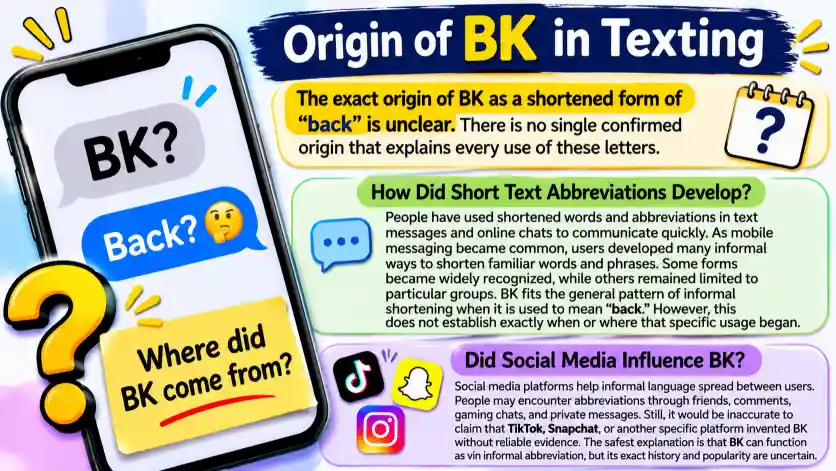
The exact origin of BK as a shortened form of “back” is unclear. There is no single confirmed origin that explains every use of these letters.
How Did Short Text Abbreviations Develop?
People have used shortened words and abbreviations in text messages and online chats to communicate quickly.
As mobile messaging became common, users developed many informal ways to shorten familiar words and phrases. Some forms became widely recognized, while others remained limited to particular groups.
BK fits the general pattern of informal shortening when it is used to mean “back.” However, this does not establish exactly when or where that specific usage began.
Did Social Media Influence BK?
Social media platforms help informal language spread between users. People may encounter abbreviations through friends, comments, gaming chats, and private messages.
Still, it would be inaccurate to claim that TikTok, Snapchat, or another specific platform invented BK without reliable evidence.
The safest explanation is that BK can function as an informal abbreviation, but its exact history and popularity are uncertain.
BK vs. IDK, IDC, IMO, and BRB
May look similar to other short texting terms, but each abbreviation serves a different purpose.
| Term | Meaning | Type | Usage | Popularity |
| BK | Back, in some chats | Informal abbreviation | Indicating a return | Recognition varies |
| IDK | I don’t know | Initialism | Expressing uncertainty | Widely recognized |
| IDC | I don’t care | Initialism | Expressing indifference | Widely recognized |
| IMO | In my opinion | Initialism | Sharing a viewpoint | Widely recognized |
| BRB | Be right back | Initialism | Saying you will return shortly | Widely recognized |
BK vs. BRB
May mean “back,” while BRB means “be right back.”
For example:
- “im bk” means “I’m back.”
- “brb” means “Be right back.”
BRB usually tells someone that you are leaving temporarily. BK, when used to mean “back,” can indicate that you have returned.
BK vs. IDK
IDK means “I don’t know.” It expresses uncertainty.
Example: “idk what time the shop closes.”
This means the sender does not know the shop’s closing time. It is different from BK, which may refer to returning.
BK vs. IDC
IDC means “I don’t care.” It can express indifference, although its tone depends on the conversation.
BK does not normally express indifference when used to mean “back.”
BK vs. IMO
IMO stands for “in my opinion.” It introduces a personal viewpoint.
For example, “IMO, this movie is great” means “In my opinion, this movie is great.”
Unlike IMO, BK does not normally introduce an opinion.
Real-World Example of BK
Imagine two classmates are preparing a presentation together. One student leaves the conversation to find information in a textbook.
After a few minutes, the other student asks if they are ready to continue.
The first student replies:
“im bk, found the answer.”
Here, BK means “back.” The student has returned to the conversation and found the information they needed.
The same situation could happen between friends playing an online game or chatting on WhatsApp.
However, imagine that someone mentions BK while discussing a restaurant. In that context, BK might refer to Burger King instead.
This example demonstrates why the surrounding topic is important. The same letters can have different meanings in different situations.
Frequently Asked Questions
1. What does BK mean in text messages?
BK may mean “back” in informal text messages. For example, “im bk” can mean “I’m back.” The intended meaning depends on the conversation.
2. What does BK mean on TikTok?
On TikTok, BK may mean “back” in a comment or direct message. It can also refer to a brand, initials, or another term depending on the context.
3. Is BK slang?
BK is an informal abbreviation when used to mean “back.” However, it is not universally recognized, so some people may need clarification.
4. Is BK rude or offensive?
No, BK is not inherently rude or offensive when it means “back.” It is generally neutral in casual conversations.
5. How should you reply to BK?
You can reply with “welcome back,” “okay,” or “what’s up?” If you do not understand the message, ask, “Do you mean back?”
Conclusion
BK can mean “back” in informal text messages, especially when someone wants to tell a friend they have returned to a conversation. You may see it in messaging apps, social media comments, and online chats.
However, BK does not have one universal meaning. It may also refer to Burger King, initials, or another context-specific term.
Use BK in casual conversations when the meaning is clear. For schoolwork, professional messages, and important communication, writing the complete word is usually better.
Read More:
- BIW Meaning in Text: What Does This Slang Stand For?
- What Does Bio Mean in Text? Meaning, Examples & Social Media Use
- PA Meaning in Texting: What Does This Abbreviation Mean?

Hi, I’m Sophia Turner, a writer at SlangRise with 7 years of experience researching English slang, internet abbreviations, and modern vocabulary.