Australian slang is a fun and colorful part of everyday Australian English. If you watch Australian movies, follow Australian creators, visit Australia, or chat with Australians online, you may notice words that sound unusual at first. Words like arvo, brekkie, mate, barbie, and servo are common examples.
Australian slang often makes everyday speech shorter, friendlier, and more relaxed. Some words are used across Australia, while others are linked to certain places, age groups, or social settings. Some are also so common that Australians may use them without thinking of them as slang.
This guide explains the most useful Australian slang words, what they mean, where they are used, and how to understand them in real conversations.
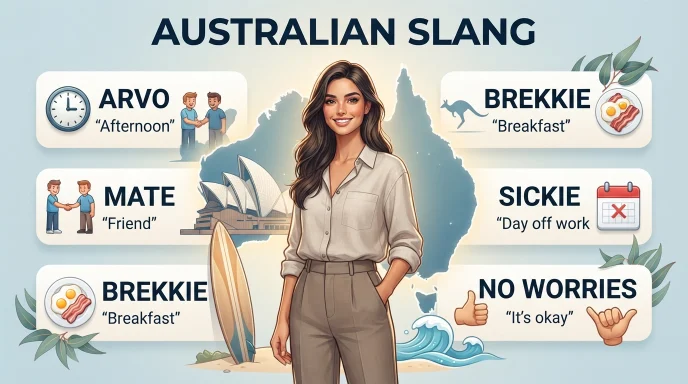
Quick Answer: Australian slang is a collection of informal Australian words and expressions used in everyday speech and online communication. Common examples include arvo for afternoon, brekkie for breakfast, barbie for barbecue, and mate for friend.
What Is Australian Slang?
Australian slang refers to informal words, shortened expressions, nicknames, and phrases commonly used in Australian English.
Some Australian slang comes from shortening longer words.
For example:
- Afternoon → arvo
- Breakfast → brekkie
- Barbecue → barbie
- Service station → servo
- Football → footy
Australians are also known for using informal words as friendly forms of address. Mate is one of the best-known examples.
Australian slang is not one single fixed list. Language changes over time, so some expressions become less common while new ones appear.
You may also hear different slang depending on the person’s age, location, profession, and social group.
Why Does Australian English Have So Much Slang?
Australian English developed from British English, but it also developed its own vocabulary and style.
Australia’s history brought together English settlers, Aboriginal languages, immigrant communities, and local expressions shaped by Australian life.
The country’s large size and distinct culture also helped create regional words and expressions.
Australian speech is often associated with informality. People may shorten words, add friendly endings, or use playful expressions.
For example:
“See you this arvo, mate.”
A learner might say:
“See you this afternoon, friend.”
Both sentences communicate the same basic idea, but the first sounds much more casual and Australian.
Common Australian Slang Words
Here are some of the most useful Australian slang terms to know.
1. Arvo
Meaning: Afternoon.
Example:
“Let’s meet this arvo.”
This is one of the most common Australian shortened words.
2. Brekkie
Meaning: Breakfast.
Example:
“I’m going out for brekkie.”
It is usually casual and friendly.
3. Barbie
Meaning: Barbecue.
Example:
“We’re having a barbie this weekend.”
Do not confuse this with the name Barbie. In Australian conversation, barbie can simply mean a barbecue.
4. Servo
Meaning: Service station or gas station.
Example:
“I need to stop at the servo.”
A servo may sell fuel, snacks, drinks, and other basic items.
5. Bottle-o
Meaning: A shop that sells alcoholic drinks for takeaway.
Example:
“I’m stopping at the bottle-o.”
This is very informal Australian English.
6. Macca’s
Meaning: McDonald’s.
Example:
“Let’s grab something from Macca’s.”
This nickname is especially recognizable in Australia.
7. Footy
Meaning: Football.
Example:
“Are you watching the footy tonight?”
The exact sport meant by footy can depend on the region and context. It may refer to Australian rules football, rugby league, or rugby union.
8. Mate
Meaning: Friend, companion, or informal way to address someone.
Example:
“Thanks, mate.”
Mate can also be used with someone you do not know well. Its tone depends on the situation.
9. Good on ya
Meaning: Well done or good for you.
Example:
“You finished the project? Good on ya!”
It is usually positive and friendly.
10. No worries
Meaning: No problem.
Example:
“Thanks for helping.”
“No worries!”
This expression is common in casual Australian English.
Australian Slang for Friends
Australian English has several informal ways to refer to friends or people.
Mate
Mate is probably the most famous.
It can show friendship, friendliness, or casual familiarity.
“How are you going, mate?”
Cobber
Cobber is an older informal word for a friend or companion.
It is much less common in modern everyday speech than mate, but you may still see it in Australian cultural references.
Bloke
Bloke means a man.
“He’s a friendly bloke.”
It is informal but not necessarily slang in the same way as some other Australian expressions.
Sheila
Sheila is an old Australian informal term for a woman.
It appears in older Australian slang and cultural references, but it can sound dated or disrespectful depending on the speaker and context.
It is better to understand the word than to use it casually with people you do not know.
Australian Slang for Food and Drinks
Food-related slang is another interesting part of Australian English.
Brekkie
Breakfast.
“What did you have for brekkie?”
Barbie
Barbecue.
“We’re having a barbie tonight.”
Sanga
Sandwich.
“I’ll make a sanga for lunch.”
Biccy
Biscuit or cookie.
“Want a biccy with your tea?”
Choccy
Chocolate.
“Can I have a choccy?”
Lollies
Candy or sweets.
“The kids bought some lollies.”
These words can make Australian conversations sound very different to learners of American English.
Australian Slang for Places and Daily Life
Australians also shorten words related to everyday places.
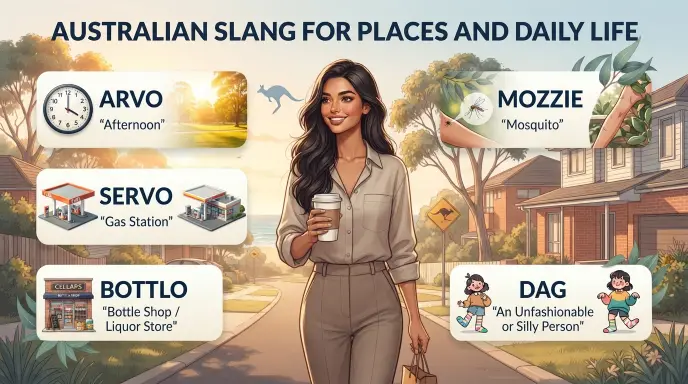
Servo
Service station.
“There’s a servo around the corner.”
Bottle-o
Takeaway alcohol shop.
“He went to the bottle-o.”
Uni
University.
“I’m heading back to uni.”
Rellie
Relative.
“My rellies are visiting this weekend.”
Tradie
Tradesperson.
“My brother is a tradie.”
A tradie can be someone working in a skilled trade, such as construction, plumbing, electrical work, or carpentry.
Australian Slang for Money
You may also hear informal terms related to money.
Buck
A dollar.
“It only costs a few bucks.”
This is not uniquely Australian, as the term is also used in other varieties of English.
Dosh
Money.
“I don’t have enough dosh for that.”
This is informal and playful.
Quid
Money or pounds in older British usage.
In Australian contexts, you may encounter this in older expressions, historical material, or references influenced by British English.
Australian Slang for Weather
Australia’s climate has influenced everyday vocabulary and expressions.
You may hear:
Scorcher — a very hot day.
“It’s a real scorcher today.”
Stinker — a very hot or unpleasant day.
“Yesterday was a stinker.”
These expressions are informal and depend on context.
Australian Slang for Getting Around
Transportation also has some shortened words.
Servo
A service station.
Ute
A utility vehicle, similar to a pickup truck.
“He drives a ute.”
Ute is one of the most recognizable Australian terms.
Tinny
A small aluminum boat.
“They took the tinny out on the water.”
In some contexts, tinny can also have another slang meaning, so context matters.
Australian Slang and the Word “Yeah”
Australian conversations often use simple informal phrases that may sound different because of tone rather than vocabulary.
For example:
“Yeah, nah.”
This does not always mean a simple “yes and no.”
It can be used to politely disagree or indicate that the answer is actually no.
Example:
“Do you want to come with us?”
“Yeah, nah. I’m too tired.”
The speaker is usually saying no, despite starting with “yeah.”
You may also hear:
“Nah, yeah.”
This can indicate agreement.
These expressions can be confusing to learners because their meaning depends heavily on tone and context.
Australian Slang Examples in Real Conversations
Friendly Conversation
Sam: “What are you doing this arvo?”
Jack: “Going to the beach, mate.”
Sam: “Good on ya. Have fun!”
Here, arvo means afternoon, mate is a friendly form of address, and good on ya means well done or good for you.
At Breakfast
A: “Want to grab some brekkie?”
B: “Sure. Where should we go?”
Here, brekkie simply means breakfast.
Going to a Store
“I’m heading to the servo. Do you need anything?”
The speaker means they are going to a service station.
Talking About Work
“The tradie is coming over this morning.”
Here, tradie means a tradesperson.
Talking About a Vehicle
“That ute looks great.”
Here, ute means a utility vehicle.
Australian Slang on Social Media
Australian slang is also common online.
You may see it on:
- TikTok
- Snapchat
- YouTube
- Discord
- Text messages
- Gaming chats
However, not every Australian uses every slang term.
For example, a teenager in Sydney and an older person in rural Queensland may use very different expressions.
Social media also mixes Australian slang with American internet slang.
A person might write:
“That was a massive W, mate.”
Here, W comes from wider internet slang, while mate is strongly associated with Australian and British English.
This shows how modern online language often combines slang from different cultures.
Is Australian Slang Rude?
Most Australian slang is not rude.
Words such as:
- Mate
- Arvo
- Brekkie
- Barbie
- Servo
- No worries
- Good on ya
are generally harmless in casual settings.
However, some older slang terms or words referring to people can be offensive or outdated.
The safest approach is to understand the meaning and context before using unfamiliar expressions.
A word that sounds funny in a movie may not sound friendly when directed at a real person.
Australian Slang vs American English
Australian and American English share many words, but everyday vocabulary can differ.
| Australian English | American English | Meaning |
| Arvo | Afternoon | Afternoon |
| Brekkie | Breakfast | Breakfast |
| Barbie | Barbecue | Barbecue |
| Servo | Gas station | Fuel station |
| Ute | Pickup truck | Utility vehicle |
| Lollies | Candy | Sweets |
| Capsicum | Bell pepper | Vegetable |
| Thongs | Flip-flops | Footwear |
| Footy | Football | Football-related sport |
| Rubbish | Trash | Waste |
One important example is thongs.
In Australia, thongs commonly means flip-flops.
In American English, the word has a different meaning, so this can create funny misunderstandings.
Australian Slang vs British English
Australian English has strong historical links with British English.
As a result, some words are shared.
For example:
- Mate
- Bloke
- Rubbish
- Uni
- Cheers
- Biscuit
However, Australian English has developed its own expressions and pronunciations.
Some Australian words also became shorter over time.
For example:
Afternoon → arvo
Breakfast → brekkie
Service station → servo
This shortening pattern is a noticeable feature of informal Australian speech.
Why Do Australians Shorten Words?
Word shortening is one of the most recognizable features of Australian slang.
Australians often turn longer words into shorter, friendlier forms.
Some common patterns include:
- -o endings: arvo, servo, bottle-o
- -ie/-y endings: brekkie, rellie, sanga
- Shortened everyday nouns: ute, footy, uni
The result is speech that often sounds casual and friendly.
This does not mean every word is shortened. The pattern is simply common enough to be a noticeable part of Australian English.
When Should You Avoid Australian Slang?
Australian slang is great for casual conversations, but it is not appropriate everywhere.
Avoid heavy slang in:
- Formal essays
- Academic assignments
- Business reports
- Job applications
- Legal documents
- Official letters
- Professional presentations
For example, instead of:
“I’ll get back to you this arvo, mate.”
A professional email could say:
“I’ll get back to you this afternoon.”
The second version is clearer and more suitable for a formal setting.
Why Is Australian Slang Popular?
Australian slang is popular because it adds personality to communication.
It can make speech sound:
- Friendly
- Relaxed
- Humorous
- Informal
- Local
- Conversational
Slang also creates a sense of belonging.
People who share the same expressions can quickly recognize a particular culture or community.
For language learners, Australian slang is especially useful because understanding it can make Australian movies, TV shows, podcasts, social media posts, and conversations much easier to follow.
Common Mistakes When Learning Australian Slang
Mistake 1: Thinking Every Australian Uses the Same Slang
Australia is a large and diverse country.
Language can vary by age, location, profession, and social group.
Mistake 2: Using Slang in Every Sentence
Knowing slang does not mean you need to use it constantly.
Natural speakers switch between informal and standard English depending on the situation.
Mistake 3: Assuming Slang Has Only One Meaning
Some words can have multiple meanings.
Footy, for example, can refer to different football codes depending on the region and context.
Mistake 4: Copying Slang Without Understanding Tone
Some expressions are friendly among friends but may sound rude or old-fashioned in another situation.
Always consider who you are talking to.
FAQs About Australian Slang
What is the most common Australian slang word?
Mate is one of the most widely recognized Australian informal expressions. It can mean friend or simply be used as a friendly way to address someone.
What does “arvo” mean in Australia?
Arvo means afternoon. It is a common informal shortening used in Australian English.
What does “brekkie” mean?
Brekkie means breakfast. It is casual and commonly used in everyday conversation.
What does “barbie” mean in Australian slang?
Barbie means barbecue. For example, “We’re having a barbie tonight” means “We’re having a barbecue tonight.”
What does “servo” mean in Australia?
Servo is a shortened form of service station. In American English, this is generally called a gas station.
What does “good on ya” mean?
Good on ya usually means well done, good for you, or that’s great. It is generally friendly and positive.
Conclusion
Australian slang gives Australian English its relaxed and distinctive character. Words such as mate, arvo, brekkie, barbie, servo, ute, footy, tradie, and no worries are useful examples of how Australians communicate casually.
Many slang terms are simply shortened versions of longer words. Others reflect Australian culture, history, and everyday life.
The most important thing is context. Not every Australian uses the same expressions, and some slang can sound outdated or inappropriate in certain situations.
If you are learning Australian English, start with common terms such as mate, arvo, brekkie, barbie, servo, and no worries. Once you understand how Australians use them naturally, conversations, movies, and social media become much easier to understand.
You may also like:
- Sherm Drug Slang: Meaning, Uses, and Examples
- 2012 Slang: Remember When Everyone Said This Nonstop?
- Spanish Slang for White Girl: The Term That Sparks Debate Online
- Throw in Modern Slang Crossword: Your 2026 Quick Fix

Hi, I’m Olivia Carter. I enjoy researching English slang, online expressions, and everyday vocabulary. I write clear, beginner-friendly guides with simple definitions and practical examples to make modern English easier to understand.