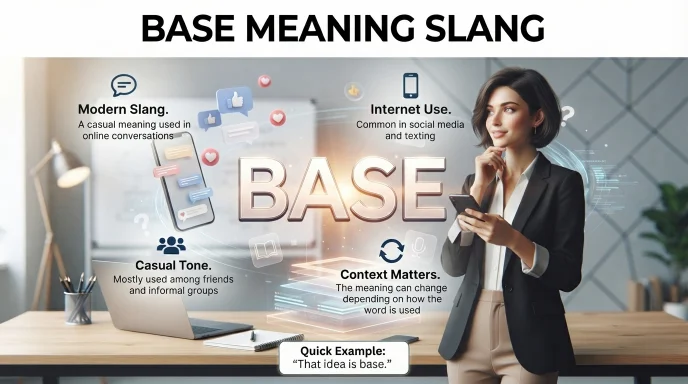
Base meaning slang can be confusing because the word “base” has several meanings in English. In online conversations, some people use base as a short or playful form of based, usually to show agreement, approval, or praise.
You may see it in comments, memes, chats, and social media replies. In other situations, “base” simply means a main place or home spot, such as “I’m back at base.”
The meaning depends heavily on the sentence and the community using it.
This guide explains the slang meaning, how it differs from based, where it comes from, and how to use it naturally without misunderstanding the tone.
Quick Answer:
In internet slang, base can be used as a casual variant of based, meaning “I agree,” “that’s good,” or “that person is being confidently themselves.” However, based is the more established form of this slang.
What Does Base Mean in Text?
When base appears as internet slang, it can express approval, agreement, or admiration.
For example:
“You should always speak your mind.”
“Base.”
Here, “base” means something close to “That’s true,” “I agree,” or “That’s a good take.”
However, there is an important point: base is not always the same as based.
The established internet slang term is based. It became popular as a way to praise someone for being authentic, confident, or willing to express an unpopular opinion. Some online users shorten or alter the word to “base,” often as a meme, stylistic choice, or community-specific usage.
So, if you see someone write:
“That opinion is base.”
They may be using base to mean:
- Good
- True
- Bold
- I agree
- Respect
- Unapologetic
- Not afraid of other people’s opinions
The exact meaning comes from context.
Base Meaning Slang: What Does It Stand For?
Unlike abbreviations such as “LOL” or “BRB,” base does not have a standard full form in this slang usage.
So, if someone searches for base full form, there is no official expansion such as “B-A-S-E.”
In many online contexts, “base” is connected to the slang word based rather than being an acronym.
Based generally describes a person, opinion, action, or statement that is seen as admirable because it is confident, authentic, or independent. Wiktionary records this internet-slang meaning as being unafraid of what others think and maintaining individuality.
What Does Base Stand For?
In slang, base does not stand for a specific phrase.
If it is being used as a variant of “based,” its meaning is usually something like:
“I agree with that.”
or
“That is bold, honest, or admirable.”
This is why translating it word-for-word can be misleading.
Is Base Slang the Same as Based?
Not exactly.
Based is the much more established slang form. Base can appear as a shortened, altered, or community-specific version.
| Term | Common online meaning | Typical use |
| Based | Admirable, authentic, bold, or worthy of agreement | “That was based.” |
| Base | Sometimes a shortened or playful form of “based” | “That take is base.” |
| Cringe | Embarrassing or awkward | “That was cringe.” |
| W | A win or good result | “That’s a W.” |
| Valid | Worth accepting or respecting | “That opinion is valid.” |
| Real | True, relatable, or honest | “Real.” |
Because base is less standardized, you should pay attention to the surrounding conversation.
If you want to use the widely understood slang form, based is usually the safer choice.
What Is the Meaning of Based Slang?
Understanding based makes the slang use of base much easier.
Today, based can mean that someone has expressed an opinion without worrying too much about how others will react.
For example:
“I don’t care if everyone hates my favorite movie. I still love it.”
Someone might reply:
“Based.”
The reply does not necessarily mean the person thinks the movie is objectively good. It means they respect the person’s confidence or honesty.
The term can also simply mean “I agree.”
For example:
“People should be allowed to enjoy things without being judged.”
“Based.”
The slang can be sincere or ironic. Context matters. Academic research on the term notes that its meaning has shifted across different online communities and political spaces, while its central idea often remains connected to authenticity and approval.
Is Base Rude, Offensive, or Neutral?
Usually, base is not automatically rude or offensive.
When used as a form of “based,” it is often positive.
For example:
“You told the truth even though it was difficult. Base.”
The speaker is probably praising the person.
However, slang can change tone depending on the topic and community. “Based” has also been used in political and controversial online discussions. Because of that history, a comment containing “based” or “base” can sometimes carry an ideological or ironic tone. Researchers have documented how the word moved through different online communities and gained different associations over time.
This does not mean every person using it has a political meaning in mind.
Always look at the full conversation.
Where Is Base Slang Commonly Used?
If “base” is being used as a version of “based,” you are more likely to see it in informal online communication than in formal writing.
It can appear in:
- Social media comments
- Meme communities
- Reddit discussions
- Discord chats
- Gaming communities
- Short-form video comments
- Group chats
- Online debates
- Text messages
- Internet forums
The exact frequency varies from one online community to another.
Based is much more widely recognized than base as an internet compliment. Online communities have helped spread the term far beyond its original cultural setting.
Friendly Examples of Base Slang
In a friendly conversation, base can show support.
Example 1
“I’m going to wear what I like instead of following every trend.”
“Base.”
Here, the speaker is approving the confidence.
Example 2
“Everyone deserves a second chance.”
“Base opinion.”
This means the person thinks the opinion is good or reasonable.
Example 3
“I deleted the app because it was wasting too much of my time.”
“Honestly, base.”
The speaker is showing agreement.
Casual Examples
Internet slang often appears as a very short response.
“I don’t like coffee. Tea is better.”
“Base.”
The reply may simply mean:
“I agree.”
Another example:
“I’m not changing my style just because people online dislike it.”
“That’s base.”
Here, the word expresses approval of being confident and independent.
Argumentative Examples
The word can also appear during arguments or debates.
Imagine someone writes:
“You don’t have to agree with everyone just to be polite.”
Another person replies:
“Base take.”
In this case, the speaker is strongly approving the opinion.
But tone can change.
Someone could also write:
“Base, bro. Whatever helps you sleep.”
Here, the word may be sarcastic rather than sincere.
This is why reading only the slang word is not enough. Look at punctuation, emojis, surrounding comments, and the relationship between the people talking.
Gaming and Social Media Examples
Online gaming has its own fast-moving vocabulary, so short reactions are common.
For example:
“I’m playing support again. Someone has to keep the team alive.”
“Base.”
The player may be praising the decision.
On social media, someone might comment:
“I stopped buying things just because influencers recommend them.”
“Based.”
Again, the message means something like “Good choice” or “I respect that.”
If someone uses base instead of based, it may be a stylistic variation rather than a completely different slang term.
What Is the Origin of Base or Based Slang?
The history of based is more interesting than it first appears.
The modern slang sense is strongly associated with rapper Lil B, also known as the BasedGod.
Research on internet language traces his use of “based” to the late 2000s and early 2010s. Lil B reworked a word that had previously carried a negative association connected to “basehead,” a term related to freebase cocaine. He used “based” positively, connecting it with being yourself, staying positive, and not being afraid of other people’s opinions.
The term later spread through online communities and meme culture.
Its meaning continued to change. In some communities, especially political and meme-focused spaces, based became a quick way to approve of a strong or controversial opinion. Over time, it also became more general and could simply mean good, admirable, or correct.
This history explains why the word can feel confusing today.
Why Do People Use Base or Based?
People use this slang because it is quick and expressive.
Instead of writing:
“I strongly agree with what you just said.”
Someone can simply write:
“Based.”
It can communicate several ideas at once:
- I agree.
- I respect your opinion.
- You are being honest.
- You are confident.
- You are not following the crowd.
- That was a good decision.
- I support that take.
Internet slang often works this way. A short word can carry a larger emotional meaning.
Base vs. Real vs. Valid vs. W
These words can overlap, but they are not identical.
| Slang | Basic meaning | Example |
| Base/Based | Admirable, bold, or worthy of agreement | “That was based.” |
| Real | True, honest, or relatable | “Real.” |
| Valid | A reasonable or acceptable opinion | “That’s valid.” |
| W | A win or positive result | “Huge W.” |
| Facts | Strong agreement with a statement | “Facts.” |
| Based take | A strongly approved opinion | “That’s a based take.” |
For example, “real” often emphasizes relatability, while “based” often emphasizes approval of someone’s attitude or opinion.
“W” is more connected to success or winning.
When Should You Avoid Using Base Slang?
You generally do not need to avoid the word in casual online conversations, but it is not suitable for every situation.
Avoid using slang like base in:
- Formal academic writing
- Job applications
- Official business documents
- Professional reports
- Formal emails
- Legal documents
- School assignments unless the teacher allows informal language
For example, this is not appropriate in a formal report:
“The company’s decision was base.”
A professional alternative would be:
“The company’s decision was reasonable.”
Or:
“The decision was well supported.”
The problem is not that slang is bad. The problem is that slang depends on a shared understanding between speakers.
Polite Alternatives to Base Slang
If you want to express the same idea clearly, you can use:
- I agree.
- That’s a good point.
- I respect that.
- That’s true.
- Good take.
- I understand your point.
- That’s a fair opinion.
- I think you’re right.
- Well said.
- I support that.
These alternatives work in a wider range of situations.
Why Does Context Matter So Much?
Slang does not have one fixed meaning in every conversation.
For example:
“Base.”
could mean:
Agreement:
“I agree with you.”
Praise:
“That was a good decision.”
Irony:
“Sure, that’s totally a great idea.”
A location:
“I’m back at base.”
That last example has nothing to do with internet slang.
The ordinary meaning of base can refer to a main place, starting point, or location. It is common in phrases such as “home base” and “base camp.” So you should not automatically interpret every use of “base” as internet slang.
Is Base Safe for Social Media?
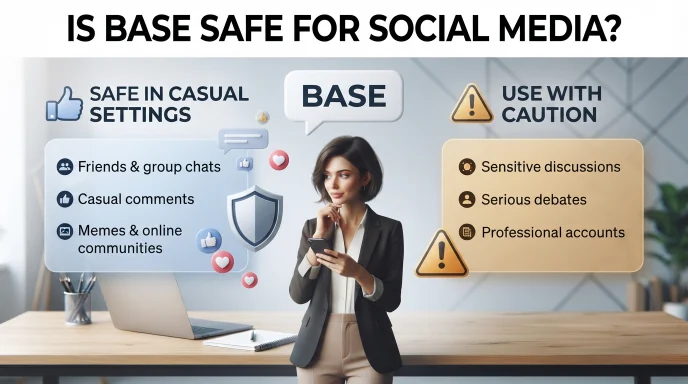
Yes, the word itself is generally safe for ordinary social media use.
However, the context can matter.
Because “based” has appeared in political, meme, and controversial discussions, a post using the term may sometimes communicate more than simple agreement. Academic research has specifically documented how the term developed different associations in different online communities.
If you are posting publicly, read the whole sentence before using it.
A harmless example is:
“You chose sleep over staying up all night. Based.”
A potentially more sensitive example would involve a political or controversial statement. In that situation, readers may interpret “based” as strong approval of the underlying position.
Common Mistakes With Base Slang
Mistake 1: Thinking Base Is an Acronym
It is not a standard acronym.
There is no universal base full form in internet slang.
Mistake 2: Assuming Base Always Means Based
Not necessarily.
“Base” can have its normal English meaning, including a place or starting point.
Mistake 3: Using It in Formal Writing
Slang is best kept for informal communication.
Mistake 4: Assuming It Always Means “Correct”
“Based” often shows approval, but it does not automatically mean something is factually correct.
Someone can call an opinion “based” simply because they admire the person’s confidence.
Mistake 5: Ignoring Sarcasm
Online users often use slang ironically.
A person may say “based” while actually disagreeing with the statement.
Frequently Asked Questions
What does base mean in slang?
In some online communities, base is used as a shortened or playful form of based, meaning agreement, approval, or admiration. However, “based” is the more established slang form.
What does base stand for in texting?
It does not have a standard full form. When used as slang, it may be a variation of based, rather than an abbreviation.
Is base the same as based?
Not exactly. Based is the established internet slang term. Base may be used as a shortened or stylized version in some communities.
Is based a compliment?
Usually, yes. Calling someone “based” often means you admire their confidence, honesty, opinion, or willingness to go against popular opinion. The word can also be used sarcastically.
Is base a bad word?
No. Base is not inherently offensive. Its meaning depends on how and where it is used.
Where did based slang come from?
The modern slang meaning is strongly linked to rapper Lil B, who used “based” positively to describe authenticity, confidence, positivity, and not worrying about other people’s opinions. The term later spread through online communities and developed additional meanings.
Conclusion
Base meaning slang can refer to a casual online use of “base” as a variant of based, usually expressing agreement, approval, or respect. However, based is the more common and established form of the internet slang.
The meaning is not always fixed. In one conversation, “base” may mean “I agree.” In another, it may praise someone’s confidence or bold opinion. And in ordinary English, “base” can simply refer to a main place or starting point.
The safest way to understand the word is to look at the context, tone, and surrounding conversation. If you want to use the slang yourself, “based” will usually be clearer to a wider online audience.
You may also like:
- Bish Slang: Everything You Need to Know
- Smash Slang Meaning: Why This Casual Dating Term Went Viral
- Tesla Meaning Slang: One Word, Instant Status Symbol

Hi, I’m Sophia Turner, a writer at SlangRise with 7 years of experience researching English slang, internet abbreviations, and modern vocabulary.