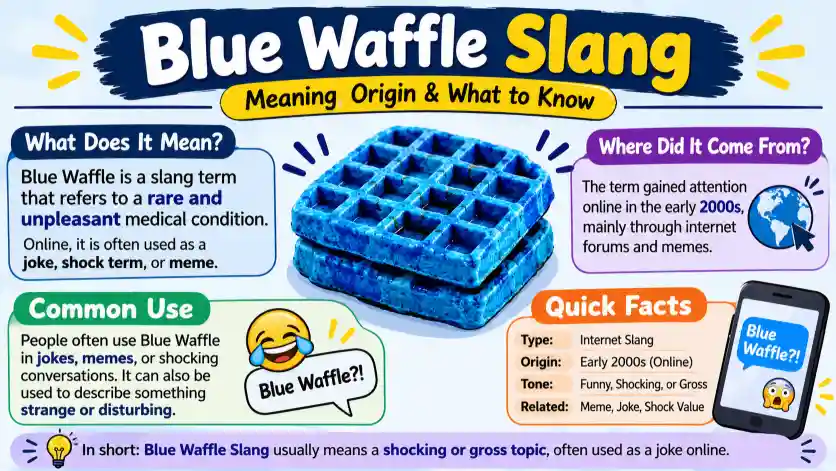
Blue waffle in text usually refers to an internet shock term connected to a fake sexually transmitted infection (STI) hoax. The phrase became known online through disturbing images and false medical claims designed to shock or trick people. It is not a standard texting abbreviation, and “blue waffle disease” is not a real medical condition.
If someone sends you this phrase in a message, they may be joking, referring to an old internet prank, trying to shock you, or warning you about misleading online content. The exact meaning depends on the conversation.
Quick Answer: What Does Blue Waffle Mean in Text?
Blue waffle is an internet slang term associated with an old online hoax and shock prank. The hoax falsely claimed that a sexually transmitted infection could turn a person’s genital area blue. Medical sources confirm that this supposed disease does not exist.
In texting, the phrase may be used to:
- Refer to an old internet myth or prank.
- Shock someone with a disturbing or unexpected topic.
- Joke about an unpleasant or misleading internet search.
- Warn someone not to trust a viral medical claim.
- Refer to a notorious example of online misinformation.
Important: Blue waffle is not a medical diagnosis or a common abbreviation like LOL, BRB, or IDK.
Blue Waffle at a Glance
| Feature | Details |
| Term | Blue waffle |
| Common Meaning | Internet shock term associated with a fake medical hoax |
| Type | Internet slang / shock content reference |
| Tone | Shocking, crude, joking, or cautionary |
| Common Contexts | Text messages, memes, forums, social media, online pranks |
| Medical Status | The supposed “blue waffle disease” is fictional |
| Suitable for Formal Use? | Generally no |
| Related Terms | Internet hoax, shock prank, bait, misinformation |
What Does Blue Waffle Mean in Internet Slang?
The phrase blue waffle is mainly known for its connection to a viral internet hoax. It was presented online as the name of a frightening sexually transmitted infection, often alongside fake or misleading images.
The claim was designed to provoke strong reactions, including fear, disgust, and curiosity. People who encountered it sometimes shared the phrase with friends to see how they would react.
In modern online conversations, someone using the term may be referring to the hoax rather than making a genuine statement about sexual health.
Is Blue Waffle a Texting Abbreviation?
No. Blue waffle is not an acronym or a standard abbreviation.
Unlike texting expressions such as LOL (“laughing out loud”) or TBH (“to be honest”), it is a phrase with a specific internet-culture association.
Its meaning comes from the online myth and prank culture surrounding it, rather than from the first letters of a longer expression.
Is Blue Waffle a Real Disease?
No. Blue waffle disease is a fictional condition created through an internet hoax. There is no medically recognized STI by that name. The images and claims associated with the hoax do not establish that such a disease exists.
However, genuine infections and other health conditions can cause symptoms such as itching, irritation, unusual discharge, or discomfort. Anyone experiencing these symptoms should seek advice from a qualified healthcare professional instead of relying on internet slang or viral images.
How Is Blue Waffle Used in Text Messages?
The phrase can appear in different kinds of online conversations. It is usually a reference to internet culture, a prank, or a shocking topic rather than a normal expression of emotion.
1. As an Internet Prank
Someone may mention blue waffle to trick a friend into searching for the phrase or to provoke a reaction.
Example:
- Person A: “Have you heard of blue waffle?”
- Person B: “No, what is that?”
- Person A: “It was an old internet hoax.”
The person introducing the term may be trying to create curiosity or surprise.
2. As a Reference to an Old Internet Hoax
People familiar with older internet pranks may use the phrase when discussing misleading websites or shocking online content.
Example:
“Remember those fake medical stories people used to share online?”
“Yeah, blue waffle was one of those internet hoaxes.”
Here, the phrase refers to a piece of internet history rather than a real health condition.
3. As a Joke Between Friends
Friends may mention the term while joking about strange searches or unpleasant internet surprises. However, not everyone will understand the reference or find it funny.
Example:
- “Why would you tell me to search for that?”
- “It was an old internet prank. Sorry!”
The humor, if any, comes from the shock or unexpected nature of the reference.
4. As a Warning About Misinformation
Someone might use the phrase when explaining why people should check medical claims before believing or sharing them.
Example:
“Don’t trust every medical story you see online. Blue waffle was a fake disease.”
In this context, the phrase serves as an example of internet misinformation.
What Does Blue Waffle Mean on Social Media?
The meaning generally stays connected to the internet hoax, but the purpose of using it may differ from platform to platform.
Blue Waffle Meaning on TikTok
On TikTok, someone might refer to blue waffle when discussing old internet pranks, online myths, or shocking content. A creator might mention it as an example of a misleading medical claim.
The phrase itself does not have a universal TikTok-specific meaning. Its interpretation depends on the video’s subject and the creator’s intention.
Blue Waffle Meaning on Instagram
On Instagram, the phrase may appear in comments, direct messages, memes, or discussions about internet culture.
Someone might mention it to describe an old prank or warn others about a fake health claim. Because the term has a disturbing association, it is wise to understand the context before responding.
Blue Waffle Meaning on Snapchat
On Snapchat, someone may send the phrase as a joke, a reference to an online hoax, or an attempt to surprise a friend.
For example:
“Someone brought up blue waffle in our group chat again.”
This suggests that the phrase has become a topic of conversation, not that anyone has a medical condition.
Blue Waffle Meaning in Online Forums
Online forums may discuss the term in conversations about internet history, shock websites, pranks, or misinformation.
In these discussions, the phrase often serves as an example of how false claims can spread when people share shocking content without checking if it is true.
Why Did the Blue Waffle Hoax Become Popular?
The blue waffle hoax attracted attention because it combined a frightening medical claim with shocking imagery. Such content can encourage people to search for more information, share links, or send the phrase to friends.
Several factors help explain why this type of prank spreads.
1. Shock Value
Content that causes surprise, fear, or disgust can attract attention. Some people share it specifically because they expect a strong reaction.
2. Curiosity
An unfamiliar phrase can make people want to search for its meaning. That curiosity may lead them to websites or images that they would not normally seek out.
3. Peer Pranks
Friends sometimes share shocking terms or links as a joke. A person may pass the phrase along without understanding its background or checking its accuracy.
4. Medical Misinformation
False medical claims can spread when people mistake a viral post for reliable health information. The blue waffle story is an example of why it is important to verify health claims through trustworthy medical sources.
The broader lesson is simple: a shocking image or confident online claim is not proof that a medical condition is real.
Is Blue Waffle Rude or Offensive?
Blue waffle can be considered crude, disturbing, or inappropriate in many settings. Its association with sexual health and shock content makes it different from ordinary texting slang.
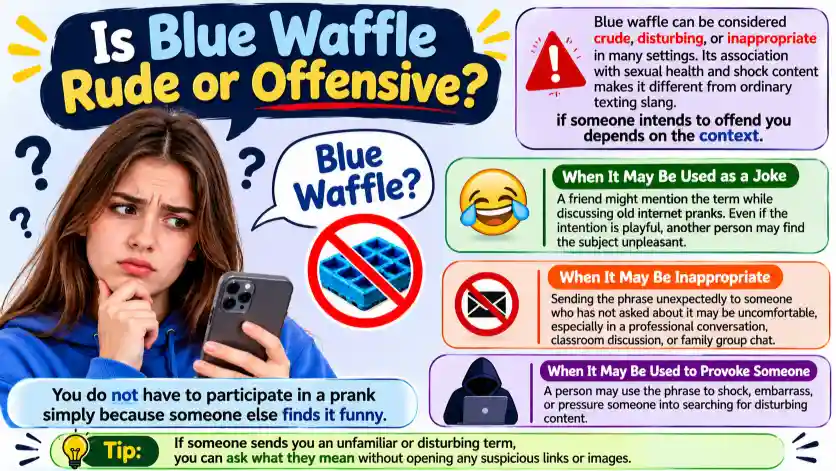
if someone intends to offend you depends on the context.
When It May Be Used as a Joke
A friend might mention the term while discussing old internet pranks. Even if the intention is playful, another person may find the subject unpleasant.
When It May Be Inappropriate
Sending the phrase unexpectedly to someone who has not asked about it may be uncomfortable, especially in a professional conversation, classroom discussion, or family group chat.
When It May Be Used to Provoke Someone
A person may use the phrase to shock, embarrass, or pressure someone into searching for disturbing content.
You do not have to participate in a prank simply because someone else finds it funny.
Tip: If someone sends you an unfamiliar or disturbing term, you can ask what they mean without opening any suspicious links or images.
How Should You Reply to Blue Waffle in Text?
Your response depends on why the person sent the phrase and if you want to continue the conversation.
If a Friend Sends It as a Joke
You could reply:
- “Isn’t that an old internet hoax?”
- “I’m not falling for that prank.”
- “What’s the context?”
- “Please don’t send me disturbing stuff.”
If Someone Asks You to Search for It
You can ask them to explain the term instead of following an unfamiliar link.
Possible replies include:
- “Just tell me what it means.”
- “Is this another internet prank?”
- “I’d rather not open random links.”
If Someone Claims It Is a Real Disease
You can correct the misinformation politely.
For example:
“Blue waffle disease is an internet hoax, not a recognized medical condition.”
Reliable medical sources, including Planned Parenthood and WebMD, explain that the supposed disease is fictional.
If You Do Not Want to Discuss It
You can simply change the subject or tell the sender that you are not comfortable with the topic.
You do not need to respond to every online joke or shock reference.
Blue Waffle vs. Other Internet Slang Terms
Blue waffle differs from ordinary internet slang because it is primarily associated with a specific hoax.
| Term | Meaning |
| Blue waffle | Internet shock term linked to a fake medical hoax |
| LOL | Laughing out loud |
| WTF | An expression of surprise, confusion, or frustration |
| Troll | Someone who provokes or annoys people online |
| Clickbait | Content designed to attract clicks, often with a sensational headline |
| Hoax | A false story or trick presented as real |
| Rage bait | Content designed to provoke anger and engagement |
These terms are not interchangeable. Blue waffle refers to a particular internet myth, while the others describe common reactions, behaviors, or types of online content.
Common Mistakes About Blue Waffle
People may misunderstand the phrase because of the way it has circulated online.
Mistake 1: Believing It Is a Real STI
The supposed disease is fictional. Do not treat the hoax as a medical diagnosis.
Mistake 2: Assuming It Has a Hidden Romantic Meaning
Blue waffle is not a standard way to express love, attraction, or affection. Its main online association is the shock prank.
Mistake 3: Thinking It Is an Acronym
The phrase is not a standard texting abbreviation with a longer phrase behind its letters.
Mistake 4: Believing Every Image Associated With It
Shocking images can be edited, misrepresented, or taken out of context. Do not use a viral image to diagnose a health condition.
Mistake 5: Ignoring Real Symptoms Because the Hoax Is Fake
Although blue waffle disease does not exist, real health conditions do. Unusual discharge, itching, sores, pain, or other genital symptoms deserve appropriate medical attention.
Frequently Asked Questions
1. What does blue waffle mean in text?
Blue waffle is an internet shock term associated with a fake sexually transmitted infection hoax. In a message, it may refer to an old prank, shocking content, or internet misinformation.
2. Is blue waffle a real disease?
No. Blue waffle disease is fictional and is not a medically recognized condition.
3. Is blue waffle an acronym?
No. It is a phrase associated with an internet hoax, not a standard abbreviation like LOL or BRB.
4. What does blue waffle mean on TikTok?
It may refer to the old internet hoax, a prank, or a discussion about shocking online content. There is no universal TikTok-specific definition.
5. Why do people send blue waffle in messages?
Some people use the phrase to joke, surprise friends, refer to internet history, or discuss misinformation. Others may send it to provoke a reaction.
6. Is blue waffle offensive?
It can be considered crude or disturbing because of its sexual and medical associations. Its appropriateness depends on the audience and situation.
7. What should I do if someone sends me a blue waffle link?
Avoid opening suspicious links or downloading unfamiliar files. Ask the sender to explain the context, and verify any medical claim using a reliable health source.
8. Does blue waffle mean someone likes you?
No. It is not a recognized romantic expression. If someone sends it, they are more likely referring to a prank, a hoax, or shocking internet content.
9. Can blue waffle spread through sexual contact?
No. A fictional disease cannot be transmitted. However, genuine sexually transmitted infections exist, so anyone concerned about exposure or symptoms should consult a healthcare professional.
10. What is the main lesson behind the blue waffle hoax?
It demonstrates why people should verify shocking health claims before believing or sharing them. Reliable medical information is more useful than viral rumors or misleading images.
Conclusion
Blue waffle in text refers to an internet shock term connected to a fake medical hoax. It became known through disturbing images and false claims about a supposed sexually transmitted infection. The condition does not exist, and the phrase is not a standard texting abbreviation.
If someone sends you the term, they may be joking, discussing internet history, or trying to provoke a reaction. Consider the context before replying, and avoid trusting unfamiliar medical claims simply because they appear online.
For genuine health concerns, consult a qualified healthcare professional and rely on trusted medical sources rather than internet pranks.
Read More:
- What Does Blue Heart Mean in Text? Blue Heart Emoji Explained
- Confused by HN in a Text? Here’s What It Can Mean
- Blud Mean in Text: What Does This Slang Word Really Mean?

Hi, I’m Sophia Turner, a writer at SlangRise with 7 years of experience researching English slang, internet abbreviations, and modern vocabulary.