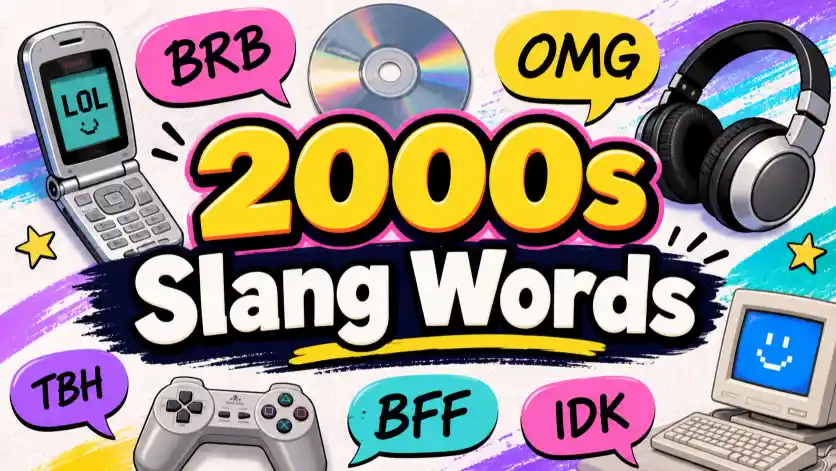
2000s slang words reflect the language, music, fashion, gaming, and internet culture of the early 21st century. Expressions like bling, phat, crunk, my bad, dude, and peace out were familiar in different communities during this era. At the same time, abbreviations such as LOL, BRB, and TTYL became common in text messages and instant messaging.
The 2000s were the era of flip phones, early social media, computer chat rooms, pop punk music, hip hop, and online gaming. These trends influenced how people talked to friends, shared jokes, and communicated online.
Some expressions were already popular before 2000, while others gained wider recognition during the decade. Many are still used today, while others bring back memories of early internet culture.
In this guide, you’ll discover 40 popular 2000s slang words and their meanings, complete with examples, texting abbreviations, gaming terms, and expressions influenced by music and pop culture.
Quick Answer: What Are 2000s Slang Words?
2000s slang words are informal expressions associated with the language and popular culture of the 2000 2009 period. People used them in everyday conversations, text messages, online games, music, and social settings.
Popular examples include:
- Bling: Flashy or expensive jewelry.
- Phat: Excellent, impressive, or attractive.
- Crunk: High energy hip hop music or an energetic party atmosphere.
- My Bad: My mistake or my fault.
- Hella: Very or extremely.
- Dude: A casual way to address someone.
- LOL: Laughing Out Loud.
- Peace Out: A casual way to say goodbye.
- Noob: A beginner, especially in gaming.
- BFF: Best Friends Forever.
These expressions help capture the communication styles and cultural trends associated with the decade.
What Is 2000s Slang?
2000s slang refers to informal words, phrases, and abbreviations used or popularized during the 2000s. People used these expressions to communicate casually, express emotions, describe trends, and connect with friends.
Several cultural influences helped spread slang during this period.
Music and Hip Hop
Hip hop had a strong influence on popular language during the decade. Terms such as bling, crunk, and phat became recognizable through music, celebrity culture, and fashion.
Some expressions originated in specific communities long before they became widely known. Their broader popularity during the 2000s does not mean they were invented during that decade.
Texting and Instant Messaging
Mobile phones and instant messaging services encouraged people to use short forms to communicate quickly.
Abbreviations such as LOL, BRB, IDK, and TTYL became familiar in online chats and text messages.
Gaming and Online Communities
Online gaming introduced or spread expressions such as noob, pwned, and ownage. Players used these terms to describe beginners, victories, and impressive performances.
Television, Movies, and Celebrity Culture
Television shows, films, music videos, and celebrities helped popularize informal expressions. Words that were once associated with particular communities sometimes became familiar to a wider audience.
40 Popular 2000s Slang Words and Their Meanings
Here are 40 expressions associated with the language and culture of the 2000s. Their popularity varied by region, age group, and community.
1. Bling
Meaning: Flashy or expensive jewelry, especially diamond accessories.
Bling became strongly associated with hip hop fashion and celebrity culture during the 2000s.
Example: “Look at his new bling!”
2. BFF
Meaning: Best Friends Forever.
BFF is an abbreviation used to describe a very close friend. It appeared in text messages, online profiles, and friendship related posts.
Example: “She’s been my BFF since school.”
3. LOL
Meaning: Laughing Out Loud.
People use LOL to show that something is funny or to give a message a casual tone.
Example: “That video was hilarious, LOL.”
4. Crunk
Meaning: High energy hip hop music or an energetic party atmosphere.
The term became widely associated with Southern hip hop and lively party culture during the 2000s.
Example: “The music made the whole party feel crunk.”
5. Hella
Meaning: Very, extremely, or a lot.
Hella is particularly associated with Northern California slang, although it is understood elsewhere.
Example: “That concert was hella good.”
6. My Bad
Meaning: My mistake or my fault.
This casual expression is used to admit a mistake without making the conversation overly formal.
Example: “My bad! I sent you the wrong file.”
7. Phat
Meaning: Excellent, impressive, or attractive.
Phat was associated with hip hop and popular culture. Its meaning depended on the context.
Example: “Those are some phat sneakers!”
8. Whatever
Meaning: An expression of indifference, dismissal, or unwillingness to argue.
The word existed long before the 2000s, but it was familiar in casual conversations and teen culture during the decade.
Example: “Whatever, let’s just watch a movie.”
9. Dude
Meaning: A casual way to address someone.
Dude can express surprise, excitement, frustration, or friendship.
Example: “Dude, you won’t believe what happened!”
10. BRB
Meaning: Be Right Back.
People used BRB in instant messages and text conversations when stepping away briefly.
Example: “BRB, getting something to drink.”
11. Awesome
Meaning: Extremely good, impressive, or enjoyable.
Awesome was already established before the 2000s, but it remained common in everyday conversation.
Example: “That was an awesome concert!”
12. Sick
Meaning: Cool, impressive, or excellent when used as slang.
Although sick normally refers to illness, it can describe something exciting or skillful.
Example: “Those skateboard tricks were sick!”
13. Tight
Meaning: Cool, impressive, or close knit, depending on the context.
During the 2000s, people sometimes used tight to praise clothing, music, or someone’s skills.
Example: “Your new jacket looks tight.”
14. Fresh
Meaning: Stylish, fashionable, or impressive.
Fresh was often used to compliment someone’s clothing, appearance, or overall style.
Example: “Those sneakers look fresh.”
15. Sweet
Meaning: Great, excellent, or pleasing.
Sweet is a simple way to express excitement or approval.
Example: “You got concert tickets? Sweet!”
16. Legit
Meaning: Genuine, legitimate, or really good.
Depending on the context, legit can describe something authentic or something particularly impressive.
Example: “That restaurant is legit.”
17. Chill
Meaning: Relaxed, calm, or to relax.
People use chill to describe a laid back person or tell someone to calm down.
Example: “Let’s chill at home tonight.”
18. Homie
Meaning: A close friend or someone from one’s social circle.
The term has roots in earlier community and regional speech, including African American English.
Example: “I’m meeting my homies after school.”
19. Dawg
Meaning: An informal way to address a friend.
Dawg is associated with casual speech and hip hop influenced language.
Example: “Thanks for helping me out, dawg.”
20. Fo’ Shizzle
Meaning: A playful expression meaning “for sure.”
The expression became widely recognizable through Snoop Dogg and early 2000s pop culture. It draws on a style of playful word substitution associated with hip hop speech.
Example: “I’ll be there, fo’ shizzle!”
21. Word
Meaning: An expression of agreement, acknowledgment, or approval.
People may say word to show they understand or agree with something.
Example: “Word, I’ll see you there.”
22. Peace Out
Meaning: Goodbye.
This informal expression is used when leaving a place or ending a conversation.
Example: “I’m heading home. Peace out!”
23. Noob
Meaning: A beginner or inexperienced person, especially in gaming.
Noob is often used playfully, although it can sound insulting when used to mock someone.
Example: “I’m still a noob at this game.”
24. Pwned
Meaning: Defeated or dominated, particularly in online gaming.
Pwned became recognizable in gaming and internet communities. It often describes a decisive defeat.
Example: “You got pwned in that match!”
25. Epic Fail
Meaning: A major or embarrassing mistake.
The phrase became familiar in internet humor, gaming discussions, and videos showing funny mistakes.
Example: “I walked into the wrong classroom. Epic fail!”
26. Ownage
Meaning: A strong victory or complete domination.
Gaming communities used ownage to describe a player who clearly outperformed an opponent.
Example: “That final round was pure ownage.”
27. TMI
Meaning: Too Much Information.
People use TMI when someone shares more personal or uncomfortable detail than necessary.
Example: “I don’t need to know all those details. TMI!”
28. OMG
Meaning: Oh My God.
OMG expresses surprise, excitement, disbelief, or shock in text messages and online conversations.
Example: “OMG, I can’t believe we won!”
29. WTF
Meaning: An abbreviation of “What the f—?”
WTF expresses strong surprise, confusion, or frustration. Because it contains profanity, it may be inappropriate in formal settings.
Example: “WTF just happened?”
30. IDK
Meaning: I Don’t Know.
This abbreviation became familiar in text messages and online chats.
Example: “IDK what time the movie starts.”
31. JK
Meaning: Just Kidding.
JK tells someone that a statement was intended as a joke rather than a serious comment.
Example: “You owe me a million dollars. JK!”
32. TBH
Meaning: To Be Honest.
People use TBH to introduce an honest opinion or personal observation.
Example: “TBH, I liked the first movie better.”
33. Busted
Meaning: Caught doing something wrong or against the rules.
Busted was used in casual conversation long before the 2000s and remained familiar during the decade.
Example: “We got busted sneaking snacks into the theater.”
34. Boo
Meaning: A romantic partner or someone a person cares about.
Boo can be an affectionate term for a boyfriend, girlfriend, spouse, or loved one.
Example: “I’m going out with my boo tonight.”
35. Hater
Meaning: Someone who regularly criticizes or resents another person.
The term often appears in discussions about jealousy, criticism, and online negativity.
Example: “Don’t let the haters ruin your day.”
36. Player
Meaning: Someone who dates multiple people or is considered smooth in romantic situations.
The word may describe a confident person in dating, but it can also suggest dishonesty or a lack of commitment.
Example: “Everyone warned her that he was a player.”
37. Hook Up
Meaning: To meet up, or, depending on the context, to have a casual romantic or sexual encounter.
The phrase has several meanings. It is important to understand the context before interpreting it.
Example: “Let’s hook up after class” may simply mean meeting up.
38. Crib
Meaning: A person’s home or place.
Crib was strongly associated with hip hop and casual youth language.
Example: “Come over to my crib after school.”
39. Bounce
Meaning: To leave a place.
This informal expression is used when someone wants to leave a gathering or end an outing.
Example: “It’s getting late. Let’s bounce.”
40. Dip
Meaning: To leave, sometimes quickly or without much explanation.
Dip is an informal expression used in casual conversation.
Example: “I have an early start tomorrow, so I need to dip.”
Popular 2000s Texting and Internet Slang
The spread of mobile phones and instant messaging made abbreviations an important part of communication during the 2000s.
Many people wanted to send messages quickly, particularly when using older phones with small keypads. Internet chat services also helped popularize short forms.
Here are more expressions associated with early online communication.
| Abbreviation | Full form | Meaning |
| BRB | Be Right Back | I’ll return shortly |
| TTYL | Talk To You Later | Ending a conversation |
| ROFL | Rolling On the Floor Laughing | Something is extremely funny |
| LMAO | Laughing My Ass Off | Strong amusement; contains profanity |
| IMO | In My Opinion | Introducing a personal opinion |
| IMHO | In My Humble Opinion | Introducing an opinion politely or casually |
| CUL8R | See You Later | A playful phonetic abbreviation |
| B4 | Before | A shortened spelling |
| GR8 | Great | A number based spelling |
| 2day | Today | A shortened spelling |
| 2moro | Tomorrow | A shortened spelling |
| NM | Not Much or Never Mind | Meaning depends on context |
These forms were not all invented in the 2000s. Many developed earlier or evolved alongside other forms of online communication. However, the decade helped make text abbreviations familiar to a much wider audience.
2000s Gaming Slang Words
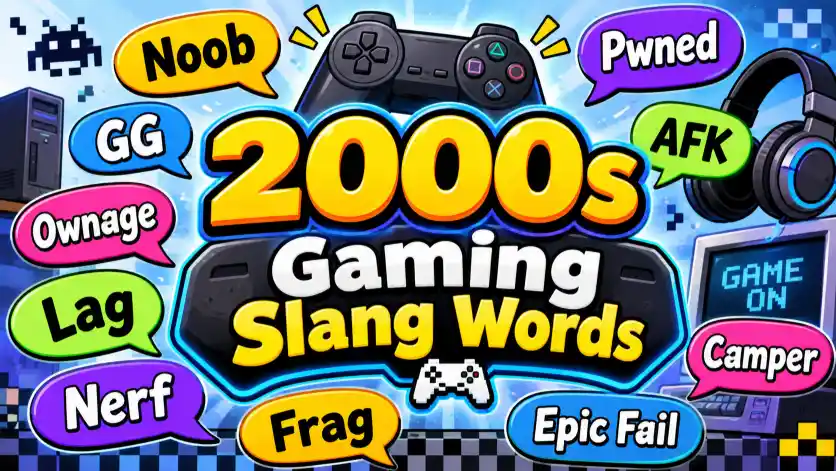
Gaming was another major source of informal language during the decade. Multiplayer games, online communities, and competitive gaming encouraged players to develop short expressions for common situations.
Noob
A noob is a beginner or inexperienced player. The word can be neutral or insulting, depending on how someone uses it.
Pwned
Pwned describes being defeated or outplayed. It became a recognizable expression in online gaming culture.
Ownage
Ownage describes a strong victory or a situation in which one player clearly dominates another.
GG
GG means “Good Game.” Players commonly use it at the end of a match to acknowledge the game.
AFK
AFK means “Away From Keyboard.” It tells other players that someone is temporarily unavailable.
Lag
Lag describes a delay between a player’s action and the game’s response, often because of network or performance problems.
Nerf
To nerf something in a game means to reduce its strength or effectiveness, often through a game update.
Camper
A camper is a player who stays in one area to gain an advantage, particularly in shooting games. The term is often used critically.
Frag
Frag can refer to eliminating an opponent in certain games, especially first person shooters.
Epic Fail
Epic fail describes a major mistake or a particularly embarrassing failure. It was also widely used in internet humor beyond gaming.
These terms show how gaming communities created and spread their own language during the early internet era.
2000s Slang From Music and Pop Culture
Music and entertainment helped carry slang from specific communities into mainstream conversation.
Hip hop, in particular, influenced fashion, expressions, and popular culture during the 2000s. Television shows, films, and celebrity interviews also helped spread catchphrases and informal language.
Some notable examples include:
- Bling: Flashy jewelry associated with celebrity fashion and hip hop culture.
- Crunk: High energy hip hop and party culture.
- Fo’ shizzle: A playful expression popularized by Snoop Dogg.
- Phat: A compliment meaning excellent or attractive.
- Fresh: Stylish or fashionable.
- Player: A person associated with dating multiple people.
- Hater: Someone who criticizes or resents another person’s success.
- Dude: A casual term of address used in many communities.
- Sick: An expression of approval meaning impressive or excellent.
- Tight: A casual compliment meaning cool or impressive.
It is important to remember that popular culture often spreads existing expressions rather than creating them. Some words on this list were in use well before 2000.
Are 2000s Slang Words Still Used Today?
Yes. Many expressions associated with the 2000s remain recognizable, although their popularity varies among communities and generations.
Words such as dude, chill, awesome, legit, my bad, LOL, OMG, and IDK continue to appear in everyday conversations and online messages.
Other expressions may sound more nostalgic or be associated with a particular era. For example, fo’ shizzle may remind people of early 2000s hip hop, while phat may evoke older youth and music culture.
Some gaming terms, including noob, GG, and AFK, remain familiar to many players.
Slang also changes meaning over time. A word may become less common in everyday speech but remain popular in a particular community.
2000s Slang vs. Modern Slang
Some expressions from the 2000s are still used alongside newer slang. However, words that seem similar may have different meanings and cultural associations.
| 2000s associated term | Modern or continuing expression | General comparison |
| Phat | Fire | Both can praise something impressive |
| Tight | Lit | Both can express approval |
| Awesome | That goes hard | Both can praise something |
| My bad | My fault | Both admit a mistake |
| BFF | Bestie | Both can refer to a close friend |
| Epic fail | Major fail | Both describe a noticeable mistake |
| Fresh | Drip | Both can describe stylish clothing |
| LOL | LOL | Still widely recognizable |
| Noob | Noob | Still used in gaming |
| Hater | Hater | Still used in online conversations |
These are approximate comparisons rather than exact replacements. The words differ in tone, history, and usage, and some expressions span several generations.
Frequently Asked Questions About 2000s Slang Words
1. What are the most popular 2000s slang words?
Recognizable examples include bling, crunk, phat, my bad, dude, fresh, sick, tight, LOL, BRB, and BFF. Their popularity varied by region and community.
2. What slang did teenagers use in the 2000s?
Teenagers used expressions such as “dude,” “whatever,” “my bad,” “that’s sick,” and “peace out.” They also used abbreviations such as LOL, BRB, TTYL, and OMG in text messages and online chats.
3. What did “bling” mean in the 2000s?
Bling referred to flashy or expensive jewelry, particularly diamond accessories associated with hip hop fashion and celebrity culture.
4. What did “crunk” mean?
Crunk referred to a high energy style of hip hop and an energetic party atmosphere. The term became widely associated with Southern hip hop during the 2000s.
5. Was LOL popular in the 2000s?
Yes. LOL was widely recognized in text messages, chat rooms, and instant messaging. It means “Laughing Out Loud.”
6. What were popular 2000s gaming terms?
Examples include noob, pwned, ownage, GG, AFK, lag, nerf, and epic fail. Players used them to describe beginners, victories, delays, and mistakes.
7. Are 2000s slang words outdated?
Some expressions sound dated today, while others remain common. Words such as “dude,” “chill,” “my bad,” and “awesome” are still familiar to many English speakers.
8. Did all 2000s slang originate in the 2000s?
No. Many expressions existed earlier. The 2000s helped spread some of them through music, television, gaming, texting, and online communities.
9. What is the difference between 2000s slang and Gen Z slang?
2000s slang is associated with the culture and communication styles of the 2000 2009 period. Gen Z slang includes expressions used by members of Generation Z, although there is overlap between generations and communities.
10. Why is 2000s slang popular again?
Nostalgia, older music, television shows, films, fashion trends, and social media can bring older expressions back into conversations. However, not every term from the decade has returned to widespread use.
Conclusion
The 2000s produced a memorable collection of slang expressions shaped by music, fashion, gaming, texting, and early internet culture. Words such as bling, crunk, phat, fresh, my bad, dude, and peace out help capture the language associated with that era.
Many abbreviations, including LOL, BRB, and IDK, also became familiar through online chats and mobile messaging. Some expressions remain common today, while others bring back memories of older internet communities and pop culture.
Learning these 40 popular 2000s slang words can help you understand old messages, music lyrics, movies, and conversations about the decade.
Read More:
- Gen X Slang: Popular Words, Meanings, and Examples
- What Does Shawty Mean in Slang? (Full Guide With Examples)
- Morgan Meaning Slang: What Does It Mean?

Hi, I’m Sophia Turner, a writer at SlangRise with 7 years of experience researching English slang, internet abbreviations, and modern vocabulary.