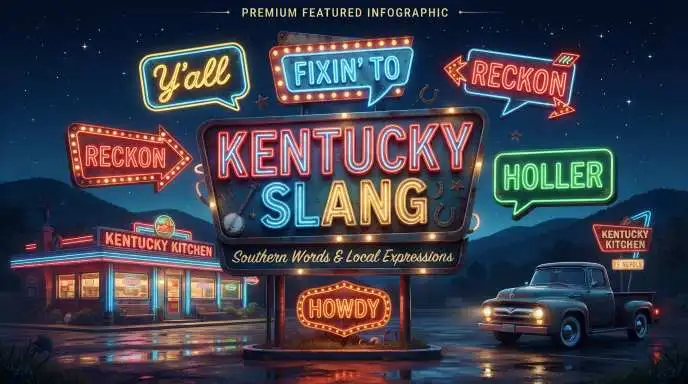
Kentucky Slang refers to the unique informal words and expressions used across the Bluegrass State, such as “buggy” (shopping cart), “holler” (a small valley), and “fixin’ to” (about to), reflecting the region’s rural and Appalachian roots.
“Kentucky hug” playfully describes the warm sensation you feel in your chest after sipping bourbon, while Kentucky natives use “buggy” to refer to a car, truck, or shopping cart depending on the sentence.
Some terms even carry uniquely Kentucky meanings a “waterfall” here isn’t a body of water but a visual way to describe a mullet crashing down someone’s neck.
In this guide, you’ll discover popular Kentucky slang words, their meanings, and how they reflect the state’s rich Appalachian and Southern heritage.
Quick Answer
Kentucky slang means informal words and phrases linked with everyday speech in Kentucky.
Some common examples include:
- Holler a small valley
- Yonder over there
- Fixin’ to about to
- Reckon think or suppose
- Y’all you all
- Tote carry
- Kin family
- Young’un child
- Ornery difficult or mischievous
- Buggy shopping cart
- Might could might be able to
- Mash press
Kentucky speech varies by region, so you may hear some expressions more often in rural or Appalachian communities than in larger cities.
Word at a Glance
| Word or Phrase | Meaning | Part of Speech | Tone |
| Holler | Small valley | Noun | Casual |
| Yonder | Over there | Adverb | Regional |
| Fixin’ to | About to | Phrase | Casual |
| Reckon | Think or suppose | Verb | Informal |
| Y’all | You all | Pronoun | Friendly |
| Tote | Carry | Verb | Casual |
| Kin | Family | Noun | Informal |
| Young’un | Child | Noun | Friendly |
| Ornery | Difficult or mischievous | Adjective | Casual |
| Buggy | Shopping cart | Noun | Casual |
| Might could | Might be able to | Phrase | Regional |
| Mash | Press | Verb | Regional |
What Is Kentucky Slang?
Kentucky slang includes informal words, phrases, and speech patterns connected with Kentucky.
The state has different regional influences. Southern English is common across much of Kentucky, while Appalachian English has a strong influence in eastern Kentucky.
Because of this, Kentucky slang is not one fixed list.
You may hear similar expressions in:
- Tennessee
- West Virginia
- Virginia
- North Carolina
- Missouri
- Other Southern states
Some expressions are very common today. Others are older and may appear more often among older speakers or in rural communities.
1. Holler
Part of speech: Noun / Verb
US pronunciation: HAH-lər
Meaning: A small valley; as a verb, it can also mean to shout or call loudly.
Examples
“My grandparents live back in the holler.”
“Holler if you need some help.”
The noun holler is strongly linked with Appalachian speech. In Kentucky, especially in eastern areas, it can describe a narrow valley surrounded by hills.
As a verb, holler has a different meaning. It means to call or shout loudly.
2. Yonder
Part of speech: Adverb
US pronunciation: YON-dər
Meaning: A place over there or some distance away.
Examples
“The barn is over yonder.”
“Go look down yonder by the fence.”
You may hear yonder in Southern and Appalachian conversations. It gives a sentence a clear regional feel.
3. Fixin’ to
Part of speech: Phrase
US pronunciation: FIK-sin tuh
Meaning: Getting ready or planning to do something soon.
Examples
“I’m fixin’ to leave.”
“We’re fixin’ to eat dinner.”
This phrase does not mean repairing something.
When someone says:
“I’m fixin’ to go.”
they mean:
“I’m about to go.”
It is common in Southern American speech.
4. Reckon
Part of speech: Verb
US pronunciation: REK-ən
Meaning: To think, guess, or suppose.
Examples
“I reckon he’ll come later.”
“Do you reckon it’ll rain?”
Reckon is an older English word that remains familiar in Southern and Appalachian speech.
It can sound casual and friendly.
5. Y’all
Part of speech: Pronoun
US pronunciation: YAWL
Meaning: You all or all of you.
Examples
“Are y’all ready?”
“What are y’all doing tonight?”
Y’all is one of the best-known Southern expressions.
It is not exclusive to Kentucky. People use it across much of the Southern United States.
It can also appear in modern texting and social media.
6. Kin
Part of speech: Noun
US pronunciation: KIN
Meaning: Family members or relatives.
Examples
“Some of my kin live nearby.”
“We’re visiting kin this weekend.”
Kin is an older English word. It remains common in some Southern and Appalachian communities.
7. Kinfolk
Part of speech: Noun
US pronunciation: KIN-fohk
Meaning: Relatives or extended family.
Examples
“We’re having dinner with our kinfolk.”
“Some of her kinfolk live in Kentucky.”
Kinfolk sounds warm and informal. It is often used when talking about family and relatives.
8. Young’un
Part of speech: Noun
US pronunciation: YUNG-un
Meaning: A child or young person.
Examples
“The young’uns are playing outside.”
“That young’un has a lot of energy.”
The word comes from a regional pronunciation of young one.
You may hear it in Southern and Appalachian communities.
9. Feller
Part of speech: Noun
US pronunciation: FEL-ər
Meaning: An informal word for a man or fellow.
Examples
“That feller works at the store.”
“I met an old feller down the road.”
Feller has an old-fashioned and rural feel. It is not only used in Kentucky, but it can appear in Kentucky and Appalachian speech.
10. Tote
Part of speech: Verb
US pronunciation: TOHT
Meaning: To carry something.
Examples
“Can you tote this box?”
“I’ll tote the bags inside.”
Instead of saying carry, some speakers may use tote in casual conversation.
The word is also found in other Southern and Appalachian areas.
Did You Know?
Kentucky does not have one single accent or vocabulary.
A person from Louisville may speak differently from someone from rural eastern Kentucky. Someone from northern Kentucky may also have speech patterns influenced by nearby states.
This is why it is more accurate to call these words Kentucky-associated expressions rather than saying every Kentuckian uses them.
11. Ornery
Part of speech: Adjective
US pronunciation: OR-nə-ree
Meaning: Difficult, troublesome, stubborn, or mischievous.
Examples
“That dog is pretty ornery.”
“He’s an ornery little kid.”
The tone can change the meaning.
Someone may use ornery as a criticism. A family member may also use it in a playful way to describe a mischievous child.
12. Buggy
Part of speech: Noun
US pronunciation: BUG-ee
Meaning: A shopping cart.
Examples
“Grab a buggy before we shop.”
“I left the buggy near the checkout.”
In many parts of Kentucky, buggy can mean a shopping cart.
People from other parts of the United States may use shopping cart instead.
13. Might Could
Part of speech: Phrase
US pronunciation: MYT KUD
Meaning: Might be able to do something.
Examples
“I might could help tomorrow.”
“We might could finish it today.”
This construction is linked with Southern and Appalachian English.
In standard American English, a speaker might say:
“I might be able to help.”
The regional form sounds more conversational.
14. Mash
Part of speech: Verb
US pronunciation: MASH
Meaning: To press something, especially a button.
Examples
“Mash the button.”
“Mash the brake.”
This usage may surprise people from other regions.
In many forms of American English, mash usually means crushing or mixing food. In some Kentucky and Appalachian speech, it can also mean press.
15. Piddlin’
Part of speech: Verb
US pronunciation: PID-lin
Meaning: Doing small tasks or wasting time on unimportant things.
Examples
“I’ve been piddlin’ around the house.”
“Quit piddlin’ and get ready.”
Piddlin’ can describe someone who is busy with small things without doing anything important.
16. Plumb
Part of speech: Adverb
US pronunciation: PLUM
Meaning: Completely or very.
Examples
“I’m plumb tired.”
“That road is plumb dangerous.”
In this regional use, plumb adds emphasis.
“I’m plumb tired” means:
“I’m completely tired.”
17. Pert Near
Part of speech: Adverbial phrase
US pronunciation: PERT NEER
Meaning: Almost or nearly.
Examples
“I’m pert near finished.”
“It’s pert near midnight.”
Pert near is an informal regional form of pretty near.
It may sound old-fashioned to some speakers.
18. Pickin’
Part of speech: Noun / Verb
US pronunciation: PICK-in
Meaning: Playing a string instrument, especially in country or bluegrass music.
Examples
“They’re pickin’ banjo tonight.”
“We went to a pickin’ session.”
This word fits Kentucky’s strong connection with bluegrass music.
In this context, pickin’ means playing music rather than simply choosing something.
19. Fixins
Part of speech: Noun
US pronunciation: FIX-ins
Meaning: The extra foods or side dishes served with a meal.
Examples
“We’ve got all the fixins for dinner.”
“Bring the fixins for the barbecue.”
The word is common in Southern American speech.
It can refer to the ingredients or side dishes needed for a meal.
20. Cutting Up
Part of speech: Phrase
US pronunciation: CUT-ing UP
Meaning: Fooling around, joking, or misbehaving.
Examples
“The kids are cutting up again.”
“Quit cutting up and finish your work.”
Cutting up can describe playful behavior or actual misbehavior.
The meaning depends on the situation.
Kentucky Slang and Appalachian Speech
Kentucky has a strong connection with Appalachian culture, especially in the eastern part of the state.
Words such as holler, yonder, kin, young’un, reckon, and might could can appear in Appalachian speech.
However, these expressions are not exclusive to Kentucky.
The same word may appear in several nearby states.
Kentucky Slang vs. Southern Slang
There is a lot of overlap between Kentucky and Southern slang.
| Expression | Meaning | Common Region |
| Holler | Small valley | Appalachian areas |
| Yonder | Over there | South/Appalachia |
| Fixin’ to | About to | Southern U.S. |
| Y’all | You all | Southern U.S. |
| Reckon | Think | South/Appalachia |
| Tote | Carry | South/Appalachia |
| Kin | Family | South/Appalachia |
| Might could | Might be able to | South/Appalachia |
This overlap is normal. Regional language does not always follow state borders.
Quick Writing Tip
If you are writing about Kentucky slang, avoid saying that every word is unique to Kentucky.
Instead, use wording such as:
“This expression is commonly associated with Kentucky and other Southern or Appalachian regions.”
This makes your explanation more accurate and gives readers useful cultural context.
Common Mistakes
Mistake 1: Thinking “Holler” Has Only One Meaning
Holler can mean a valley or a loud call.
Mistake 2: Thinking “Fixin’ To” Means Repairing
In this expression, fixin’ to means about to.
Mistake 3: Assuming Every Kentuckian Uses These Words
Kentucky has many regional accents and speech patterns.
Mistake 4: Calling Every Southern Word “Kentucky Slang”
Many expressions are shared across the South.
Mistake 5: Using Regional Speech in Formal Writing
Most of these expressions work best in casual conversation, dialogue, or informal writing.
More Kentucky Slang Words and Phrases
Kentucky slang has many colorful expressions. Some describe people, places, feelings, food, weather, and everyday situations. Many words come from Southern and Appalachian speech.
21. Carrying On
Part of speech: Phrase
US pronunciation: KAR-ee-ing on
Meaning: Making a fuss or behaving in a dramatic way.
Examples
“Quit carrying on over nothing.”
“The kids were carrying on all afternoon.”
It can describe noisy, playful, or annoying behavior.
22. Raising Cain
Part of speech: Phrase
US pronunciation: RAY-zing KANE
Meaning: Causing trouble or making a lot of noise.
Examples
“Those kids are raising Cain again.”
“The dog was raising Cain when someone knocked.”
It is an old Southern expression that is often used in a playful way.
23. Gully Washer
Part of speech: Noun
US pronunciation: GUL-ee WOSH-er
Meaning: A very heavy rainstorm.
Examples
“Looks like we’re getting a gully washer.”
“That storm last night was a real gully washer.”
The phrase refers to heavy rain that can send water rushing through small channels and valleys.
24. Tickled
Part of speech: Adjective
US pronunciation: TIK-əld
Meaning: Very pleased or happy.
Examples
“I’m tickled to see you.”
“She was tickled about the good news.”
Here, tickled means happy or delighted.
25. Mighty
Part of speech: Adverb / Adjective
US pronunciation: MY-tee
Meaning: Very or extremely.
Examples
“That’s a mighty fine meal.”
“It’s mighty cold outside.”
This use gives everyday speech a traditional Southern feel.
26. All Get-Out
Part of speech: Phrase
US pronunciation: AWL GET-out
Meaning: Extremely or very much.
Examples
“It’s hot as all get-out today.”
“That truck is loud as all get-out.”
It is an informal phrase used for strong emphasis.
27. Cattywampus
Part of speech: Adjective / Adverb
US pronunciation: KAT-ee-WOM-pus
Meaning: Crooked, uneven, or out of order.
Examples
“That picture is hanging cattywampus.”
“The chairs are all cattywampus.”
You may also see the spelling catawampus.
28. Hold Your Horses
Part of speech: Phrase
US pronunciation: HOHLD yer HOR-siz
Meaning: Wait or slow down.
Examples
“Hold your horses. We’re not ready yet.”
“Hold your horses and let me explain.”
It is not unique to Kentucky, but it fits the state’s strong horse culture.
29. In a Pickle
Part of speech: Phrase
US pronunciation: IN uh PICK-əl
Meaning: In a difficult or troublesome situation.
Examples
“I’m in a pickle now.”
“We got ourselves in a real pickle.”
It is a lighthearted way to talk about being in trouble.
30. That Dog Won’t Hunt
Part of speech: Idiom
US pronunciation: THAT DOG WOHNT HUNT
Meaning: An idea, plan, or excuse will not work.
Examples
“That excuse won’t work. That dog won’t hunt.”
“We need another plan. This one won’t hunt.”
This is a well-known Southern expression.
31. Tough Row to Hoe
Part of speech: Idiom
US pronunciation: TUHF ROH tuh HOH
Meaning: A difficult task or situation.
Examples
“Starting over will be a tough row to hoe.”
“Finishing that project alone is a tough row to hoe.”
The expression comes from farm work.
32. Too Big for Your Britches
Part of speech: Idiom
US pronunciation: TOO BIG fer yer BRICH-iz
Meaning: Acting too proud or important.
Examples
“Don’t get too big for your britches.”
“He’s getting too big for his britches.”
It can be serious, but people often use it playfully.
33. Bless Your Heart
Part of speech: Phrase
US pronunciation: BLESS yer HART
Meaning: A phrase that can show kindness, sympathy, pity, or sarcasm.
Examples
“Bless your heart, you must be tired.”
“He forgot the meeting again. Bless his heart.”
The tone matters. A person can say it with genuine kindness or use it sarcastically.
34. Wore Out
Part of speech: Adjective
US pronunciation: WORN OUT
Meaning: Extremely tired.
Examples
“I’m completely wore out.”
“She was wore out after working all day.”
It is common informal speech.
35. Plumb Tired
Part of speech: Phrase
US pronunciation: PLUM TY-erd
Meaning: Completely exhausted.
Examples
“I’m plumb tired tonight.”
“He was plumb tired after working outside.”
Plumb adds extra emphasis to tired.
36. Down the Road
Part of speech: Phrase
US pronunciation: DOWN thuh ROHD
Meaning: Somewhere farther along the road or at a later time.
Examples
“There’s a store down the road.”
“We’ll deal with that problem down the road.”
The exact meaning depends on context.
37. Over Yonder
Part of speech: Phrase
US pronunciation: OH-ver YON-dər
Meaning: Over there or in that direction.
Examples
“The truck is over yonder.”
“Your shoes are over yonder by the door.”
It is strongly linked with Southern and Appalachian speech.
38. Somewheres
Part of speech: Adverb
US pronunciation: SUM-wairz
Meaning: Somewhere.
Examples
“I left my keys somewheres in the house.”
“He must be somewheres nearby.”
This is an informal regional form.
39. Every Which Way
Part of speech: Phrase
US pronunciation: EV-ree wich WAY
Meaning: In many different directions or without order.
Examples
“The papers were scattered every which way.”
“The kids were running every which way.”
It is common informal American English.
40. Fine as Frog Hair
Part of speech: Idiom
US pronunciation: FINE az FROG HAIR
Meaning: Very good or excellent.
Examples
“That pie is fine as frog hair.”
“The old truck is running fine as frog hair.”
The phrase is humorous because frog hair is not something people normally see.
Kentucky Slang for Food and Meals
Kentucky has a strong food culture, and several Southern food expressions may appear in local conversations.
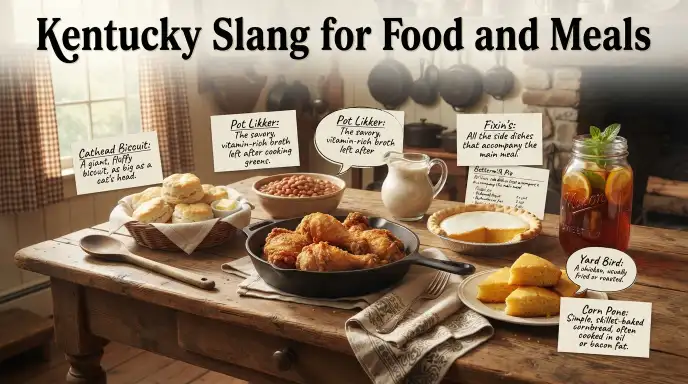
Fixins
Fixins means the side dishes or extra foods served with a meal.
“We’ve got all the fixins ready.”
Potlikker
Potlikker is the flavorful liquid left after cooking greens.
“Save some potlikker for the cornbread.”
Sweet Tea
Sweet tea is iced tea prepared with sugar.
“I’ll have some sweet tea.”
These terms are not all unique to Kentucky, but they are part of the wider Southern food tradition.
Kentucky Slang and Horse Culture
Kentucky has a strong connection with horse racing.
Derby
In Kentucky, the Derby can refer to the Kentucky Derby when the context is clear.
“Are you watching the Derby?”
Run for the Roses
Run for the Roses is a nickname for the Kentucky Derby.
The name comes from the roses traditionally presented to the winner.
Kentucky Slang in Text Messages
Regional expressions can appear online too.
“Y’all coming over?”
“I’m fixin’ to leave.”
“The store is over yonder.”
People may use these expressions to show humor, personality, or regional identity.
Is Kentucky Slang the Same as Southern Slang?
Not exactly.
There is a lot of overlap, but Kentucky also has strong Appalachian influences.
| Expression | Meaning |
| Holler | Small valley |
| Yonder | Over there |
| Fixin’ to | About to |
| Reckon | Think |
| Y’all | You all |
| Kin | Family |
| Tote | Carry |
| Young’un | Child |
| Might could | Might be able to |
| Ornery | Difficult or mischievous |
Some expressions are common throughout the South, while others are more strongly associated with Appalachian areas.
Is Kentucky Slang Still Used Today?
Yes, but usage varies.
Traditional expressions may be more common among older speakers, rural communities, and families with strong local roots.
Younger Kentuckians may use traditional expressions alongside modern American and internet slang.
Do All Kentuckians Speak the Same Way?
No.
Kentucky has different accents and speech patterns.
Someone from Louisville may speak differently from someone in eastern Kentucky. Northern Kentucky can also have influences from nearby states.
Kentucky slang should therefore not be treated as one fixed dialect.
Common Mistakes
Assuming Every Word Is Unique to Kentucky
Many expressions are also used in other Southern and Appalachian regions.
Overusing Regional Words
Using too many slang terms in one sentence can make speech sound forced.
Confusing Accent With Slang
A regional pronunciation is not always a slang word.
Using Slang in Formal Writing
Words such as y’all, fixin’ to, and might could usually fit casual settings better.
Misunderstanding “Bless Your Heart”
The phrase can be sincere or sarcastic depending on tone.
Kentucky Slang Cheat Sheet
| Slang | Meaning |
| Holler | Small valley |
| Yonder | Over there |
| Fixin’ to | About to |
| Reckon | Think |
| Y’all | You all |
| Kin | Family |
| Kinfolk | Relatives |
| Young’un | Child |
| Feller | Man |
| Tote | Carry |
| Ornery | Difficult or mischievous |
| Buggy | Shopping cart |
| Might could | Might be able to |
| Mash | Press |
| Piddlin’ | Doing small things |
| Plumb | Completely |
| Pert near | Almost |
| Pickin’ | Playing music |
| Fixins | Side dishes |
| Cutting up | Fooling around |
| Carrying on | Making a fuss |
| Raising Cain | Causing trouble |
| Gully washer | Heavy rain |
| Tickled | Very pleased |
| Cattywampus | Crooked or out of order |
| In a pickle | In trouble |
| Wore out | Very tired |
| Bless your heart | Kindness or sarcasm |
| Tough row to hoe | Difficult task |
| That dog won’t hunt | That won’t work |
Frequently Asked Questions
What is Kentucky slang?
Kentucky slang is a collection of informal words and phrases associated with Kentucky speech. Many have Southern or Appalachian roots.
What is a famous Kentucky slang word?
Holler is one of the best-known words associated with Kentucky and Appalachian speech.
What does “holler” mean in Kentucky?
It can mean a small valley. As a verb, it can also mean to shout or call loudly.
What does “fixin’ to” mean?
It means getting ready or planning to do something soon.
What does “yonder” mean?
It means over there or in that direction.
What does “might could” mean?
It means might be able to.
What does “tote” mean?
It means to carry something.
What does “buggy” mean in Kentucky?
In many Kentucky stores, buggy can mean a shopping cart.
Is Kentucky slang the same as Appalachian slang?
No. There is a lot of overlap, but Kentucky speech also includes wider Southern influences.
Do young people in Kentucky use slang?
Yes. Younger speakers may use traditional regional expressions along with modern slang.
Final Takeaway
Kentucky slang gives everyday speech a colorful Southern and Appalachian flavor. Words such as holler, yonder, fixin’ to, reckon, y’all, tote, kin, young’un, ornery, and might could can help you understand conversations from different parts of Kentucky.
Not every expression is unique to Kentucky. Many are also heard across the South and Appalachia. The words people use can depend on their location, age, family, and community.
If you are learning Kentucky slang, focus on meaning, context, and tone. A word like holler can mean a valley or a loud call. Bless your heart can be kind or sarcastic. Fixin’ to means “about to,” not repairing something.
Once you understand these differences, Kentucky conversations become much easier to follow.
Read More:
- Bay Area Slang Words: Talk the Talk Like You’re From the Bay
- Swedish Slang: The Casual Vocabulary Behind Swedish Culture
- Southern Slang Insults: Funny Sayings and Their Meanings

Hi, I’m Sophia Turner, a writer at SlangRise with 7 years of experience researching English slang, internet abbreviations, and modern vocabulary.