Southern Slang Insults are playful or sharp expressions from the American South used to tease, criticize, or insult someone in a colorful way.
Someone in the American South can insult you without saying anything openly harsh. A simple phrase can sound polite, funny, or even friendly while carrying a sharp meaning underneath. That is what makes Southern slang insults so interesting.
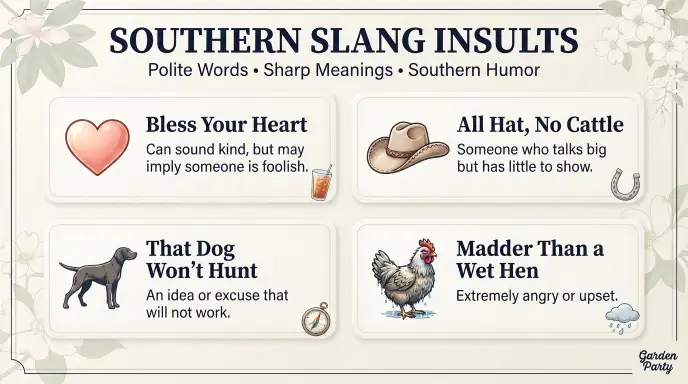
For example, “bless your heart” can show genuine sympathy, but in the right context, it can also suggest that someone is foolish. “All hat and no cattle” describes a person who talks big but has little to show for it. “That dog won’t hunt” means an idea, excuse, or plan will not work.
Southern expressions often use humor, animals, farm life, food, and everyday objects. Many are not strictly “slang” in the modern sense. Some are old Southern sayings or American idioms that became strongly associated with Southern speech.
In this guide, you will learn common Southern slang insults, what they mean, how people use them, and how their tone can change depending on the situation.
Quick Answer
Southern slang insults are informal Southern U.S. expressions used to tease, criticize, or insult someone in a colorful and indirect way.
Some common examples include:
- Bless your heart can be sincere or sarcastic.
- All hat and no cattle talks big but has little to show.
- That dog won’t hunt that idea will not work.
- Full of hot air talks too much without saying much.
- Not the sharpest tool in the shed not very smart.
- Meaner than a junkyard dog very mean or aggressive.
- Too big for his britches acting too important or confident.
Word at a Glance
| Feature | Details |
| Topic | Southern slang insults |
| Region | Southern United States |
| Type | Slang, idioms, and sayings |
| Tone | Funny, sarcastic, teasing, or critical |
| Common Contexts | Casual speech, jokes, stories |
| Style | Often indirect |
| Formal Use | Usually avoided |
| Main Feature | Humor and colorful comparisons |
What Are Southern Slang Insults?
Southern slang insults are informal expressions associated with speech in the Southern United States.
Instead of directly saying:
“You’re not very smart.”
someone might say:
“You ain’t the sharpest tool in the shed.”
Both sentences criticize someone’s intelligence. The second one simply does it through a colorful comparison.
This indirect style is common in many Southern sayings.
A speaker might compare someone to:
- A farm animal
- A broken tool
- A bad hunting dog
- A muddy fence
- A person wearing a hat without owning cattle
- Someone who cannot find their way out of a paper bag
The humor often comes from the unusual image.
Why Do Southern Insults Sound So Polite?
Some Southern insults sound polite because the speaker does not directly state the criticism.
One famous example is:
“Bless your heart.”
On its own, the phrase sounds kind.
Someone could say it sincerely to show sympathy:
“Bless your heart. You’ve had a difficult day.”
But another person might use it sarcastically:
“He tried to fix the television with a hammer. Bless his heart.”
In the second example, the speaker is gently suggesting that the person made a foolish decision.
This is why tone and context matter so much with Southern expressions.
Bless Your Heart
“Bless your heart” is one of the most famous Southern expressions.
It does not always mean something negative.
It can express:
- Sympathy
- Kindness
- Concern
- Pity
- Sarcasm
Example: Sincere
“Bless your heart. I hope you feel better soon.”
Here, the speaker is being caring.
Example: Sarcastic
“He forgot his own birthday. Bless his heart.”
Here, the speaker is making fun of his forgetfulness.
So, it is incorrect to say that “bless your heart” always means “you’re irrational,.” Its meaning depends heavily on context.
All Hat and No Cattle
“All hat and no cattle” describes someone who talks like they are important, successful, or powerful but cannot prove it.
The phrase uses an image connected with ranch life.
Someone may look like a cowboy and wear the hat, but if they have no cattle, the appearance does not match reality.
Example
“He keeps bragging about his business, but he’s all hat and no cattle.”
Meaning:
“He talks big, but he has little to show for it.”
This expression is usually humorous, but it can still be insulting.
That Dog Won’t Hunt
“That dog won’t hunt” means an idea, plan, excuse, or argument will not work.
It is not normally about a real dog.
Example
“You expect me to believe that excuse? That dog won’t hunt.”
Meaning:
“That excuse isn’t going to work.”
Another example:
“We can’t finish the whole project in one hour. That dog won’t hunt.”
Meaning:
“That plan is unrealistic.”
The expression is often firm but playful.
Full of Hot Air
Someone who is full of hot air talks a lot without offering much useful information.
It can describe someone who makes exaggerated claims or boasts about themselves.
Example
“Don’t believe everything he says. He’s full of hot air.”
Meaning:
“He talks a lot, but his words may not mean much.”
This expression is used throughout the United States, not only in the South, but it fits the style of colorful Southern insults.
Not the Sharpest Tool in the Shed
This phrase means someone is not very intelligent.
It is a softer and more humorous way to criticize someone’s intelligence.
Example
“He tried to use a fork to fix the computer. He’s not the sharpest tool in the shed.”
Meaning:
“He isn’t very smart.”
The phrase is not uniquely Southern, but it is common in informal American speech.
Couldn’t Pour Water Out of a Boot
A longer version of this saying is:
“Couldn’t pour water out of a boot if the instructions were written on the heel.”
It describes someone as very incompetent or unable to handle a simple task.
The humor comes from the ridiculous image.
If instructions were literally written on the heel, the person should be able to figure out how to pour water from the boot.
Example
“He couldn’t pour water out of a boot if the instructions were on the heel.”
Meaning:
“He is terrible at simple tasks.”
This is a strong but humorous insult.
Meaner Than a Junkyard Dog
“Meaner than a junkyard dog” describes someone who is extremely mean, aggressive, or unpleasant.
The expression compares the person’s behavior to a protective dog guarding a junkyard.
Example
“Don’t bother him right now. He’s meaner than a junkyard dog.”
Meaning:
“He’s in a terrible mood.”
It can be used jokingly between friends, but it can also be a serious criticism.
Ugly as a Mud Fence
“Ugly as a mud fence” is an old-fashioned humorous expression for something considered very unattractive.
Example
“That old shed is ugly as a mud fence.”
It can also be directed at a person, but that makes the phrase much more personal and potentially hurtful.
Because of this, it is better understood as a colorful old saying rather than something to use casually toward strangers.
Slicker Than a Greased Pig
“Slicker than a greased pig” describes someone who is very difficult to catch, control, or deal with.
It can also suggest that someone is clever, slippery, or hard to trust.
Example
“That salesman is slicker than a greased pig.”
Meaning:
“That salesman is very clever and difficult to deal with.”
The phrase is often humorous rather than openly aggressive.
A Few Sandwiches Short of a Picnic
“A few sandwiches short of a picnic” is a playful way to suggest that someone is not thinking clearly or may be a little foolish.
Example
“He thinks his phone works better when it’s in the freezer. He’s a few sandwiches short of a picnic.”
Meaning:
“He has some strange ideas.”
The phrase softens the insult through humor.
A Few Fries Short of a Happy Meal
This expression has a similar meaning.
“A few fries short of a Happy Meal” suggests that someone is not very smart or is behaving strangely.
Example
“He tried to microwave a metal spoon. He’s a few fries short of a Happy Meal.”
Meaning:
“He is making a very foolish decision.”
This expression is more modern than some traditional Southern sayings and is not uniquely Southern.
Ain’t Got Both Oars in the Water
“Ain’t got both oars in the water” suggests that someone is confused, foolish, or not thinking properly.
The image comes from rowing a boat.
If one oar is not in the water, the boat cannot move properly.
Example
“After hearing that plan, I think he ain’t got both oars in the water.”
Meaning:
“I don’t think he’s thinking clearly.”
The phrase is colorful and indirect.
Doesn’t Have the Sense God Gave a Goose
This old expression means someone does not have much common sense.
Example
“He left the door wide open during the storm. He doesn’t have the sense God gave a goose.”
Meaning:
“He showed very poor judgment.”
This saying has an old-fashioned Southern flavor.
Because of its wording, it may sound humorous or exaggerated rather than modern.
Couldn’t Find His Way Out of a Paper Bag
This phrase describes someone who is very bad at finding their way or solving simple problems.
Example
“He gets lost everywhere. He couldn’t find his way out of a paper bag.”
Meaning:
“He has a terrible sense of direction.”
It can also be used more broadly to joke about someone’s lack of ability.
He Thinks He’s God’s Gift to Women
This expression describes a man who thinks he is extremely attractive or impressive.
Example
“He thinks he’s God’s gift to women.”
Meaning:
“He has a very high opinion of himself.”
The phrase is usually sarcastic.
It does not necessarily mean the speaker believes the man is actually attractive.
Too Big for His Britches
“Too big for his britches” means someone is acting more important, powerful, or confident than they should.
Example
“That new manager is getting too big for his britches.”
Meaning:
“He’s acting like he’s more important than everyone else.”
It can be used for adults, children, coworkers, or friends.
The expression can be a serious criticism or a playful warning.
Common Themes in Southern Slang Insults
Southern sayings often use familiar images from everyday life.
Animals
Examples include:
- Junkyard dog
- Greased pig
- Goose
- Hunting dog
Farm and Rural Life
Examples include:
- All hat and no cattle
- That dog won’t hunt
- Too big for his britches
Everyday Objects
Examples include:
- Tools
- Boots
- Paper bags
- Sandwiches
- Fries
These comparisons make the expressions memorable.
Are Southern Slang Insults Always Mean?
No.
Many are used jokingly between people who know each other well.
A friend might say:
“You’re too big for your britches today.”
and both people may laugh.
But the same phrase can sound insulting when said seriously or to someone you barely know.
The relationship between the speakers matters.
A good rule is simple:
Understand the expression before using it.
Some phrases that sound funny online can sound rude when directed at a real person.
How Tone Changes a Southern Insult
Tone can completely change the meaning.
Consider:
“Bless your heart.”
A warm voice can make it sound caring.
A sarcastic voice can make it sound like an insult.
The same thing can happen with:
“Well, aren’t you something?”
This might be genuine praise or sarcastic criticism.
Southern speech often depends on how something is said, not only what is said.
Southern Slang Insults vs. Direct Insults
| Southern Expression | Direct Meaning |
| Bless your heart | You may be foolish or unfortunate |
| All hat and no cattle | You talk big without proof |
| That dog won’t hunt | Your idea will not work |
| Full of hot air | You talk without substance |
| Not the sharpest tool | You are not very smart |
| Meaner than a junkyard dog | You are very mean |
| Too big for your britches | You are acting too important |
| A few sandwiches short | You are acting foolish |
The Southern versions often sound more humorous and less direct.
Are Southern Slang Insults Offensive?
They can be, depending on the expression and context.
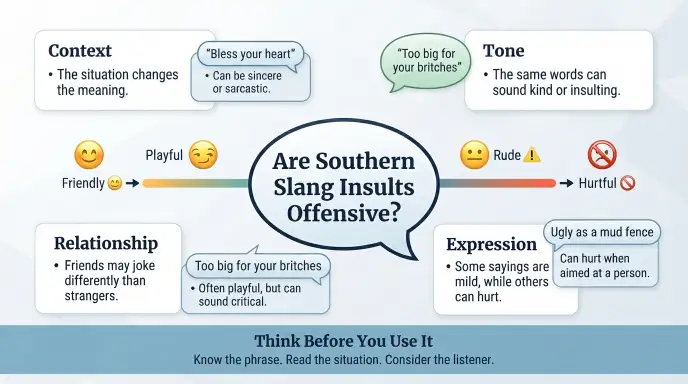
Some are mild jokes.
Others can be genuinely hurtful.
For example, “bless your heart” may be completely kind in one situation. But calling someone “ugly as a mud fence” directly can easily hurt their feelings.
Before using one, think about:
- Who you are speaking to
- How well you know them
- The situation
- Your tone
- The specific phrase
- How the other person may interpret it
Understanding slang is useful. Using every slang phrase you learn is not always necessary.
Southern Slang Insults About Intelligence
Some Southern expressions criticize a person’s common sense, judgment, or intelligence without directly calling them irrational,.
These phrases are often humorous because they use unusual comparisons.
Not the Brightest Crayon in the Box
This means someone is not very smart.
“He thought the oven was a refrigerator. He ain’t the brightest crayon in the box.”
It is a playful insult, but it can still sound rude if used seriously.
Not Playing With a Full Deck
This phrase suggests that someone is not thinking normally or is a little strange.
“I don’t think he’s playing with a full deck today.”
The phrase is usually used humorously.
One Brick Shy of a Load
This is another indirect way to say someone is not very intelligent or sensible.
“He forgot where he parked his car again. He’s one brick shy of a load.”
The wording is exaggerated to make the insult sound funny.
A Few Cards Short of a Deck
This expression has a similar meaning.
“She believes her cat can read minds. She might be a few cards short of a deck.”
It suggests that someone’s thinking is unusual or confused.
Southern Insults About Someone Who Brags
Southern speech has several expressions for people who talk themselves up too much.
All Hat and No Cattle
This is one of the best-known examples.
“He talks like he’s a rancher, but he’s all hat and no cattle.”
The person looks impressive but has little to prove it.
Big Talker
A big talker is someone who makes large claims or boasts.
“He’s a big talker, but let’s see what he actually does.”
This is simple and easy to understand.
Full of Hot Air
This describes someone who talks a lot without offering much substance.
“Don’t pay attention to him. He’s full of hot air.”
It can be teasing or critical.
Thinks He’s Something Special
This phrase describes someone who has an overly high opinion of themselves.
“He sure thinks he’s something special.”
The tone can be sarcastic.
Southern Insults for a Lazy Person
Some Southern expressions criticize people who avoid work.
Good for Nothing
Good for nothing describes someone who is seen as useless or unwilling to help.
“That good-for-nothing fellow never helps around here.”
This can be a strong insult.
Won’t Lift a Finger
This describes someone who refuses to help.
“He won’t lift a finger to help anybody.”
It focuses on behavior rather than intelligence.
Lazy as a Sunday Morning
This humorous comparison can describe someone who is very relaxed or lazy.
“He’s lazy as a Sunday morning.”
Depending on tone, it can sound playful rather than harsh.
Takes His Sweet Time
This means someone moves or works very slowly.
“He takes his sweet time getting anything done.”
It can be a mild complaint.
Southern Insults for Someone Who Is Difficult
Some phrases describe people who are hard to deal with, stubborn, or unpleasant.
Stubborn as a Mule
This means someone refuses to change their mind.
“He’s stubborn as a mule.”
The phrase is common across the United States but fits naturally into Southern speech.
Mean as a Snake
Mean as a snake describes someone who is very unpleasant or cruel.
“That man is mean as a snake.”
It is a strong comparison but can also be used jokingly.
Meaner Than a Junkyard Dog
This is a stronger version.
“She’s meaner than a junkyard dog when she’s angry.”
The phrase paints a vivid picture of someone who is extremely unpleasant.
Got a Chip on His Shoulder
This describes someone who seems angry, defensive, or ready to argue.
“He’s got a chip on his shoulder today.”
It is not uniquely Southern, but it is common in American informal speech.
Southern Insults for Someone Who Is Arrogant
A person who acts superior may receive one of these expressions.
Too Big for His Britches
This means someone is acting too important or confident.
“That boy is getting too big for his britches.”
Thinks He’s God’s Gift
This means someone thinks very highly of themselves.
“She thinks she’s God’s gift to the world.”
It is usually sarcastic.
Thinks the Sun Comes Up Just for Him
This humorous phrase describes someone who thinks everything revolves around them.
“He thinks the sun comes up just for him.”
The phrase is more of a criticism than a direct insult.
Southern Insults for a Person Who Is Unreliable
Southern speech also has colorful ways to describe someone who cannot be trusted to do what they promise.
All Talk and No Action
This means someone talks about doing things but rarely does them.
“He’s all talk and no action.”
That Dog Won’t Hunt
This can also be used when someone’s excuse or promise is not believable.
“You say you’ll finish it tomorrow, but that dog won’t hunt.”
The speaker does not believe the claim.
A Lot of Bark, Not Much Bite
This describes someone who sounds threatening but does not actually do much.
“He’s got a lot of bark and not much bite.”
It compares the person to a noisy dog.
Southern Insults Using Animals
Animals appear often in Southern sayings.
They make the expressions colorful and easy to remember.
Mean as a Snake
Very mean or unpleasant.
“He’s mean as a snake.”
Stubborn as a Mule
Very stubborn.
“She’s stubborn as a mule.”
Slicker Than a Greased Pig
Hard to catch, control, or trust.
“That guy is slicker than a greased pig.”
Madder Than a Hornet
Extremely angry.
“He was madder than a hornet.”
This is more of an expression about anger than a direct insult.
Busy as a Bee
Usually positive, but it can be used sarcastically if someone is moving around without getting useful work done.
“Look at you, busy as a bee and still nothing finished.”
Southern Insults About Bad Behavior
Not every Southern insult attacks intelligence or appearance.
Some criticize someone’s behavior.
Acting Foolish
If someone is behaving badly, a Southern speaker may simply say:
“You’re acting foolish.”
The word foolish can sound softer than directly calling someone irrational,.
Raising Cain
Raising Cain means causing trouble, making noise, or creating a disturbance.
“Those kids are raising Cain again.”
It is not exactly an insult, but it can describe troublesome behavior.
Cutting Up
In Southern speech, cutting up can mean behaving badly, joking around, or causing trouble.
“Y’all need to quit cutting up.”
It can be playful or corrective.
Carrying On
Carrying on can describe someone behaving dramatically or making a fuss.
“She’s carrying on over nothing.”
Meaning:
“She’s making too much fuss about something.”
Southern Slang Insults for Someone Who Complains
Some expressions describe people who complain too much.
Crybaby
A crybaby is someone who complains or gets upset easily.
“Don’t be such a crybaby.”
It is a common American insult, not uniquely Southern.
Making a Mountain Out of a Molehill
This means someone is turning a small problem into a huge one.
“You’re making a mountain out of a molehill.”
It is more of a criticism than a personal insult.
Carrying On
As mentioned earlier, this can describe someone who is making too much noise or fuss.
“Why are you carrying on like that?”
Southern Slang Insults for Someone Who Is Cheap
A person who does not like spending money may be called:
Tight
In some Southern and American contexts, tight can describe someone who is very careful with money.
“He’s mighty tight with his money.”
Depending on the tone, this can mean thrifty or stingy.
Stingy
Stingy means someone does not like sharing or spending money.
“He’s too stingy to buy a round of drinks.”
This is a direct but common criticism.
Southern Insults About Appearance
Some old Southern sayings comment on appearance.
These should be used carefully because comments about someone’s looks can be hurtful.
Ugly as a Mud Fence
Very unattractive.
“That old truck is ugly as a mud fence.”
The expression can be used for objects as well as people.
Looks Like Something the Cat Dragged In
This phrase describes someone who looks tired, messy, dirty, or badly dressed.
“You look like something the cat dragged in.”
It is usually used jokingly toward someone who looks rough after a long night or tiring day.
Dressed to Beat the Band
This one is usually not an insult. It means someone is dressed very well or noticeably.
Southern speech often uses colorful expressions that can be positive or negative depending on the phrase.
Southern Slang Insults About Being Clumsy
Someone who keeps making mistakes may hear:
Can’t Walk and Chew Gum
This means someone struggles to handle two simple things at the same time.
“He can’t walk and chew gum at the same time.”
It is usually humorous.
Couldn’t Find His Way Out of a Paper Bag
This can describe someone who is bad at navigation or solving basic problems.
“He couldn’t find his way out of a paper bag.”
Are These Expressions Actually Southern Slang?
Not every phrase on a list of Southern slang insults is exclusive to the South.
This is important.
Some expressions are:
- Southern sayings
- American idioms
- Rural expressions
- Older English phrases
- General U.S. slang
- Expressions strongly associated with Southern speech
For example, “full of hot air” is used across the United States.
Likewise, “not the sharpest tool in the shed” is not limited to Southern speakers.
The reason these phrases appear in Southern slang lists is that they fit the colorful, indirect style often associated with Southern American speech.
How to Use Southern Slang Insults Naturally
If you are learning these expressions, do not translate them word for word.
Instead, learn the idea behind the phrase.
For example:
“That dog won’t hunt.”
Do not interpret this as a statement about an actual dog.
Understand it as:
“That plan will not work.”
Likewise:
“All hat and no cattle.”
does not literally mean someone owns a hat but no cattle.
It means:
“That person talks big but has little to show.”
Learning the meaning behind the expression makes Southern speech much easier to understand.
When Should You Avoid Southern Insults?
Avoid using these expressions when you are not sure how the other person will react.
Be especially careful in:
- Job interviews
- Business meetings
- School presentations
- Formal emails
- Professional writing
- Conversations with strangers
- Sensitive situations
Even a phrase meant as a joke can offend someone.
For casual conversations with close friends, mild expressions may be fine if everyone understands the humor.
Common Mistakes
1. Thinking “Bless Your Heart” Always Means Something Bad
It does not.
It can be sincere, sympathetic, or sarcastic.
2. Calling Every Southern Saying “Slang”
Some are better described as idioms, sayings, or expressions.
3. Using an Expression Without Understanding Its Tone
A phrase that sounds funny may be insulting in the wrong situation.
4. Assuming All Southerners Use These Expressions
Southern speech varies greatly by state, city, age, family, and community.
5. Taking the Words Literally
Many Southern sayings use figurative language.
6. Using Old Expressions Too Often
Some expressions sound old-fashioned today.
Using too many at once can make your speech sound unnatural.
7. Forgetting Regional Differences
A phrase common in Texas may not be equally common in Virginia, Georgia, Tennessee, or Louisiana.
Southern Slang Insults vs. Modern Internet Insults
Southern expressions often rely on imagery and indirect humor.
Modern internet insults may be shorter and more direct.
| Southern Style | Modern Style |
| “All hat and no cattle” | “All talk” |
| “Too big for his britches” | “Full of himself” |
| “Bless your heart” | “Sure, buddy” |
| “That dog won’t hunt” | “That won’t work” |
| “Full of hot air” | “You’re talking nonsense” |
| “Stubborn as a mule” | “You’re stubborn” |
Southern expressions can sound more playful because they tell a little story instead of giving a direct insult.
Why Are Southern Insults So Funny?
The humor often comes from unexpected comparisons.
Calling someone:
“A few sandwiches short of a picnic”
is funny because sandwiches have nothing to do with intelligence.
Likewise:
“All hat and no cattle”
creates a funny picture of someone dressed like a rancher without actually having cattle.
This use of imagery makes Southern expressions memorable.
Conclusion
Southern slang insults are often less direct than ordinary insults. Instead of simply saying someone is foolish, arrogant, lazy, stubborn, or unreliable, Southern speakers may use a colorful phrase.
Expressions such as “bless your heart,” “all hat and no cattle,” “that dog won’t hunt,” “too big for your britches,” and “meaner than a junkyard dog” show this style clearly.
But remember that not every phrase is uniquely Southern, and not every expression is automatically an insult. Context, tone, and the relationship between speakers can completely change the meaning.
If you are learning Southern American English, these expressions can help you understand movies, conversations, social media posts, and casual speech. Use them carefully, though. Understanding a Southern insult is often much easier than knowing when it is safe to say one.
Read More:
- Manchester Slang: Mad for It, Mint & Everything Between
- Wagon Irish Slang: Why This Word Means So Much More
- Swedish Slang: The Casual Vocabulary Behind Swedish Culture

Hi, I’m Sophia Turner, a writer at SlangRise with 7 years of experience researching English slang, internet abbreviations, and modern vocabulary.