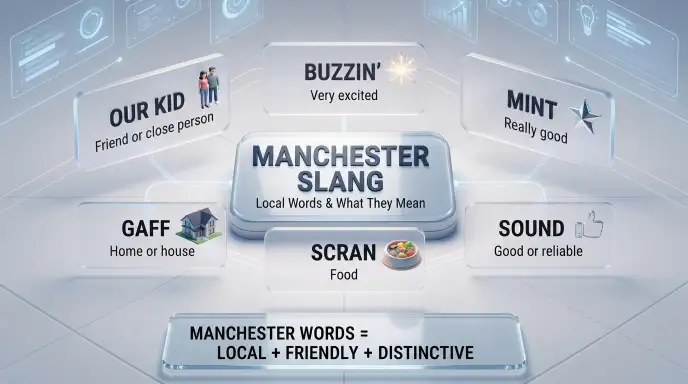
Manchester Slang refers to the distinctive words and phrases used across the city, such as “mad for it,” “mint,” and “our kid,” shaped by the region’s music, football, and working-class roots.
“Mad for it” is closely associated with Liam Gallagher of the band Oasis, synonymous with the Madchester era of the late 20th century, while “mithering” means to worry, fuss, or nag someone repeatedly.
“Grim” doesn’t necessarily mean awful just unpleasant, miserable, or inconvenient, If describing the weather, a hangover, or a delayed tram.
In this guide, you’ll discover popular Manchester slang words, their meanings, and how they reflect the city’s unique character and history.
Quick Answer
Manchester slang refers to informal words and phrases used in Manchester and surrounding areas. Common examples include our kid, mint, sound, buzzing, and mad fer it.
What Is Manchester Slang?
Manchester slang is the casual language you may hear in everyday conversations around the city.
Manchester is often called “Manny” in informal speech, while someone from Manchester may be called a “Manc” or “Mancunian.”
The local way of speaking is closely connected to the broader Northern English dialect.
Examples include:
- Our kid — a close friend, sibling, or familiar person.
- Mint — excellent or very good.
- Sound — good, reliable, or okay.
- Buzzing — very excited or happy.
- Mad fer it — extremely enthusiastic or excited.
- Mardy — sulky, moody, or easily upset.
- Ginnel — a narrow passage or alleyway.
Word at a Glance
| Feature | Details |
| Term | Manchester slang |
| Type | Regional slang |
| Region | Manchester, England |
| Tone | Casual / Informal |
| Common Contexts | Everyday speech, football, music, social media |
| Related Terms | Manc slang, Northern English slang, British slang |
Popular Manchester Slang Words
Our Kid
Our kid is a familiar expression for a sibling, close friend, or someone you know well.
Example:
“I’m meeting our kid later.”
The exact meaning depends on the speaker and context.
Mint
Mint means excellent, great, or very good.
Example:
“That concert was mint.”
Sound
Sound can mean good, reliable, friendly, or okay.
Example:
“He’s a sound lad.”
Buzzing
Buzzing means very excited or happy.
Example:
“I’m absolutely buzzing about the match.”
Mad Fer It
Mad fer it means being extremely enthusiastic or excited about something.
The phrase is strongly associated with Manchester’s music and football culture.
Mardy
Mardy describes someone who is sulky, moody, or acting upset.
Example:
“Don’t be mardy.”
Ginnel
A ginnel is a narrow passage or pathway between buildings. The word is used in parts of Northern England.
Example:
“Walk through the ginnel and turn left.”
Why Is Manchester Slang Popular?
Manchester has had a major influence on British music, football, television, and popular culture.
The city is strongly associated with bands, football clubs, nightlife, and working-class culture. These influences have helped spread local expressions beyond Greater Manchester.
Football and music have played a particularly important role in making Mancunian expressions recognizable around the UK.
Where Is Manchester Slang Used?
You may hear or see Manchester slang in:
- Everyday conversations.
- Football discussions.
- Music.
- TV shows.
- Text messages.
- TikTok.
- Instagram.
- YouTube.
- Local communities.
- Online forums.
Some expressions are strongly local, while others are common across Northern England.
Is Manchester Slang the Same as British Slang?
No. Manchester slang is a regional part of British slang.
British slang varies across England, Scotland, Wales, and Northern Ireland. Even within England, London, Liverpool, Newcastle, Birmingham, and Manchester have different speech patterns.
Manchester slang also overlaps with wider Northern English vocabulary, so some expressions cannot be considered exclusive to Manchester.
Is Manchester Slang Rude?
Not usually.
Most Manchester slang is casual and friendly, but some words can sound rude depending on context.
For example, mardy can be teasing, while other local expressions may sound more insulting if used aggressively.
When using regional slang, tone and context matter just as much as the dictionary meaning.
Real-Life Examples of Manchester Slang
Manchester slang is often used in casual conversations, football discussions, music, and social media. Some words are strongly linked to Manchester, while others are common across Northern England.
Friendly Examples
Friends may use Manchester slang to sound relaxed and familiar.
- “You alright, our kid?”
- “That gig was mint.”
- “He’s a sound lad.”
- “I’m buzzing for the weekend.”
- “Don’t be mardy.”
These expressions are informal and are usually used with people you know.
Casual Examples
You may hear these terms in everyday Manchester conversations.
- “That food was mint.”
- “She’s proper sound.”
- “I’m absolutely buzzing.”
- “He’s being mardy again.”
- “Walk through the ginnel.”
The meaning is often clear from the situation and tone.
Social Media Examples
Manchester slang also appears in posts, comments, memes, and football discussions.
Examples:
- “Manny is buzzing tonight.”
- “That match was mint.”
- “Our kid finally got tickets.”
- “Proper sound people.”
- “Mad fer it tonight!”
You may see Manchester slang on:
- TikTok
- X
- YouTube
- Snapchat
Origin and Background of Manchester Slang
Manchester slang developed from the city’s Mancunian dialect and the wider speech patterns of Northern England.
Working-class communities, local neighborhoods, football, music, and Manchester’s industrial history all helped shape the city’s language.
Music has had a particularly strong influence. Manchester became famous for bands and musical movements that brought local expressions to audiences across Britain and beyond.
Football has also helped spread Manchester expressions through fans, stadium culture, interviews, songs, and social media.
Popular Manchester Slang Words
| Slang | Meaning | Common Context |
| Our kid | Friend, sibling, or close person | Casual speech |
| Mint | Excellent / very good | Everyday speech |
| Sound | Good / reliable / friendly | Casual speech |
| Buzzing | Very excited or happy | Everyday speech |
| Mad fer it | Extremely enthusiastic | Music / football |
| Mardy | Sulky or moody | Casual speech |
| Ginnel | Narrow passageway | Local speech |
| Manny | Manchester | Informal reference |
| Manc | Person from Manchester | Local identity |
| Proper | Very / really | Northern speech |
Comparison With Similar British Slang
Manchester slang can overlap with slang from other parts of Britain.
Key Differences
| Region | Example | Common Association |
| Manchester | Our kid, mint, mardy | Mancunian culture |
| Liverpool | Sound, boss, la | Scouse culture |
| London | Bloke, mate, peng | London speech |
| Newcastle | Canny, bonny, pet | Geordie culture |
| Birmingham | Bab, bostin’ | Brummie culture |
These categories overlap. A word used in Manchester may also be understood elsewhere in the UK.
Comparison Table
| Manchester Slang | Meaning | Standard English |
| Our kid | Friend / sibling | Friend / sibling |
| Mint | Excellent | Excellent |
| Sound | Good / reliable | Good / reliable |
| Buzzing | Very excited | Very excited |
| Mardy | Sulky / moody | Moody |
| Mad fer it | Very enthusiastic | Very excited |
| Ginnel | Narrow passage | Alleyway |
| Manny | Manchester | Manchester |
| Manc | Person from Manchester | Mancunian |
When to Avoid Using Manchester Slang
Manchester slang is mainly informal, so it may not fit formal situations.
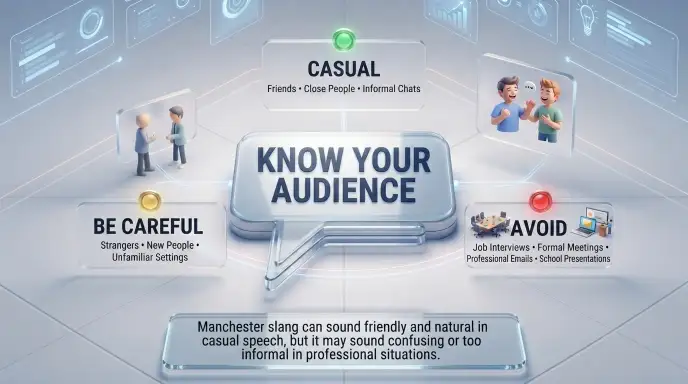
Avoid unfamiliar regional slang when:
- Writing academic assignments.
- Sending professional emails.
- Preparing formal reports.
- Speaking in a business meeting.
- Writing for an international audience.
Some readers may not understand a local expression without context.
Polite Alternatives to Manchester Slang
You can replace local expressions with standard English.
| Manchester Slang | Clear Alternative |
| Our kid | My friend / my sibling |
| Mint | Excellent |
| Sound | Reliable / friendly |
| Buzzing | Very excited |
| Mardy | Moody |
| Mad fer it | Very enthusiastic |
| Ginnel | Narrow passage |
| Manny | Manchester |
| Manc | Person from Manchester |
These alternatives work better when your audience may not know Manchester slang.
Impact of Manchester Slang on Communication
Manchester slang gives speech a strong local identity.
It can:
- Show where someone is from.
- Create a sense of community.
- Make speech sound friendly.
- Add humor and personality.
- Connect people through local culture.
However, regional slang can confuse people from other parts of the UK or other countries.
Using a term naturally is important. Simply adding local slang to speech does not automatically make someone sound Mancunian.
Is Manchester Slang Safe for Social Media?
Most Manchester slang is safe for casual social media use.
Words such as mint, sound, buzzing, and our kid are generally harmless. Some other expressions may be more informal or depend heavily on tone.
If you are writing for a broad audience, explain less familiar terms so readers outside Manchester can understand them.
FAQs About Manchester Slang
1. What is Manchester slang?
Manchester slang refers to informal words and phrases associated with Manchester and Greater Manchester. It is influenced by Mancunian speech, Northern English dialects, football, music, and local culture.
2. What are some common Manchester slang words?
Some well-known examples include our kid, mint, sound, buzzing, mardy, mad fer it, ginnel, Manny, and Manc.
3. What does “our kid” mean in Manchester slang?
Our kid can refer to a sibling, close friend, or someone familiar. The exact meaning depends on the speaker and context.
Example:
“I’m meeting our kid later.”
4. What does “mint” mean in Manchester slang?
Mint means excellent, great, or very good.
Example:
“That new restaurant is mint.”
The word is also used in other parts of Britain.
5. What does “sound” mean in Manchester slang?
Sound can mean good, friendly, reliable, or trustworthy.
Example:
“He’s a sound lad.”
It is common across Britain, not only Manchester.
6. What does “buzzing” mean?
Buzzing means very excited, happy, or pleased.
Example:
“I’m buzzing about the match.”
The term is widely used across the UK.
7. What does “mardy” mean?
Mardy describes someone who is sulky, moody, or easily upset.
Example:
“Don’t be mardy.”
The word is especially associated with Northern England.
8. What does “mad fer it” mean?
Mad fer it means being extremely enthusiastic or excited, especially about music, football, or going out.
The expression became strongly associated with Manchester’s music and nightlife culture.
9. What does “Manny” mean?
Manny is an informal nickname for Manchester.
It is commonly seen in casual speech and online posts.
10. What does “Manc” mean?
Manc is a casual term for a person from Manchester.
The more formal term is Mancunian.
11. What does “ginnel” mean?
A ginnel is a narrow passage or pathway, often between buildings.
The word is used in parts of Northern England and is not exclusive to Manchester.
12. Is Manchester slang the same as Northern slang?
No. Manchester slang is part of the wider Northern English language and slang.
Some expressions are strongly linked to Manchester, while others are used across Yorkshire, Lancashire, Merseyside, and other northern areas.
13. Is Manchester slang still used today?
Yes. Manchester slang continues to appear in everyday speech, music, football culture, social media, and local communities.
New expressions can also develop as language changes.
Conclusion
Manchester slang reflects the city’s strong local identity and its influence on British music, football, and popular culture. Expressions such as our kid, mint, sound, buzzing, mardy, mad fer it, Manny, and Manc are commonly associated with Manchester or the wider North of England.
Some terms are distinctly local, while others are now understood across the UK. Their meaning can also change based on tone and context.
If you are learning Manchester slang, understanding the local context is just as important as learning the dictionary meaning. This helps you recognize how Mancunians use these expressions naturally in everyday speech.
Read more:
- Southern Slang Insults: Funny Sayings and Their Meanings
- Wagon Irish Slang: Why This Word Means So Much More
- Swedish Slang: The Casual Vocabulary Behind Swedish Culture

Hi, I’m Sophia Turner, a writer at SlangRise with 7 years of experience researching English slang, internet abbreviations, and modern vocabulary.