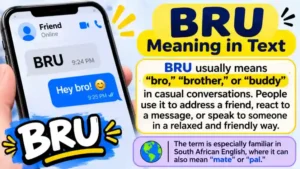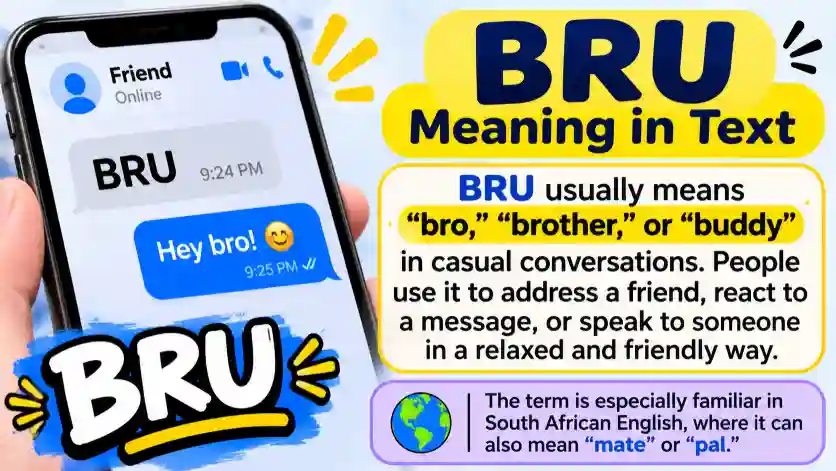
BRU usually means “bro,” “brother,” or “buddy” in casual conversations. People use it to address a friend, react to a message, or speak to someone in a relaxed and friendly way. The term is especially familiar in South African English, where it can also mean “mate” or “pal.”
When someone sends you “BRU” in a text, they are usually speaking casually rather than using a formal abbreviation. The exact feeling depends on the conversation. It can express friendship, surprise, frustration, or affection.
Quick Answer
BRU means “bro,” “brother,” or “buddy” in informal conversations. It is a friendly way to address someone, similar to saying “mate,” “pal,” or “bro.”
For example:
- “Hey bru, how are you?” means “Hey bro, how are you?”
- “Thanks, bru!” means “Thanks, buddy!”
- “Bru, what are you doing?” means “Bro, what are you doing?”
BRU is not normally an acronym with a separate full form. It is an informal word used as a term of address, particularly in South African English.
BRU Meaning at a Glance
| Detail | Meaning |
| Word | BRU |
| Common Meaning | Bro, brother, buddy, mate |
| Part of Speech | Noun / informal term of address |
| Pronunciation | /bruː/ sounds like “brew” |
| Tone | Casual, friendly, familiar |
| Common Contexts | Texting, chats, social media, everyday conversation |
| Origin | Connected to Afrikaans broer, meaning brother |
| Related Words | Bro, Bruh, Brah, Boet, Mate |
BRU is commonly used between friends, relatives, classmates, and people who are comfortable with one another. It can also appear in online comments and social media conversations.
What Does BRU Stand For?
BRU does not usually stand for a specific set of words. Unlike abbreviations such as BRB (Be Right Back), BRU is generally an informal word rather than an acronym.
It is connected to the word “brother.” In South African English, BRU is associated with Afrikaans broer, which means brother. Over time, it became a familiar way to address friends and other people.
For example:
- “Howzit, bru?” means “How are you, bro?”
- “Listen, bru.” means “Listen, buddy.”
- “Thanks for helping me, bru.” means “Thanks for helping me, friend.”
You may see BRU written in capital letters or lowercase as “bru.” Both forms can communicate the same meaning.
Where Does the Word BRU Come From?
BRU has a strong connection with South African English. It is commonly associated with Afrikaans broer, meaning “brother.”
In everyday South African conversation, people may use BRU when speaking to friends, colleagues, relatives, or acquaintances. It does not always mean that the person is your actual brother. Instead, it can communicate familiarity and friendliness.
For example, two friends might greet each other with:
“What’s happening, bru?”
They are not necessarily related. They are simply using a familiar expression similar to “What’s up, bro?”
The word has also appeared in online conversations, comments, messages, and informal discussions. People outside South Africa may encounter it through social media or conversations with South African speakers.
However, BRU is not equally common in every English-speaking country. In some places, people are more familiar with “bro,” “mate,” or “dude.”
How Is BRU Used in Text Messages?
People use BRU in text messages as a casual way to address someone. It can make a message sound more relaxed and personal.
The word does not have one fixed emotional meaning. Its tone depends on the words around it, the relationship between the people, and the situation.
Here are some common ways it appears in messages.
1. To Greet a Friend
BRU can be used at the beginning of a conversation, just like “bro” or “mate.”
Example:
- Person A: “Hey bru, what’s up?”
- Person B: “Not much. How are you?”
The sender is simply greeting a friend.
2. To Show Appreciation
Someone may use BRU when thanking a person for helping them.
Example:
- Person A: “I sent you the notes.”
- Person B: “Thanks, bru. I appreciate it.”
Here, BRU makes the thank-you message sound friendly and informal.
3. To Express Surprise
BRU can also introduce a reaction when something unexpected happens.
Example:
- Person A: “I forgot my phone at home.”
- Person B: “Bru, seriously?”
The sender sounds surprised or slightly confused.
4. To Show Frustration
Sometimes BRU appears when someone is annoyed or cannot believe what another person has done.
Example:
- Person A: “I deleted the whole project by mistake.”
- Person B: “Bru, why would you do that?”
In this situation, the word adds emphasis to the reaction.
5. To Get Someone’s Attention
A person may use BRU at the beginning of a message to make someone pay attention.
Example:
“Bru, listen to what happened today.”
It works similarly to “Hey, bro” or “Listen, mate.”
What Does BRU Mean From a Guy?
When a guy sends you BRU, he is usually addressing you in a relaxed and familiar way. He may see you as a friend, someone he feels comfortable talking to, or simply someone he knows.
For example:
- “What’s up, bru?” A casual greeting.
- “Thanks, bru!” A friendly thank-you.
- “Bru, you won’t believe this.” He wants to share something surprising.
- “Good job, bru.” He is showing appreciation.
The word alone does not prove romantic interest. A guy can use BRU with male friends, female friends, classmates, or people he talks to regularly.
If you are trying to understand his feelings, pay attention to the full conversation rather than one word.
What Does BRU Mean From a Girl?
When a girl uses BRU, she may be addressing someone in a friendly, playful, or casual way.
For example:
- “Hey bru, are you coming?”
- “Bru, that was so funny!”
- “Thanks, bru. You’re the best.”
- “Bru, I can’t believe you said that.”
In these messages, BRU works like “bro,” “buddy,” or “mate.”
Some girls use it with close friends regardless of gender. Others use it as part of their everyday speaking style.
It does not automatically mean that she sees the other person only as a friend, nor does it prove romantic interest. The meaning depends on the relationship and the surrounding conversation.
What Does BRU Mean From Your Crush?
If your crush sends you BRU, it is usually a casual way to address you. It may show that they feel comfortable communicating with you, but it is not enough to confirm romantic feelings.
Consider these examples:
- “Hey bru, how was your day?” A friendly way to start a conversation.
- “Bru, I missed that class too.” A casual shared reaction.
- “Thanks, bru ❤️” A friendly message with an affectionate emoji.
- “Bru, you’re actually so funny.” A playful compliment.
Notice the complete message, not just BRU. Their overall communication style, attention, and behavior can provide more context.
If your crush regularly uses BRU with everyone, it may simply be part of their normal vocabulary.
What Does BRU Mean on Social Media?
BRU can appear on different social platforms, including TikTok, Instagram, Snapchat, and WhatsApp. Its basic meaning generally stays the same: bro, brother, buddy, or mate.
However, the way people use it can change depending on the platform.
BRU Meaning on TikTok
On TikTok, BRU may appear in comments, captions, and replies. People use it to react to funny, surprising, or unexpected videos.
Examples:
- “Bru, this video is hilarious.”
- “What did I just watch, bru?”
- “Bru really did that.”
- “I wasn’t expecting that, bru.”
It can make a comment sound more conversational and expressive.
BRU Meaning on Instagram
On Instagram, BRU may appear in direct messages, comments, and story replies.
Examples:
- “Nice picture, bru!”
- “Bru, where did you get that?”
- “Thanks for sharing, bru.”
- “Bru, this looks amazing.”
It is usually a casual way to communicate with friends or familiar followers.
BRU Meaning on Snapchat
On Snapchat, BRU can appear in quick messages, snaps, and replies.
Examples:
- “Hey bru, send me that snap.”
- “Bru, check your messages.”
- “That was intense, bru.”
- “See you later, bru.”
The word keeps the conversation informal and friendly.
BRU Meaning on WhatsApp
On WhatsApp, BRU may be used in private chats and group conversations.
Examples:
- “Bru, are you coming today?”
- “I’ll call you later, bru.”
- “Thanks for the help, bru.”
- “Bru, don’t forget the meeting.”
It is simply a relaxed way to address someone.
10 Example Sentences Using BRU in Text
These examples show how BRU can appear in everyday messages.
- “Hey bru, how was your weekend?”
Meaning: The sender is greeting a friend and asking about their weekend. - “Thanks, bru, for helping me.”
Meaning: The sender is thanking someone in a friendly way. - “Bru, you won’t believe what happened.”
Meaning: The sender wants to share surprising news. - “See you tomorrow, bru.”
Meaning: The sender is casually saying goodbye. - “That’s a great idea, bru.”
Meaning: The sender is agreeing with or appreciating someone’s idea. - “Bru, why are you laughing?”
Meaning: The sender is asking why the other person is laughing. - “Don’t worry, bru. Everything will be fine.”
Meaning: The sender is reassuring a friend. - “Bru, I forgot my homework again.”
Meaning: The sender is sharing a problem in a casual way. - “Good game, bru!”
Meaning: The sender is complimenting someone after a game. - “What’s happening, bru?”
Meaning: The sender is asking what is going on.
These examples are illustrative. The exact tone can change depending on the relationship and conversation.
How Should You Reply When Someone Says BRU?
Your reply depends on what the person is saying. Since BRU is usually just a friendly way to address you, you do not need to explain or repeat its meaning.
Here are some natural replies.
| Their Message | Possible Reply |
| “Hey bru!” | “Hey! What’s up?” |
| “Thanks, bru.” | “No problem!” |
| “Bru, listen to this.” | “I’m listening.” |
| “How are you, bru?” | “I’m good. How about you?” |
| “Good game, bru!” | “Thanks! You played well too.” |
| “See you later, bru.” | “See you!” |
| “Bru, that’s intense.” | “I know, right?” |
You can also reply with “bro,” “mate,” “buddy,” or the person’s name if that feels natural.
Is BRU Rude or Offensive?
BRU is generally not considered rude or offensive. It is usually a casual and friendly term.
However, the tone can change depending on how someone uses it.
For example:
- “Thanks, bru!” sounds friendly.
- “Listen, bru, calm down.” may sound impatient.
- “Bru, what is wrong with you?” may sound annoyed.
- “You’re a legend, bru!” sounds positive and appreciative.
The word itself is not necessarily disrespectful. The surrounding sentence, tone, and relationship matter.
It may also sound too informal in professional situations. If you are speaking with a teacher, manager, customer, or someone you do not know well, a person’s name or a polite form of address is usually more appropriate.
Is BRU Formal or Informal?
BRU is an informal expression. It is suitable for relaxed conversations but is not normally used in formal writing.
| Situation | Is BRU Suitable? |
| Texting close friends | Yes |
| Talking with classmates | Yes |
| Casual group chats | Yes |
| Social media comments | Yes |
| Talking with family | Yes, depending on the family |
| Professional emails | No |
| Formal business messages | No |
| Academic writing | No |
For example, you could write:
- Casual: “Thanks for the help, bru!”
- Formal: “Thank you for your assistance.”
Use BRU when the conversation is relaxed and the other person understands the expression.
BRU vs. BRO: What’s the Difference?
BRU and BRO are closely related in meaning. Both can be used to address a friend or someone you feel comfortable with.
However, their usage and regional associations are different.
| BRU | BRO |
| Informal term associated strongly with South African English | Widely used in many English-speaking communities |
| Connected to Afrikaans broer | Shortened form of brother |
| Means mate, pal, or buddy | Means brother, friend, or buddy |
| Often pronounced like “brew” | Usually pronounced like “broh” |
Example:
- “How are you, bru?”
- “How are you, bro?”
Both messages are friendly, but BRU has a stronger South African English connection.
BRU vs. BRUH: Are They the Same?

BRUH and BRU look similar, but they are not always used in exactly the same way.
BRU is commonly a familiar term of address meaning bro, mate, or buddy.
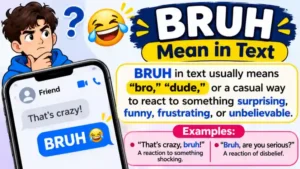
BRUH is an informal internet expression often used to react to something surprising, ridiculous, frustrating, or unbelievable. It can also be used to address someone.
Examples:
- “What’s up, bru?” A friendly greeting.
- “Bruh, are you serious?” A reaction of surprise or disbelief.
People may use these words differently depending on their region and personal texting style.
Other Words Similar to BRU
Several informal expressions have meanings close to BRU.
- BRO: A shortened form of brother, commonly used for friends.
- BRUH: An informal expression used to address someone or react to a situation.
- MATE: A common friendly term in British, Australian, and other varieties of English.
- BUDDY: A friendly word for a friend or companion.
- PAL: An informal word meaning friend.
- DUDE: A casual way to address someone.
- BRAH: An informal term used in some communities as a variation of bro.
- BOET: A South African informal term connected to Afrikaans boet, meaning brother.
These words are similar, but they do not have exactly the same regional background or conversational style.
Is BRU Common Among Teenagers and Adults?
BRU can be used by both teenagers and adults, especially in communities where the word is familiar.
Teenagers may use it in messages, group chats, gaming conversations, and social media comments. Adults may use it when speaking casually with friends, relatives, or colleagues they know well.
Its popularity depends on location and social environment. It is particularly recognizable in South African English, but people elsewhere may be more familiar with BRO, BRUH, or MATE.
There is no reason to assume that every teenager or adult uses BRU. Some people use it regularly, while others rarely encounter it.
Frequently Asked Questions About BRU
1. What does BRU mean in texting?
BRU usually means “bro,” “brother,” “buddy,” or “mate.” It is an informal way to address someone in a friendly conversation.
2. Is BRU short for brother?
BRU is connected to the word “brother.” It is associated with Afrikaans broer, which means brother, and is used as a casual term for a friend or companion.
3. Is BRU an acronym?
No. BRU is not normally an acronym with a standard full form. It is generally an informal word used to address someone.
4. What does BRU mean from a guy?
When a guy says BRU, he is usually addressing someone casually. It may mean bro, buddy, or mate. It does not automatically indicate romantic interest.
5. What does BRU mean from a girl?
A girl may use BRU as a friendly or playful way to address someone. It can be similar to saying “bro” or “buddy.”
6. Does BRU mean friend?
Yes. In casual conversation, BRU can mean friend, mate, pal, or buddy. It does not always refer to an actual brother.
7. Is BRU the same as BRO?
They are similar, but not identical in regional usage. BRO is widely used across English-speaking communities, while BRU has a strong association with South African English.
8. Is BRU the same as BRUH?
Not exactly. BRU is generally a friendly term of address. BRUH is often used as a reaction to something surprising, frustrating, or unbelievable.
9. What does BRU mean on TikTok?
On TikTok, BRU usually works as a casual way to address someone in comments or replies. It may also add emphasis to a reaction.
10. How do you pronounce BRU?
BRU is usually pronounced /bruː/, which sounds like the English word “brew.”
11. Can I call a girl BRU?
Yes. In casual conversations, some people use BRU regardless of gender. However, it depends on the person’s preferences and the way they normally speak.
12. Is BRU used outside South Africa?
Yes, people outside South Africa may use or recognize it through social media and personal conversations. However, its strongest regional association is with South African English.
Conclusion
BRU is an informal term that usually means bro, brother, buddy, or mate. It is especially associated with South African English and is connected to the Afrikaans word broer, meaning brother.
People use BRU in text messages, social media comments, group chats, and everyday conversations to address friends or familiar people. Depending on the situation, it can sound friendly, playful, surprised, or even slightly frustrated.
If someone sends you BRU, they are most likely speaking casually. Look at the complete message and the relationship you share to understand the exact tone.
Read More
- BRT Meaning in Text: What Is Someone Trying to Tell You?
- BRP Mean in Text: Why Are People Using These Three Letters?
- BRK Text Meaning: Don’t Confuse It With Other Slang

Hi, I’m Olivia Carter. I enjoy researching English slang, online expressions, and everyday vocabulary. I write clear, beginner-friendly guides with simple definitions and practical examples to make modern English easier to understand.