
Swedish Slang refers to the informal, everyday words Swedes use in casual conversations like “fika” (coffee break), “lagom” (just the right amount), and “kanon” (great) going beyond textbook Swedish.
The word “fika” is thought to have originated from a form of backslang, where the letters of “kaffi” (an old spelling of coffee) were reversed and shortened, first recorded in Swedish over a century ago.
Beyond fika, Swedes often use “skit” before adjectives to mean “very” or “really,” similar to how English speakers might say “damn,” as in “skitbra” (really good).
In this guide, you’ll learn essential Swedish slang words, their meanings, and how to sound more natural in everyday Swedish conversations.
Quick Answer
Swedish slang means informal Swedish words and expressions used in casual conversations, texting, social media, music, and youth culture.
Some common examples are:
- Bror bro
- Chilla relax or hang out
- Fett very or really
- Lugnt no worries
- Tagga leave or head off
- Orka have the energy to do something
- Palla feel like doing something
- Gött great or nice
Word at a Glance
| Feature | Details |
| Topic | Swedish slang |
| Language | Swedish |
| Type | Informal language |
| Common Users | Young people, friends, online users |
| Common Contexts | Texting, social media, music, casual speech |
| Tone | Casual |
| Formal Use | Usually avoided |
| Related Areas | Youth culture and internet slang |
What Is Swedish Slang?
Swedish slang is the informal language people use when they are relaxed and talking with friends.
It is different from formal Swedish.
For example, a textbook might teach a formal sentence, while friends may use shorter words, borrowed expressions, or slang.
Slang can also change quickly.
A word that is popular among young people today may become less common later. New words can enter Swedish through English, music, immigration, social media, and popular culture.
This makes Swedish slang interesting for language learners.
Why Do People Use Swedish Slang?
People use slang for many reasons.
To Sound Casual
Slang makes a conversation feel relaxed.
To Talk Like Friends
Friends often use words that would sound strange in formal situations.
To Show Personality
Slang can make speech sound funny, modern, confident, or playful.
To Fit Into a Group
Certain words can be common within a particular age group, neighborhood, or online community.
To Keep Language Short
Some slang expressions are quick and easy to use in text messages.
Bror
Bror is a common Swedish slang word that literally means “brother.”
In casual speech, people can use it much like “bro” or “brother” in English.
It can be used between friends, especially in relaxed conversations.
Example
“Bror, vad gör du?”
This can be understood as:
“Bro, what are you doing?”
The word does not always mean that the two people are actual brothers.
It can simply show familiarity or friendship.
Chilla
Chilla means “relax,” “take it easy,” or sometimes “hang out.”
It comes from the English word “chill” and has become part of casual Swedish speech.
Example
“Vi ska bara chilla hemma.”
Meaning:
“We’re just going to chill at home.”
You may hear this word among friends or see it in messages.
It is informal and should not be used in very formal writing.
Fett
Fett literally means “fat,” but it has a different meaning in Swedish slang.
In casual speech, fett can work as an intensifier meaning:
“very,” “really,” or “extremely.”
For example:
“Det är fett bra.”
Meaning:
“It’s really good.”
Another example:
“Fett kul!”
Meaning:
“Really fun!”
This slang use is very different from the literal meaning of the word.
Fett Nice
Fett nice combines Swedish slang with an English word.
It means:
“Really nice” or “very cool.”
Example
“Din jacka är fett nice.”
Meaning:
“Your jacket is really nice.”
This type of Swedish-English mix is common in casual speech.
Lugnt
Lugnt literally relates to something being calm or quiet.
In casual Swedish, it can also mean:
“No worries,” “it’s fine,” or “don’t worry about it.”
Example
“Förlåt att jag är sen.”
“Lugnt!”
Meaning:
“Sorry I’m late.”
“No worries!”
It is a useful casual expression in everyday conversations.
Tagga
Tagga is informal Swedish slang that can mean “leave,” “head off,” or “get going.”
The exact meaning depends on the sentence.
For example:
“Vi taggar nu.”
This can mean:
“We’re leaving now.”
It is common in casual speech.
You may also hear:
“Tagga till festen!”
This can mean:
“Head to the party!”
Orka
Orka is a very common Swedish word that can mean “to have the energy” or “to be able” to do something.
In casual speech, it is often used to say that someone does not have the energy or motivation to do something.
Example
“Jag orkar inte.”
Meaning:
“I don’t have the energy.”
Or:
“Jag orkar inte gå ut.”
Meaning:
“I don’t feel like going out.”
Although orka is not always considered pure slang, it is extremely common in casual Swedish.
Palla
Palla is informal Swedish and can mean “to feel like doing something” or “to have the energy to do something.”
It is often used in negative expressions.
Example
“Jag pallar inte.”
Meaning:
“I can’t be bothered.”
Another example:
“Pallar du gå dit?”
Meaning:
“Do you feel like going there?”
The word is very casual.
Gött
Gött is an informal word meaning something like:
“great,” “nice,” “good,” or “enjoyable.”
It is especially associated with western Sweden and is strongly connected with regional speech.
Example
“Gött!”
This could mean:
“Great!”
Or:
“Det var gött.”
Meaning:
“That was great.”
The exact tone depends on the situation.
Sjukt
Sjukt literally relates to the word “sick.”
In slang and casual speech, it can mean:
“really,” “wildly,,” or “extremely.”
It is often used to emphasize something.
Example
“Det var sjukt bra.”
Meaning:
“It was wildly good.”
Another example:
“Sjukt dyrt!”
Meaning:
“Extremely expensive!”
The word can be positive or negative depending on what follows it.
Asså
Asså is an informal spelling and pronunciation associated with alltså.
It can work like:
- “I mean”
- “Like”
- “Well”
- “Seriously”
People often use it as a conversational filler.
Example
“Asså, jag vet inte.”
Meaning:
“I mean, I don’t know.”
You are more likely to see asså in texts or informal writing than in formal Swedish.
Ba
Ba is a very informal spoken and written form connected with bara, which normally means “only,” “just,” or “simply.”
In casual speech, it can sometimes work like “just” or “like.”
Example
“Jag ba: nej!”
This can mean:
“I was just like, ‘No!’”
The word is strongly informal and is common in casual youth speech.
Fika
Fika is one of the best-known Swedish cultural words.
It usually refers to taking a coffee or snack break, often while spending time with other people.
Although fika is not simply slang, it is an important informal Swedish expression.
Example
“Ska vi fika?”
Meaning:
“Shall we grab coffee?”
Fika can involve coffee, tea, pastries, sandwiches, or other snacks.
It is often more about the social break than the food itself.
Knas
Knas is informal Swedish for something that is weird, strange, confused,, or messed up.
Example
“Det där är helt knas.”
Meaning:
“That’s completely confused,.”
It can be used seriously or jokingly.
The tone depends on the situation.
Bäng
Bäng is informal slang that can mean confused,, strange, or out of control.
It is often used to describe a person, situation, or behavior.
Example
“Det där var bäng.”
Meaning:
“That was confused,.”
The word is more informal than standard Swedish and may be more familiar to people exposed to Swedish youth or street language.
Swedish Slang and English
English has a strong influence on modern Swedish slang.
Words such as chilla show how English words can enter Swedish and take on Swedish grammar or pronunciation.
You may also see Swedish speakers mix English words with Swedish slang.
For example:
“Det var fett nice.”
This combines:
- fett — very/really
- nice — nice/cool
This type of language mixing is especially common online and among younger speakers.
Swedish Slang in Texting
Swedish texting often uses shortened words and casual spellings.
For example:
“Asså jag pallar inte 😭”
A natural English meaning could be:
“Like, I can’t be bothered 😭”
Another example:
“Bror, vi taggar nu.”
Meaning:
“Bro, we’re leaving now.”
These messages are casual and should not be copied into formal Swedish writing.
Swedish Slang on Social Media
Social media has helped Swedish slang spread quickly.
You may see slang in:
- TikTok comments
- Instagram captions
- Snapchat messages
- YouTube comments
- Gaming chats
- Group messages
- Swedish hip-hop
- Online memes
Some terms are regional, while others become popular across Sweden.
This is why Swedish slang can be different from what you find in a standard Swedish dictionary.
Swedish Slang in Everyday Conversations
Swedish slang is often easier to understand when you see it in a real conversation.
Example 1
Alex: “Vad gör du?”
Sam: “Jag ska bara chilla.”
Meaning:
Alex: “What are you doing?”
Sam: “I’m just going to chill.”
Example 2
Alex: “Förlåt!”
Sam: “Lugnt!”
Meaning:
Alex: “Sorry!”
Sam: “No worries!”
Example 3
Alex: “Ska du med?”
Sam: “Jag pallar inte.”
Meaning:
Alex: “Are you coming?”
Sam: “I can’t be bothered.”
These examples show how slang can make Swedish conversations sound more natural and relaxed.
Swedish Slang for Friends
Some Swedish slang words are often used between friends.
Bror
it can work like “bro” in English.
, kom hit!”
Meaning:
“Bro, come here!”
Chilla
Chilla means to relax or hang out.
“Vi kan chilla hemma.”
Meaning:
“We can hang out at home.”
Gött
it can show approval.
“Gött! Vi ses senare.”
Meaning:
“Great! See you later.”
Lugnt
it can reassure someone.
“Lugnt, det är ingen fara.”
Meaning:
“No worries, it’s fine.”
Swedish Slang for Saying “I Can’t Be Bothered”
Two useful words are orka and palla.
They can overlap, but they are not always used in exactly the same way.
Orka
“Jag orkar inte.”
Meaning:
“I don’t have the energy.”
Palla
“Jag pallar inte.”
Meaning:
“I can’t be bothered.”
Both are common in casual Swedish.
Swedish Slang for Something Very Good
Swedish speakers have several casual ways to make a positive statement stronger.
Fett bra
Fett bra means:
“Really good.”
“Filmen var fett bra.”
Meaning:
“The movie was really good.”
Sjukt bra
Sjukt bra means:
“Extremely good” or “wildly good.”
“Det var sjukt bra.”
Meaning:
“It was wildly good.”
Gött
it can also express approval.
“Gött!”
Meaning:
“Great!”
Swedish Slang for Something Weird
If something feels strange or confused,, you may hear knas or bäng.
Knas
“Det där är knas.”
Meaning:
“That’s weird.”
Bäng
“Han är helt bäng.”
Depending on context, this can mean:
“He’s acting confused,.”
These terms are informal and can sound different depending on who is speaking.
Swedish Slang vs. Standard Swedish
One important thing to remember is that slang is not the same as standard Swedish.
For example:
| Casual Swedish | Standard Meaning | English |
| Bror | informal address | Bro |
| Chilla | relax | Chill |
| Fett bra | very good | Really good |
| Lugnt | no worries | It’s fine |
| Tagga | leave | Head off |
| Palla inte | lack the desire | Can’t be bothered |
| Orka inte | lack the energy | Don’t have the energy |
| Gött | good/nice | Great |
| Asså | informal “alltså” | I mean / like |
| Ba | informal “bara” | Just / like |
| Knas | strange | Weird |
| Bäng | strange | confused, |
Some of these words are not slang in every situation. A few are simply informal words that are common in spoken Swedish.
Is Swedish Slang Different by Region?
Yes.
Sweden has many regional accents and dialects. Some slang expressions are strongly linked to certain places.
For example, gött is particularly associated with Gothenburg and western Sweden.
Other words are more widespread.
Social media has also made regional expressions easier to spread across the country.
A word that once sounded local can become familiar to people in other parts of Sweden.
Swedish Youth Slang
Young people often create, change, and spread slang faster than older generations.
Youth slang may include:
- Shortened words
- English words
- Internet expressions
- Words from music
- Regional expressions
- Expressions influenced by other languages
This does not mean every young Swedish person uses the same slang.
A person’s city, friends, age, interests, and online communities can all affect their vocabulary.
Swedish Slang and Multilingual Communities
Modern Swedish slang has also been influenced by multilingual communities.
In cities with diverse populations, young people may mix Swedish with words or expressions influenced by other languages.
Music and social media can spread these expressions beyond the communities where they first became popular.
This is one reason modern Swedish slang can sound very different from the Swedish taught in beginner language courses.
It is also important to avoid assuming that every slang word has one fixed origin. Language develops through many communities at the same time.
Swedish Slang in Music
Swedish hip-hop has played an important role in making certain informal expressions more visible.
Artists often use casual language that reflects everyday speech.
Listeners may then repeat these expressions in:
- Text messages
- Social media
- Conversations
- Memes
- Online comments
However, lyrics can contain strong language or regional expressions.
A word used in a song may not be appropriate in every situation.
Is Swedish Slang Appropriate for School?
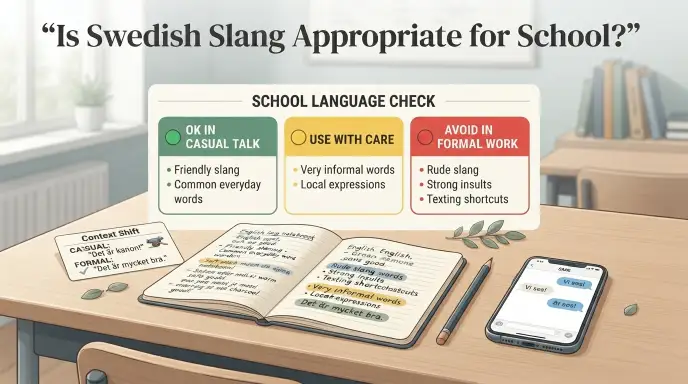
It depends on the setting.
Talking casually with friends at school is different from writing a school assignment.
For an essay, report, or formal presentation, standard Swedish is usually safer.
For example, instead of writing:
“Filmen var fett bra.”
A formal version could be:
“Filmen var mycket bra.”
The first sentence is casual.
The second is more suitable for formal writing.
Is Swedish Slang Rude?
Most Swedish slang is not automatically rude.
Words such as chilla, bror, fett, and lugnt are generally casual rather than offensive.
However, some slang terms can become rude depending on the word, speaker, and situation.
Tone also matters.
A friendly word between close friends may sound disrespectful when used toward a stranger.
If you are learning Swedish, it is useful to understand slang before using it.
Common Mistakes
1. Treating Every Slang Word as Standard Swedish
Some slang words are very informal.
Learn the standard form too.
2. Using Slang in Formal Writing
Words such as bror and asså may sound out of place in a formal report.
3. Assuming Every Swedish Person Uses the Same Slang
Slang can vary by age, city, and social group.
4. Translating Every Word Literally
Some slang has a meaning that is different from its literal translation.
For example, fett literally relates to “fat,” but fett bra means “really good.”
5. Assuming English and Swedish Slang Are Identical
Some Swedish slang comes from English, but the meaning and usage can change after a word enters Swedish.
6. Using Slang Without Knowing the Tone
A word may be friendly among friends but inappropriate in another situation.
Swedish Slang vs. Swedish Internet Slang
These terms are related, but they are not exactly the same.
Swedish slang can include spoken expressions used in everyday life.
Swedish internet slang is more focused on:
- Texting
- Social media
- Gaming
- Memes
- Online comments
- Abbreviations
Some words appear in both groups.
For example, bror can be used in spoken conversations and online messages.
Frequently Asked Questions
1. What is Swedish slang?
Swedish slang is informal language used in casual conversations, texting, social media, music, and youth culture.
2. What does bror mean in Swedish slang?
Bror literally means “brother,” but in casual slang it can mean “bro” or be used to address a friend.
3. What does chilla mean in Swedish?
Chilla means “relax” or “hang out.” It comes from the English word “chill.”
4. What does fett mean in Swedish slang?
Fett can mean “very,” “really,” or “extremely” in casual Swedish.
For example:
“Fett bra!”
means:
“Really good!”
5. What does lugnt mean?
In casual conversation, lugnt can mean “no worries,” “it’s fine,” or “don’t worry.”
6. What does tagga mean?
Tagga can mean “leave,” “head off,” or “get going.”
7. What does palla mean?
Palla can mean “feel like doing something” or “have the energy to do something.”
“Jag pallar inte” can mean “I can’t be bothered.”
8. What does orka mean?
Orka means to have the energy or ability to do something.
“Jag orkar inte” means “I don’t have the energy.”
9. What does gött mean?
Gött is an informal expression meaning “great,” “nice,” “good,” or “enjoyable.” It is strongly associated with western Sweden.
10. What does sjukt mean in Swedish slang?
Sjukt literally relates to “sick,” but slang use can mean “very,” “extremely,” or “wildly,.”
11. Is Swedish slang hard to learn?
It can be confusing because slang changes quickly and varies between groups. Learning common words with real examples makes it easier.
12. Can I use Swedish slang with native speakers?
Yes, if you understand the context and tone. Start with common casual words and avoid using slang in formal situations.
Conclusion
Swedish slang adds a casual and modern side to the Swedish language. Words such as bror, chilla, fett, lugnt, tagga, orka, palla, gött, and sjukt can appear in conversations, texts, social media, music, and online communities.
Some words are widely understood, while others are linked to certain regions or age groups. English and other languages have also influenced modern Swedish slang.
The most important thing for learners is to understand context. A slang word may sound natural between friends but strange in a formal setting.
If you are learning Swedish, knowing slang can help you understand real conversations, social media posts, songs, and messages. Just remember that slang changes over time, so not every expression will be popular forever.
Read More:
- Manchester Slang: Mad for It, Mint & Everything Between
- Southern Slang Insults: Funny Sayings and Their Meanings
- Wagon Irish Slang: Why This Word Means So Much More

Hi, I’m Olivia Carter. I enjoy researching English slang, online expressions, and everyday vocabulary. I write clear, beginner-friendly guides with simple definitions and practical examples to make modern English easier to understand.