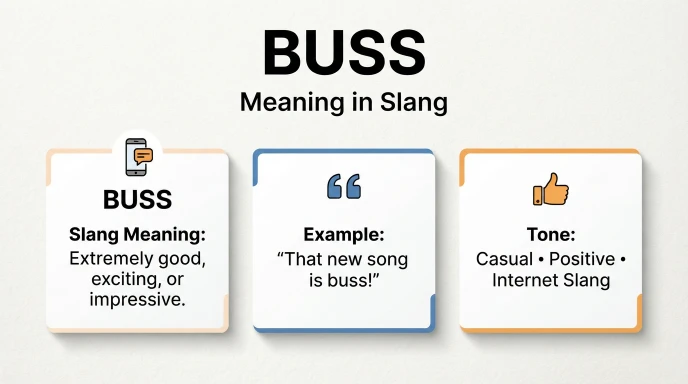
“Buss” is slang carrying multiple meanings traditionally meaning “to kiss,” while in modern Gen Z usage, it’s the root word behind “bussin,” used to praise something as excellent, especially food.
The kissing meaning is centuries old, with Merriam-Webster tracing “buss” back to 1567, historically used across British and Caribbean English.
The newer sense exploded through short-form video culture and AAVE-rooted slang, turning “bussin'” into a viral way to describe delicious food or an amazing song.
In this guide, you’ll learn both meanings of “buss,” their origins, and how to tell which one applies based on the conversation.
Quick Answer
Buss is slang that often means very good, especially when describing food. It can also be used as a shortened form of “bussin’.”
Example:“That burger buss!”
Meaning:“That burger tastes amazing!”
The exact meaning can change based on context.
Word at a Glance
| Feature | Details |
| Word | Buss |
| Main Slang Meaning | Very good or enjoyable |
| Common Use | Describing delicious food |
| Related Term | Bussin’ |
| Type | Internet and youth slang |
| Tone | Casual |
| Common Platforms | TikTok, Instagram, Snapchat, texting |
| Formal Use | No |
| Common Context | Food, reactions, casual conversations |
What Does Buss Mean in Slang?
In modern slang, buss is often used to say that something is really good.
Food is the most common subject.
For example:
“These tacos buss.”
This means:
“These tacos taste really good.”
Someone may also say:
“That pizza is buss!”
The speaker is praising the pizza.
The word is informal. You are more likely to see it in a text, social media comment, or conversation with friends than in formal writing.
What Does Buss Mean When Talking About Food?
When people use buss for food, they usually mean that the food tastes delicious, satisfying, or unusually good.
It can show strong approval.
Example
“This mac and cheese buss!”
Meaning:
“This mac and cheese tastes amazing!”
Another example:
“These fries buss.”
Meaning:
“These fries are really good.”
The word can make a simple compliment sound more energetic and playful.
What Does Bussin’ Mean?
Bussin’ is closely related to buss.
It is commonly used to mean:
“Extremely good,” especially when describing food.
For example:
“This pizza is bussin’!”
This means:
“This pizza is extremely delicious!”
You may also see:
“This food is buss.”
and:
“This food is bussin’.”
Both can express strong praise, but bussin’ is often the more recognizable slang form.
Buss vs. Bussin’
These two forms are related, but people use them slightly differently.
| Term | Common Meaning | Example |
| Buss | Very good | “This burger buss.” |
| Bussin’ | Extremely good | “This burger is bussin’.” |
In casual online speech, people may use the two forms loosely.
The important idea is that the speaker is usually saying something is really enjoyable or delicious.
Where Did Buss Come From?
The slang use of buss is connected to Black American speech and internet culture.
The exact history is not always presented in the same way, and slang often develops gradually rather than coming from one single person or event.
The expression became much more visible through social media, especially short-form video platforms.
Food videos helped make bussin’ widely recognizable.
People began using the word in captions, comments, memes, and reaction videos.
As a result, the term moved from a more specific slang use into broader internet vocabulary.
How Did Buss Become Popular Online?
Social media played a major role in spreading buss and bussin’.
Food content is especially important.
People often post videos of:
- Restaurant meals
- Homemade food
- Fast food
- Desserts
- Snacks
- Cooking experiments
- Food reviews
A creator may taste something and say:
“This is bussin’!”
Viewers then repeat the expression in comments and other videos.
This helped the term become familiar to a much wider audience.
Why Do People Say Buss?
People use buss because it gives a stronger reaction than simply saying “good.”
Compare these two sentences:
“This burger is good.”
and:
“This burger buss!”
The second sentence sounds more casual, expressive, and energetic.
It can show that the speaker is genuinely impressed by the food.
Buss in Text Messages
You may see buss in casual texting.
For example:
“Bro, this food buss 😭”
The person is saying that the food tastes extremely good.
Another example:
“That cake buss fr.”
Here, fr means “for real.”
The full message means:
“That cake is really good, for real.”
Texting slang often combines several short expressions in one sentence.
Buss on TikTok
TikTok has helped make many slang terms popular, including bussin’.
A person may post a food review and write:
“This place bussin’ 🔥”
The phrase tells viewers that the food is very good.
Comments may include:
“That looks bussin’.”
or:
“Bro found the buss spot.”
The exact wording can vary, but the positive meaning remains similar.
Buss on Snapchat
On Snapchat, friends may use buss while sharing food pictures or videos.
For example:
“My mom made tacos and they buss 😂”
The person is saying that the tacos taste great.
Because Snapchat is informal, slang like this fits naturally into messages between friends.
Buss on Instagram
Instagram users may use buss in comments and captions.
For example:
“This dessert buss 🔥”
or:
“That pasta looks bussin’.”
Food creators may also use the word to make captions sound more casual and relatable.
Is Buss Only Used for Food?
No.
Food is the most common modern use, but slang can change quickly.
People sometimes use buss more broadly to describe something that is enjoyable, impressive, or satisfying.
For example:
“That new song buss.”
This could mean:
“That new song is really good.”
However, this broader use is less specific than the food-related meaning.
Always look at the context.
Can Buss Describe a Person?
Usually, buss is not used as a simple adjective for a person.
You might see slang expressions that praise someone’s appearance, dancing, performance, or style, but the exact meaning can vary.
For example:
“She bussin’ with that outfit.”
This may be intended as praise, but it is not as standard or clear as using bussin’ for food.
If you are writing for a general audience, it is safer to explain the context instead of assuming one fixed meaning.
What Does “This Buss” Mean?
When someone says:
“This buss.”
they usually mean:
“This is really good.”
If they are eating something, the meaning is usually:
“This tastes really good.”
Example:
“This ramen buss!”
Meaning:
“This ramen tastes amazing!”
The phrase is very casual and may sound unusual in formal English.
What Does “Bussin” Mean on TikTok?
On TikTok, bussin’ usually means extremely good or delicious.
It is often connected with food content.
Example:
“This pasta is bussin’!”
Meaning:
“This pasta is incredibly good!”
You may also see exaggerated versions such as:
“That meal is bussin’ bussin’.”
Repeating the slang adds emphasis.
It is similar to saying:
“That food is really, really good.”
Is Buss Positive or Negative?
In its common slang use, buss is positive.
When someone says:
“This food buss.”
they are praising it.
However, sarcasm can change almost any slang term.
For example:
“Wow, this food buss 🙄”
The speaker may actually dislike the food.
The emoji and surrounding words can change the tone.
Examples of Buss Slang
Food Example
“These wings buss!”
Meaning:
“These wings are delicious!”
Restaurant Example
“That restaurant buss.”
Meaning:
“That restaurant has really good food.”
Dessert Example
“This cheesecake bussin’.”
Meaning:
“This cheesecake tastes amazing.”
Casual Text
“Bro, you gotta try this. It buss.”
Meaning:
“You need to try this. It is really good.”
Social Media Comment
“That meal looks bussin’ 🔥”
Meaning:
“That meal looks extremely good.”
Music Example
“This track buss.”
Meaning:
“This track is really good.”
This broader use depends more on context.
Buss vs. Delicious
Both can praise food, but they have different tones.
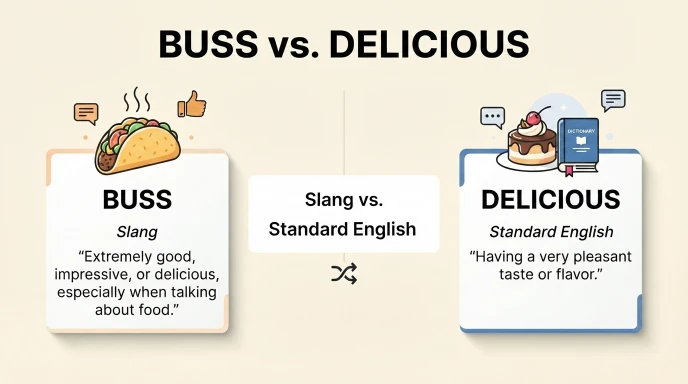
Delicious is standard English.
Buss is casual slang.
Compare:
“The food was delicious.”
with:
“The food buss!”
The first sounds normal in almost any setting.
The second sounds informal and is more likely to appear online or in casual speech.
Buss vs. Fire
Fire is another slang word that can mean excellent or impressive.
For example:
“This pizza is fire.”
and:
“This pizza buss.”
Both praise the pizza.
However, buss is especially associated with food, while fire can describe many things.
You can say:
“That song is fire.”
But buss may be less natural for some speakers in that situation.
Buss vs. Slaps
Slaps can also mean something is very good.
For example:
“This song slaps.”
This means:
“This song is really good.”
When talking about food, people may also use slang such as:
“This food slaps.”
and:
“This food buss.”
Both can be positive, but buss is strongly linked to food in modern internet slang.
Is Buss Appropriate for Formal Writing?
No.
Buss is informal slang.
Avoid it in:
- School essays
- Academic papers
- Business reports
- Job applications
- Formal emails
- Professional documents
Instead of:
“The meal buss.”
write:
“The meal was delicious.”
Instead of:
“The restaurant buss.”
write:
“The restaurant served excellent food.”
This keeps your writing clear and professional.
Quick Writing Tip
If you are writing a casual social media caption, buss can make your wording sound natural and playful.
For example:
“This burger buss 🔥”
But if you are writing an article, report, or school assignment, use standard words such as:
- Delicious
- Excellent
- Tasty
- Enjoyable
- Impressive
Choose the word based on your audience and setting.
How to Use Buss in a Sentence
The slang word buss usually appears in short, casual sentences. It is often used after describing food.
For example:
“This pizza buss.”
This means:
“This pizza tastes really good.”
You may also see it with words like really, so, or fr.
“This food really buss.”
“That cake buss fr.”
“Bro, this meal buss!”
The grammar can look unusual because slang does not always follow standard English rules. That is normal in casual online speech.
Common Buss Phrases
Several phrases appear often in social media conversations.
“This Buss”
This means something is very good.
“This burger buss.”
“That Buss”
This can praise something someone has shown or recommended.
“That restaurant buss.”
“Bussin’”
This is a stronger form used to say something is extremely good.
“These wings are bussin’.”
“Bussin’ Bussin’”
Repeating the phrase adds emphasis.
“Nah, this food is bussin’ bussin’.”
It means the food is really, really good.
“This Food Buss”
This is one of the clearest uses.
“This food buss!”
The speaker is strongly praising the meal.
What Does “Bussin’ Bussin’” Mean?
“Bussin’ bussin’” is an intensified version of bussin’.
It means something is exceptionally good.
For example:
“These tacos are bussin’ bussin’.”
The speaker is not simply saying the tacos are good. They are showing strong approval.
The repeated phrase is similar to saying:
“This is seriously amazing.”
What Does “Buss Fr” Mean?
You may see buss together with fr in text messages.
FR means “for real.”
So:
“This food buss fr.”
means:
“This food is really good, for real.”
The combination makes the compliment stronger.
Other examples include:
“That burger buss fr.”
“This dessert buss fr.”
“That place is buss fr.”
What Does “Bussin’ No Cap” Mean?
You may also see bussin’ with “no cap.”
No cap means “no lie” or “I’m being honest.”
For example:
“This pizza is bussin’, no cap.”
The speaker means:
“This pizza is seriously amazing. I’m not exaggerating.”
This combination is very casual and is mostly found in online slang.
Buss in Food Reviews
Food reviews are one of the most common places to see buss and bussin’.
A person may taste a meal and say:
“This is bussin’!”
They are giving a very positive reaction.
You may see the word used for:
- Pizza
- Burgers
- Chicken
- Tacos
- Pasta
- Desserts
- Fries
- Snacks
- Homemade meals
- Restaurant dishes
For example:
“The fries were bussin’.”
This means:
“The fries were extremely good.”
Buss in Memes
The word buss also appears in memes.
A meme may show someone eating a large meal with a caption such as:
“When the food finally buss.”
The joke is usually about how satisfying the meal feels.
Memes often exaggerate slang for humor, so you may see unusual versions of the word.
Buss and Internet Culture
The popularity of bussin’ shows how quickly slang can spread online.
A word may start in a particular community or region. Social media can then expose millions of people to it.
Food creators, influencers, gamers, and younger users helped make terms like bussin’ familiar to a wider audience.
TikTok, Instagram, YouTube, and other platforms allow slang to spread through:
- Videos
- Comments
- Memes
- Captions
- Reactions
- Text messages
Because internet slang changes quickly, the meaning of buss may continue to develop.
Is Buss Still Popular?
Bussin’ became especially popular in online culture during the early 2020s.
You may still see it today, but slang popularity changes over time.
Some people use it seriously.
Others use it jokingly or ironically.
For example:
“This cafeteria food is bussin’ 😭”
The speaker may genuinely like the food, or they may be exaggerating for humor.
Context helps you understand the intended tone.
Can Buss Be Used Sarcastically?
Yes.
Slang can be used sarcastically when the speaker means the opposite of the normal definition.
For example:
“Yeah, this burnt toast really buss 🙄.”
The speaker probably does not think the toast tastes great.
The eye-roll emoji makes the sarcasm easier to understand.
Without context, the word itself usually has a positive meaning.
Does Buss Mean the Same Thing as Bussin’?
They are closely related, but they are not always used in exactly the same way.
Buss can work as a short slang description:
“This food buss.”
Bussin’ is often used as a stronger expression:
“This food is bussin’.”
Both usually communicate strong approval.
The difference is mostly about style and sentence structure.
Common Mistakes
1. Thinking Buss Is Standard English
It is slang. Do not use it in formal writing.
2. Assuming Buss Always Refers to Food
Food is the most common use, but people can use it more broadly.
3. Confusing Buss With Bus
Bus is a vehicle.
Buss in slang can mean something is very good.
For example:
“I took the bus to school.”
Here, bus has its normal meaning.
“This food buss!”
Here, buss is slang.
4. Thinking Buss and Delicious Are Identical
They have similar meanings when describing food, but their tones are different.
Delicious is standard English.
Buss is casual slang.
5. Using Buss in Every Situation
The word may sound unnatural in formal or professional conversations.
6. Assuming Everyone Understands It
Not every person knows current internet slang.
If your audience is unfamiliar with the term, use standard English or explain it.
Buss vs. Other Food Slang
| Slang | Meaning | Example |
| Buss | Very good | “This chicken buss.” |
| Bussin’ | Extremely good | “This chicken is bussin’.” |
| Slaps | Very good | “This food slaps.” |
| Fire | Excellent | “This pizza is fire.” |
| Hits | Very satisfying or good | “This meal hits.” |
| Gas | Very good or impressive | “This food is gas.” |
| Delish | Delicious | “This dessert is delish.” |
These terms can overlap, but they are not always interchangeable.
Frequently Asked Questions
1. What does buss mean in slang?
Buss usually means very good, delicious, or enjoyable, especially when talking about food.
2. What does bussin’ mean?
Bussin’ means extremely good or delicious. It is especially common when praising food.
3. Is buss a positive word?
Yes. In its common slang use, buss is positive and shows strong approval.
4. What does “this food buss” mean?
It means:
“This food tastes really good.”
5. Is buss the same as delicious?
Not exactly. Both can praise food, but delicious is standard English while buss is informal slang.
6. What does “bussin’ bussin’” mean?
It means something is really, really good. Repeating the word adds emphasis.
7. What does “buss fr” mean?
It means something is really good, for real. Here, fr means “for real.”
8. Is buss appropriate for school writing?
No. Use standard words such as delicious, excellent, tasty, or enjoyable instead.
9. Where is buss commonly used?
You may see it in text messages, TikTok, Instagram, Snapchat, memes, comments, and casual conversations.
10. Can buss be used sarcastically?
Yes. The speaker may use it ironically to suggest that something is actually bad or disappointing.
Conclusion
The most common buss meaning slang is “very good,” “delicious,” or “really enjoyable.” It is especially common when people talk about food.
The related term bussin’ often carries an even stronger meaning. Saying “This food is bussin’” means the speaker thinks the food tastes extremely good.
You may see buss and bussin’ on TikTok, Instagram, Snapchat, YouTube, and in casual text messages. The terms are informal and work best in relaxed conversations.
Remember that slang changes with context. Buss can sometimes have other meanings, so always look at the full sentence before deciding what the speaker means.
For formal writing, avoid slang and use clear words such as delicious, excellent, tasty, or impressive.
Read More:
- YW Slang Meaning: Small Letters, Same Polite Meaning
- What Does Fronting Mean Slang: Why People Say “Stop Fronting”
- OMD Meaning Slang: Surprise, Shock & Everything in Between

Hi, I’m Olivia Carter. I enjoy researching English slang, online expressions, and everyday vocabulary. I write clear, beginner-friendly guides with simple definitions and practical examples to make modern English easier to understand.