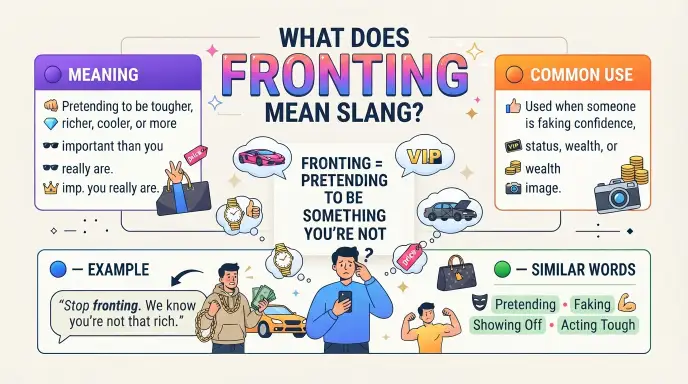
Fronting in slang most commonly means pretending, acting fake, or putting up a false image to impress others as in “stop fronting like you don’t care.”
This term became especially popular through hip-hop culture, often used to call out someone for lying, exaggerating, or acting differently than they truly feel.
In a separate context, particularly in drug culture, “fronting” also means giving someone goods or money on credit, to be paid back later.
In this guide, you’ll learn both meanings of “fronting,” their origins, and how to tell which one applies based on context.
Quick Answer
Fronting means pretending, showing off, or acting like something is true when it is not. It often describes someone who is trying to impress others or hide their real situation.
What Does Fronting Mean in Slang?
In slang, fronting usually means putting on a false image.
Someone might be fronting by:
- Pretending to have money.
- Acting tougher than they are.
- Pretending to know someone important.
- Exaggerating their success.
- Hiding their true feelings.
- Acting confident when they are actually nervous.
Example:
“He keeps saying he owns three cars, but I think he’s fronting.”
Here, fronting means pretending or exaggerating.
Word at a Glance
| Feature | Details |
| Word | Fronting |
| Part of Speech | Verb / Slang |
| Pronunciation | US: /ˈfrʌntɪŋ/ |
| Common Meaning | Pretending or putting on a false image |
| Tone | Informal |
| Common Contexts | Texting, music, social media, casual speech |
| Related Words | Pretending, faking, flexing, bluffing |
What Does Fronting Stand For?
Fronting is not an abbreviation, so it does not have a full form.
It comes from the verb “front,” which can mean putting up a false appearance or acting in a certain way to influence how others see you.
The slang form fronting describes the action of doing this.
Is Fronting Rude or Offensive?
Fronting is usually not offensive by itself.
However, calling someone a front or saying “you’re fronting” can sound accusatory because you are suggesting that the person is being fake or dishonest.
For example:
“Stop fronting. We know you don’t have that car.”
This sounds confrontational.
Where Is Fronting Commonly Used?
You may see or hear fronting in:
- Text messages.
- Hip-hop and rap.
- TikTok.
- Instagram.
- Reddit.
- YouTube.
- Gaming chats.
- Casual conversations.
It is especially common when people talk about someone’s behavior, lifestyle, money, confidence, or claims.
Why Do People Say Someone Is Fronting?
People may call someone out for fronting when they believe that person is trying too hard to impress others.
For example:
- Someone pretends to be wealthy.
- Someone exaggerates their achievements.
- Someone acts tough to gain respect.
- Someone claims to know a celebrity.
- Someone pretends not to care when they actually do.
In simple terms, fronting means putting on an act.
Real-Life Examples of Fronting Slang Usage
Fronting is usually used when someone is pretending, exaggerating, or trying to create a false image. The exact meaning depends on the situation.
Friendly Examples
Friends may use fronting when joking about someone who is pretending to be something they are not.
- “Bro, stop fronting. You know you liked the song.”
- “She’s fronting like she doesn’t care.”
- “He’s just fronting to look cool.”
- “Don’t front with me. I know the truth.”
These examples can sound playful when used between close friends.
Casual Examples
People may use fronting when they believe someone is exaggerating or hiding the truth.
- “He’s fronting about how much money he makes.”
- “Why are you fronting like you know everything?”
- “She keeps fronting about being famous.”
- “I know you’re fronting.”
Here, fronting suggests that someone is putting on a false image.
Social Media Examples
Fronting is also common when people discuss online behavior.
- “People be fronting on social media.”
- “He’s fronting for the camera.”
- “She’s always fronting about her lifestyle.”
- “Don’t believe everything you see online. People front.”
Social media can make the term especially relevant because people sometimes present an edited or exaggerated version of their lives.
Origin and Background of Fronting Slang
The slang use of fronting comes from the idea of putting up a front or outward appearance.
A person may show one image to other people while hiding what is really happening behind that image.
The expression became especially common through African American Vernacular English, hip-hop culture, rap music, and urban slang. It later spread widely through movies, television, social media, and everyday informal speech.
Today, people may use fronting in many different situations, from joking about a friend’s behavior to calling out someone for exaggerating online.
Comparison With Similar Slang
Several slang words have meanings close to fronting, but they are not always identical.
Key Differences
| Slang | Meaning | Common Use |
| Fronting | Pretending or creating a false image | Behavior |
| Faking | Pretending something is real | General situations |
| Flexing | Showing off possessions or success | Money / lifestyle |
| Cap | Lying or saying something untrue | Texting / social media |
| Bluffing | Pretending to have confidence or an advantage | Games / arguments |
| Posing | Acting or presenting yourself in a certain way | Image / appearance |
Comparison Table
| Term | Meaning | Example |
| Fronting | Pretending or hiding the truth | “He’s fronting about his money.” |
| Faking | Pretending something is real | “She’s faking confidence.” |
| Flexing | Showing off | “He’s flexing his new car.” |
| Cap | A lie or false claim | “That’s cap.” |
| Bluffing | Pretending to have an advantage | “He’s bluffing.” |
| Posing | Creating a certain image | “He’s posing for attention.” |
When to Avoid Using Fronting Slang
Fronting is informal slang, so it may not fit every situation.
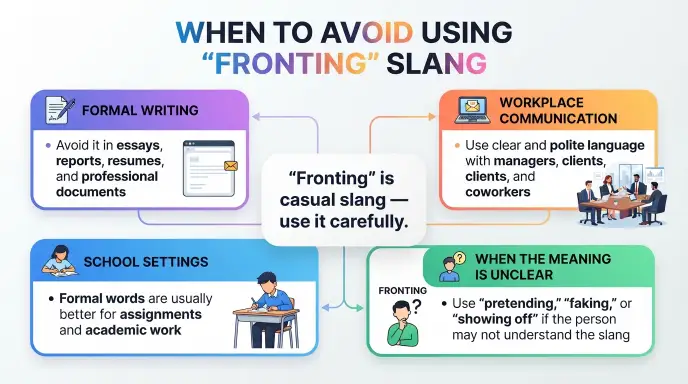
Avoid using it when:
- Writing academic assignments.
- Preparing formal reports.
- Sending professional emails.
- Speaking in a formal meeting.
- Communicating with someone unfamiliar with slang.
Instead, use clearer words such as pretending, exaggerating, misleading, or putting on an act.
Polite Alternatives to Fronting
You can replace fronting with a more neutral phrase.
| Fronting | Clear Alternative |
| “You’re fronting.” | “You’re pretending.” |
| “Stop fronting.” | “Please be honest.” |
| “He’s fronting about his money.” | “He is exaggerating his financial situation.” |
| “She’s fronting like she doesn’t care.” | “She is pretending not to care.” |
| “They’re fronting online.” | “They are presenting a different image online.” |
These alternatives are better for formal or professional communication.
Impact of Using Fronting in Communication
Calling someone out for fronting can make a conversation feel direct or confrontational.
It can:
- Suggest that someone is being fake.
- Challenge someone’s claims.
- Point out exaggeration.
- Show that you do not believe someone.
- Make casual conversations more expressive.
However, telling someone they are fronting can also cause an argument if they feel accused of lying.
Is Fronting Slang Safe for Social Media?
Yes. Fronting is generally safe to discuss on social media.
It is not a vulgar word, but it can sound negative when used to accuse someone of being fake or dishonest.
Examples include:
- “Stop fronting.”
- “He’s fronting for the camera.”
- “People are always fronting online.”
- “Don’t front with me.”
The phrase is best suited to casual communication rather than formal writing.
Frequently Asked Questions About Fronting Slang
1. What does fronting mean in slang?
Fronting means pretending, exaggerating, or acting like something is true when it is not. It often describes someone who is trying to impress others or hide their real situation.
2. What does “stop fronting” mean?
“Stop fronting” means “stop pretending” or “be honest.”
Example:
“Stop fronting. I know you liked the song.”
3. What does “he’s fronting” mean?
“He’s fronting” means the person is putting on an act or pretending.
For example, if someone acts wealthy but constantly lies about their money, another person might say, “He’s fronting.”
4. Is fronting the same as lying?
Not always. Fronting can involve lying, but it can also mean exaggerating, acting differently, or creating a false image without making a direct lie.
5. Is fronting the same as flexing?
No. Flexing usually means showing off something you have, such as money, clothes, or a car. Fronting is broader and means pretending or creating a false image.
Someone can be flexing without fronting, but someone who exaggerates their lifestyle may be doing both.
6. Is fronting rude?
The word itself is not offensive, but saying “you’re fronting” can sound accusing or confrontational. It suggests that the person is not being genuine.
7. Where is fronting commonly used?
Fronting is common in:
- Text messages.
- Social media.
- Hip-hop and rap culture.
- TikTok.
- Instagram.
- Reddit.
- Gaming chats.
- Casual conversations.
8. What are some synonyms for fronting?
Depending on the context, similar words include:
- Pretending
- Faking
- Exaggerating
- Bluffing
- Posing
- Putting on an act
The best synonym depends on what the person is actually doing.
9. Can fronting be used in a sentence?
Yes. Here are some simple examples:
- “He’s fronting about his money.”
- “Stop fronting and tell me the truth.”
- “She’s fronting like she doesn’t care.”
- “People sometimes front on social media.”
10. Is fronting used on social media?
Yes. People often use fronting when talking about someone who presents a lifestyle or personality online that does not match reality.
For example:
“Don’t believe everything online. People front.”
Conclusion
Fronting meaning slang is pretending, exaggerating, or putting on a false image. Someone who is fronting may act richer, tougher, more successful, or less interested than they really are.
The term is common in casual speech, texting, social media, hip-hop culture, and online conversations. It can describe anything from a small act among friends to a person presenting a completely different lifestyle online.
Fronting is related to words such as faking, bluffing, posing, flexing, and cap, but each word has a slightly different meaning.
If someone says “stop fronting,” they usually mean “stop pretending and be honest.”
Read More:
- YW Slang Meaning: Small Letters, Same Polite Meaning
- OMD Meaning Slang: Surprise, Shock & Everything in Between
- Los Angeles Slang: Everyday Words Every Local Knows

Hi, I’m Sophia Turner, a writer at SlangRise with 7 years of experience researching English slang, internet abbreviations, and modern vocabulary.