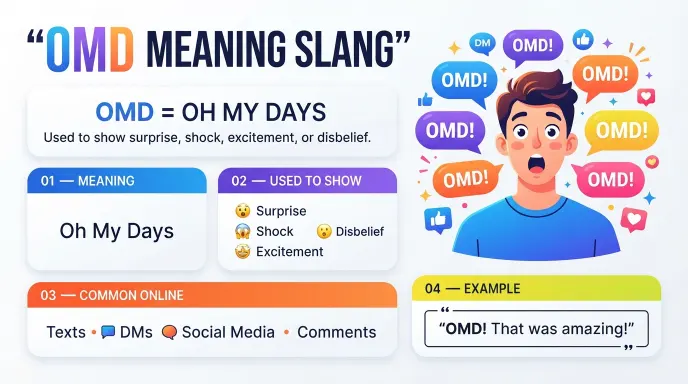
OMD is slang for “Oh My Days,” a British expression used to show surprise, shock, excitement, or disbelief a softer, less religious alternative to “OMG.”
This phrase originated in UK slang culture and gained global popularity through TikTok and Instagram, where British expressions increasingly cross over into mainstream internet language.
Unlike “OMG,” which can feel more intense, OMD carries a slightly softer, more playful tone that fits both excited and frustrated reactions depending on context.
In this guide, you’ll learn the true meaning of OMD, its British origin, and how it’s commonly used to react to surprising or unbelievable moments today.
Quick Answer
OMD most commonly means “Oh My Days.” It is a casual expression used to show surprise, excitement, shock, or disbelief.
Word at a Glance
| Feature | Details |
| Term | OMD |
| Full Form | Oh My Days |
| Type | Texting slang |
| Common Use | Surprise or strong reaction |
| Tone | Casual |
| Common Contexts | Texting, social media, chats |
| Regional Use | Especially common in British English |
| Similar Term | OMG |
What Does OMD Mean in Slang?
In texting slang, OMD usually stands for “Oh My Days.”
People use it when something makes them feel a strong emotion.
For example:
“OMD! Look at that view!”
The person is expressing amazement.
Another example:
“OMD, I forgot my keys again.”
Here, OMD shows frustration or disbelief.
The phrase does not have to describe one specific emotion. Its meaning changes with the situation.
What Does “Oh My Days” Mean?
“Oh my days” is an informal expression used to react to something surprising, exciting, annoying, or unbelievable.
It is similar to:
- Oh my God
- OMG
- Wow
- No way
- Seriously?
- I can’t believe it
The tone depends on the message.
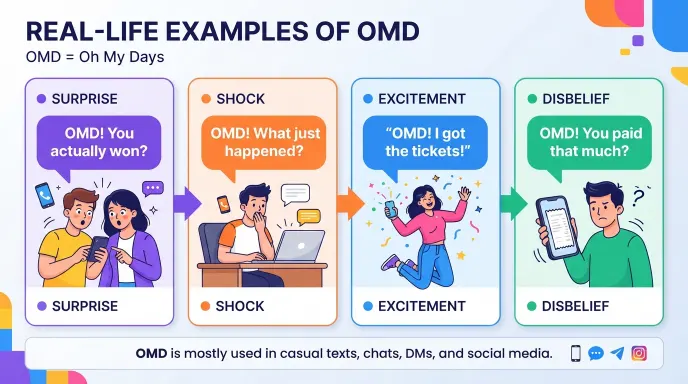
Surprise
“OMD, you got the job!”
Meaning: “I can’t believe you got the job!”
Excitement
“OMD, this concert was amazing!”
Meaning: “This concert was incredibly good!”
Shock
“OMD, what just happened?”
Meaning: “I can’t believe what just happened.”
Frustration
“OMD, I missed the bus again.”
Meaning: “I’m really frustrated that I missed the bus.”
OMD vs. OMG
OMD and OMG are very similar.
| Term | Meaning | Common Tone |
| OMD | Oh My Days | Surprise, shock, excitement |
| OMG | Oh My God | Surprise, shock, excitement |
| OMFG | Oh My F***ing God | Very strong reaction |
| WOW | Wow | Surprise or admiration |
The main difference is the phrase behind the abbreviation.
OMD = Oh My Days
OMG = Oh My God
OMD can be a useful alternative for people who prefer not to use religious language in an expression.
Is OMD a British Slang Term?
OMD is strongly associated with British English, especially casual speech and online communication.
You may see it in:
- British texting
- Social media comments
- TikTok
- Snapchat
- Casual conversations
It is not limited to the UK, though. People outside Britain may also use it after seeing it online.
How Do People Use OMD in Texting?
OMD is usually placed at the beginning of a sentence or reaction.
Example 1
“OMD, that’s so funny!”
The person is showing strong amusement.
Example 2
“OMD! You look amazing.”
The person is showing excitement or admiration.
Example 3
“OMD, I can’t believe this.”
The person is showing disbelief.
Example 4
“OMD, that was close!”
The person is reacting to a surprising event.
Is OMD Positive or Negative?
OMD can be either positive or negative.
The abbreviation itself does not tell you the emotion.
For example:
“OMD, you won!”
This is positive and excited.
But:
“OMD, I lost my phone.”
This shows frustration or stress.
The words around OMD tell you what the speaker really means.
Real-Life Examples of OMD
Text Message
Liam: “OMD, did you see that goal?”
Noah: “Yes! That was amazing.”
Here, OMD shows excitement.
Social Media
“OMD 😭 this video is too funny.”
Here, it shows strong amusement.
Surprise
“OMD, she actually came!”
Here, the speaker is surprised.
Frustration
“OMD, I forgot my homework.”
Here, it shows annoyance or stress.
Excitement
“OMD! We’re going to the concert!”
Here, it shows excitement and happiness.
How to Use OMD in a Sentence
OMD is usually placed at the start of a sentence, but it can also appear in the middle of a message.
At the Start
“OMD, that’s incredible!”
This shows surprise or excitement.
Before a Reaction
“OMD! What was that?”
This shows shock or disbelief.
In a Casual Message
“I just saw your photo, OMD 😂.”
Here, OMD adds an emotional reaction.
Because it is texting slang, punctuation and capitalization can change.
You may see:
- OMD
- omd
- OMD!
- OMD 😂
- omd 😭
They can all carry the same basic meaning.
OMD on Social Media
People often use OMD in comments, captions, and direct messages.
TikTok
“OMD this video 😭”
It can show that the video is very funny or surprising.
“OMD, you look amazing!”
It can show excitement or admiration.
Snapchat
“OMD, what happened?”
It can show surprise or disbelief.
“OMD I forgot to call you!”
It can show frustration or embarrassment.
OMD vs. Similar Slang
Several expressions can show surprise or strong emotion.
| Expression | Meaning | Tone |
| OMD | Oh My Days | Casual |
| OMG | Oh My God | Casual |
| OMFG | Oh My F***ing God | Strong |
| Jeez | Strong reaction | Casual |
| Wow | Surprise or admiration | General |
| No way! | Surprise or disbelief | Casual |
| Seriously? | Doubt or shock | Casual |
OMD is useful when you want a strong reaction without using the word God.
Is OMD Rude or Offensive?
OMD is generally not rude or offensive.
It is a casual expression.
However, it may not fit every situation. A formal email, school report, or professional message should use standard language instead.
For example, instead of:
“OMD, this is amazing!”
A formal version could be:
“This is excellent.”
The meaning is similar, but the tone is different.
Common Mistakes
1. Thinking OMD Always Means One Emotion
OMD can show surprise, excitement, frustration, shock, or disbelief.
2. Confusing OMD With OMG
They are similar, but they have different full forms.
OMD = Oh My Days
OMG = Oh My God
3. Using OMD in Formal Writing
OMD is texting slang. Avoid it in formal documents.
4. Assuming Everyone Knows OMD
Not everyone knows British texting slang. If someone asks what it means, explain it clearly.
5. Thinking OMD Is Always Positive
The context matters. It can express both positive and negative reactions.
Frequently Asked Questions
1. What does OMD mean in slang?
OMD usually means “Oh My Days.” It expresses surprise, shock, excitement, disbelief, or frustration.
2. What does OMD mean in texting?
In texting, OMD usually means “Oh My Days.” It works as a quick emotional reaction.
3. Is OMD British slang?
Yes. OMD is strongly associated with British English and British online slang.
4. Is OMD the same as OMG?
They have a similar purpose, but they are different expressions. OMD means “Oh My Days,” while OMG means “Oh My God.”
5. Is OMD a bad word?
No. OMD is generally harmless and is not considered profanity.
6. Can OMD be positive?
Yes. You can use it to show excitement, happiness, or admiration.
7. Can OMD be negative?
Yes. It can also show frustration, shock, annoyance, or disbelief.
8. What does “OMD 😭” mean?
It usually shows a strong reaction. Depending on the context, it can mean “Oh my days, this is so funny,” “I can’t believe this,” or “I’m overwhelmed.”
Conclusion
The most common OMD meaning slang is “Oh My Days.” It is a casual expression used to show a strong reaction.
You may use OMD when you feel surprised, excited, shocked, amused, or frustrated. The exact emotion depends on the words and emojis around it.
OMD is especially common in British online communication, but it can also appear in social media conversations around the world.
If you see “OMD!” in a message, the simplest interpretation is usually:
“Oh my days!”
Read More:
- YW Slang Meaning: Small Letters, Same Polite Meaning
- What Does Fronting Mean Slang: Why People Say “Stop Fronting”
- Los Angeles Slang: Everyday Words Every Local Knows

Hi, I’m Olivia Carter. I enjoy researching English slang, online expressions, and everyday vocabulary. I write clear, beginner-friendly guides with simple definitions and practical examples to make modern English easier to understand.