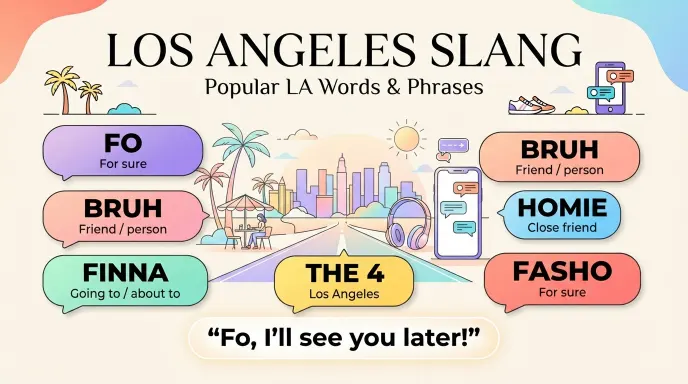
Los Angeles Slang refers to the unique informal words and expressions used across LA, such as “the 405” (a freeway), “hella” (very), and “the Valley” (San Fernando Valley), reflecting the city’s diverse culture and laid-back lifestyle.
This vocabulary blends influences from Hollywood entertainment culture, surf and skate communities, and the city’s rich multicultural neighborhoods.
Learning this slang helps visitors, transplants, and locals better navigate conversations and understand the relaxed, trend-driven personality embedded in everyday LA speech.
In this guide, you’ll discover the most popular Los Angeles slang words, their meanings, and how to use them naturally in conversation.
Quick Answer
Los Angeles slang refers to informal words and phrases associated with Los Angeles and its diverse communities. Common examples include foo, homie, the 213, the Valley, and June Gloom.
What Is Los Angeles Slang?
Los Angeles slang is the casual language used in different parts of LA. It can describe people, places, feelings, activities, and local experiences.
Some terms are connected to specific neighborhoods or cultures, while others have become popular through music and entertainment.
For example:
- Foo — an informal word for a person or friend.
- Homie — a friend or someone you know well.
- The 213 — a famous Los Angeles area code used as a nickname for part of LA.
- The Valley — commonly refers to the San Fernando Valley.
- June Gloom — a local term for the cloudy and cool weather often seen along the Southern California coast during early summer.
Not every person in Los Angeles uses every slang word. LA is a large and diverse city, so slang can vary from one community to another.
Word at a Glance
| Feature | Details |
| Term | Los Angeles slang |
| Type | Regional slang |
| Region | Los Angeles, California |
| Tone | Casual and informal |
| Common Contexts | Conversations, music, social media, local culture |
| Related Terms | LA slang, SoCal slang, California slang |
| Main Influence | Local communities and popular culture |
Common Los Angeles Slang Words
Los Angeles has a wide range of informal expressions. Some are strongly associated with local culture, while others became popular through music, television, and social media.
Foo
Foo is an informal term for a person, friend, or guy. It is strongly associated with Southern California speech and can have different tones depending on the speaker.
Example:
“That foo is always making jokes.”
Homie
Homie means a friend or someone you are close with.
Example:
“I’m meeting my homies after work.”
The 213
The 213 refers to the Los Angeles area code 213. It can also be used as a nickname for parts of central Los Angeles.
Example:
“He grew up in the 213.”
The Valley
The Valley commonly refers to the San Fernando Valley, a large area of Los Angeles.
Example:
“She lives out in the Valley.”
June Gloom
June Gloom describes the cloudy, gray, and cool weather that can occur along the Southern California coast during early summer.
Example:
“It looks like another day of June Gloom.”
Why Is Los Angeles Slang Popular?
Los Angeles has a major influence on American popular culture. The city is known for its entertainment industry, music scene, fashion, sports, and diverse communities.
Because of this, words that develop in LA can spread far beyond the city.
Music and movies have played a major role in this process. Hip-hop, rap, television shows, and social media have introduced many LA expressions to people across the country and around the world.
Where Is Los Angeles Slang Used?
You may encounter LA slang in many different places.
Common settings include:
- Everyday conversations.
- Text messages.
- TikTok.
- Instagram.
- YouTube.
- Reddit.
- Music.
- Movies and television.
- Gaming chats.
- Local communities.
The exact words people use can depend on their age, neighborhood, culture, and social group.
Is Los Angeles Slang the Same as California Slang?
No. Los Angeles slang is not exactly the same as California slang.
California is a very large state with many different regions and cultures. Slang used in Los Angeles may be different from slang heard in San Francisco, San Diego, Sacramento, or other parts of the state.
Some expressions overlap, but others are strongly connected to specific communities or areas.
For example, LA has slang influenced by Southern California’s Mexican-American and Chicano communities, hip-hop culture, and local neighborhood identities.
Does Los Angeles Slang Include Spanish Words?
Yes. Spanish has influenced many expressions used in Los Angeles, especially because of the city’s large Mexican-American and Latino communities.
Some words may be borrowed from Spanish or used alongside English in everyday speech.
However, not every Spanish word heard in LA should automatically be called slang. Some are simply part of normal bilingual or multicultural speech.
Context and community matter.
Is Los Angeles Slang Rude?
Not necessarily.
Most LA slang is casual rather than automatically rude. The tone depends on the word, speaker, relationship, and situation.
For example, homie is usually friendly, while some other expressions can sound disrespectful if used with the wrong person.
Regional slang is often best used with people who understand the cultural context.
Why Should You Learn Los Angeles Slang?
Learning LA slang can help you understand local culture and informal conversations.
It can be useful when:
- Watching LA-based movies.
- Listening to California hip-hop.
- Reading social media posts.
- Understanding local conversations.
- Studying American regional language.
- Understanding online slang.
The key is to learn the meaning and context rather than using a word simply because it sounds popular.
How Does LA Slang Change?
Like all slang, Los Angeles slang changes over time.
New words can become popular through:
- Music artists.
- Social media creators.
- Movies and television.
- Teen culture.
- Sports communities.
- Neighborhood communities.
- Internet trends.
Some older expressions may disappear, while newer expressions can spread quickly across social media.
This is why Los Angeles slang today may not sound exactly like the slang used in LA decades ago.
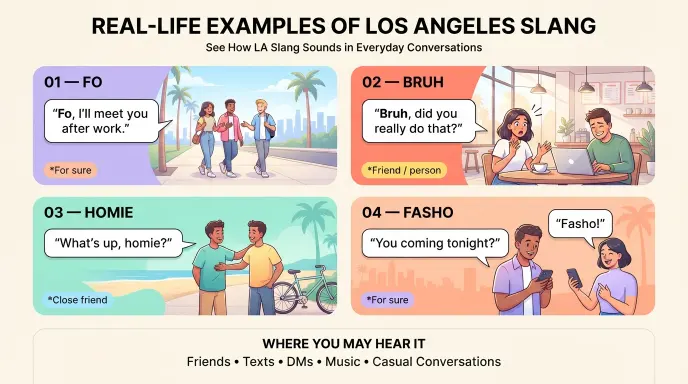
Real-Life Examples of Los Angeles Slang
Los Angeles slang is often used in casual conversations, social media posts, music, and local communities. The meaning of a word can change based on the neighborhood, speaker, and situation.
Friendly Examples
Friends may use LA slang to sound relaxed and familiar.
- “What’s up, homie?”
- “That foo is my friend.”
- “We’re heading to the Valley.”
- “The 213 is busy tonight.”
These expressions are informal and are usually used with people who understand the local style of speech.
Casual Examples
You may also hear LA slang in everyday conversations.
- “That foo is always late.”
- “My homies are coming over.”
- “She lives in the Valley.”
- “We’re driving through the 213.”
Social Media Examples
LA slang often appears in captions, comments, videos, and music-related posts.
Examples:
- “LA life with the homies.”
- “Another day of June Gloom.”
- “The 213 always feels different.”
- “That foo really did it 😂.”
You may see LA slang on:
- TikTok
- YouTube
- X
- Snapchat
Origin and Background of Los Angeles Slang
Los Angeles slang has developed through many different communities over several decades.
The city’s large Mexican-American and Chicano communities have had a major influence on local language. Hip-hop and rap culture have also helped spread LA expressions.
Skateboarding, surfing, street culture, sports, and entertainment have added their own words and phrases.
Because Los Angeles is so diverse, there is no single form of LA slang. Different neighborhoods and communities can have their own expressions.
Popular Los Angeles Slang Words
Here are some common examples you may encounter:
| Slang | Meaning | Context |
| Foo | Person, guy, or friend | Casual speech |
| Homie | Friend | Friendly conversations |
| The 213 | Los Angeles area associated with area code 213 | Local culture |
| The Valley | San Fernando Valley | Local geography |
| June Gloom | Coastal summer cloudiness | Weather |
| Hella | Very or a lot | Casual California speech |
| Finna | Going to / about to | Informal speech |
| Fire | Excellent or impressive | Modern slang |
| Dope | Very good or cool | Casual slang |
| Lit | Exciting or energetic | Social media |
Some of these terms are not unique to Los Angeles and are used more widely.
Comparison With Similar Regional Slang
Los Angeles slang is sometimes compared with slang from other parts of California.
Key Differences
| Region | Example Style | Common Association |
| Los Angeles | Foo, homie, the 213 | LA neighborhoods and culture |
| Northern California | Hella, hyphy | Bay Area culture |
| San Diego | Dude, bro, beach slang | Surf and beach culture |
| California broadly | Hella, dude, fire | Statewide or modern slang |
These categories overlap. A word heard in LA may also be common in other parts of California.
Comparison Table
| LA Term | Meaning | Formal Alternative |
| Foo | Person / guy / friend | Person / friend |
| Homie | Friend | Friend |
| The 213 | Area associated with 213 | Central Los Angeles |
| The Valley | San Fernando Valley | San Fernando Valley |
| June Gloom | Coastal cloudy weather | Overcast coastal weather |
| Fire | Excellent | Excellent |
| Dope | Very good | Great / impressive |
| Lit | Exciting | Exciting |
When to Avoid Using Los Angeles Slang
LA slang is best used in informal settings.
Avoid using unfamiliar regional slang when:
- Writing a formal report.
- Sending a professional email.
- Writing an academic assignment.
- Speaking with someone unfamiliar with the expression.
- Writing for an international audience.
A slang word may sound natural among friends but confusing in a formal setting.
Polite Alternatives to LA Slang
You can replace informal expressions with standard English.
| LA Slang | Clear Alternative |
| Foo | Person / guy |
| Homie | Friend |
| Fire | Excellent |
| Dope | Very good |
| Lit | Exciting |
| The Valley | San Fernando Valley |
| The 213 | Central Los Angeles / 213 area |
These alternatives make the meaning easier for a wider audience to understand.
Impact of Los Angeles Slang on Communication
LA slang can make conversations sound more casual, local, and expressive.
It can:
- Show familiarity with LA culture.
- Make conversations sound relaxed.
- Create a sense of community.
- Add personality to speech.
- Help people connect through shared language.
However, slang can also cause confusion when someone does not know the local meaning.
A word such as foo may sound normal to one speaker but unfamiliar or unusual to someone from another region.
Is Los Angeles Slang Safe for Social Media?
Most Los Angeles slang is safe for casual social media use. However, some expressions can have cultural or regional meanings that should be understood before using them.
Words such as homie, fire, dope, and lit are generally easy to understand.
Other terms may be more closely tied to specific communities. Using them without understanding their cultural context can sound forced or disrespectful.
For social media, it is best to use slang naturally and understand what the expression means before using it.
FAQs About Los Angeles Slang
1. What is Los Angeles slang?
Los Angeles slang refers to informal words and phrases used in LA communities. It has been shaped by local neighborhoods, music, Chicano culture, entertainment, skateboarding, surfing, and social media.
2. What are some popular LA slang words?
Some common examples include foo, homie, the 213, the Valley, June Gloom, fire, dope, and lit. Some are strongly associated with LA, while others are used across California or the United States.
3. What does “foo” mean in Los Angeles slang?
Foo is an informal word for a person, guy, or friend. It is strongly associated with Southern California speech.
Its tone depends on the speaker and situation.
4. What does “homie” mean in LA slang?
Homie means friend or someone you are close with.
Example:
“I’m meeting my homies later.”
It is generally friendly and casual.
5. What does “the 213” mean?
The 213 comes from the 213 telephone area code associated with Los Angeles. It is also used as a cultural nickname for parts of LA.
6. What does “the Valley” mean in Los Angeles?
The Valley commonly refers to the San Fernando Valley, a large region within Los Angeles.
Example:
“She lives in the Valley.”
7. What is “June Gloom”?
June Gloom is a Southern California term for the cloudy, gray, and cool weather that can occur along the coast during early summer.
It is especially associated with coastal areas around Los Angeles and San Diego.
8. Is LA slang the same as California slang?
No. LA slang is one part of California slang.
California has many different regions and communities, so people in Los Angeles may use expressions that are less common in Northern California or other parts of the state.
9. Is Los Angeles slang rude?
Not necessarily. Most LA slang is casual rather than automatically rude.
However, some words can sound disrespectful or inappropriate depending on the context. Understanding the cultural background of a term is important.
10. Where can I hear Los Angeles slang?
You may hear or see LA slang in:
- Everyday conversations.
- Hip-hop and rap.
- Movies and television.
- TikTok.
- Instagram.
- YouTube.
- Reddit.
- Gaming chats.
- Local communities.
11. Why is Los Angeles slang popular?
LA has a major influence on American entertainment and popular culture. Music, movies, television, sports, fashion, and social media have helped spread many LA expressions to audiences around the world.
12. Can LA slang include Spanish words?
Yes. Los Angeles has a large Mexican-American and Latino population, and Spanish has influenced local speech and slang.
However, not every Spanish word used in LA is slang. Some are simply part of normal bilingual communication.
Conclusion
Los Angeles slang reflects the city’s diverse communities and strong influence on American popular culture. Words such as foo, homie, the 213, the Valley, and June Gloom are examples of expressions connected with LA culture.
Some LA slang is local, while other terms have spread across California and the wider United States through music, movies, television, and social media.
The meaning and tone of a slang word can also change depending on the speaker and community. For this reason, it is important to understand the context before using a regional expression.
If you are learning Los Angeles slang, focus on both the meaning and the culture behind each word. This will help you understand LA conversations more naturally and avoid using a term in the wrong context.
Read More:
- YW Slang Meaning: Small Letters, Same Polite Meaning
- What Does Fronting Mean Slang: Why People Say “Stop Fronting”
- OMD Meaning Slang: Surprise, Shock & Everything in Between

Hi, I’m Olivia Carter. I enjoy researching English slang, online expressions, and everyday vocabulary. I write clear, beginner-friendly guides with simple definitions and practical examples to make modern English easier to understand.