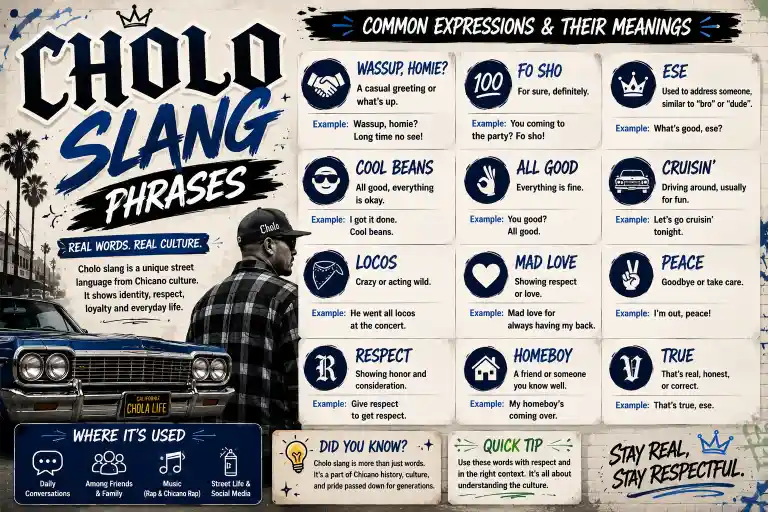
Cholo slang phrases are informal expressions commonly used in Chicano street culture to show identity, friendship, respect, or everyday communication.
Cholo slang phrases are informal words and expressions linked to Chicano street culture in the United States.
Many of these phrases come from a mix of English and Spanish and are commonly heard in conversations, music, movies, and social media. Their meanings can change depending on the community and the situation.
People often search for cholo slang phrases after hearing them in films, rap songs, YouTube videos, or online discussions. While some phrases have become widely recognized, others are mainly used within Chicano communities.
Because these expressions are closely connected to a specific culture, it is important to understand their meaning and use them respectfully.
In this guide, you’ll learn the meanings of common cholo slang phrases, where they are used, how they became popular, and when you should avoid using them.
Quick Answer
Cholo slang phrases are casual expressions that come from Chicano culture. Many combine English and Spanish words and are used to show friendship, respect, identity, or everyday emotions. Some phrases are harmless, while others can be offensive or connected to gang culture, so context is important.
What Are Cholo Slang Phrases?
Cholo slang phrases are part of the everyday language used by many people in Chicano communities. They are influenced by Mexican Spanish, American English, and local street culture.
Not every Chicano person uses these expressions, and the meaning of a phrase may vary from one city or neighborhood to another.
Many phrases are friendly and casual, while others should only be used by people who understand the culture and the situation.
Common Cholo Slang Phrases
| Phrase | Meaning |
| Órale | An expression of surprise, agreement, or encouragement. |
| Simón | Means yes or that’s right. |
| Carnal | A close friend or brother. |
| Ese | A way to address a friend, similar to bro or man. |
| Vato | A guy or a man. |
| Feria | Money or cash. |
| Jefa | Mother. |
| Jefe | Father or boss. |
| Ruca | Girlfriend or woman (informal). |
| Homeboy | A close friend from the same neighborhood. |
Are All Cholo Slang Phrases the Same?
No.
Some phrases are used in everyday conversations and are completely harmless.
Others have stronger cultural meanings or may be connected to street life or gangs in certain places.
Because of this, it is always important to understand the context before using a phrase.
Different Meanings of Cholo Slang Phrases
Some expressions have more than one meaning depending on the conversation.
Órale
Órale is one of the best-known Chicano expressions.
It can mean okay, let’s go, wow, or I agree, depending on the speaker’s tone.
Example:
“Órale! That was an amazing game.”
Simón
Simón simply means yes.
People use it instead of saying yeah or yes in casual conversations.
Example:
A: “Are you coming tonight?”
B: “Simón.”
Carnal
Carnal means brother, but it is also used for a very close friend.
It shows trust, loyalty, and respect.
Example:
“Thanks for always having my back, carnal.”
Ese
Ese is a casual way to say friend, man, or bro.
It is one of the most recognizable words linked to Cholo speech.
Example:
“What’s up, ese?”
Where Are Cholo Slang Phrases Commonly Used?
Cholo slang phrases are most common in parts of the United States with strong Chicano communities, especially in states like California, Arizona, Texas, and New Mexico. Today, some of these expressions are also heard in music, movies, and online content.
In Everyday Conversations
Friends and family members may use these phrases in casual conversations.
Example:
A: “Órale, let’s get some food.”
B: “Simón, I’m hungry.”
In Music
Many hip hop and Chicano rap artists use these expressions in their lyrics to reflect their culture and everyday life.
Fans may also use the phrases when talking about songs or artists.
In Movies and TV Shows
Cholo slang appears in many films and television shows that feature Chicano characters or neighborhoods.
These expressions help make the dialogue sound more natural and authentic.
On Social Media
People sometimes use these phrases in TikTok videos, Instagram captions, YouTube comments, and memes.
Some users are part of the culture, while others use the words because they have become familiar through music and entertainment.
Are Cholo Slang Phrases Rude, Offensive, or Harmless?
It depends on the phrase.
Many Cholo slang phrases are friendly and harmless. Others can sound disrespectful or may have links to gang culture in certain situations.
Always think about the context before using them.
| Phrase | Tone | Notes |
| Órale | ✅ Friendly | Shows surprise, agreement, or excitement. |
| Simón | ✅ Friendly | Casual way to say “yes.” |
| Carnal | ✅ Friendly | Used for a close friend or brother. |
| Ese | ✅ Casual | Friendly in many situations. |
| Vato | ✅ Casual | Informal word for a man or guy. |
| Ruca | ⚠️ Use carefully | Some people see it as disrespectful. |
Can You Use Cholo Slang Phrases at School or Work?
In most formal settings, it is better not to use them.
Teachers, coworkers, or customers may not understand the expressions, and some phrases can sound too informal.
If you’re speaking in a professional setting, standard English is usually the better choice.
Real-Life Examples of Cholo Slang Phrases
Here are some natural examples of how these expressions are used.
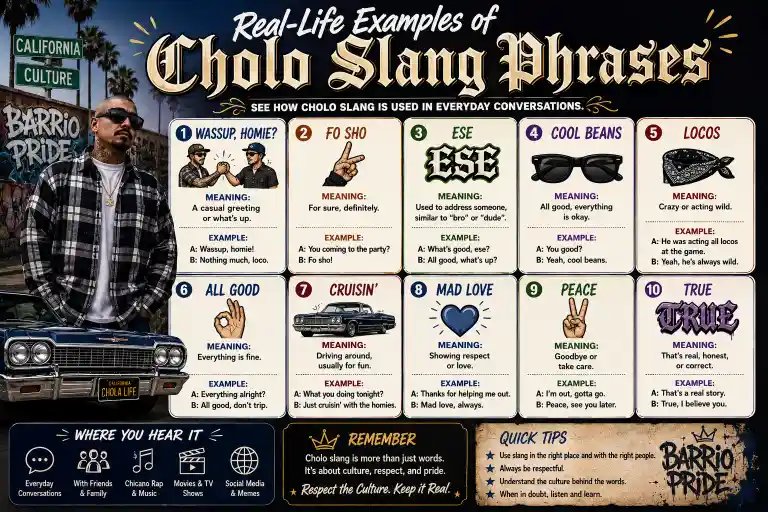
Friends
A: “Órale, let’s leave before traffic starts.”
B: “Simón, let’s go.”
Family
“My jefa made my favorite dinner tonight.”
Here, jefa means mother.
Talking to a Friend
“What’s up, ese? Haven’t seen you in a while.”
Showing Appreciation
“Thanks for helping me move, carnal.”
This shows friendship and respect.
Casual Conversation
“That vato always knows how to make people laugh.”
Here, vato simply means a guy.
These examples show that Cholo slang phrases are mostly used in relaxed conversations. The meaning often depends on the relationship between the speakers and the community they belong to.
Origin and History of Cholo Slang Phrases
Cholo slang phrases developed within Chicano communities in the United States. Most of these expressions grew from a mix of Mexican Spanish, American English, and local neighborhood speech.
The word Cholo has a long and complex history. Its meaning has changed over time and can vary by country, region, and community. In the United States, it is often linked with Chicano identity, fashion, and street culture. Because of this history, the word can mean different things to different people.
Many Cholo slang phrases became more widely known through movies, music, and television during the 1980s and 1990s.
Today, they are also seen on YouTube, TikTok, Instagram, and other social media platforms.
How These Phrases Became Popular
As Chicano culture gained more attention in music and entertainment, many of its everyday expressions reached a wider audience.
Today, you may hear Cholo slang phrases in:
- Chicano rap
- Hip hop music
- Movies
- TV shows
- YouTube videos
- TikTok clips
- Everyday conversations
Even though some phrases are now widely recognized, many are still closely connected to Chicano culture and should be used with respect.
Similar Slang and Related Terms
Some Cholo slang phrases have meanings that are similar to common English slang.
| Cholo Phrase | Similar English Expression |
| Órale | Let’s go / Wow / Okay |
| Simón | Yes / Yeah |
| Carnal | Brother / Bro |
| Ese | Dude / Man / Bro |
| Vato | Guy / Dude |
| Homeboy | Close friend |
| Feria | Money / Cash |
| Jefa | Mom |
| Jefe | Dad / Boss |
| Ruca | Girlfriend |
These words may have similar meanings, but they also carry cultural importance that standard English expressions do not.
Why Do People Use Cholo Slang Phrases?
People use these phrases because they feel natural within their community and reflect shared culture and identity.
Common reasons include:
- Showing friendship.
- Expressing respect.
- Speaking casually.
- Reflecting cultural identity.
- Feeling connected to family and community.
For many speakers, these phrases are part of everyday life rather than just slang.
Common Misunderstandings
Some people misunderstand Cholo slang because they only hear it in movies or online.
Not Every Chicano Person Uses These Phrases
Chicano communities are diverse.
Some people use these expressions every day, while others rarely use them at all.
Cholo Slang Is More Than Gang Language
Many people incorrectly believe all Cholo slang is connected to gangs.
That is not true.
Most expressions are simply everyday words used among friends and family. However, a few terms may have gang-related meanings in certain places, so context matters.
Meanings Can Change by Region
A phrase that is common in one city may be uncommon or have a different meaning somewhere else.
This is normal with many types of slang.
When Should You Avoid Using Cholo Slang Phrases?
Although many Cholo slang phrases are harmless, they are not always appropriate.
It is best to avoid using them:
- In professional meetings.
- In school assignments.
- In formal emails.
- With people who may not understand the cultural background.
- If you are unsure of the phrase’s meaning or context.
Using these expressions respectfully helps avoid misunderstandings and shows appreciation for the culture they come from.
Frequently Asked Questions
1. What are Cholo slang phrases?
Cholo slang phrases are informal expressions that come from Chicano culture in the United States. Many combine English and Spanish and are used in everyday conversations, music, movies, and social media.
2. What does ese mean?
Ese is a casual way to address a friend. It is similar to saying bro, man, or dude.
3. What does carnal mean?
Carnal means brother, but it is also used for a very close friend. It expresses loyalty, trust, and respect.
4. Is Simón the same as “yes”?
Yes. Simón is an informal way of saying yes or that’s right. It is commonly heard in casual conversations.
5. Are Cholo slang phrases offensive?
Most are not. Phrases like órale, simón, and carnal are generally friendly and harmless. However, some expressions can sound disrespectful or have different meanings depending on the community and situation.
6. Can I use Cholo slang phrases at school or work?
It is usually better to avoid them in formal settings. Many people may not know their meanings, and some expressions are too informal for professional conversations.
7. Are Cholo slang phrases only used in California?
No. They are common in several parts of the United States, especially in areas with large Chicano communities, including California, Texas, Arizona, and New Mexico. Some phrases are also recognized in other regions through music, films, and social media.
8. Why is it important to understand the cultural background?
These expressions are closely connected to Chicano culture and identity. Understanding their background helps you use them respectfully and avoid taking them out of context.
9. What are the most common cholo slang phrases?
Common cholo slang phrases include órale, simón, vato, carnal, feria, and barrio. These words are often used in Chicano culture and everyday conversations.
10. What does “vato” mean in cholo slang?
Vato means guy, dude, or man. It is a common way to refer to a male friend or person.
11. What are some Mexican slang insults?
Some common Mexican slang insults are guey, menso, baboso, and cabrón. Their meaning depends on the situation and tone.
12. What is Mexican slang for a gangster?
Words like cholo, pandillero, and sometimes vato loco are used to describe a gangster or someone connected to gang culture.
13. What are basic Mexican words and phrases?
Some basic Mexican words and phrases are hola (hello), gracias (thank you), por favor (please), órale (come on/okay), and ¿qué onda? (what’s up?).
14. What are some unique Mexican slang words?
Popular Mexican slang words include güey, chido, órale, no manches, lana, and feria. These are widely used in casual conversations.
15. What is Mexican slang for “dude”?
The most common Mexican slang for “dude” is güey (wey). Vato is also used in many regions.
16. What is Chicano gangster slang?
Chicano gangster slang includes words like vato, carnal, barrio, homie, and firme. These terms are linked to Chicano street culture.
17. What are popular Mexican slang words used in daily conversation?
Everyday Mexican slang includes güey, chido, órale, no manches, neta, and simón. These words are common in informal speech.
18. What is the difference between Chicano slang and Mexican slang?
Chicano slang developed among Mexican Americans in the United States and often mixes English and Spanish. Mexican slang comes from Mexico and is mainly based on regional Spanish.
Conclusion
Cholo slang phrases are an important part of Chicano culture and everyday communication. Many of these expressions come from a blend of English and Spanish and are used to show friendship, respect, agreement, or community.
While some phrases have become popular through music, movies, and social media, they still carry cultural meaning. Learning what they mean and using them in the right context will help you better understand conversations and appreciate the culture they come from.
You might also like:
- Massachusetts Slang Words: Essential Local Expressions
- Cook Slang Meaning: Definition, Uses & Examples
- Chirping Meaning Slang: How to Use It in Everyday Conversations

Hi, I’m Sophia Turner, a writer at SlangRise with 7 years of experience researching English slang, internet abbreviations, and modern vocabulary.