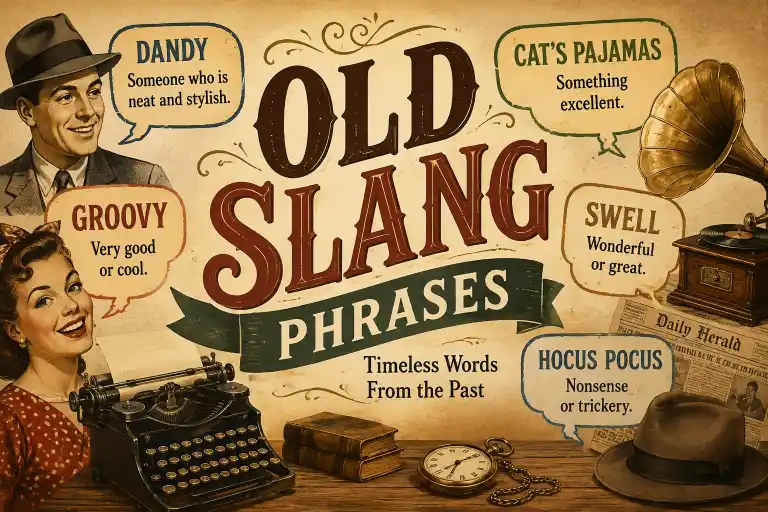
Old Slang Phrases refers to vintage, often forgotten expressions from past decades like “the bee’s knees,” “ankle-biter,” and “cat’s pajamas” that once dominated everyday conversation.
Some phrases have real staying power: “stool-pigeon” (an informer) dates back to 1826, while “ankle-biter” (a young child) has been used since 1840, proving certain vintage slang can survive over a century.
Most old slang, though, had one brief moment of popularity before fading Prohibition-era terms like “giggle water” (alcohol) and “zozzled” (drunk) capture entire eras of American culture in just a word or two.
In this guide, you’ll rediscover popular old slang phrases, their surprising origins, and which ones might be worth bringing back into everyday conversation in 2026.
Quick Answer: What Are Old Slang Phrases?
Old slang phrases are informal expressions that were popular in the past. Examples include “the bee’s knees,” “cat’s pajamas,” “cool it,” “far out,” and “groovy.” Some are still used today, but many now sound old-fashioned.
Famous Old Slang Phrases and Their Meanings
1. The Bee’s Knees
Meaning: Something excellent or very good.
“That new car is the bee’s knees.”
Era: Mainly the 1920s.
2. The Cat’s Pajamas
Meaning: Something or someone considered excellent.
“She thinks she’s the cat’s pajamas.”
Era: Mainly the 1920s.
3. The Cat’s Meow
Meaning: Something excellent.
“This new phone is the cat’s meow.”
Era: Mainly the 1920s.
4. Cool It
Meaning: Calm down or stop doing something.
“Hey, cool it!”
Era: Popular for many decades.
5. Far Out
Meaning: Amazing, strange, or exciting.
“Far out! That concert was great.”
Era: Strongly linked with the 1960s and 1970s.
6. Groovy
Meaning: Cool, fashionable, or excellent.
“Those sunglasses are groovy.”
Era: Mainly the 1960s and 1970s.
7. Outta Sight
Meaning: Excellent or amazing.
“That song is outta sight!”
Era: Common in the 1960s.
8. Right On
Meaning: Exactly, yes, or I agree.
“You finally finished it?”
“Right on!”
Era: Popular in the 1960s and 1970s.
9. Dig It
Meaning: Understand it or like it.
“Dig it? We leave at eight.”
Era: Popular in the mid-20th century.
10. You Bet
Meaning: Yes or definitely.
“Can you help me?”
“You bet!”
Era: Older but still commonly used.
11. What’s the Skinny?
Meaning: What is the latest news or information?
“So, what’s the skinny on the new job?”
Era: Mainly the early and mid-1900s.
12. Beat It
Meaning: Go away or leave.
“I told him to beat it.”
Era: Popular for many decades.
13. Hang a Louie
Meaning: Turn left.
“Go down the road and hang a Louie.”
Era: Mainly American slang from the 20th century.
14. Hang a Ralph
Meaning: Turn right.
“At the next light, hang a Ralph.”
Era: Informal American slang.
15. Square
Meaning: A boring or old-fashioned person.
“Don’t be such a square.”
Era: Especially popular in the 1950s and 1960s.
16. Daddy-O
Meaning: A friendly way to address a man.
“Take it easy, Daddy-O.”
Era: Mainly the 1950s.
17. Hep Cat
Meaning: A fashionable or well-informed person.
“He’s a real hep cat.”
Era: Mainly the 1930s and 1940s.
18. Solid
Meaning: Excellent or reliable.
“That’s a solid idea.”
Era: Older slang, but still used today.
19. Copacetic
Meaning: Very good or completely fine.
“Everything is copacetic.”
Era: Popular in the 20th century.
20. Keen
Meaning: Excellent or very attractive.
“That’s a keen idea.”
Era: Especially associated with older American and British speech.
21. Swell
Meaning: Very good or excellent.
“That sounds swell!”
Era: Common in the early and mid-1900s.
22. Neato
Meaning: Nice, cool, or excellent.
“That’s neato!”
Era: Mainly the 1950s and 1960s.
23. Nifty
Meaning: Clever, useful, or great.
“That’s a nifty little tool.”
Era: Older but still understood.
24. Golly
Meaning: An expression of surprise.
“Golly, that was close!”
Era: Common in older speech.
25. Gee Whiz
Meaning: An expression of surprise.
“Gee whiz, I didn’t know that!”
Era: Mainly older American speech.
26. Hot Diggity
Meaning: An expression of excitement or happiness.
“Hot diggity! We won!”
Era: Mainly mid-20th century.
27. Sock It to Me
Meaning: Give it to me with full force or excitement.
“Sock it to me!”
Era: Especially associated with the 1960s.
28. What a Gas!
Meaning: Something very fun or exciting.
“That party was a gas!”
Era: Mainly the 1960s.
29. Flip Your Lid
Meaning: Become extremely angry or excited.
“My dad will flip his lid.”
Era: Mid-20th-century slang.
30. Blow Your Top
Meaning: Become very angry.
“She blew her top when she saw the bill.”
Era: Older American slang.
Old Slang Phrases Still Used Today
Some old slang phrases have survived because they are still easy to understand.
Examples include:
- Cool it
- You bet
- Beat it
- Dig it
- Solid
- Nifty
- Swell
- Keen
- Right on
These phrases may not always sound modern, but many people still use them.
Old Slang Phrases That Sound Dated Today
Some expressions are now mostly used for humor, nostalgia, or a retro style.
Examples include:
- The bee’s knees
- The cat’s pajamas
- Daddy-O
- Hep cat
- Neato
- Groovy
- Far out
- Hot diggity
- What’s the skinny?
Using these phrases today can make a person sound intentionally old-fashioned or playful.
Old Slang Phrases by Era
| Era | Popular Old Slang |
| 1920s | The bee’s knees, cat’s pajamas, copacetic |
| 1930s–1940s | Hep cat, swell, keen |
| 1950s | Daddy-O, neato, nifty |
| 1960s | Groovy, far out, outta sight |
| 1970s | Right on, what a gas, cool it |
These dates are approximate. Slang often begins before it becomes widely known and can remain in use long after its most popular period.
Why Do Old Slang Phrases Become Outdated?
Slang changes quickly because each generation creates new ways to express identity and ideas.
A phrase may become old-fashioned when:
- Younger people stop using it
- New slang replaces it
- Its style becomes strongly linked with an older generation
- Movies and TV make it sound nostalgic
- People start using it as a joke
Some phrases disappear completely. Others return as part of retro trends.
Can You Still Use Old Slang Phrases?
Yes. Old slang can still be fun to use.
You can use it when:
- Writing a funny message
- Creating a retro style
- Talking about old movies
- Making a joke
- Writing historical fiction
- Creating social media content
However, some old slang may confuse younger people.
If you want clear communication, use a more modern word when needed.
Common Mistakes With Old Slang Phrases
Thinking Every Old Phrase Is Completely Dead
Some phrases are still used.
For example, “you bet” and “cool it” are still common.
Using Old Slang in a Formal Situation
Phrases like “hot diggity” or “the cat’s pajamas” may not fit a business email or school essay.
Assuming All Old Slang Has the Same Era
Slang from the 1920s, 1950s, and 1970s is not the same. Each period had its own popular expressions.
Frequently Asked Questions
What are some old slang phrases?
Popular old slang phrases include the bee’s knees, the cat’s pajamas, groovy, far out, Daddy-O, right on, and what’s the skinny?
What is the oldest slang phrase still used?
There is no single answer because many old slang phrases have remained in use for a long time. Words such as cool, keen, and swell have older slang histories but are still understood.
Is “groovy” old slang?
Yes. Groovy is strongly linked with the 1960s and 1970s, although people still use it today for a retro or playful effect.
Is “the bee’s knees” still used?
Yes, but it usually sounds playful or old-fashioned today.
Why do people use old slang?
People use old slang for humor, nostalgia, retro style, and to understand language from earlier periods.
Conclusion
Old slang phrases are a fun part of language history. Expressions like “the bee’s knees,” “groovy,” “far out,” and “what a gas” show how people spoke in different periods.
Some old slang phrases are now dated, while others are still part of everyday English. Learning them can help you understand old movies, books, songs, and conversations and you may even find a few fun phrases to bring back.
You may also like:
- Hebrew Slang: Everyday Words Every Traveler Needs (2026)
- Lemon Slang: The 2026 Guide to This Classic Consumer Term
- Australian Slang: The 2026 Guide Every Traveler Needs

Hi, I’m Sophia Turner, a writer at SlangRise with 7 years of experience researching English slang, internet abbreviations, and modern vocabulary.