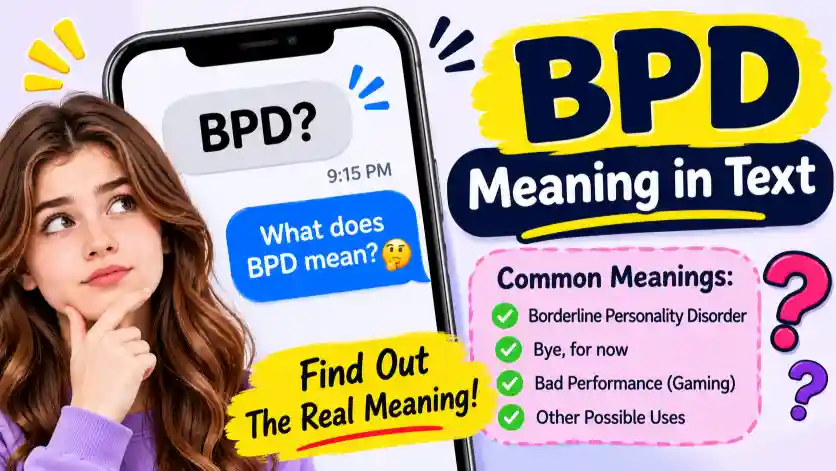
BPD most commonly stands for Borderline Personality Disorder in text messages and online conversations. It is a mental health abbreviation, not traditional internet slang. People may use it when discussing mental health, personal experiences, relationships, or emotional well-being.
You might see BPD in a private message, TikTok comment, Instagram caption, or online discussion. Someone may mention having BPD, ask what it means, or talk about a character or situation they associate with the condition.
However, the meaning depends on the conversation. In most mental health discussions, BPD refers to Borderline Personality Disorder. It is important not to use the abbreviation to diagnose someone or make assumptions about their personality.
Let’s explore its meaning, examples, social media use, and common ways to respond.
Quick Answer: What Does BPD Mean in Text?
BPD means Borderline Personality Disorder. It is a mental health condition associated with difficulties regulating emotions, changes in self-image, impulsive behavior, and challenges in relationships.
For example:
- “I was diagnosed with BPD last year.”
- “She’s sharing her experience of living with BPD.”
- “I’m learning more about BPD and mental health.”
In these messages, BPD refers to the mental health condition.
Important: BPD is not a universal texting slang term. It is a recognized medical abbreviation that people also use in everyday online conversations.
Word at a Glance
| Detail | Explanation |
| Word | BPD |
| Full Form | Borderline Personality Disorder |
| Usage | Mental health discussions and personal conversations |
| Part of Speech | Abbreviation |
| Pronunciation | Bee-Pee-Dee |
| Common Meaning | Borderline Personality Disorder |
| Tone | Neutral and sensitive |
| Common Contexts | Texting, mental health discussions, social media |
| Related Words | Mental Health, DBT, Anxiety, Depression |
What Does BPD Stand For?
BPD stands for Borderline Personality Disorder, a recognized mental health condition that affects how a person experiences emotions, understands themselves, and relates to other people.
People with BPD may experience intense emotions, changes in their self-image, impulsive behavior, and difficulties maintaining stable relationships. Experiences vary from person to person, and not everyone has the same symptoms.
The abbreviation is commonly used by mental health professionals, researchers, people discussing their experiences, and online communities.
What Is Borderline Personality Disorder?
Borderline Personality Disorder is a mental health condition that can make emotional regulation difficult.
For example, someone with BPD may experience strong emotional reactions to situations that other people find less upsetting. They may also struggle with fears of abandonment, an unstable sense of identity, or intense relationship difficulties.
Some possible experiences include:
- Intense or rapidly changing emotions.
- Fear of being abandoned or rejected.
- Unstable or difficult relationships.
- An uncertain or changing sense of identity.
- Impulsive decisions or actions.
- Feelings of emptiness.
- Difficulty managing anger.
Not everyone with BPD experiences all these symptoms. Only a qualified mental health professional can assess and diagnose the condition.
Is BPD a Slang Word or an Acronym?
BPD is an abbreviation formed from the initial letters of Borderline Personality Disorder.
It is not originally a slang expression. However, people often use medical abbreviations in casual conversations, especially when discussing personal experiences or mental health topics.
For example:
“My friend opened up about having BPD.”
Here, BPD is used as a medical abbreviation in an everyday conversation.
How Is BPD Used in Text Messages?
People use BPD in messages when discussing mental health, personal experiences, relationships, or emotional challenges.
The meaning usually remains the same, but the purpose of the message can change.
1. Sharing a Personal Experience
Someone may mention BPD when explaining their mental health journey.
Example:
“I was diagnosed with BPD a few years ago, and I’m learning how to manage it.”
The sender is sharing personal information about a diagnosis.
2. Talking About Mental Health
People may use BPD while discussing mental health awareness or education.
Example:
“I’ve been reading about BPD to understand it better.”
Here, the sender is talking about learning more about the condition.
3. Discussing Relationships
BPD may appear in conversations about emotional experiences and relationship challenges.
Example:
“Living with BPD can sometimes make relationships difficult.”
The sender is discussing how the condition may affect relationships.
4. Asking for Information
Someone may use BPD when asking a friend or online community about its meaning.
Example:
“Can someone explain what BPD actually means?”
The person wants to understand the abbreviation and the condition.
What Does BPD Mean on TikTok, Snapchat, Instagram, and WhatsApp?
BPD generally has the same meaning across popular social media platforms: Borderline Personality Disorder. However, the way people discuss it may differ depending on the platform.
BPD on TikTok
On TikTok, BPD may appear in educational videos, personal stories, mental health awareness posts, and discussions about emotional well-being.
For example:
“Things I wish people understood about living with BPD.”
The creator is sharing information or personal experiences related to the condition.
Remember that short videos cannot provide enough information to diagnose someone.
BPD on Snapchat
On Snapchat, someone may mention BPD in a private conversation with a friend.
For example:
“I’ve been trying to understand my BPD diagnosis.”
The sender is discussing their mental health experience.
Because Snapchat conversations are often personal, the abbreviation may appear in sensitive discussions.
BPD on Instagram
On Instagram, BPD may appear in captions, comments, stories, and mental health awareness posts.
For example:
“Spreading awareness about BPD and emotional health.”
Here, the abbreviation refers to Borderline Personality Disorder.
BPD on WhatsApp
On WhatsApp, people may use BPD while talking with friends, family members, or support groups.
For example:
“My therapist explained more about BPD today.”
The sender is discussing a mental health conversation.
BPD in Regular SMS
In ordinary text messages, BPD usually refers to Borderline Personality Disorder when the conversation involves mental health.
For example:
“I think I should learn more about BPD before making assumptions.”
The message shows that the sender wants to understand the condition.
10 Examples of BPD in Text Messages
Here are ten realistic examples showing how people might use BPD in everyday conversations.
Example 1: Sharing a Diagnosis
A: “I’ve been dealing with some emotional challenges.”
Person B: “Have you spoken to a professional?”
Person A: “Yes, I was diagnosed with BPD.”
Meaning: The sender is sharing a Borderline Personality Disorder diagnosis.
Example 2: Asking About the Meaning
Person A: “I saw BPD in a comment.”
Person B: “It stands for Borderline Personality Disorder.”
Meaning: The abbreviation is being explained.
Example 3: Mental Health Awareness
Person A: “Why are people talking about BPD today?”
Person B: “There’s a mental health awareness post going around.”
Meaning: BPD is being discussed as a mental health topic.
Example 4: Supporting a Friend
Person A: “My friend told me she has BPD.”
Person B: “Try to listen and support her without judging.”
Meaning: The conversation concerns a friend’s mental health.
Example 5: Learning About the Condition
Person A: “I’ve never heard of BPD before.”
Person B: “You can find reliable information from mental health organizations.”
Meaning: The speakers are discussing the condition and learning about it.
Example 6: Sharing a Personal Story
Person A: “I watched a video about someone’s experience with BPD.”
Person B: “Did it help you understand the condition?”
Meaning: BPD refers to Borderline Personality Disorder.
Example 7: Discussing Treatment
Person A: “What kind of support can help someone with BPD?”
Person B: “A mental health professional can explain suitable treatment options.”
Meaning: The conversation is about professional support.
Example 8: Correcting a Misunderstanding
Person A: “Is BPD the same as bipolar disorder?”
Person B: “No, they are different mental health conditions.”
Meaning: The speakers are clarifying the difference between two conditions.
Example 9: Sharing an Awareness Post
Person A: “I shared a post about BPD today.”
Person B: “That’s a good way to encourage understanding.”
Meaning: BPD is mentioned in a mental health awareness context.
Example 10: Asking for Support
Person A: “I’ve been finding my emotions difficult to manage.”
Person B: “You deserve support. Have you considered speaking with a professional?”
Meaning: The conversation may relate to emotional health, but it does not establish that anyone has BPD.
How to Reply When Someone Says BPD
Your response should depend on the conversation. If someone shares a personal diagnosis, respond with kindness and respect. If they are simply asking about the abbreviation, explain its meaning.
Casual Replies
- “Oh, I understand what you mean.”
- “Thanks for explaining that.”
- “I didn’t know much about it before.”
- “Can you tell me a little more?”
Friendly Replies
- “Thanks for trusting me with that.”
- “I’m here if you want to talk.”
- “I appreciate you sharing your experience.”
- “You deserve understanding and support.”
Supportive Replies
- “I’m glad you felt comfortable telling me.”
- “I won’t judge you.”
- “Let me know how I can support you.”
- “Your experience matters.”
Neutral Replies
- “What does BPD stand for?”
- “Are you talking about Borderline Personality Disorder?”
- “Can you explain what you mean?”
- “I’d like to understand it better.”
Tip: Avoid making jokes about someone’s diagnosis or assuming that you understand their experiences based on the abbreviation alone.
Is BPD Rude or Offensive?
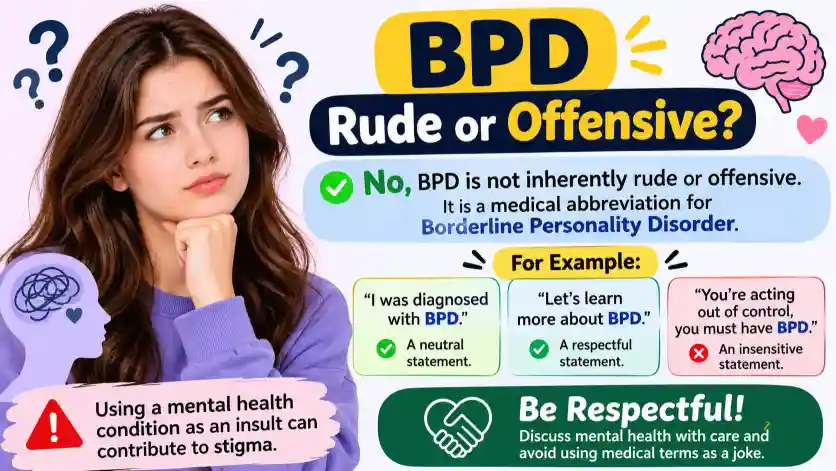
No, BPD is not inherently rude or offensive. It is a medical abbreviation for Borderline Personality Disorder.
However, the way someone uses it can be insensitive or hurtful.
For example:
- “I was diagnosed with BPD.” A neutral statement about a personal diagnosis.
- “Let’s learn more about BPD.” A respectful educational statement.
- “You’re acting out of control, you must have BPD.” An insensitive statement that makes an unsupported assumption.
Using a mental health condition as an insult or labeling someone without a diagnosis can contribute to stigma.
It is better to discuss mental health conditions respectfully and avoid using medical terms to describe someone’s personality as a joke.
Is BPD the Same as Bipolar Disorder?
No. Borderline Personality Disorder and Bipolar Disorder are two different mental health conditions.
People sometimes confuse them because both can involve changes in mood and emotional experiences. However, they have different diagnostic features.
| Term | Full Form | General Description |
| BPD | Borderline Personality Disorder | Involves difficulties with emotional regulation, self-image, impulsivity, and relationships |
| BD | Bipolar Disorder | Involves episodes of mania or hypomania and depression |
| ADHD | Attention-Deficit/Hyperactivity Disorder | Can involve differences in attention, activity, and impulse control |
| PTSD | Post-Traumatic Stress Disorder | Can develop after experiencing or witnessing a traumatic event |
Bipolar disorder is commonly abbreviated as BD, not BPD. Mood changes alone are not enough to determine which condition someone may have.
A qualified mental health professional can assess symptoms and provide an accurate diagnosis.
Who Uses BPD in Text Messages?
BPD can appear in conversations among people of different ages and backgrounds. Its use is not limited to one generation or social media platform.
Some common users include:
- Teenagers: May encounter BPD in social media discussions or mental health awareness content.
- Young adults: May use the abbreviation when discussing personal experiences, relationships, or mental health.
- Adults: May use BPD in conversations with friends, family, or healthcare professionals.
- Mental health communities: May use the abbreviation when sharing information, experiences, and support.
It is not specifically a Gen Z slang term. It is a recognized abbreviation that people use in both formal and informal discussions.
How to Understand BPD From Context
If someone sends you BPD and you are unsure what they mean, follow these simple steps.
1. Read the Complete Message
Look at the words before and after BPD. They can help you understand the topic.
2. Identify the Conversation
If the conversation involves therapy, emotions, mental health, or a diagnosis, BPD most likely refers to Borderline Personality Disorder.
3. Consider the Sender’s Intention
The person may be sharing a personal experience, asking for information, or discussing mental health awareness.
4. Ask for Clarification
If you are still unsure, ask:
“Are you referring to Borderline Personality Disorder?”
This is a simple and respectful way to avoid misunderstanding.
5. Avoid Making Assumptions
Never assume someone has BPD because of their mood, behavior, or a message. A diagnosis requires an assessment by a qualified professional.
Frequently Asked Questions
1. What does BPD mean in texting?
BPD most commonly means Borderline Personality Disorder in texting. People use it when discussing mental health, personal experiences, or emotional well-being.
2. What does BPD stand for?
BPD stands for Borderline Personality Disorder, a recognized mental health condition that can affect emotional regulation, self-image, behavior, and relationships.
3. Is BPD a slang word?
No. BPD is a medical abbreviation, not traditional internet slang. People may use it casually in text messages and social media conversations.
4. Does BPD mean bipolar disorder?
No. BPD stands for Borderline Personality Disorder, while bipolar disorder is commonly abbreviated as BD. They are different conditions.
5. Is BPD offensive to say?
No. BPD is a neutral medical abbreviation. However, using it as an insult or making assumptions about someone’s mental health can be hurtful and disrespectful.
6. What does BPD mean on TikTok?
On TikTok, BPD generally refers to Borderline Personality Disorder. It may appear in educational videos, personal stories, and mental health awareness content.
7. How should I reply when someone says they have BPD?
Respond with kindness and respect. You can say, “Thanks for trusting me with that” or “I’m here if you want to talk.” Avoid judging or making assumptions.
Conclusion
BPD means Borderline Personality Disorder in most mental health-related text messages and online conversations. It is a medical abbreviation rather than a traditional slang expression.
You may see it on TikTok, Snapchat, Instagram, WhatsApp, or in private messages when people discuss mental health, personal experiences, or emotional well-being.
Remember that BPD and bipolar disorder are different conditions, and the abbreviation should never be used to label or judge someone. Understanding the context and responding respectfully can help make online conversations more thoughtful.
Read More:
- What Does BQ Mean in Text? The Meaning Might Surprise You
- What Does BP Mean in Text? The Meaning Might Surprise You
- BOW Mean in Text: What Does It Really Stand For?

Hi, I’m Olivia Carter. I enjoy researching English slang, online expressions, and everyday vocabulary. I write clear, beginner-friendly guides with simple definitions and practical examples to make modern English easier to understand.