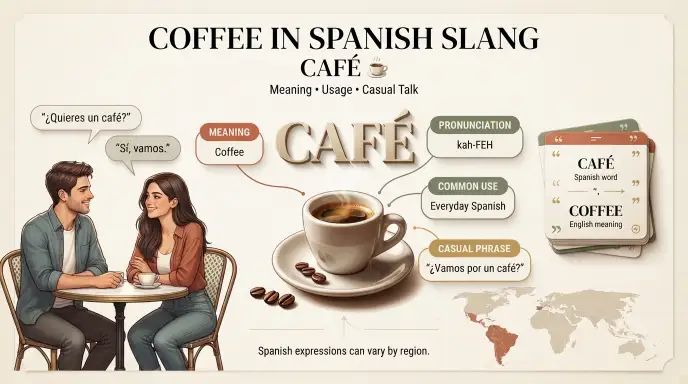
Coffee in Spanish Slang refers to the informal terms and regional variations used to order coffee across Spanish speaking countries, going beyond the basic word “café.”
Since day-to-day conversations rarely match textbook Spanish, learning terms like “cortado” (a small espresso with milk) or “café con leche” (coffee with steamed milk) makes ordering much easier.
These terms vary widely by region what’s called one thing in Spain might have a completely different name in Mexico or Colombia, reflecting each country’s unique coffee culture.
In this guide, you’ll learn popular Spanish coffee slang, regional variations, and how to confidently order your favorite coffee drink while traveling.
Quick Answer
The standard Spanish word for coffee is café. A common informal and affectionate form is cafecito, which means “little coffee” but often simply means a coffee in a friendly or casual way.
Other expressions can vary by country.
Word at a Glance
| Feature | Details |
| Standard Word | Café |
| Common Slang / Informal Form | Cafecito |
| Meaning | Coffee / a little coffee |
| Part of Speech | Noun |
| Pronunciation | Café: kah-FEH • Cafecito: kah-feh-SEE-toh |
| Tone | Casual, friendly |
| Common Contexts | Cafés, homes, texting, daily conversation |
| Language | Spanish |
What Does Coffee Mean in Spanish Slang?
The normal Spanish word for coffee is café.
In casual speech, many Spanish speakers may say cafecito. The ending -cito is a diminutive form. Literally, cafecito can mean “little coffee.”
However, it does not always mean that the coffee is physically small.
It can simply make the word sound:
- Friendly
- Warm
- Casual
- Affectionate
For example:
“¿Quieres un cafecito?”
This means:
“Do you want a coffee?”
The speaker is not necessarily talking about a tiny cup.
What Does Cafecito Mean?
Cafecito is one of the most useful informal words to know when learning how Spanish speakers talk about coffee.
It comes from:
café + -cito = cafecito
The -cito ending can add a softer or more affectionate feeling.
Example
“Voy por un cafecito.”
This means:
“I’m going to get a coffee.”
The phrase sounds casual and natural in many Spanish-speaking settings.
Common Spanish Slang and Informal Words for Coffee
Different Spanish-speaking communities may use different expressions.
Café
Café is the standard Spanish word for coffee.
Example:
“Quiero un café.”
Meaning: “I want a coffee.”
This word is understood throughout the Spanish-speaking world.
Cafecito
Cafecito is a casual and affectionate form of café.
Example:
“Vamos por un cafecito.”
Meaning: “Let’s go get a coffee.”
Cafecillo
Cafecillo can also mean a small or casual coffee in some Spanish varieties.
It is formed with another diminutive ending and may sound more natural in certain regions than others.
Example:
“Me voy a tomar un cafecillo.”
Meaning: “I’m going to have a little coffee.”
The exact popularity of this form depends on the region.
Regional Differences
Spanish is spoken across many countries, so coffee vocabulary can change from place to place.
Mexico
Café is the normal word for coffee. Cafecito is also a familiar casual form.
Spain
Speakers commonly use café, while diminutive forms such as cafecito may appear in casual speech depending on the speaker and region.
Colombia
Coffee is a major part of local culture, and café is the standard word. Informal forms such as cafecito can also be heard.
Argentina
Café is the standard word. The exact expression used can depend on the situation and local speech style.
Puerto Rico
Café and affectionate forms such as cafecito may be used in everyday conversations.
Because Spanish slang is regional, you should always consider who is speaking and where they are from.
How Do People Use Cafecito in Conversation?
Cafecito can appear in many everyday situations.
Asking Someone for Coffee
“¿Quieres un cafecito?”
English: “Do you want a coffee?”
Talking About a Morning Routine
“Necesito mi cafecito de la mañana.”
English: “I need my morning coffee.”
Meeting a Friend
“Vamos a tomar un cafecito.”
English: “Let’s have a coffee.”
Offering Coffee
“¿Te preparo un cafecito?”
English: “Shall I make you a coffee?”
These examples show how cafecito can make a simple sentence sound warmer and more casual.
Is Cafecito Slang, Informal, or Standard Spanish?
Cafecito is better described as an informal or affectionate form rather than strong slang.
It is created through a normal Spanish word-formation pattern. Spanish speakers often use diminutives to express smallness, affection, friendliness, or a softer tone.
So, if someone says cafecito, it does not automatically mean they are using street slang.
It is simply a natural casual expression in many Spanish-speaking communities.
Real-Life Examples
Example 1: Friends
Ana: “¿Quieres un cafecito?”
Luis: “Sí, por favor.”
English:
Ana: “Do you want a coffee?”
Luis: “Yes, please.”
Example 2: Morning
“Primero necesito mi cafecito.”
English: “First, I need my coffee.”
Example 3: Meeting a Friend
“Nos vemos para un cafecito.”
English: “Let’s meet for a coffee.”
Example 4: At Home
“Voy a preparar café.”
English: “I’m going to make coffee.”
Here, café is the standard word, while cafecito would sound more casual or affectionate.
Regional Coffee Expressions
Spanish coffee vocabulary can change by country. Café is understood almost everywhere, but local expressions may have different meanings.
Mexico
In Mexico, café is the standard word. Cafecito is also common in friendly conversation.
“¿Vamos por un cafecito?”
Meaning: “Shall we go get a coffee?”
Colombia
Café is the normal word. Because coffee is an important part of Colombian culture, you may hear many casual conversations about having or making coffee.
“Tomemos un cafecito.”
Meaning: “Let’s have a coffee.”
Spain
Café is standard. People may also use diminutives such as cafecito in casual speech.
Puerto Rico
Café is widely used, while cafecito can add a warm or familiar tone.
Argentina
Café is the standard term. The exact way people order coffee can vary based on the type of drink and local café culture.
Similar Spanish Words for Coffee
| Word or Phrase | Meaning | Tone |
| Café | Coffee | Standard |
| Cafecito | Coffee / little coffee | Friendly |
| Cafecillo | Little coffee | Informal |
| Tomar un café | Have a coffee | Everyday |
| Tomarse un cafecito | Have a coffee | Casual / warm |
| Ir por un café | Go get a coffee | Casual |
These expressions are not all slang. Some are simply normal Spanish phrases used in everyday speech.
Why Do Spanish Speakers Say Cafecito?
The ending -cito is a Spanish diminutive. It can make a word sound smaller, softer, friendlier, or more affectionate.
For example:
café → cafecito
The speaker may not mean a physically small cup.
Compare:
“Quiero café.”
This sounds direct:
“I want coffee.”
Now compare:
“Quiero un cafecito.”
This can sound warmer:
“I want a coffee.”
The difference is often about tone, not size.
Is Coffee Slang Different Across Spanish-Speaking Countries?
Yes. Spanish is spoken across many countries, and informal language can vary by region.
A word can be:
- Very common in one country
- Less common in another
- Unusual somewhere else
- Used with a different meaning in another region
That is why café is the safest word if you want to be understood everywhere.
If you want a friendly and casual expression, cafecito is widely recognizable.
When Should You Use Cafecito?
Cafecito works well in relaxed situations.
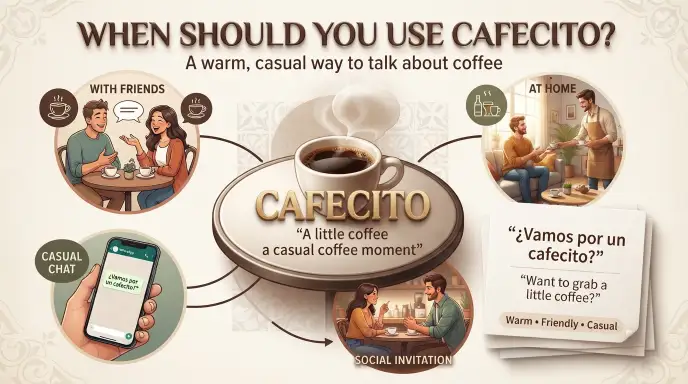
You can use it when:
- Talking with friends
- Inviting someone for coffee
- Talking about your morning coffee
- Ordering casually
- Posting about coffee on social media
- Speaking with family
For example:
“¿Tomamos un cafecito?”
This is a natural casual way to invite someone to have coffee.
When Should You Avoid Slang or Informal Coffee Words?
There is no major problem with cafecito, but formal situations may call for simpler language.
For example, in a formal business document, you might simply use:
“café”
instead of trying to sound informal.
Also, avoid assuming that every unusual coffee word is universal Spanish. Some expressions may be highly regional.
Common Misunderstandings
1. Cafecito Always Means a Small Coffee
Not necessarily. Cafecito literally suggests a small coffee, but it can simply mean coffee in a warm or friendly way.
2. Cafecito Is a Strong Slang Word
Not really. It is better described as an informal or affectionate diminutive.
3. Café Is Only Used in Spain
No. Café is the standard Spanish word for coffee across Spanish-speaking countries.
4. Every Spanish Country Uses the Same Coffee Expressions
No. Local vocabulary and ordering habits can vary.
5. Cafecito Has Only One Tone
Not always. It can sound friendly, affectionate, casual, or simply natural depending on the speaker and situation.
Frequently Asked Questions
1. What is coffee in Spanish slang?
The standard word is café. A common informal form is cafecito, which can mean coffee in a warm or friendly way.
2. What does cafecito mean?
Cafecito literally means “little coffee,” but people often use it simply to mean a coffee or some coffee.
3. Is cafecito Spanish slang?
It is more accurate to call cafecito an informal or affectionate form of café. It is created with a common Spanish diminutive ending.
4. How do you say “let’s get coffee” in Spanish?
A common casual phrase is:
“Vamos por un café.”
You can also say:
“Vamos por un cafecito.”
The second version sounds warmer and more casual.
5. How do you say “coffee” in Spanish?
Café is the standard Spanish word for coffee.
6. Is cafecito used in all Spanish-speaking countries?
It is widely understood, but local usage can vary. Spanish expressions are often different across countries and regions.
7. What does “un cafecito” mean?
“Un cafecito” usually means “a coffee” in a friendly or affectionate way. It does not always mean a very small coffee.
Conclusion
The most common answer to coffee in Spanish slang is cafecito when you want a casual, warm, or affectionate form of café.
The standard Spanish word remains café, and it is understood across Spanish-speaking countries. Cafecito adds a softer and more friendly feeling, so you may hear it when friends meet for coffee, someone offers a drink, or a person talks about their morning routine.
Because Spanish changes by region, local coffee terms can vary. When in doubt, café is the safest and most universal choice.
Read More:
- What Is PTSO Slang: Confused by This Comment? Read This
- Rail Slang: Sound Like a True Railroad Insider
- Brodie Slang: The Word for a Close Friend Explained

Hi, I’m Olivia Carter. I enjoy researching English slang, online expressions, and everyday vocabulary. I write clear, beginner-friendly guides with simple definitions and practical examples to make modern English easier to understand.