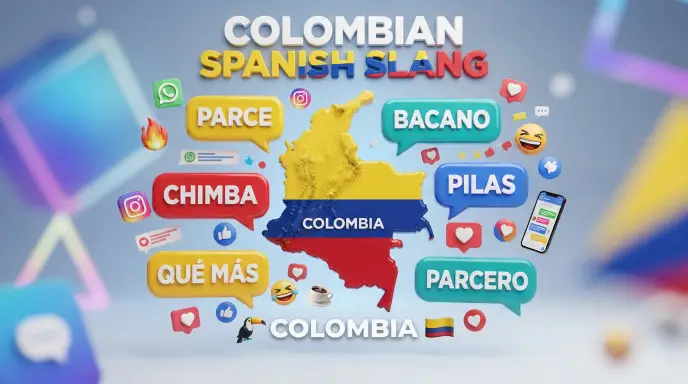
Colombian Spanish Slang refers to the unique informal words and expressions used across Colombia, such as “parce” (friend), “chevere” (cool), and “que pena” (excuse me/I’m sorry), that reflect the country’s distinct culture and personality.
These expressions vary by region, with cities like Bogotá, Medellín, and the Caribbean coast each adding their own local flavor to everyday conversation.
Learning this slang helps travelers, language learners, and Spanish speakers better connect with locals and understand the warmth and humor embedded in Colombian culture.
In this guide, you’ll discover the most popular Colombian Spanish slang words, their meanings, and how to use them naturally in conversation.
Quick Answer
Colombian Spanish slang refers to the informal words and expressions commonly used in Colombia. Popular examples include parce (friend), bacano (cool or awesome), chévere (great), berraquera (strength or determination), and qué más (what’s up?).
Word at a Glance
| Feature | Details | Usage |
| Word | Colombian Spanish Slang | Informal Colombian expressions |
| Part of Speech | Phrase | Refers to slang words used in Colombia |
| Pronunciation (US & UK) | /kəˈlʌmbiən ˈspænɪʃ slæŋ/ | Standard English pronunciation |
| Common Meaning | Informal words and phrases used in Colombia | Everyday conversations |
| Tone | Friendly and casual | Used among friends, family, and online |
| Related Words | Parce, Bacano, Chévere, Qué Más, Vaina | Common Colombian slang |
What Is Colombian Spanish Slang?
Colombian Spanish slang includes the everyday expressions that people in Colombia use instead of formal Spanish.
These words often vary by region, but many are understood throughout the country. Learning a few common expressions can help you communicate more naturally with Colombian Spanish speakers.
Examples
- “¡Qué más, parce!” (What’s up, friend!)
- “Esa película estuvo bacana.” (That movie was awesome.)
- “Todo bien, gracias.” (Everything’s good, thanks.)
Common Colombian Spanish Slang Words
Here are some of the most popular slang words you’ll hear in Colombia.
Parce
Meaning: Friend, buddy, or pal.
Example:
“Hola, parce. ¿Cómo estás?”
(Hi, buddy. How are you?)
Bacano
Meaning: Cool, awesome, or great.
Example:
“Ese restaurante es bacano.”
(That restaurant is awesome.)
Chévere
Meaning: Nice, cool, or excellent.
Example:
“¡Qué chévere!”
(How cool!)
Qué Más
Meaning: What’s up? or How’s it going?
Example:
“¡Qué más!”
(What’s up!)
Vaina
Meaning: Thing, stuff, situation, or problem.
Example:
“¿Qué es esa vaina?”
(What’s that thing?)
Where Is Colombian Spanish Slang Commonly Used?
Colombian Spanish slang is used in everyday life across Colombia. You’ll hear these expressions in conversations with friends, on social media, in music, movies, and television.
In Everyday Conversations
Most Colombians use slang naturally when speaking with friends and family.
Example:
A: “¡Qué más, parce?”
B: “Todo bien.”
(A: “What’s up, buddy?” B: “Everything’s good.”)
On Social Media
Colombian users often include slang in captions, comments, and direct messages.
Example:
“¡Qué foto tan bacana!”
(What an awesome photo!)
In Colombian Music
Many Colombian singers include local slang in their songs to sound authentic and relatable.
Example:
You may hear words like parce, bacano, and chévere in pop, reggaeton, and urban music.
In TV Shows and Movies
Colombian films and television series frequently use local slang to reflect everyday speech.
This helps viewers understand the personalities and backgrounds of different characters.
While Traveling in Colombia
Knowing a few slang expressions can make it easier to communicate with locals and understand casual conversations.
Is Colombian Spanish Slang Rude, Offensive, or Harmless?
Most Colombian Spanish slang is friendly and harmless.
However, like any language, some expressions may be informal or offensive depending on the context.
| Slang | Tone | Meaning |
| Parce | ✅ Friendly | Friend or buddy |
| Bacano | ✅ Positive | Cool or awesome |
| Chévere | ✅ Positive | Great or nice |
| Qué Más | ✅ Casual | What’s up? |
| Vaina | ✅ Informal | Thing or situation |
When speaking with teachers, employers, or in formal situations, standard Spanish is usually a better choice.
Real-Life Examples of Colombian Spanish Slang
Friends
A: “¡Qué más, parce!”
B: “Todo bien. ¿Y tú?”
(A: “What’s up, buddy?” B: “All good. And you?”)
At a Café
“Este café está bacano.”
(This coffee is great.)
Social Media
“¡Qué viaje tan chévere!”
(What an amazing trip!)
Family Conversation
“¿Qué es esa vaina?”
(What’s that thing?)
Everyday Chat
“Ese concierto estuvo bacanísimo.”
(That concert was amazing.)
Did You Know?
Colombia is home to many regional accents, so slang can vary from one city to another. For example, parce is especially common in Medellín, while other regions may prefer different local expressions. Even so, many Colombian slang words are now recognized across the country thanks to music, television, and social media.
Origin and History of Colombian Spanish Slang
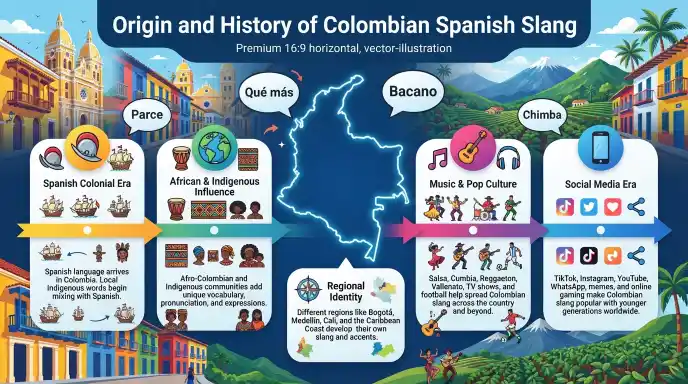
Colombian Spanish slang has developed over hundreds of years through the country’s rich cultural history. It combines Spanish, Indigenous languages, African influences, and regional traditions to create unique words and expressions.
As different regions of Colombia developed their own identities, local slang also evolved. Cities such as Bogotá, Medellín, Cali, Barranquilla, and Cartagena each have expressions that reflect their local culture and way of speaking.
In recent decades, Colombian music, television, movies, and social media have introduced many of these slang words to people around the world. Today, expressions like parce, bacano, and chévere are recognized by many Spanish learners and Latin American Spanish speakers.
More Popular Colombian Spanish Slang Words
Here are more everyday slang words and phrases commonly heard in Colombia.
| Slang | Meaning |
| Parcero (Parcera) | Close friend |
| Rumba | Party |
| Guaro | Aguardiente (a popular Colombian alcoholic drink) |
| Mono (Mona) | Blonde person or someone with light hair |
| Camellar | To work hard |
| Jartera | Boredom or annoyance |
| Pilas | Be careful or pay attention |
| Lucas | Money |
| Chino (China) | Boy or girl (informal) |
| Dar Papaya | To make yourself an easy target or take unnecessary risks |
These expressions are commonly used in casual conversations throughout Colombia.
Why Do People Use Colombian Spanish Slang?
People use Colombian Spanish slang because it makes conversations sound more natural and friendly.
Common reasons include:
- Talking with friends and family.
- Expressing local identity.
- Sounding more like a native speaker.
- Understanding Colombian music and TV shows.
- Making everyday conversations more relaxed.
Learning a few slang expressions can also help visitors connect more easily with local people.
Common Misunderstandings About Colombian Spanish Slang
Not Every Colombian Uses the Same Slang
Colombia has many different regions, and some slang words are only common in certain cities or departments.
Some Words Have Different Meanings
A slang word may have one meaning in Colombia and a completely different meaning in another Spanish-speaking country.
Always pay attention to the context.
Slang Is Different From Standard Spanish
Slang is best used in casual conversations.
For formal situations, schools, business meetings, or official documents, standard Spanish is more appropriate.
When Should You Avoid Using Colombian Spanish Slang?
Although Colombian slang is fun to learn, it’s better to avoid it in:
- Business meetings.
- Job interviews.
- Academic writing.
- Official documents.
- Professional presentations.
Using standard Spanish in formal situations helps you communicate clearly and respectfully.
Frequently Asked Questions
1. What is Colombian Spanish slang?
Colombian Spanish slang refers to the informal words and expressions people in Colombia use in everyday conversations. These words help speakers sound more natural and are an important part of Colombian culture.
2. What does parce mean in Colombian slang?
Parce means friend, buddy, or pal. It is one of the most common and recognizable slang words in Colombia.
Example:
“¡Hola, parce!” (Hi, buddy!)
3. What does bacano mean in Colombia?
Bacano means cool, awesome, or great. Colombians use it to describe something they really like.
Example:
“La comida estuvo bacana.” (The food was awesome.)
4. What does chévere mean in Colombian Spanish?
Chévere means cool, nice, or excellent. It is commonly used to express approval or excitement.
5. What does qué más mean?
Qué más is a casual greeting that means “What’s up?”, “How’s it going?”, or “How are you?”
6. Is Colombian Spanish different from Mexican Spanish?
Yes. While both use standard Spanish grammar, they have different accents, pronunciation, and slang words. Many Colombian expressions are unique to Colombia.
7. Is Colombian Spanish easy to understand?
Yes. Many language learners find Colombian Spanish, especially the accent spoken in Bogotá, to be clear and easy to understand.
8. What are some common Colombian slang words?
Some popular Colombian slang words include:
- Parce
- Parcero
- Bacano
- Chévere
- Vaina
- Pilas
- Lucas
- Rumba
- Guaro
- Dar Papaya
These expressions are commonly heard in everyday conversations.
9. Is Colombian slang used on social media?
Yes. Colombian slang is widely used on TikTok, Instagram, Facebook, X, YouTube, and in text messages.
10. Can I use Colombian slang while traveling?
Yes. Learning a few common expressions like parce, bacano, and qué más can help you communicate more naturally with locals and make your trip more enjoyable.
11. Does every region in Colombia use the same slang?
No. Colombia has many regional dialects, so some slang words are more common in cities like Medellín, Bogotá, or Cali than in other parts of the country.
12. Should I use Colombian slang in formal situations?
It’s better to avoid slang in business meetings, academic writing, or official conversations. Use standard Spanish in formal settings and save slang for casual conversations.
Conclusion
Colombian Spanish slang is a fun and important part of everyday communication in Colombia. Words like parce, bacano, chévere, and qué más help conversations sound natural and friendly. Whether you’re learning Spanish, planning a trip to Colombia, or simply curious about Latin American culture, understanding these expressions will make it easier to connect with native speakers and enjoy authentic conversations.
Read More:
- BFR Slang: Decoding This Viral Social Media Term
- Foo Slang Explained: From 90s Culture to Today
- Cray Meaning Slang: The Real Meaning Behind This Popular Word
- GOATED Slang Meaning: Popular Use in Sports and Social Media

Hi, I’m Olivia Carter. I enjoy researching English slang, online expressions, and everyday vocabulary. I write clear, beginner-friendly guides with simple definitions and practical examples to make modern English easier to understand.