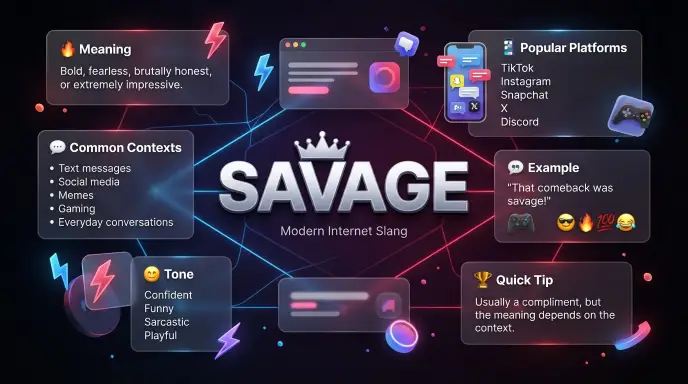
Savage is slang used to describe someone who is bold, fearless, or brutally honest often meant as a compliment for being unapologetically confident or cleverly ruthless.
While the word traditionally meant wild or uncivilized, its modern slang usage flipped the meaning into something positive, especially in pop culture and social media.
The term exploded in popularity through hip-hop, memes, and viral moments where someone’s clever comeback or bold action was labeled “savage.”
In this guide, you’ll learn the true modern meaning of “savage,” how it evolved, and how it’s commonly used in everyday conversations today.
Quick Answer
Savage slang means someone who is bold, fearless, brutally honest, or does something extremely impressive or funny. Online, it is often used as a compliment for a clever comeback or confident action.
What Does Savage Slang Mean in Text?
In text messages and online conversations, savage is used to describe a person, comment, joke, or action that is unusually bold or intense.
When someone says:
“That reply was savage.”
They usually mean the reply was sharp, funny, and powerful. It may have surprised others or perfectly answered a situation.
The meaning is not always negative. On platforms like TikTok, Instagram, Reddit, and X, people often use savage as praise when someone makes a clever response or shows confidence.
Examples:
- “Her comeback was savage.”
- “That roast was savage.”
- “He made a savage move.”
In these examples, savage means impressive, fearless, or entertaining.
Word at a Glance
| Feature | Details |
| Word | Savage |
| Part of Speech | Adjective / Noun |
| Pronunciation | US: /ˈsævɪdʒ/ |
| Common Meaning | Bold, fearless, brutally honest, or impressive |
| Tone | Usually playful, but can be negative |
| Common Contexts | Texting, memes, social media, jokes, conversations |
| Related Words | Bold, fearless, ruthless, intense, fearless |
Savage Slang Full Form / Definition
Savage does not have a full form because it is not an abbreviation.
The slang meaning developed from the original word savage, which traditionally described something wild, rough, or uncontrolled. Over time, internet culture changed the meaning.
Today, savage slang often describes:
- A person who is extremely confident.
- A comment that is brutally honest.
- A joke that is unexpectedly strong.
- An action that shows courage or attitude.
The modern slang meaning depends on the situation. A savage comment can be funny and admired, but a savage action can also be seen as too harsh.
What Does Savage Stand For?
Savage does not stand for a specific phrase or acronym.
Some internet users may create jokes or fake meanings for words, but savage is a normal word that gained a new slang meaning through online culture.
The modern slang use focuses on confidence, humor, boldness, and strong reactions.
Is Savage Slang Rude, Offensive, or Neutral?
Savage slang is usually neutral or positive, but the meaning depends on the context.
When used as a compliment:
- “That comeback was savage.”
- “She is savage in debates.”
It means someone is confident, clever, or impressive.
However, it can sound negative when describing cruel or disrespectful behavior:
- “That comment was savage.”
In this case, it may mean the comment was too harsh.
The tone, situation, and relationship between people decide if savage sounds funny or offensive.
Where Is Savage Slang Commonly Used?
Savage slang is widely used in online and casual conversations.
Common places include:
- TikTok
- X
- YouTube comments
- Text messages
- Gaming communities
People often use savage when reacting to:
- Funny videos
- Clever replies
- Roasting battles
- Memes
- Competitive moments
For example:
A person posts a funny comeback, and someone comments:
“Savage!”
Here, the person is showing approval and saying the comeback was impressive.
Why Do People Use Savage Slang?
People use savage slang because it quickly expresses strong emotions. Instead of saying someone was “very confident” or “extremely funny,” they can simply say “savage.”
Common reasons people use this slang include:
- To praise a clever response.
- To react to funny content.
- To show excitement.
- To describe confidence.
- To add humor to conversations.
The word became popular because it is short, memorable, and works well in online communication.
Social media helped spread the slang meaning because users often react quickly to entertaining or surprising content.
Real-Life Examples of Savage Slang
Savage slang can have different meanings based on the situation. It can describe a funny response, a confident action, or behavior that feels too harsh. The tone helps people understand the real meaning.
Friendly Examples
In friendly conversations, savage is often used as a compliment. It shows that someone did something impressive or funny.
Examples:
- “Your reply was savage. Everyone loved it.”
- “That joke was savage but hilarious.”
- “She gave the perfect comeback. So savage!”
- “His confidence is savage today.”
These examples show admiration and excitement.
Casual Examples
People often use savage casually when talking about online posts, jokes, or everyday moments.
Examples:
- “That meme is savage.”
- “He roasted his friend with a savage comment.”
- “That was a savage move during the game.”
- “The ending of that video was savage.”
The word adds energy and shows that something was surprising or powerful.
Argumentative Examples
Savage can also appear during arguments or debates. In these situations, it may describe a strong or harsh response.
Examples:
- “That answer was savage, but it was true.”
- “Her response was savage during the debate.”
- “He made a savage comment about the situation.”
- “That comeback was too savage.”
Here, savage may sound negative if the response hurts someone.
Gaming and Social Media Examples
Savage slang is very common in gaming and online communities. Players often use it when someone makes an impressive move or defeats an opponent.
Examples:
- “That final move was savage.”
- “He destroyed the competition. Savage!”
- “That player made a savage comeback.”
- “The team had a savage victory.”
On platforms like TikTok, Instagram, Reddit, Discord, and YouTube, users often use savage as a reaction word.
Origin and Background of Savage Slang
The word savage originally described something wild, untamed, or violent. It was often used to describe people, animals, or actions that were considered uncontrolled.
Over time, popular culture changed the meaning. Music, movies, comedy, and internet communities helped turn savage into a slang term for someone who is bold, fearless, or impressive.
The modern slang meaning became especially popular through:
- Social media memes
- Comedy videos
- Roasting culture
- Rap and hip-hop discussions
- Online comments
Today, many people use savage in a playful way. It often celebrates confidence instead of describing actual violence or cruelty.
Comparison With Similar Slang
Savage slang is similar to other words used to describe confidence, humor, or strong behavior. However, each word has a slightly different feeling.
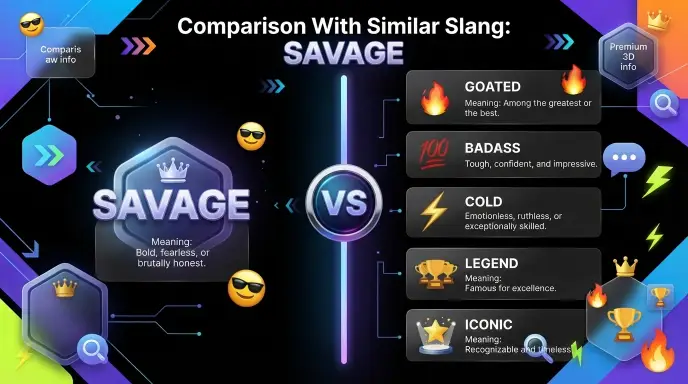
For example:
- Savage means bold, ruthless, or impressively direct.
- Badass mean tough, confident and impressive.
- Fire means excellent or exciting.
- Legendary means extremely impressive.
- Witty means clever and funny.
The main difference is that savage often includes an element of surprise or intensity.
Key Differences
| Slang Word | Meaning | Tone |
| Savage | Bold, fearless, or brutally honest | Strong and intense |
| Fire | Excellent or amazing | Positive |
| Brutal | Very honest or harsh | Can be negative |
| Legendary | Extremely impressive | Positive |
| Witty | Clever and funny | Positive |
Comparison Table
| Term | Common Meaning | Example |
| Savage | A bold or powerful action/comment | “That comeback was savage.” |
| Ruthless | Showing no mercy | “The player was ruthless.” |
| Fire | Something amazing | “That song is fire.” |
| Bold | Confident and fearless | “That was a bold decision.” |
| Brutal | Extremely honest or harsh | “That review was brutal.” |
When to Avoid Using Savage Slang
Although savage is often positive, it does not fit every situation.
Avoid using it when:
- Speaking in formal settings.
- Talking about serious problems.
- Giving professional feedback.
- Communicating with people who may not know the slang meaning.
For example, calling a serious comment “savage” may make the situation sound less respectful.
It is also important to avoid using savage to praise harmful behavior. A confident action and a hurtful action are not the same.
Polite Alternatives for Savage Slang
If you need a more professional or clear word, you can use these alternatives:
| Savage Slang | Polite Alternative |
| Savage comeback | Clever response |
| Savage move | Bold decision |
| Savage comment | Strong comment |
| Savage person | Confident person |
| Savage reaction | Powerful reaction |
These alternatives keep the meaning clear in formal conversations.
Impact of Using Savage Slang in Communication
Savage slang can make conversations more expressive and entertaining. It helps people quickly show excitement, approval, or surprise.
Positive effects include:
- Making online conversations more fun.
- Showing appreciation for humor.
- Creating a casual connection.
- Expressing strong reactions quickly.
However, the word can also create confusion because some people may understand it as negative or aggressive.
Using savage correctly depends on the audience, tone, and situation.
Is Savage Slang Safe for Social Media?
Yes, savage slang is generally safe for social media when used in the right context.
People commonly use it in:
- TikTok comments
- Instagram captions
- YouTube reactions
- Reddit discussions
- Discord chats
- Gaming communities
Examples:
- “That comeback was savage 😂”
- “Savage reply!”
- “This video is savage.”
However, users should remember that text does not always show tone clearly. A joke that feels funny to one person may sound rude to another.
Using savage in a playful way is usually accepted online, but using it to attack someone can create problems.
Frequently Asked Questions About Savage Slang
1. What does savage slang mean?
Savage slang means someone or something that is bold, fearless, brutally honest, or extremely impressive. On social media, it is often used to praise a funny comeback or confident action.
2. Is savage slang a bad word?
No, savage slang is not always a bad word. It is usually positive when people use it to praise humor, confidence, or a clever response. However, it can sound negative if it describes cruel or disrespectful behavior.
3. What does savage mean in texting?
In texting, savage usually means a strong, funny, or unexpected response. People often use it after seeing a clever comeback, joke, or impressive action.
4. Where is savage slang commonly used?
Savage slang is common on TikTok, Instagram, Reddit, YouTube, Discord, gaming communities, and text messages. People often use it in reactions, comments, and memes.
5. Can savage be used as a compliment?
Yes. Many people use savage as a compliment. For example, saying “That reply was savage” usually means the reply was smart, funny, and powerful.
6. Is savage slang still popular?
Yes. Savage slang is still commonly used online, especially in memes, social media comments, and casual conversations. Its popularity comes from its strong and expressive meaning.
Conclusion
Savage slang is a modern expression used to describe something bold, fearless, funny, or surprisingly powerful. The meaning depends on the situation and tone. In many online conversations, calling someone savage is a compliment that shows admiration for a clever response or confident action.
The word can also describe behavior that feels too harsh, so understanding the context is important. People commonly use savage slang on social media, in texting, and during casual conversations.
Using savage correctly can make communication more expressive and fun. However, it is always better to consider the audience before using slang, especially in serious or professional situations.
Related Articles:
- What Does Adidas Stand For Slang: The Truth Will Surprise You
- Squid Slang Meaning: Everything Explained in One Guide
- Slang for Brother: Fun & Popular Terms People Actually Use
- What Does RD Mean Slang: Stop Guessing, Start Knowing

Hi, I’m Olivia Carter. I enjoy researching English slang, online expressions, and everyday vocabulary. I write clear, beginner-friendly guides with simple definitions and practical examples to make modern English easier to understand.