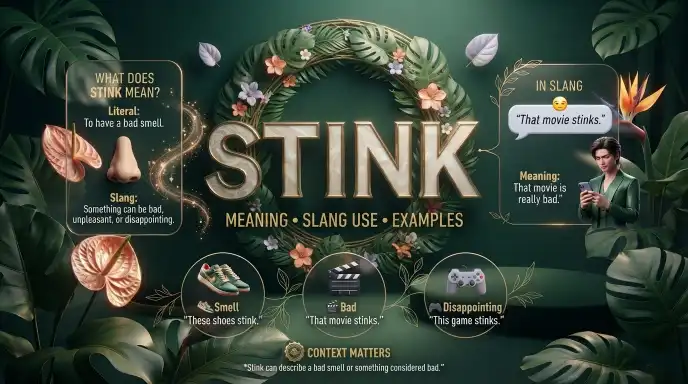
“Stink” in slang carries several meanings depending on context it can be an affectionate nickname for a close friend or partner, mean being bad at something, or simply describe an unpleasant odor.
Said between couples or close friends, “stink” often becomes a term of endearment, similar to calling someone “babe” or “boo,” with zero connection to actual smell.
In sports or casual conversation, “you stink” typically means you’re not good at something, a lighter alternative to harsher put-downs.
In this guide, you’ll learn the different meanings of “stink” in slang, how tone changes its interpretation, and how to tell which one applies.
Quick Answer
Stink in slang means to be very bad, unpleasant, or disappointing. When someone says “you stink,” they may mean that you are bad at something, not that you smell bad.
Word at a Glance
| Feature | Details |
| Word | Stink |
| Type | Slang / Informal expression |
| Part of Speech | Verb / Noun |
| Pronunciation | stink |
| Common Slang Meaning | To be very bad or unpleasant |
| Tone | Casual, critical, or teasing |
| Common Contexts | Sports, gaming, music, social media |
| Related Words | Suck, awful, terrible, lousy |
What Does Stink Mean in Slang?
In casual slang, stink can mean that something is bad, disappointing, or unpleasant.
For example:
“That movie stinks.”
This means the speaker thinks the movie is very bad.
Another example is:
“I stink at basketball.”
Here, the speaker means they are not good at basketball.
So, the slang meaning can describe either the quality of something or someone’s ability.
What Does “You Stink” Mean?
When someone says:
“You stink.”
They may mean “You are bad at this” or “You are doing a poor job.”
For example:
“You stink at chess.”
This means:
“You are very bad at chess.”
Friends may also say “you stink” jokingly after someone makes a mistake.
The tone matters. A playful comment between friends may not be intended as a serious insult.
What Does “That Stinks” Mean?
“That stinks” usually means “That is disappointing” or “That is unfortunate.”
Example:
“You missed the concert? That stinks.”
Here, the speaker is not saying that the concert smells bad. They are expressing sympathy or disappointment.
This is a very common informal use of the word.
Stink vs. Smell
The words stink and smell are related, but they do not always have the same tone.
Smell is neutral:
“The flowers smell nice.”
Stink usually suggests a bad or unpleasant smell:
“The garbage stinks.”
In slang, stink can go beyond smell and mean that something is simply bad.
“That game stinks.”
Is Stink a Rude Word?
Stink is usually mild slang.
Calling someone “stink” or saying “you stink” can sound insulting, especially if you are criticizing their ability.
However, the expression is not normally considered a strong swear word.
The tone can range from:
- Playful
- Teasing
- Critical
- Annoyed
- Insulting
Context determines how harsh it sounds.
Real-Life Examples of Stink Slang
The slang use of stink often appears when people describe something as bad, disappointing, or unpleasant. It can also describe someone who is not good at a particular activity.
Everyday Examples
People may use stink casually in daily conversations.
- “That movie stinks.”
- “This weather stinks.”
- “That restaurant really stinks.”
- “Missing the party stinks.”
- “This old computer stinks.”
In these examples, stink means something is bad, disappointing, or unpleasant.
Sports Examples
Sports fans often use stink to criticize poor performance.
- “Our team stinks this season.”
- “He stinks at basketball.”
- “They really stunk up the game.”
- “I stink at football.”
- “That defense stinks.”
Here, the word usually means performing badly.
Gaming Examples
Gamers may use stink when someone performs poorly.
- “I stink at this game.”
- “Our team stinks today.”
- “That player stinks.”
- “This update stinks.”
- “I really stunk that round.”
The expression can be serious criticism or friendly teasing.
Social Media Examples
You may see stink used in posts, comments, and casual online conversations.
- “That movie stinks 😂”
- “This update stinks.”
- “Missing the concert really stinks.”
- “Bro, you stink at this game.”
- “That ending stunk.”
The surrounding words and emojis often show if the comment is playful or serious.
What Does “That Stinks” Mean?
“That stinks” is a common informal expression for “That is unfortunate” or “That is disappointing.”
Example:
“My flight got canceled.”
“Oh, that stinks.”
The speaker is showing sympathy. They are not necessarily talking about an unpleasant smell.
What Does “You Stink” Mean?
“You stink” can mean “You are bad at something.”
For example:
“You stink at tennis.”
This means the person is not good at tennis.
Friends may also use the phrase jokingly:
“You beat me again? You stink!”
In this case, the speaker may be teasing rather than seriously insulting the other person.
What Does “Stink at Something” Mean?
“Stink at” means to be very bad at an activity or skill.
Examples:
- “I stink at math.”
- “She stinks at cooking.”
- “He stinks at video games.”
- “They stink at basketball.”
It is an informal way to admit or point out poor performance.
What Does “Stunk” Mean in Slang?
Stunk is the past tense of stink.
In casual speech, it can mean that something was very bad or disappointing.
Example:
“The movie stunk.”
This means:
“The movie was really bad.”
Another example:
“I stunk at the game yesterday.”
This means:
“I performed very badly yesterday.”
What Does “Stink Up” Mean?
Stink up can mean to make something bad or to perform very poorly.
In sports and entertainment, someone might say:
“The team stunk up the game.”
This means the team played very badly.
The phrase can also have its literal meaning of making a place smell bad.
Origin and Background of Stink Slang
The word stink has a long history in English. Its basic meaning is to produce or have an unpleasant smell.
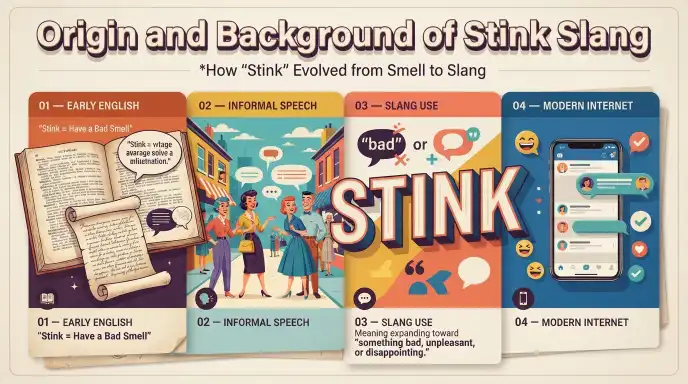
Over time, English speakers began using the idea of a bad smell as a comparison for something bad.
This led to expressions such as:
- “That stinks.”
- “You stink at it.”
- “The team stinks.”
- “That movie stunk.”
The slang use is therefore connected to the word’s older literal meaning.
Comparison With Similar Slang
| Expression | Meaning | Tone |
| Stink | Be bad or unpleasant | Mild / casual |
| Suck | Be very bad | Casual / stronger |
| Suck at | Be bad at something | Informal |
| Lousy | Poor or bad | Mild |
| Terrible | Very bad | Neutral |
| Trash | Very poor quality | Informal |
These words can overlap, but they do not always have the same tone.
Stink vs. Suck
Stink and suck can both mean that something is bad.
“This game stinks.”
“This game sucks.”
Both express strong dislike.
However, suck can sound more blunt or vulgar in some situations, while stink is generally milder.
When Should You Use Stink Slang?
Stink works best in casual settings.
You can use it when talking with:
- Friends.
- Family.
- Gaming groups.
- Social media followers.
- People you know well.
It is less suitable for formal writing.
When to Avoid Stink Slang
Avoid phrases like “you stink” in professional situations because they can sound insulting.
Be careful when speaking to:
- Teachers.
- Employers.
- Clients.
- Customers.
- People you do not know.
Instead of saying:
“Your work stinks.”
You could say:
“Your work needs improvement.”
This sounds much more professional.
Is Stink Safe for Social Media?
Yes. Stink is generally mild slang and is commonly used in casual social media conversations.
Still, phrases such as “you stink” can sound insulting if directed at another person.
If you are joking with friends, the meaning may be harmless. In public comments, however, it is better to consider how the other person may interpret it.
Frequently Asked Questions About Stink Slang
1. What does stink mean in slang?
In slang, stink can mean that something is very bad, unpleasant, disappointing, or low-quality. It can also mean that someone is not good at something.
2. What does “that stinks” mean?
“That stinks” usually means “That is unfortunate” or “That is disappointing.”
Example:
“My trip was canceled.”
“Oh, that stinks.”
3. What does “you stink” mean?
“You stink” can mean “You are bad at something.”
For example:
“You stink at tennis.”
This means the person is not good at tennis.
4. Is stink a bad word?
No. Stink is not normally considered a swear word. It is a mild informal expression, although saying “you stink” can sound insulting.
5. What does “stink at” mean?
“Stink at” means to be very bad at an activity or skill.
Example:
“I stink at drawing.”
This means the speaker is not good at drawing.
6. What does “stunk” mean in slang?
Stunk is the past tense of stink. In casual speech, it can mean that something was very bad.
Example:
“The movie stunk.”
This means the movie was very bad.
7. What does “stink up” mean?
Stink up can mean to perform very badly or make something unpleasant.
Example:
“The team stunk up the game.”
This means the team played very poorly.
8. Can stink be used jokingly?
Yes. Friends often use stink as playful teasing.
Example:
“You stink at this game!”
If the speakers are friends, the statement may be humorous rather than a serious insult.
9. Is “stink” the same as “suck”?
They can have a similar meaning when describing something bad.
“This movie stinks.”
“This movie sucks.”
Both mean the speaker thinks the movie is bad. Stink is generally a little milder.
10. Is stink used on social media?
Yes. People use stink in comments, posts, memes, gaming conversations, and casual messages.
Examples include:
- “That update stinks.”
- “This game stinks.”
- “That really stinks.”
- “I stink at this.”
Common Mistakes With Stink Slang
Mistake 1: Assuming It Always Refers to Smell
Stink can have a figurative meaning.
“That movie stinks.”
This usually means the movie is bad, not that it smells.
Mistake 2: Assuming “You Stink” Always Means You Smell Bad
The phrase can mean someone is bad at an activity.
“You stink at basketball.”
Mistake 3: Using It in Formal Communication
“Your work stinks” sounds rude and unprofessional.
Use:
“Your work needs improvement.”
instead.
Mistake 4: Ignoring Tone
Friends may use “you stink” as a joke, while the same words from a stranger can sound insulting.
Stink in Different Contexts
| Context | Meaning |
| “The garbage stinks.” | Has a bad smell |
| “That movie stinks.” | The movie is very bad |
| “You stink at chess.” | You are bad at chess |
| “That stinks.” | That is unfortunate |
| “The team stunk.” | The team performed badly |
| “He stunk up the game.” | He performed very poorly |
Is Stink Appropriate for Everyday Conversation?
Yes, stink is common in informal speech. It is generally less harsh than many stronger slang words.
Still, phrases directed at another person can sound rude.
For friendly conversations, “that stinks” is usually harmless.
For professional conversations, clearer and more polite language is better.
Conclusion
Stink meaning slang usually describes something that is bad, disappointing, unpleasant, or low-quality. It can also describe someone who performs poorly at a particular activity.
Common expressions include “that stinks,” “you stink,” “stink at,” “stunk,” and “stink up.” The meaning changes slightly depending on how the phrase is used.
The word can also have its literal meaning of having a bad smell, so context is important.
Overall, stink is mild and common informal slang, but phrases such as “you stink” can sound insulting when directed at someone. For formal communication, use clearer and more polite words instead.
Read More:
- Docking Slang: Why Your Paycheck Might Come Up Short
- Jamaican Slang Bumbaclot: Shock, Anger, or Meme Caption?
- Rosebud Slang: The Symbol That Still Means Something

Hi, I’m Olivia Carter. I enjoy researching English slang, online expressions, and everyday vocabulary. I write clear, beginner-friendly guides with simple definitions and practical examples to make modern English easier to understand.