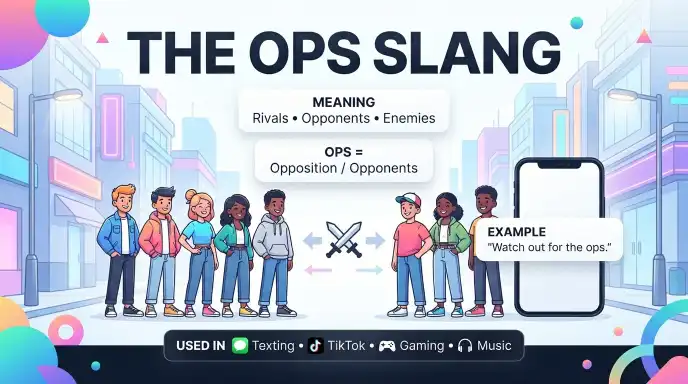
The Ops is slang short for “opposition,” used to describe enemies, rivals, or people working against you if in real street rivalries, gaming lobbies, or playful online drama.
Originating in street culture, drill music, and hip-hop, the term has since spread widely through TikTok, Discord, and gaming communities, where its tone can shift from genuinely serious to lighthearted teasing.
Someone might say “the ops are watching” about real rivals, or jokingly call online haters “ops” ontext and tone determine how seriously the word is meant.
In this guide, you’ll learn the true meaning of “the ops,” its cultural origin, and how to tell if it’s being used seriously or just for fun.
Quick Answer: What Does “The Ops” Mean?
“The ops” means the opposition, rivals, or people who are against someone. It is usually the plural form of opp, a slang word connected to “opponent” or “opposition.” Depending on context, it can mean serious enemies or simply people someone dislikes or competes with.
Example:
“I saw the ops at the party.”
This can mean: “I saw the people who are against me or my group at the party.”
What Does the Ops Slang Mean?
The the ops slang phrase usually points to a group of rivals or opponents.
In simple terms:
- The ops = the opposition
- The ops = rivals
- The ops = enemies
- The ops = people on the other side
- In casual online use, the ops can also mean people someone dislikes
The exact strength of the word depends on the situation. Someone might call a rival team “the ops” in a video game. Another person might use it in a much more serious discussion about real conflict.
That difference matters.
What Does “Opp” Stand For?
Opp is commonly explained as a shortened form related to opponent or opposition. Merriam-Webster defines opps as a plural slang noun meaning one’s opposition or opponents. Wiktionary also records opp as slang for an opponent, enemy, or opposition.
The common forms are:
| Form | Meaning |
| opp | One rival or opponent |
| opps | Multiple rivals or opponents |
| ops | Common spelling of the same slang idea |
| the ops | A group or side seen as the opposition |
For example:
“He is an opp.”
= He is someone I see as an opponent or rival.
“They are the opps.”
= They are the people on the opposing side.
“The ops are here.”
= The rivals or opposing people are here.
Where Did the Ops Slang Come From?
The slang has roots in Black English and hip-hop culture, and it became strongly associated with rap and drill music. Sources tracing the term describe opp as connected to “opponent” or “opposition,” with early uses referring to serious rivals, including rival groups.
The term became especially visible through Chicago drill and hip-hop. Chief Keef and other Chicago artists helped spread related opp/opps language through music and online culture. Know Your Meme places its broader online spread in the 2010s, while Merriam-Webster notes that the original use could refer to people involved in potentially serious conflict before the word broadened.
It is better to say that the term was popularized through hip-hop and drill culture than to claim one exact person invented it. The history is broader than a single song or artist.
How Is “The Ops” Used Today?
Today, the phrase can have a much wider meaning than its earlier street and music contexts.
Someone may use the ops to describe:
- A rival group
- An opposing team
- Someone they have a conflict with
- A person they do not trust
- A hater
- An ex or former friend
- A fictional enemy in a game
- A person jokingly treated as an enemy
Merriam-Webster notes that the meaning has broadened and can now refer to many kinds of antagonists, including people who are real or imagined.
So, if someone says:
“My alarm clock is the ops.”
There are probably joking.
They are not saying their alarm clock is literally an enemy. They are using the slang to make an everyday problem sound like a rivalry.
The Ops on TikTok and Social Media
On TikTok, Instagram, X, and other social platforms, the ops can have a playful or exaggerated meaning.
For example:
“The ops watching my story again.”
This might mean:
“People I don’t like are watching my story.”
Another example:
“My old friend is one of the ops now 😂”
Here, the speaker may simply be joking about a friendship problem.
The word has moved beyond serious conflict in many online settings. Merriam-Webster specifically notes that opps is often used jokingly and can describe imagined adversaries as well as real ones.
Still, context matters. A joke on TikTok does not carry the same meaning as the word in a drill song describing real conflict.
The Ops in Gaming
Gamers may use the ops to mean enemy players or an opposing team.
Examples:
“The ops are camping near the building.”
Meaning:
“The enemy players are waiting near the building.”
“We took out the ops in the last round.”
Meaning:
“We defeated the opposing players.”
Gaming gives the word a simple competitive meaning. It does not automatically mean real-life enemies.
You may see it in chats around games such as Call of Duty, Fortnite, GTA, and other multiplayer games.
The Ops in Texting
In texting, the ops is usually informal.
Example 1
“Don’t tell the ops about the plan.”
This means:
“Don’t tell the people who are against us.”
Example 2
“Why are the ops always in my comments?”
This can mean:
“Why are my rivals or haters always commenting?”
Example 3
“Bro switched sides and joined the ops.”
This means:
“My friend joined the people we see as rivals.”
The tone can range from serious to completely playful.
Is “The Ops” Rude or Offensive?
The ops is informal slang, but it is not automatically offensive. Its tone depends heavily on the context.
In a meme or gaming chat, it may be harmless.
In a conversation about real people or real conflict, it can sound hostile because the word labels someone as an enemy or opponent.
The term also has roots in cultural and music contexts where “opps” could refer to serious rivals. That background is worth remembering instead of treating every use as harmless internet slang.
A useful rule
If someone uses the ops about real people, pay attention to the rest of the conversation.
If the discussion includes threats, violence, weapons, gangs, or serious conflict, the phrase may have a much stronger meaning than a casual TikTok joke.
Is “The Ops” Appropriate at Work or School?
Usually, no.
You may understand the slang, but that does not mean you should use it in formal communication.
Avoid using the ops in:
- School assignments
- Job applications
- Business emails
- Reports
- Professional presentations
- Messages to teachers
- Formal workplace chats
Instead, use a clearer word:
| Slang | Better formal word |
| The ops | The opposing group |
| The ops | Rivals |
| The ops | Competitors |
| The ops | Opponents |
| The ops | People involved in the dispute |
For example:
Casual:
“The ops beat us.”
Formal:
“The opposing team defeated us.”
“Ops” vs “Opps” vs “Oops”
These words can look almost identical, but context separates them.
| Word | Meaning | Example |
| ops | Rivals or opposition | “The ops are outside.” |
| opps | Rivals or opposition | “I don’t trust the opps.” |
| oops | A reaction to a mistake | “Oops, I sent the wrong photo.” |
Ops and opps are commonly used for the opposition. Oops is different.
So if you read:
“Oops, wrong chat.”
It has nothing to do with enemies.
But:
“The opps are watching.”
is about rivals or people seen as opposition.
“The Ops” vs “The Opps”
The ops and the opps usually carry the same slang meaning: the opposition, rivals, or enemies.
The spelling opps makes the connection to opp more obvious, while ops is also widely seen online.
Merriam-Webster lists opps as the plural form of opp.
Example
“Don’t trust the opps.”
and
“Don’t trust the ops.”
Both can mean:
“Don’t trust the people who are against us.”
Real-Life Examples of the Ops Slang
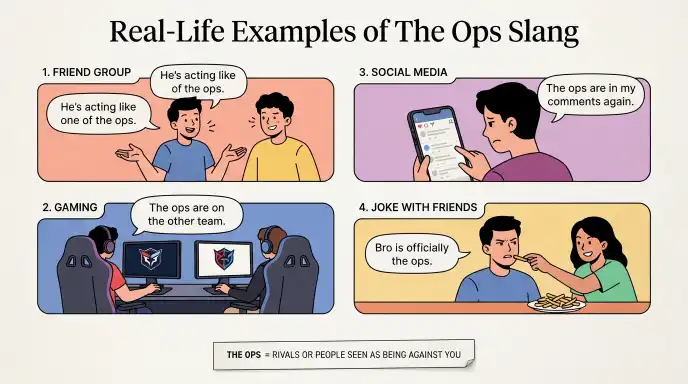
Friendly or joking use
“My little brother is the ops today.”
The speaker is joking that their brother is being annoying.
Gaming use
“The ops are pushing our side.”
The enemy players are attacking the speaker’s team.
Social media use
“The ops saw my new post.”
The speaker may mean rivals, haters, or people they do not get along with.
Friendship drama
“She became an opp after that argument.”
The speaker now sees the former friend as someone against them.
Music-related use
“The song keeps talking about the opps.”
Here, the term may have a more serious meaning connected to rivalry or conflict.
Why Do People Say “The Ops”?
People use the term because it is short, expressive, and familiar within certain online and music communities.
It can turn a simple disagreement into a playful rivalry.
For example:
“My Wi-Fi is the ops.”
sounds more dramatic and humorous than:
“My Wi-Fi keeps causing problems.”
Online slang often works this way. A word can keep its original meaning while gaining lighter uses in memes, gaming, and casual conversation.
When Should You Avoid Using the Ops?
Avoid the phrase when the meaning could create confusion or make a situation sound more hostile than you intend.
Do not use it:
- In formal writing
- When speaking to someone who may not know the slang
- In serious workplace communication
- In school assignments
- When discussing real conflict unless the context clearly supports it
- When calling a real person an “opp” could escalate an argument
If you simply mean competitor, rival, or opposing side, those words are clearer.
Common Misunderstandings About the Ops
“The ops” does not always mean gangs
The term has roots in street and hip-hop language, but modern users can apply it to ordinary rivals, enemies in games, or people they dislike.
“Ops” does not always mean police
Some online users may confuse ops with a shortened form of “operations” or even “cops,” but the slang meaning discussed here is opposition or opponents. Context is the key.
“The ops” does not always mean serious enemies
A TikTok user calling their alarm clock “the ops” is probably joking. A drill lyric may use the word in a much more serious way.
Frequently Asked Questions
What does the ops mean in slang?
The ops means the opposition, rivals, or people seen as enemies. It is related to opp/opps, slang connected to “opponent” or “opposition.”
What does opp stand for?
Opp is commonly connected to opponent or opposition. The plural is opps.
Are ops and opps the same?
Usually, yes. Ops and opps can both refer to rivals or opposition.
Is the ops a bad word?
Not necessarily. It is slang, not a swear word. However, it can sound hostile when used about real enemies or serious conflicts.
Is the ops used on TikTok?
Yes. Online users can use it to describe rivals, haters, ex-friends, or even imaginary enemies in a humorous way.
Can I use the ops at work?
It is better to avoid it in professional communication. Use rivals, opponents, competitors, or the opposing group instead.
What is the difference between ops and oops?
Ops can mean rivals or opposition. Oops is an expression used after a mistake or small accident.
Is “the ops” serious?
It depends on context. In memes and gaming, it can be playful. In street or drill contexts, it can refer to real rivals and carry a more serious meaning.
Conclusion: The Ops Slang Meaning
The the ops slang phrase usually means the opposition, rivals, or people someone sees as enemies. It comes from the slang opp, which is connected to “opponent” or “opposition,” and the plural is commonly written opps.
The important part is context. In a game or TikTok joke, “the ops” may simply mean the other side or someone you dislike. In hip-hop, drill, or discussions about real conflict, the term can carry a much more serious meaning.
Read More:
- Slang for Brain: Words That Mean More Than Intelligence
- Meth in Spanish Slang: Common Words and Their Meanings
- Crank Drug Slang: A Clear Guide to This Drug Term

Hi, I’m Sophia Turner, a writer at SlangRise with 7 years of experience researching English slang, internet abbreviations, and modern vocabulary.