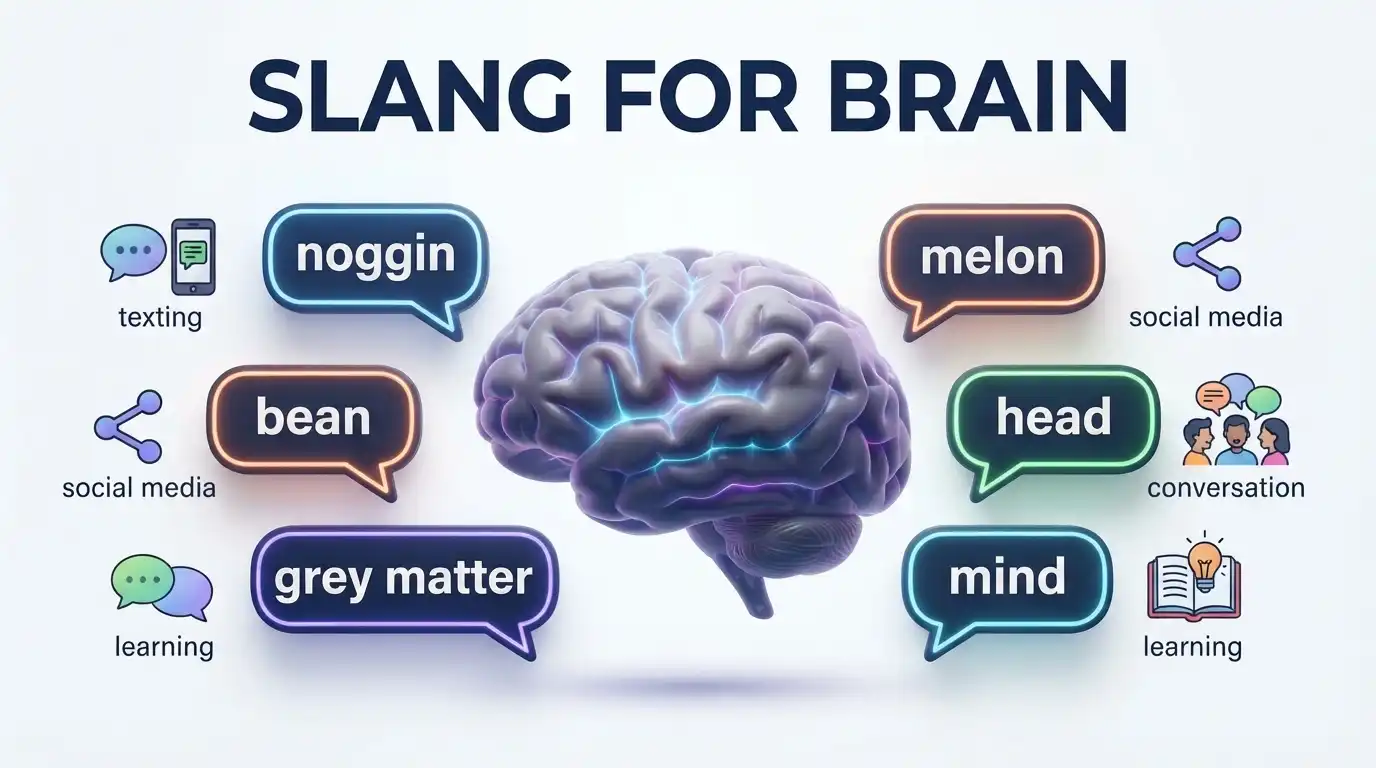
Slang for Brain refers to informal words used to describe intelligence, mental sharpness, or the brain itself like “brainiac,” “egghead,” “genius,” and the newer term “brain rot.”
Words like “brainiac” and “egghead” are typically used to compliment someone’s intelligence, while “brain rot” Oxford’s 2024 Word of the Year describes the mental fog from consuming excessive low quality online content.
Context and tone matter a lot here, since some slang terms praise intelligence while others playfully (or bluntly) call someone out for lacking it.
In this guide, you’ll learn common slang words related to “brain,” their meanings, and how they’re used in everyday conversation and internet culture.
Quick Answer
Common slang for brain includes:
- Noodle — brain
- Noggin — head or brain
- Bean — head or brain
- Gray matter — brain or intelligence
- Melon — head
- Thinker — brain
- Dome — head
- Brains — intelligence
Word at a Glance
| Slang | Meaning | Tone | Common Use |
| Noodle | Brain | Funny | Thinking |
| Noggin | Head or brain | Playful | Everyday speech |
| Bean | Head or brain | Humorous | Jokes |
| Gray matter | Brain | Casual | Intelligence |
| Melon | Head | Funny | Casual speech |
| Thinker | Brain | Playful | Thinking |
| Dome | Head | Informal | Casual speech |
| Brains | Intelligence | Casual | Smart people |
| Cranium | Skull/head | Humorous | Jokes |
| Head | Brain/thinking | Casual | Everyday speech |
What Is Slang for Brain?
Slang for brain means informal or playful words that people use instead of saying brain.
These expressions can describe:
- The physical brain
- Someone’s head
- Intelligence
- Thinking
- Memory
- Mental effort
The meaning depends on the sentence.
For example:
“Use your noodle.”
This does not mean someone should use actual noodles.
It means:
“Use your brain and think.”
1. Noodle
Part of speech: Noun
US pronunciation: NOO-dəl
Meaning: A playful slang word for the brain.
Examples
“Use your noodle and solve the puzzle.”
“My noodle is not working today.”
Noodle is one of the most playful slang terms for the brain. It is often used in jokes and casual conversations.
2. Noggin
Part of speech: Noun
US pronunciation: NOG-in
Meaning: An informal word for the head or brain.
Examples
“I bumped my noggin on the shelf.”
“Use your noggin before you answer.”
The first example refers to the head. The second means use your brain.
Noggin sounds friendly and informal.
3. Bean
Part of speech: Noun
US pronunciation: BEEN
Meaning: A funny informal word for the head or brain.
Examples
“I can’t get that idea out of my bean.”
“Protect your bean!”
People often use bean because the shape of a head can be compared jokingly to a bean.
It is mostly playful.
4. Gray Matter
Part of speech: Noun
US pronunciation: GRAY MAT-er
Meaning: The brain or its thinking ability.
Examples
“Put your gray matter to work.”
“He has plenty of gray matter.”
Gray matter comes from the actual structure of the brain.
In casual English, it can also mean intelligence or mental ability.
5. Melon
Part of speech: Noun
US pronunciation: MEL-un
Meaning: A humorous word for the head.
Examples
“I hit my melon on the door.”
“Think with that melon of yours.”
Melon is usually used as a joke about someone’s head.
It does not literally mean the brain.
6. Thinker
Part of speech: Noun
US pronunciation: THING-ker
Meaning: A playful word for the brain or thinking ability.
Examples
“Let me use my thinker.”
“My thinker is tired after that exam.”
This word focuses on the thinking function of the brain.
7. Dome
Part of speech: Noun
US pronunciation: DOHM
Meaning: Informal slang for the head.
Examples
“I got hit on the dome.”
“Protect your dome.”
Dome does not directly mean the brain. It means the head, but it can be used when talking about the brain or thinking.
It is common in casual American speech.
8. Cranium
Part of speech: Noun
US pronunciation: KRAY-nee-um
Meaning: The skull or head.
Examples
“I bumped my cranium.”
“Protect that cranium!”
Cranium is actually a standard anatomical word. However, people sometimes use it humorously in casual conversations.
It sounds more formal than noggin or noodle.
9. Brains
Part of speech: Noun
US pronunciation: BRAYNZ
Meaning: Intelligence or mental ability.
Examples
“She has the brains to solve this.”
“Use your brains!”
Here, brains usually means intelligence, not the physical organ.
It can also describe a smart person:
“She’s the brains behind the project.”
This means she is the person who provides the ideas or intelligence behind it.
10. Head
Part of speech: Noun
US pronunciation: HED
Meaning: The head, brain, or thinking ability.
Examples
“Use your head.”
“I can’t get that song out of my head.”
Head is not really slang by itself, but it is often used informally to mean brain or thinking ability.
For example:
“Use your head.”
means:
“Think carefully.”
Did You Know?
Many slang words for the brain actually describe the head, not the brain itself.
For example:
- Noggin = head
- Bean = head
- Melon = head
- Dome = head
- Cranium = skull
But speakers may use these words when talking about someone’s brain or ability to think.
That is why context matters.
Slang for Brain vs. Slang for Head
| Word | Brain Meaning | Head Meaning |
| Noodle | Yes | Sometimes |
| Noggin | Sometimes | Yes |
| Bean | Sometimes | Yes |
| Gray matter | Yes | No |
| Melon | No | Yes |
| Dome | No | Yes |
| Cranium | No | Yes |
| Thinker | Yes | No |
| Brains | Intelligence | No |
| Head | Sometimes | Yes |
Slang for a Smart Person
Some words do not mean brain directly. Instead, they describe someone who is very intelligent.
Brainiac
Meaning: A very smart person.
“She’s a total brainiac.”
Whiz
Meaning: Someone highly skilled or intelligent.
“He’s a math whiz.”
Genius
Meaning: Someone extremely intelligent or talented.
“You’re a genius!”
Egghead
Meaning: An intellectual or highly educated person.
“He’s a real egghead.”
These words are often positive, but egghead can sometimes sound teasing.
“Use Your Noodle” Meaning
Use your noodle is a common playful expression.
It means:
Use your brain. Think carefully.
Example:
“Come on, use your noodle!”
A parent, teacher, or friend might say this in a lighthearted way.
It is not normally offensive.
“Use Your Noggin” Meaning
Use your noggin also means:
Think carefully.
Example:
“Use your noggin before you make that decision.”
It is informal and can sound humorous.
Slang for a Tired Brain
People also use casual expressions when they are mentally exhausted.
Brain Is Fried
Meaning: Very mentally tired.
“My brain is fried after studying.”
Brain Is Dead
Meaning: Unable to think clearly.
“My brain is dead today.”
Brain Fog
Meaning: Difficulty thinking clearly.
“I have some brain fog this morning.”
These are casual expressions. They do not automatically describe a medical condition.
Slang for Thinking Hard
Some expressions describe intense thinking.
Rack Your Brain
Meaning: Think very hard.
“I’ve been racking my brain all day.”
Put Your Gray Matter to Work
Meaning: Think hard.
“Put your gray matter to work and solve it.”
Use Your Noodle
Meaning: Think.
“Use your noodle!”
All three expressions focus on mental effort.
Is Slang for Brain Rude?
Most common terms are not rude.
Words like:
- Noodle
- Noggin
- Bean
- Melon
- Thinker
- Gray matter
are usually playful or casual.
However, tone matters.
For example:
“Use your brain!”
can sound helpful between friends.
But if someone says it angrily, it can sound insulting.
Common Uses in Texting
Brain slang can appear in texts when people joke about thinking or forgetting something.
Example 1
Friend: “What’s 8 × 7?”
You: “Give me a second. My noodle needs to wake up.”
Example 2
Friend: “Did you remember the assignment?”
You: “Nope. My brain completely forgot.”
Example 3
Friend: “Think about it!”
You: “I’m using my noggin!”
These expressions make casual messages sound more natural and playful.
11. Gray Stuff
Part of speech: Noun
US pronunciation: GRAY STUFF
Meaning: A casual way to refer to the brain.
Examples
“Put that gray stuff to work.”
“My gray stuff is tired today.”
It is a playful version of gray matter.
12. Mind
Part of speech: Noun
US pronunciation: MYND
Meaning: A person’s thinking ability or thoughts.
Examples
“Keep your mind focused.”
“My mind is racing today.”
Mind is not exactly slang, but it is often used casually when talking about the brain.
13. Noggin Box
Part of speech: Noun phrase
US pronunciation: NOG-in BOKS
Meaning: A playful way to describe someone’s head or brain.
Examples
“Put your noggin box to work.”
“That noggin box needs a break.”
It is humorous and informal.
14. Dome Piece
Part of speech: Noun phrase
US pronunciation: DOHM PEES
Meaning: Slang for someone’s head.
Examples
“He got hit on the dome piece.”
“Protect your dome piece.”
It is more commonly associated with casual or street-style speech.
15. Coconut
Part of speech: Noun
US pronunciation: KOK-uh-nut
Meaning: A playful word for someone’s head.
Examples
“I bumped my coconut.”
“Use that coconut and think!”
The comparison is humorous because a coconut is hard and round.
16. Pumpkin
Part of speech: Noun
US pronunciation: PUM-kin
Meaning: A playful word for someone’s head.
Examples
“I hit my pumpkin on the cabinet.”
“Think with that pumpkin!”
It is usually friendly or humorous.
17. Melon Head
Part of speech: Noun phrase
US pronunciation: MEL-un HED
Meaning: A humorous term for someone’s head.
Examples
“He bumped his melon head.”
“Protect that melon head!”
It is usually teasing rather than serious.
18. Brain Box
Part of speech: Noun phrase
US pronunciation: BRAYN BOKS
Meaning: The brain or a person’s thinking ability.
Examples
“Give your brain box a minute.”
“Use your brain box and figure it out.”
This expression is playful and is more common in informal speech.
19. Think Tank
Part of speech: Noun phrase
US pronunciation: THINK TANK
Meaning: A group or place focused on ideas and problem-solving.
Examples
“Let’s get the think tank together.”
“My friends became a little think tank.”
Think tank does not literally mean a brain. It refers to people or a group that produces ideas.
20. Cerebrum
Part of speech: Noun
US pronunciation: suh-REE-brum
Meaning: The largest part of the brain, sometimes used humorously in casual speech.
Examples
“Let me activate my cerebrum.”
“My cerebrum needs coffee.”
This is a real anatomical term, not traditional slang. People sometimes use it jokingly to sound overly scientific.
21. Gray Matter
Part of speech: Noun
US pronunciation: GRAY MAT-er
Meaning: The brain or a person’s mental ability.
Examples
“Use your gray matter.”
“That puzzle really tested my gray matter.”
This expression can refer to intelligence or thinking power.
22. Brains
Part of speech: Noun
US pronunciation: BRAYNZ
Meaning: Intelligence or the person who provides the ideas.
Examples
“She’s the brains of the operation.”
“Use your brains and solve it.”
Here, brains usually means intelligence rather than the physical organ.
23. Big Brain
Part of speech: Noun phrase
US pronunciation: BIG BRAYN
Meaning: A very smart person or clever idea.
Examples
“Look at you with the big brain!”
“That was a big-brain move.”
Online, big brain is often used jokingly to praise someone for a clever idea.
24. Fivehead
Part of speech: Noun
US pronunciation: FYV-hed
Meaning: A joking term for a large forehead.
Examples
“He joked that he had a fivehead.”
“That picture makes my forehead look like a fivehead.”
It comes from the joke that a large forehead is big enough to fit five fingers instead of four.
25. Brainpan
Part of speech: Noun
US pronunciation: BRAYN-pan
Meaning: The skull or head.
Examples
“He bumped his brainpan.”
“Protect your brainpan.”
It is an informal and somewhat old-fashioned expression.
26. Think Piece
Part of speech: Noun phrase
US pronunciation: THINK PEES
Meaning: A long or thoughtful discussion about an idea.
Examples
“That article was a whole think piece.”
“People wrote think pieces about the movie.”
This does not mean the physical brain. It is connected with thinking and analysis.
27. Noggin
Part of speech: Noun
US pronunciation: NOG-in
Meaning: Head or brain.
Examples
“Use your noggin.”
“I bumped my noggin.”
Noggin remains one of the easiest playful alternatives to head or brain.
28. Noodle
Part of speech: Noun
US pronunciation: NOO-dəl
Meaning: Brain.
Examples
“My noodle is tired.”
“Use your noodle.”
This is one of the most recognizable humorous expressions for the brain.
29. Bean
Part of speech: Noun
US pronunciation: BEEN
Meaning: Head or brain.
Examples
“That idea popped into my bean.”
“Use your bean.”
It is casual and playful.
30. Dome
Part of speech: Noun
US pronunciation: DOHM
Meaning: Head.
Examples
“I got hit on the dome.”
“Protect your dome.”
It is casual slang and can sometimes appear in sports or street-style conversations.
Slang for Brain in Social Media
Social media users often turn brain-related words into jokes.
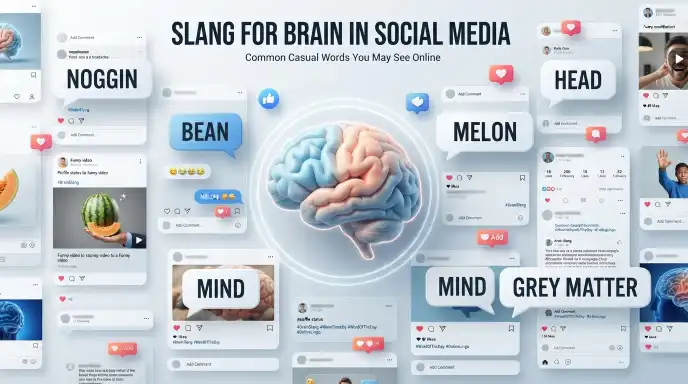
Common examples include:
“My brain has left the chat.”
“Big brain moment.”
“My last brain cell is working overtime.”
“No thoughts, just vibes.”
“Use that noodle!”
These expressions are usually humorous rather than literal.
“Last Brain Cell” Meaning
Last brain cell is a popular humorous expression.
It means someone feels mentally tired, confused, or unable to think.
Example
“My last brain cell is trying to finish this assignment.”
The person is joking that they have very little mental energy left.
“Big Brain” Meaning
Big brain is often used online to describe a clever idea or smart action.
Example
“He found the answer in two seconds. Big brain!”
It can be sincere praise or exaggerated humor.
Sometimes people use it sarcastically:
“You forgot your keys again. Big brain!”
Here, the speaker is joking.
“Brain Is Fried” Meaning
Brain is fried means someone feels mentally exhausted.
Example
“I’ve studied for six hours. My brain is fried.”
It is common in casual conversations about school, work, or difficult tasks.
Slang for Brain in American English
Some common American informal expressions include:
| Expression | Meaning |
| Noodle | Brain |
| Noggin | Head/brain |
| Bean | Head/brain |
| Melon | Head |
| Dome | Head |
| Gray matter | Brain/intelligence |
| Brains | Intelligence |
| Big brain | Clever person or idea |
| Brainiac | Very smart person |
| Brain is fried | Mentally tired |
| Last brain cell | Very little mental energy |
Slang for Brain in British English
Some brain-related informal expressions can also appear in British English.
For example:
- Noggin head
- Nut head
- Loaf head
- Bonce head
- Noodle brain
Nut
“Use your nut.”
This can mean use your head or think.
Loaf
Loaf can refer to the head in informal British speech.
Bonce
Bonce is informal British slang for the head.
These terms may sound unusual to American English speakers.
Slang for a Smart Person
If you want slang for someone who has a very good brain, these words are useful.
Brainiac
A very intelligent person.
“She’s a brainiac.”
Whiz
A person who is highly skilled.
“He’s a computer whiz.”
Genius
A very intelligent or talented person.
“You’re a genius!”
Egghead
A highly intellectual person.
“He’s a bit of an egghead.”
Smarty-Pants
Someone who acts very smart.
“Okay, smarty-pants!”
This can be friendly teasing or mildly annoying depending on tone.
Is “Noodle” Better Than “Noggin”?
They are slightly different.
Noodle usually focuses more on the brain or thinking.
“Use your noodle.”
Noggin usually means the head, although it can also mean brain.
“I bumped my noggin.”
Both are playful and informal.
Is “Bean” Rude?
Usually, no.
Bean is normally playful.
For example:
“Use your bean!”
can simply mean:
“Think!”
However, any slang term can sound rude if the speaker uses an angry or insulting tone.
Is “Dome” Slang for Brain?
Dome more directly means head, not brain.
For example:
“He got hit on the dome.”
means:
“He got hit on the head.”
It can sometimes be used loosely when talking about someone’s brain or thoughts.
Common Mistakes
Calling Every Head Word Brain Slang
Words such as melon, dome, bean, and noggin often mean head, not specifically the brain.
Using Slang in Formal Writing
Words like noodle and bean are best for casual speech, jokes, or informal content.
Missing Sarcasm
“Big brain” can be a compliment or a joke.
Assuming All Terms Are American
Some expressions are more common in British English.
Taking Figurative Words Literally
“Use your noodle” does not mean using food. It means think.
FAQs
What is the most common slang for brain?
Noodle is one of the most playful and recognizable slang terms for the brain.
What does “use your noodle” mean?
It means use your brain and think.
What does “noggin” mean?
Noggin is informal slang for the head and can sometimes mean the brain.
What does “bean” mean in slang?
Bean can be a playful term for someone’s head or brain.
What does “melon” mean in slang?
Melon is a humorous word for the head.
What does “gray matter” mean?
It can refer to the brain or someone’s intelligence and thinking ability.
What does “big brain” mean?
It usually means someone is clever or has made a smart move. Online, it can also be sarcastic.
What does “brain is fried” mean?
It means someone feels mentally exhausted and has trouble thinking clearly.
What does “last brain cell” mean?
It is a humorous way to say someone has very little mental energy left.
Conclusion
There are many fun examples of slang for brain, including noodle, noggin, bean, gray matter, melon, thinker, dome, and brains. Some words describe the brain directly, while others describe the head or a person’s intelligence.
For playful everyday speech, noodle and noggin are easy choices. For intelligence, brains, brainiac, whiz, and gray matter work well. Always consider the context and tone because the same phrase can be funny, friendly, or sarcastic.
Read More:
- Slang Terms for Coffee: Casual Nicknames for Your Favorite Drink
- Crank Drug Slang: A Clear Guide to This Drug Term
- TIL Slang: The Story Behind Every “Today I Learned” Post

Hi, I’m Olivia Carter. I enjoy researching English slang, online expressions, and everyday vocabulary. I write clear, beginner-friendly guides with simple definitions and practical examples to make modern English easier to understand.