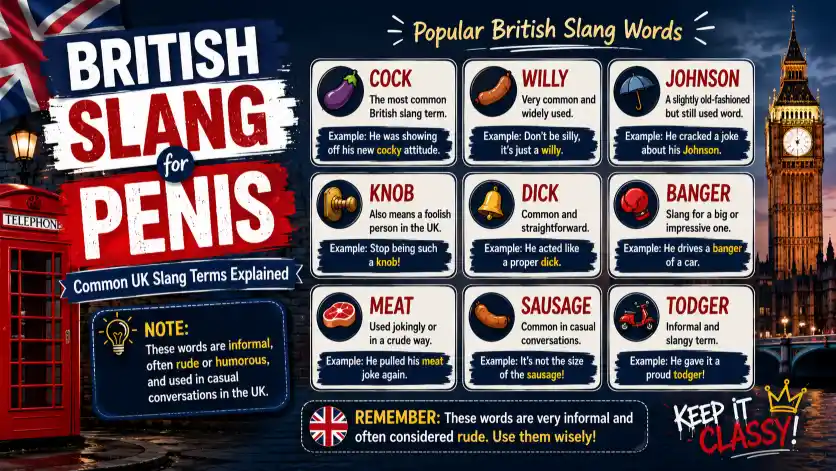
British slang for penis refers to informal, humorous, or rude words commonly used in the UK instead of the standard anatomical term.
British slang for penis includes informal words and phrases that people in the UK use instead of the medical term penis. Some are humorous, some are casual, and a few can be considered rude or offensive depending on the situation.
People often search for British slang for penis after hearing these words in British TV shows, comedy, movies, online videos, or everyday conversations.
The UK has many slang terms for body parts, and their meanings can change based on the speaker, region, and tone. Some expressions are harmless jokes, while others should only be used among close friends.
In this guide, you’ll learn the most common British slang for penis, what each term means, where people use it, and when you should avoid using these expressions.
Quick Answer
British slang for penis refers to informal UK words used instead of the medical word penis. Common examples include willy, dick, cock, todger, knob, and bellend. Some are mild and humorous, while others are vulgar or insulting.
What Does British Slang for Penis Mean?
British slang includes many informal names for the male genital organ.
Some words are used in a playful or childish way, while others are stronger and may sound offensive. The meaning depends on the word, the people involved, and the situation.
Common British Slang Terms
| Slang | Meaning | Tone |
| Willy | A childish or family-friendly word for penis. | Mild |
| Todger | A humorous British slang term. | Mild |
| Dick | Informal word for penis. It can also insult someone. | Moderate |
| Cock | A common slang word that may sound vulgar. | Strong |
| Knob | Slang for penis. It is also used as an insult. | Strong |
| Bellend | Originally refers to the tip of the penis but is now mostly used as an insult. | Strong |
Are All These Words the Same?
No.
Although they all relate to the same body part, they are not used in the same way.
Some words, such as willy and todger, are usually lighthearted.
Others, like knob, cock, and bellend, are much stronger and can offend people if used carelessly.
Different Meanings of British Slang for Penis
Some British slang words have more than one meaning.
Willy
Willy is the most common child-friendly slang word for penis in the UK.
Example:
“The little boy laughed after saying the word ‘willy.'”
Dick
Dick can simply mean penis, but it is also commonly used to describe someone who is rude or unpleasant.
Example:
“Don’t be such a dick.”
Bellend
Although bellend originally referred to part of the penis, today it is much more commonly used as an insult for someone acting foolish or annoying.
Example:
“He parked across two spaces. What a bellend.”
Where Is British Slang for Penis Commonly Used?
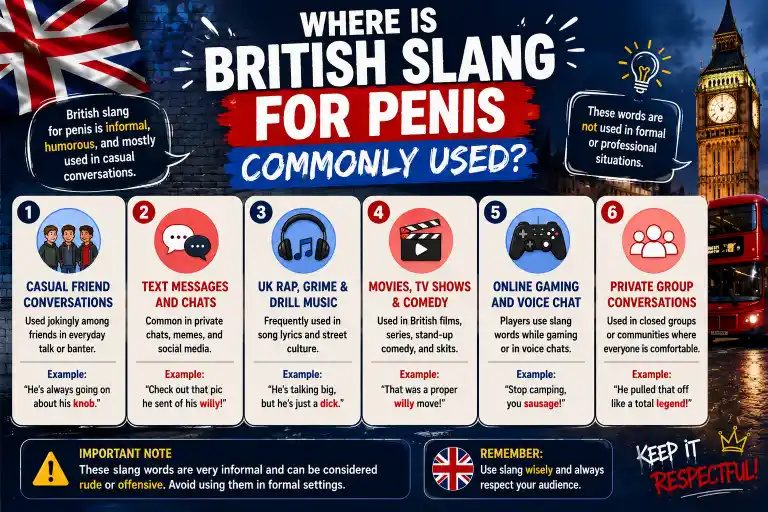
These slang words are mostly heard in casual conversations. They also appear in British TV shows, comedy, films, stand-up performances, and online discussions.
Some words are very common in the UK but may sound unusual to people from other English-speaking countries.
In Everyday Conversations
Friends sometimes use these words jokingly or as part of casual banter.
Example:
“He couldn’t stop laughing after hearing that joke about a willy.”
In British Comedy
British comedians often use slang because it sounds more natural and can make jokes funnier.
Words like todger, knob, and bellend are common in comedy shows aimed at adults.
In TV Shows and Movies
Many British dramas, sitcoms, and crime series include these slang terms to make conversations sound realistic.
The meaning usually depends on the tone and the situation.
On Social Media
People sometimes use these words in memes, comments, and humorous posts.
Some users replace letters with symbols to avoid automatic content filters.
Is British Slang for Penis Rude, Offensive, or Harmless?
It depends on the word.
Some expressions are lighthearted, while others are considered vulgar or offensive.
| Slang | Offensive? | Notes |
| Willy | ❌ No | Child-friendly and playful. |
| Todger | ❌ Usually no | Humorous and informal. |
| Dick | ⚠️ Sometimes | Can also be an insult. |
| Cock | ✅ Yes | Often considered vulgar. |
| Knob | ✅ Yes | Frequently used as an insult. |
| Bellend | ✅ Yes | Usually used to insult someone. |
Can You Use These Words at School or Work?
In most cases, no.
These words are informal, and several of them are offensive.
They are not suitable for:
- School assignments
- Professional emails
- Business meetings
- Job interviews
- Speaking with teachers or customers
If you need a neutral term, use penis, which is the correct medical word.
Real-Life Examples
Here are some natural examples that show how these words are used in different situations.
Casual Conversation
A: “Why is everyone laughing?”
B: “Someone told a silly joke about a willy.”
British Comedy
“The comedian made a joke about his todger, and the audience burst into laughter.”
Friendly Banter
“Stop acting like a knob and come help us.”
Here, knob is an insult. It does not refer to the body part.
Movie Dialogue
“Don’t be such a dick.”
In this sentence, dick means an unpleasant or rude person.
Social Media
“That comment was hilarious, but calling someone a bellend was a bit harsh.”
In modern British English, bellend, knob, and dick are often used as insults more often than they are used to refer to the body part itself. Understanding the context is important because the same word can have different meanings depending on the conversation.
Origin and History of British Slang for Penis
Many British slang words for penis have been used for decades, while others have existed for centuries. Some began as humorous nicknames, and others slowly became insults over time.
Unlike modern internet slang, these words did not come from social media. They developed through everyday speech in different parts of the UK.
Today, some of these expressions are still common, while others are heard less often or mainly in comedy and older British TV shows.
How These Words Changed Over Time
Not every slang word followed the same path.
- Willy has remained a mild and child-friendly term.
- Todger is still mostly humorous and informal.
- Dick is now used as an insult just as often as it refers to the body part.
- Knob and bellend are now far more common as insults than as anatomical slang.
Because language changes over time, the meaning of these words often depends on the context.
Similar British Slang Terms
The UK has many informal words that refer to the same body part.
| Slang | Tone | Common Use |
| Willy | Mild | Child-friendly conversations |
| Todger | Humorous | Casual speech and comedy |
| Dick | Moderate | Slang and insult |
| Cock | Strong | Adult conversations |
| Knob | Strong | Mostly used as an insult |
| Bellend | Strong | Usually an insult |
| Member | Mild | Humorous or indirect reference |
| Manhood | Neutral | Polite and indirect |
Each word has a different tone, so they are not always interchangeable.
Why Do People Use These Slang Words?
People often choose slang instead of medical terms because it sounds more casual or humorous.
Common reasons include:
- Making jokes.
- Avoiding formal language.
- Quoting movies or TV shows.
- Casual conversations with friends.
- Using British expressions naturally.
Some words are also used as insults and have little to do with their original anatomical meaning.
Common Misunderstandings
Some British slang terms are easy to misunderstand.
Not Every Word Refers to the Body Part
Words like knob, dick, and bellend often describe a rude, foolish, or annoying person.
In many conversations, they are not talking about anatomy at all.
Some Words Are Much Stronger Than Others
Many learners think all British slang words have the same tone.
They don’t.
For example, willy is much milder than cock or bellend.
Choosing the wrong word can easily offend someone.
Some Terms Are Becoming Less Common
Words like todger are still understood across the UK, but younger people may use them less often than older generations.
Meanwhile, dick, knob, and bellend remain common in casual speech and British entertainment.
When Should You Avoid Using British Slang for Penis?
Most of these words should be avoided in formal situations.
It is best not to use them:
- At work.
- In school.
- During job interviews.
- In professional emails.
- Around people you do not know well.
- When speaking with children, unless using a mild word like willy in an appropriate family context.
If you need a respectful or medical term, simply use penis instead.
Using the correct word for the situation helps you avoid embarrassment and prevents misunderstandings.
Frequently Asked Questions
1. What is the most common British slang for penis?
The most common British slang terms include willy, todger, dick, cock, knob, and bellend. Some are mild and humorous, while others are vulgar or commonly used as insults.
2. Is willy offensive?
No. Willy is generally considered a mild and child-friendly slang word in the UK. Parents and young children often use it instead of the medical term.
3. Is todger a rude word?
Not usually. Todger is a humorous British slang term and is less offensive than words like cock or knob. However, it is still informal.
4. Why do dick, knob, and bellend also mean an insulting person?
Over time, these words developed a second meaning. Today, they are often used to describe someone who is rude, foolish, or annoying. In many conversations, this meaning is more common than the anatomical one.
5. Can I use these words at school or work?
In most cases, no. These slang terms are informal, and some are offensive. In professional or educational settings, the correct word is penis.
6. Are these words used only in the UK?
Most of them are strongly associated with British English, although some words, such as dick and cock, are also understood in other English-speaking countries. Their popularity and tone can vary by region.
7. Which British slang word is the least offensive?
Willy is generally the mildest and most widely accepted slang term. Todger is also considered fairly mild, though it is mainly used in informal conversations.
8. Can the same word have different meanings?
Yes. Words like dick, knob, and bellend can refer to the body part, but they are more often used as insults. The meaning depends on the context and the speaker’s intent.
9. What is a Weiner in British slang?
Weiner is an informal word for the penis. It is more common in American English than British English.
10. Do British people say knob?
Yes. In British slang, knob can mean the penis or be used as a mild insult for someone acting foolish or rude.
11. What do we say “boy’s private part” in English?
The correct English term is penis. In casual speech, people may also say private part or private area, especially when talking to children.
12. What is the British slang for male?
Common British slang words for a male include bloke, lad, chap, and geezer, depending on the situation.
Conclusion
British slang for penis includes many informal words, but they do not all carry the same tone. Mild terms like willy and todger are often used in humorous or family settings, while stronger words such as cock, knob, and bellend can sound vulgar or insulting.
Learning these expressions helps you understand British movies, TV shows, comedy, and everyday conversations more easily. Just remember that context matters. Some words are harmless jokes, while others are best avoided in polite or professional situations.
You might also like:
- Massachusetts Slang Words: Essential Local Expressions
- Cook Slang Meaning: Definition, Uses & Examples
- Chirping Meaning Slang: How to Use It in Everyday Conversations

Hi, I’m Sophia Turner, a writer at SlangRise with 7 years of experience researching English slang, internet abbreviations, and modern vocabulary.