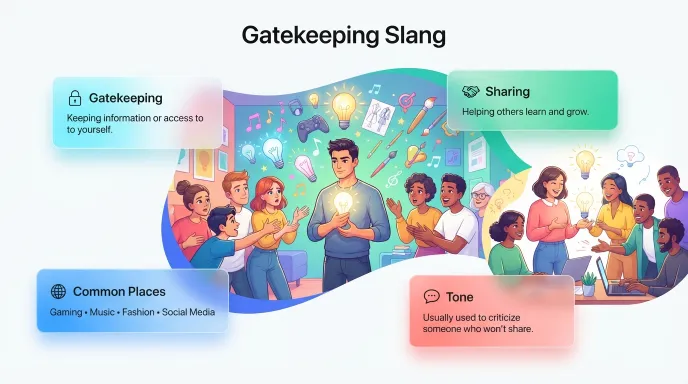
Gatekeeping slang is the act of controlling who can access certain knowledge, hobbies, communities, or experiences by keeping others out or making it difficult for them to join.
Gatekeeping slang refers to the act of controlling who can access, enjoy, or participate in something. In online conversations, calling someone a gatekeeper usually means they are trying to stop others from joining a hobby, community, trend, or interest by acting as if only certain people are “allowed” to be part of it.
Many people search for gatekeeping slang after seeing the word on TikTok, Instagram, Reddit, Discord, X (formerly Twitter), or in comment sections. While the term is often used in a negative way, its meaning depends on the situation. In this guide, you’ll learn what gatekeeping slang means, where it’s commonly used, its different meanings, and how to recognize it in everyday conversations.
Quick Answer: Gatekeeping Slang
Gatekeeping is slang for trying to control who can access, enjoy, or be part of something. It often describes someone who tells others they are “not a real fan” or refuses to share information to keep something exclusive.
What Does Gatekeeping Slang Mean?
Gatekeeping is an internet slang term used when someone tries to decide who is “allowed” to belong to a group, enjoy a hobby, or have an opinion.
A person who gatekeeps may act as though they are the authority on a topic and suggest that others are not knowledgeable or worthy enough to participate.
For example:
- “You’re not a real fan if you only know one song.”
- “I’m not telling you where I bought it. Stop asking.”
- “You haven’t played the original game, so your opinion doesn’t count.”
In each example, the speaker is limiting access or making others feel excluded.
Does Gatekeeping Have a Full Form?
No. Gatekeeping is not an acronym or abbreviation.
It comes from the English word gatekeeper, which originally referred to a person who controlled entry through a gate.
Today, the slang meaning is used to describe someone who tries to control access to information, communities, hobbies, or interests.
Different Meanings of Gatekeeping Slang
The meaning of gatekeeping can change slightly depending on the situation.
1. Gatekeeping in Online Communities
This is the most common meaning.
Someone tries to decide who is a “real” member of a community.
Examples
- “You can’t call yourself a gamer unless you’ve played every game in the series.”
- “Only true fans know that.”
Tone: Usually negative
2. Gatekeeping in Hobbies and Fandoms
People sometimes discourage newcomers by making unnecessary rules or tests.
Examples
- “If you just started watching anime, you’re not a real fan.”
- “You don’t know enough about cars to join us.”
This kind of gatekeeping can make communities feel less welcoming.
Tone: Negative
3. Gatekeeping Information
Sometimes people intentionally refuse to share useful information to keep an advantage or remain exclusive.
Examples
- “She won’t reveal where she bought that dress.”
- “He’s gatekeeping his editing techniques.”
In this case, gatekeeping means keeping information private instead of sharing it.
Tone: Depends on the context, but it’s often used as criticism.
4. Gatekeeping Everyday Interests
The word can also be used outside the internet.
People may accuse someone of gatekeeping if they act like only certain people can enjoy a movie, sport, food, or fashion style.
Examples
- “Stop gatekeeping coffee. Anyone can enjoy it.”
- “Music isn’t only for experts.”
Here, gatekeeping means excluding others from something that should be open to everyone.
Quick Overview
| Feature | Details |
| Meaning | Trying to control who can join, enjoy, or access something |
| Type | Internet slang and social term |
| Tone | Usually negative or critical |
| Common Users | Social media users, gamers, fans, online communities |
| Common Platforms | TikTok, Instagram, Reddit, Discord, X (formerly Twitter) |
| Full Form | None |
| Still Popular? | Yes, widely used in online discussions and social media |
Where Is Gatekeeping Slang Commonly Used?
Gatekeeping slang is most common on social media and in online communities. People use the term when they believe someone is unfairly trying to control who can join a group, enjoy a hobby, or access information.
On TikTok
TikTok users often accuse others of gatekeeping when they refuse to share product names, song titles, or useful information.
Examples:
- “Stop gatekeeping the skincare routine.”
- “Why are you gatekeeping the song name?”
Here, gatekeeping means intentionally keeping information from others.
On Instagram
On Instagram, the term often appears in comments when creators refuse to reveal where they bought an outfit, furniture, or accessories.
Examples:
- “Don’t gatekeep the dress. Tell us where you got it!”
- “She’s gatekeeping her makeup products.”
The word is usually used in a lighthearted but critical way.
On Reddit
Reddit discussions frequently use gatekeeping when talking about hobbies, movies, books, music, or fandoms.
Examples:
- “People are gatekeeping this hobby.”
- “Don’t gatekeep new members.”
The goal is often to encourage more welcoming communities.
On Discord
Gaming communities on Discord sometimes use gatekeeping when experienced players discourage beginners.
Examples:
- “Stop gatekeeping the game.”
- “New players should feel welcome.”
In gaming, the word often refers to excluding newcomers.
On X (Formerly Twitter)
On X, people use gatekeeping during discussions about fashion, music, entertainment, sports, and trends.
Examples:
- “People are gatekeeping old music again.”
- “Why is everyone gatekeeping this restaurant?”
The term is common in debates about sharing knowledge and recommendations.
In Gaming Communities
Gamers often use gatekeeping when someone claims that only experienced players deserve to participate.
Examples:
- “You haven’t played the first game, so you can’t have an opinion.”
- “Stop gatekeeping the community.”
This usage is especially common in online multiplayer games and gaming forums.
Is Gatekeeping Slang Rude, Offensive, or Harmless?
Gatekeeping is not a swear word, but it usually carries a negative meaning because it criticizes someone’s behavior.
| Usage | Tone | Appropriate? |
| Calling out unfair behavior | Critical | ✅ Yes |
| Casual social media discussions | Informal | ✅ Yes |
| Friendly conversations | Depends on context | ✅ Usually |
| Formal business writing | Informal | ⚠️ Better avoided |
The word itself is not offensive, but calling someone a gatekeeper may upset them if they disagree with the accusation.
Can You Use Gatekeeping at Work or School?
Yes, but use it carefully.
In casual conversations with classmates or coworkers, gatekeeping is generally understood.
Examples:
- “Let’s not gatekeep helpful study resources.”
- “Don’t gatekeep your presentation tips.”
However, in formal reports or professional emails, it’s usually better to use clearer expressions such as:
- Limiting access
- Excluding others
- Withholding information
- Creating unnecessary barriers
These alternatives sound more professional.
Real-Life Examples of Gatekeeping Slang
Here are some realistic examples of how gatekeeping is used.
Friends Talking
Alex: “Where did you buy that hoodie?”
Ryan: “I’m not telling anyone.”
Alex: “Stop gatekeeping!”
TikTok Comments
“Please stop gatekeeping the recipe!”
Instagram Comment
“Don’t gatekeep the lipstick shade.”
Gaming Chat
Player 1: “Only people who’ve played since 2018 are real fans.”
Player 2: “That’s gatekeeping.”
School Conversation
Ali1: “Can you share your study notes?”
Ayan2: “Sure!”
Akbar 3: “Good. No gatekeeping.”
Workplace Conversation
Employee: “Let’s share the training guide with the whole team instead of gatekeeping the information.”
These examples show that gatekeeping usually refers to limiting access or making others feel excluded.
Why Do People Use the Word “Gatekeeping”?
People use gatekeeping to describe behavior that feels unfair or exclusive.
Instead of saying:
“They’re refusing to let others participate.”
Many people simply say:
“They’re gatekeeping.”
Common reasons people use the term include:
- To criticize someone for excluding others.
- To encourage people to share useful information.
- To support beginners joining a community.
- To make hobbies and fandoms more welcoming.
- To call out unnecessary rules or elitist behavior.
Because the term is widely recognized online, gatekeeping has become a common way to discuss fairness, inclusion, and openness in both digital and real-life communities.
Origin and History of Gatekeeping Slang
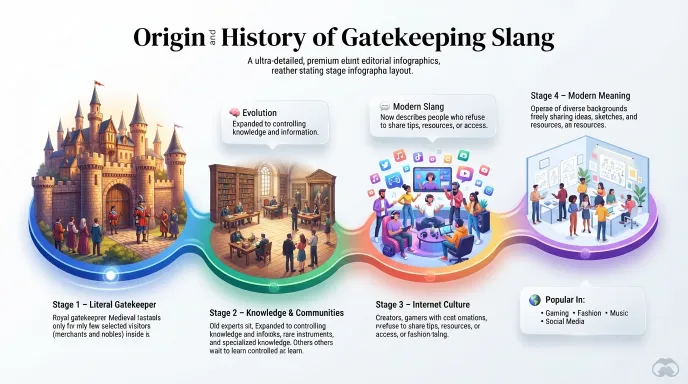
The word gatekeeping existed long before it became internet slang. It comes from the word gatekeeper, which originally referred to a person responsible for controlling who could enter through a gate or guarded entrance.
Over time, the meaning expanded beyond physical gates. People began using gatekeeping to describe anyone who controlled access to information, opportunities, or groups.
Its modern slang meaning became especially popular during the 2010s, as discussions on Reddit, Tumblr, X (formerly Twitter), YouTube, TikTok, and Instagram focused on fandoms, gaming, fashion, music, and online communities. Today, the term is widely used whenever someone is seen as unfairly excluding others or acting as though only certain people are “qualified” to participate.
How Gatekeeping Became Popular Online
As online communities grew, people noticed that some users tried to decide who counted as a “real” fan or who deserved access to certain information.
Examples included:
- Refusing to share product names.
- Saying someone isn’t a “real gamer.”
- Claiming only longtime fans understand a band or TV show.
- Discouraging beginners from joining a hobby.
Social media helped spread the word gatekeeping, and it quickly became a common way to call out this type of behavior.
Today, the term is used across many online platforms and communities.
Similar Slang and Related Terms
Several words and phrases have meanings related to gatekeeping.
| Term | Meaning | Similar to “Gatekeeping”? |
| Elitism | Acting as if only a select group is good enough | ✅ Very Similar |
| Exclusion | Keeping others out | ✅ Similar |
| Clique | A small group that excludes others | ✅ Related |
| Snobbery | Looking down on others | ✅ Similar |
| Keeping Secrets | Refusing to share information | ✅ Related |
| Flexing | Showing off knowledge or possessions | ⚠️ Sometimes |
| Being Inclusive | Welcoming everyone | ❌ Opposite Meaning |
Although these terms overlap, gatekeeping specifically focuses on controlling access or deciding who belongs.
Common Misunderstandings About Gatekeeping
Because the word is widely used online, it’s sometimes misunderstood.
Myth 1: Gatekeeping Always Means Refusing to Share Information
Reality: While refusing to share information is one form of gatekeeping, the term also includes excluding people from communities, hobbies, or discussions.
Myth 2: Gatekeeping Is Always Bad
Reality: In internet slang, gatekeeping usually has a negative meaning. However, outside of slang, the word can describe legitimate roles, such as controlling access to secure buildings or protecting private information.
Myth 3: Only Gamers Use the Word
Reality: No. The term is common in discussions about music, fashion, books, sports, movies, beauty, food, technology, and many other interests.
Myth 4: Gatekeeping Is the Same as Having an Opinion
Reality: Simply disagreeing with someone isn’t gatekeeping. The term usually applies when a person tries to prevent others from participating or claims they aren’t “real” members of a group.
When Should You Avoid Using Gatekeeping?
Although gatekeeping is a useful term, it isn’t always the best choice.
Avoid using it in:
Formal Business Documents
Instead of writing:
“The company is gatekeeping information.”
Write:
“The company is limiting access to information.”
Academic Writing
In research papers or formal assignments, use more precise terms like:
- Restricting access
- Excluding participants
- Limiting information
- Controlling participation
When Someone Is Protecting Private Information
Not every refusal to share information is gatekeeping.
For example, keeping passwords, personal details, or confidential business information private is responsible behavior—not gatekeeping.
Understanding the difference helps avoid using the term unfairly.
Polite Alternatives to Gatekeeping
If you want to sound more formal or neutral, try these alternatives.
| Instead of Saying | You Can Say |
| Stop gatekeeping. | Please share the information. |
| They’re gatekeeping. | They’re limiting access. |
| She’s gatekeeping the details. | She’s keeping the details private. |
| He’s gatekeeping the community. | He’s making the community less welcoming. |
| Don’t gatekeep new members. | Welcome new members. |
These alternatives work well in workplaces, schools, and professional communication.
Is Gatekeeping Still Popular?
Yes. Gatekeeping remains one of the most common internet slang terms used on TikTok, Instagram, Reddit, Discord, and X (formerly Twitter).
Although the situations have changed over time, the meaning has stayed consistent. People continue to use gatekeeping whenever someone unfairly controls access, excludes others, or refuses to share information that could help a wider community.
Frequently Asked Questions
Q1:What does gatekeeping mean in slang?
In slang, gatekeeping means trying to control who can join, enjoy, or access something. It often describes someone who excludes others from a hobby, community, trend, or useful information.
Q2:Is gatekeeping a bad thing?
Usually, yes. In most online conversations, gatekeeping has a negative meaning because it refers to behavior that makes others feel excluded or unwelcome. However, the seriousness depends on the situation.
Q3:Is gatekeeping rude or offensive?
The word itself is not offensive, but calling someone a gatekeeper may be taken as criticism. If you use the term, be sure it matches the situation.
Q4:Why do people say “Stop gatekeeping”?
People say “Stop gatekeeping” when they want someone to share information or stop acting as if only certain people are allowed to enjoy something.
Example:
“Stop gatekeeping the recipe and tell us where you found it!”
Q5:Is gatekeeping only used on social media?
No. While the term is very popular on TikTok, Instagram, Reddit, Discord, and X (formerly Twitter), people also use it in everyday conversations about work, school, sports, music, and hobbies.
Q6:Can gatekeeping ever be a good thing?
Sometimes. In everyday slang, gatekeeping is usually negative. However, outside internet slang, limiting access to private, confidential, or sensitive information can be necessary and responsible. The context matters.
Q7:Can I use gatekeeping at work?
You can use it in casual conversations if your coworkers understand the term. In formal meetings or documents, it’s better to use phrases like “limiting access,” “withholding information,” or “excluding others.”
Q8:Is gatekeeping the same as bullying?
No. Gatekeeping and bullying are different. Gatekeeping focuses on controlling access or excluding people from a group or activity, while bullying involves repeated harmful or aggressive behavior. However, gatekeeping can sometimes make people feel unwelcome or left out.
Q9:Is gatekeeping still popular?
Yes. Gatekeeping is still widely used online, especially in discussions about music, fashion, gaming, beauty, books, movies, and social media trends.
Conclusion
Gatekeeping slang describes the act of controlling who can access, enjoy, or participate in something. if it’s refusing to share useful information, questioning if someone is a “real fan,” or making a community feel exclusive, the term is commonly used to call out behavior that excludes others.
Today, gatekeeping is widely recognized on platforms like TikTok, Instagram, Reddit, Discord, and X (formerly Twitter). While the word usually has a negative meaning, context is important. Protecting private or confidential information is not the same as unfairly gatekeeping a hobby or community.
Understanding gatekeeping slang helps you recognize online conversations, use the term accurately, and know when a more respectful or inclusive approach is the better choice.
- Read More:1910s Slang: Meaning, Popular Words, and History
- Read More:TYT Meaning Slang: Easy Explanation with Examples
- Read More:Red Meaning Slang: What It Really Means Online

Hi, I’m Olivia Carter. I enjoy researching English slang, online expressions, and everyday vocabulary. I write clear, beginner-friendly guides with simple definitions and practical examples to make modern English easier to understand.