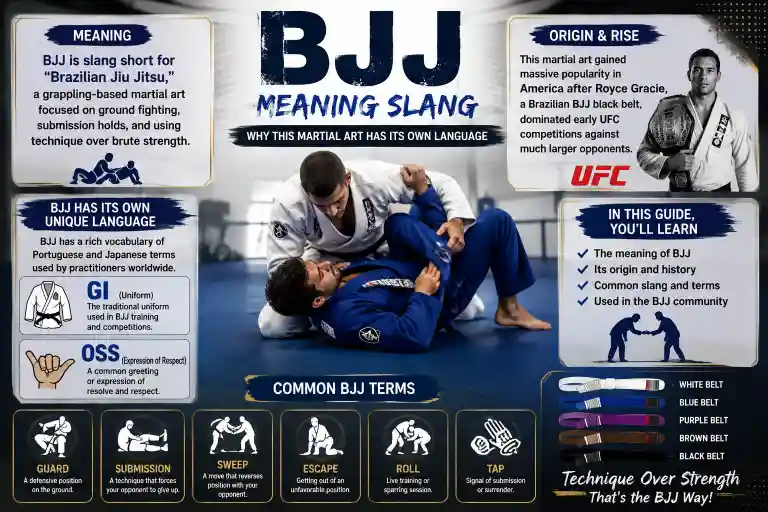
BJJ is slang short for “Brazilian Jiu Jitsu,” a grappling-based martial art focused on ground fighting, submission holds, and using technique over brute strength.
This martial art gained massive popularity in America after Royce Gracie, a Brazilian BJJ black belt, dominated early UFC competitions against much larger opponents.
Beyond the acronym itself, BJJ has its own rich vocabulary of Portuguese and Japanese terms, like “gi” (uniform) and “oss” (a common greeting or expression of resolve).
In this guide, you’ll learn the meaning of BJJ, its origin, and the common slang and terms used within the Brazilian Jiu-Jitsu community.
Quick Answer
BJJ most commonly stands for Brazilian Jiu-Jitsu. In slang and online conversations, it usually refers to the martial art, training sessions, competitions, or someone who practices Brazilian Jiu-Jitsu.
What Does BJJ Mean in Slang?
In slang, BJJ usually means Brazilian Jiu-Jitsu.
People use the abbreviation because it is much shorter than writing the full name. It commonly appears in conversations about martial arts, fitness, MMA, and self-defense.
Examples:
- “I’ve been training BJJ for two years.”
- “My BJJ class starts at 7 PM.”
- “She’s competing in a BJJ tournament.”
The meaning is usually easy to understand because it appears in sports or fitness-related conversations.
Word at a Glance
| Feature | Details |
| Word | BJJ |
| Part of Speech | Abbreviation |
| Pronunciation | US: /ˌbiː ˌdʒeɪ ˈdʒeɪ/ UK: /ˌbiː ˌdʒeɪ ˈdʒeɪ/ |
| Common Meaning | Brazilian Jiu-Jitsu |
| Tone | Neutral |
| Common Contexts | Martial arts, fitness, texting, social media |
| Related Words | MMA, grappling, jiu-jitsu, martial arts, submission |
BJJ Full Form / Definition
BJJ stands for:
Brazilian Jiu-Jitsu
It is a martial art that focuses on grappling techniques, submissions, leverage, and ground fighting rather than punches or kicks.
People commonly use the abbreviation when discussing:
- Martial arts training.
- Competitions.
- Self-defense.
- Fitness.
- MMA.
Examples:
- “He started BJJ last year.”
- “BJJ has improved my confidence.”
- “She won her first BJJ competition.”
What Does BJJ Stand For?
BJJ stands for Brazilian Jiu-Jitsu.
Although people occasionally suggest other meanings online, Brazilian Jiu-Jitsu is the standard and most widely recognized meaning in texting, sports discussions, and social media.
Is BJJ Rude, Offensive, or Neutral?
BJJ is completely neutral.
It is simply the accepted abbreviation for Brazilian Jiu-Jitsu and has no offensive meaning.
People of all ages use it in:
- Text messages.
- Fitness communities.
- Martial arts schools.
- Instagram.
- TikTok.
- Reddit.
- YouTube.
- MMA discussions.
Where Is BJJ Commonly Used?
You will commonly see BJJ in:
- Martial arts gyms.
- MMA communities.
- Text messages.
- Reddit.
- Instagram.
- TikTok.
- YouTube.
- Facebook groups.
- Discord servers about martial arts.
Coaches, athletes, content creators, and fans use the abbreviation every day because it is simple and widely recognized.
Why Do People Use BJJ Slang?
People use BJJ because writing Brazilian Jiu-Jitsu every time is long and repetitive.
Using the abbreviation makes conversations:
- Faster.
- Easier to read.
- More natural.
- Common within martial arts communities.
Today, BJJ is the standard abbreviation used worldwide by practitioners, coaches, and fans.
Real-Life Examples of BJJ Slang Usage
The meaning of BJJ is usually the same in most conversations. It refers to Brazilian Jiu-Jitsu, but the way people use it depends on the situation. You will often see it in chats between athletes, fitness enthusiasts, and martial arts fans.
Friendly Examples
Friends often use BJJ when talking about training or encouraging each other.
Examples:
- “Want to join me for BJJ tonight?”
- “You’re getting really good at BJJ.”
- “Our BJJ coach is amazing.”
- “Let’s practice BJJ this weekend.”
These examples create a friendly and supportive tone.
Casual Examples
BJJ is commonly used in everyday conversations.
Examples:
- “I started BJJ last month.”
- “She trains BJJ three times a week.”
- “He’s looking for a new BJJ gym.”
- “BJJ is great exercise.”
These conversations simply refer to the martial art.
Argumentative Examples
People may also mention BJJ during debates or disagreements about martial arts.
Examples:
- “I think BJJ is the most effective martial art.”
- “Not everyone agrees that BJJ is the best for self-defense.”
- “BJJ isn’t the only useful fighting style.”
- “He prefers boxing over BJJ.”
In these examples, the disagreement is about the sport, not the meaning of the abbreviation.
Fitness and Social Media Examples
BJJ is very common on social media and in fitness communities.
Examples:
- “First BJJ tournament today!”
- “Another great BJJ training session.”
- “BJJ changed my life.”
- “Just earned my new BJJ belt.”
You can regularly see BJJ on:
- TikTok
- YouTube
- Discord
- MMA forums
Many athletes share training clips, competition highlights, and fitness tips using the abbreviation.
Origin and Background of BJJ
BJJ is the accepted abbreviation for Brazilian Jiu-Jitsu, a martial art that developed from traditional Japanese jiu-jitsu and judo techniques before evolving in Brazil.
The abbreviation became popular because the full name is long to write. As the sport grew worldwide, athletes, coaches, and fans naturally shortened it to BJJ.
Today, BJJ is recognized across:
- Martial arts schools.
- MMA organizations.
- International competitions.
- Fitness communities.
- Online discussions.
The abbreviation is now understood almost everywhere in the martial arts world.
Comparison With Similar Slang
Although BJJ is an abbreviation rather than traditional slang, people often compare it with other martial arts abbreviations.
Some common examples include:
- MMA – Mixed Martial Arts.
- JJ – Jiu-Jitsu.
- Judo – A grappling martial art.
- Muay Thai – A striking martial art.
- Wrestling – A grappling sport.
Key Differences
| Term | Meaning | Common Context |
| BJJ | Brazilian Jiu-Jitsu | Grappling and submissions |
| MMA | Mixed Martial Arts | Multiple fighting styles |
| JJ | Jiu-Jitsu | General jiu-jitsu discussion |
| Judo | Japanese martial art | Throws and grappling |
| Wrestling | Grappling sport | Competition and training |
Comparison Table
| Term | Meaning | Example |
| BJJ | Brazilian Jiu-Jitsu | “I train BJJ every week.” |
| MMA | Mixed Martial Arts | “She competes in MMA.” |
| JJ | Jiu-Jitsu | “Our JJ class starts at six.” |
| Judo | Japanese martial art | “He earned a black belt in judo.” |
| Wrestling | Grappling sport | “He joined the wrestling team.” |
When to Avoid Using BJJ
Although BJJ is widely recognized in martial arts communities, it may not be familiar to everyone.
Avoid using only the abbreviation when:
- Writing academic papers.
- Preparing professional documents.
- Speaking with people unfamiliar with martial arts.
- Writing for beginners.
In these situations, write Brazilian Jiu-Jitsu (BJJ) the first time, then use BJJ afterward.
Polite Alternatives to BJJ
If your audience may not know the abbreviation, use these alternatives.
| BJJ | Alternative |
| BJJ | Brazilian Jiu-Jitsu |
| BJJ class | Brazilian Jiu-Jitsu class |
| BJJ gym | Brazilian Jiu-Jitsu academy |
| BJJ coach | Brazilian Jiu-Jitsu instructor |
| BJJ training | Brazilian Jiu-Jitsu training |
These alternatives make your writing clearer for new readers.
Impact of Using BJJ in Communication
Using BJJ makes conversations shorter and easier, especially among martial artists.
Benefits include:
- Faster communication.
- Easier texting.
- Clear discussions within martial arts communities.
- Simple social media hashtags.
- Better recognition among athletes.
However, people outside the martial arts world may not recognize the abbreviation immediately. Writing the full name first can improve clarity.
Is BJJ Safe for Social Media?
Yes. BJJ is completely safe to use on social media. It is a neutral abbreviation with no offensive meaning.
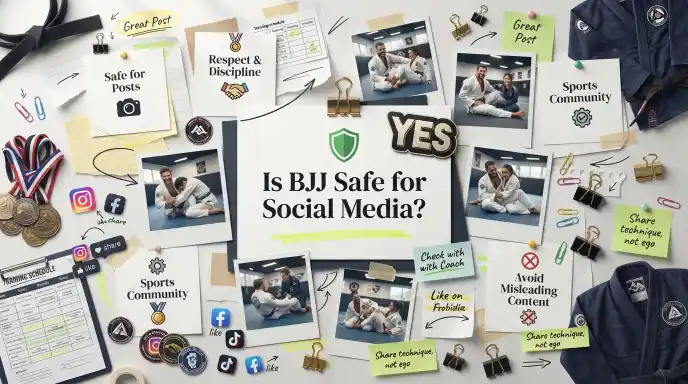
It is commonly used on:
- TikTok
- YouTube
- Discord
- X
Examples:
- “Another great BJJ class today!”
- “Preparing for my first BJJ tournament.”
- “BJJ has helped improve my confidence.”
- “Who’s training BJJ this weekend?”
Frequently Asked Questions About BJJ Meaning Slang
1. What does BJJ mean in slang?
In slang, BJJ most commonly stands for Brazilian Jiu-Jitsu, a martial art that focuses on grappling, submissions, and ground fighting.
2. What does BJJ stand for?
BJJ stands for Brazilian Jiu-Jitsu. It is the standard abbreviation used by martial artists, coaches, and fans around the world.
3. Is BJJ an internet slang term?
BJJ is an abbreviation rather than a traditional internet slang term. However, it is widely used in text messages, social media, and online fitness communities as a short way to refer to Brazilian Jiu-Jitsu.
4. Is BJJ rude or offensive?
No. BJJ is completely neutral. It simply refers to the martial art and does not have a rude or offensive meaning.
5. Where is BJJ commonly used?
BJJ is commonly used in:
- Text messages.
- Instagram.
- TikTok.
- Reddit.
- YouTube.
- Facebook.
- Discord.
- MMA and martial arts communities.
6. Can BJJ have other meanings?
Yes. Like many abbreviations, BJJ can have other meanings in specific industries or organizations. However, in slang, texting, sports, and social media, it almost always refers to Brazilian Jiu-Jitsu.
Conclusion
BJJ meaning slang most commonly refers to Brazilian Jiu-Jitsu, one of the world’s most popular martial arts. The abbreviation is widely used in texting, social media, fitness communities, and MMA discussions because it is much shorter than writing the full name.
Although BJJ can have other meanings in specialized fields, Brazilian Jiu-Jitsu is the meaning most people recognize in everyday conversations. Understanding the context makes it easy to interpret the abbreviation correctly.
Whether you see BJJ in a text message, an Instagram post, or a martial arts forum, it usually refers to the sport, its training, or the people who practice it.
Read More:
- The Secret Language of League of Legends Players
- Blue Slang Meaning: More Than Just a Color
- Cray Meaning Slang: The Real Meaning Behind This Popular Word
- GOATED Slang Meaning: Popular Use in Sports and Social Media

Hi, I’m Sophia Turner, a writer at SlangRise with 7 years of experience researching English slang, internet abbreviations, and modern vocabulary.