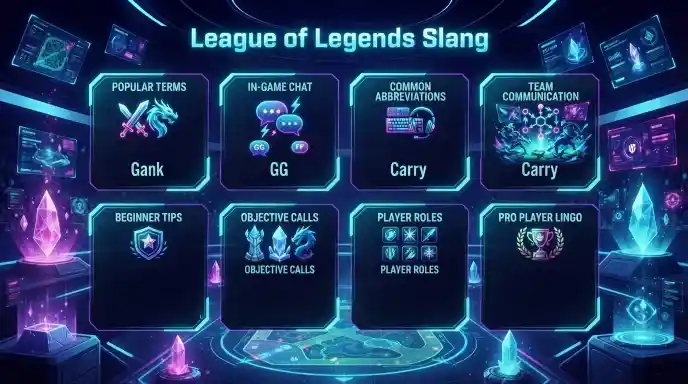
League of Legends Slang refers to the abbreviations, terms, and phrases players use in game and in chat like GG, Gank, Jungle, and Feed to communicate quickly during matches.
If you’re new to the game, understanding this slang can feel overwhelming at first. Terms fly around fast in champion select, team chat, and post-game lobbies, often leaving beginners confused.
Knowing these words isn’t just about fitting in it helps you communicate strategy, call out plays, and avoid misunderstandings with your team during intense matches.
In this guide, you’ll learn the most common League of Legends slang, what each term means, and how to use them like an experienced summoner.
Quick Answer
League of Legends slang includes gaming words and short phrases used by players to describe strategies, characters, actions, and situations during a match. These terms make communication faster and easier.
What Does League of Legends Slang Mean?
League of Legends slang is the informal language created and used by the game’s community.
Since matches require teamwork and quick decisions, players often use short words instead of full sentences.
For example:
- Gank means attacking an enemy lane with help from another player.
- AFK means a player is away from the keyboard.
- GG means good game.
- OP means overpowered or very strong.
These words are common in ranked matches, casual games, livestreams, and online communities.
Why Do Players Use League of Legends Slang?
Players use slang because League of Legends matches move quickly. Typing long messages during a fight can waste valuable time.
Common reasons include:
- Giving quick instructions.
- Sharing game information.
- Planning strategies.
- Reacting to plays.
- Building a shared gaming culture.
A player can type one short word and communicate a complete idea to the team.
Common League of Legends Slang Terms
GG
GG means good game.
Players usually type it at the end of a match to show respect or acknowledge the game.
Example:
“GG everyone, that was a close match.”
Gank
Gank means when a player surprises an enemy by attacking with help from another teammate.
It is most commonly used when the jungler helps another lane.
Example:
“Can you gank my lane? The enemy is pushing too far.”
ADC
ADC stands for Attack Damage Carry.
It usually refers to a champion who deals strong physical damage, especially in the bottom lane.
Example:
“Our ADC needs more protection during team fights.”
OP
OP means overpowered.
Players use it when a champion, item, or strategy feels too strong.
Example:
“That champion is OP after the latest update.”
AFK
AFK means Away From Keyboard.
Players use it when someone is not actively playing.
Example:
“Our teammate went AFK at the start of the match.”
Different Types of League of Legends Slang
League slang can be divided into different groups.
| Type | Examples | Meaning |
| Team Communication | Gank, Push, Help | Used for strategy |
| Player Behavior | AFK, Feed, Troll | Describes actions |
| Compliments | GG, WP | Shows respect |
| Champion Terms | OP, Nerf, Buff | Talks about game balance |
| Community Words | Noob, Smurf | Describes players |
Understanding these categories makes it easier for new players to follow conversations.
Where Is League of Legends Slang Commonly Used?
League of Legends slang is used mainly inside the game, but it has also become popular across gaming communities. Players use these terms in different places to discuss matches, strategies, and experiences.
In Game Chat
The most common place to see League slang is during live matches.
Players use short terms to communicate quickly.
Example:
“Enemy mid missing, be careful.”
“Need a gank top lane.”
On Twitch Streams
Many viewers use League slang while watching professional players and streamers.
Common words appear in chat messages, reactions, and discussions.
Example:
“That play was wild. The ADC is carrying!”
On Reddit and Gaming Forums
Players often use slang when discussing:
- Champion changes.
- Match strategies.
- Ranking systems.
- Player mistakes.
Example:
“This champion is OP after the new patch.”
On Discord and Gaming Groups
Friends and teammates use League slang while planning games or talking after matches.
Example:
“Let’s queue again. That last game was a stomp.”
Is League of Legends Slang Rude, Offensive, or Harmless?
Most League slang is harmless and simply helps players communicate faster.
However, some terms can be negative or insulting depending on how they are used.
| Term | Meaning | Tone |
| GG | Good game | Positive |
| WP | Well played | Positive |
| Noob | Inexperienced player | Can be insulting |
| Feed | Give enemies easy kills | Negative |
| Troll | Player who ruins the game | Negative |
| AFK | Not playing | Usually negative |
Can You Use League Slang Outside Gaming?
Some terms have become common outside gaming.
For example:
- OP is now used for anything extremely strong.
- GG is used online to mean a finished situation.
- Noob is used more broadly to describe beginners.
However, many League-specific terms may confuse people who do not play games.
Real-Life Examples of League of Legends Slang
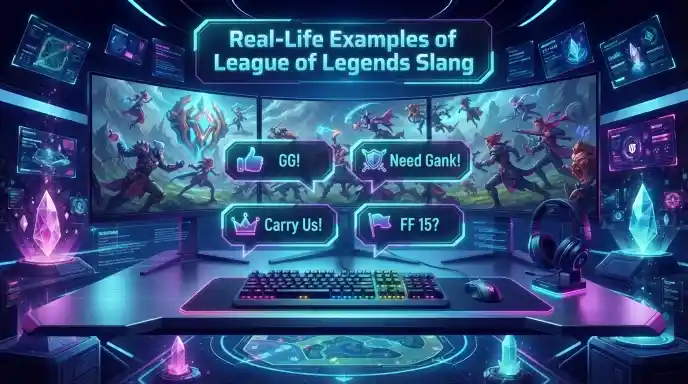
During a Match
Player 1: “Enemy jungler is missing.”
Player 2: “Careful, he might gank bot.”
After Winning
“GG, everyone played well.”
Talking About a Champion
A: “Why is everyone playing that champion?”
B: “Because it’s OP right now.”
Talking About a Mistake
“Our top lane fed early, so the enemy got ahead.”
Gaming Discord
Friend 1: “Ready for ranked?”
Friend 2: “Yes, but don’t AFK this time.”
Popular League of Legends Slang Terms Players Should Know
Buff
A buff is a change that makes a champion, item, or ability stronger.
Example:
“This champion got a buff in the latest update.”
Nerf
A nerf is a change that makes something weaker.
Example:
“That ability needs a nerf because it is too strong.”
Carry
A carry is a player who performs extremely well and helps the team win.
Example:
“Our mid laner carried the whole game.”
Feed
To feed means giving the enemy too many kills, usually by making repeated mistakes.
Example:
“I made bad plays and fed the enemy team.”
Smurf
A smurf is an experienced player using a new or lower-ranked account.
Example:
“That player looks like a smurf.”
Origin and History of League of Legends Slang
League of Legends slang developed from a mix of traditional gaming language, internet culture, and the game’s own community. When League of Legends was released in 2009, players quickly created short words and phrases to communicate faster during matches.
Because the game requires teamwork, strategy, and quick reactions, players started using abbreviations and simple terms instead of typing long explanations.
Many League slang terms also come from the wider MOBA (Multiplayer Online Battle Arena) genre, which includes games with similar team-based gameplay.
How League Slang Became Popular
League of Legends slang spread through:
- In-game chat
- Ranked matches
- Twitch streams
- YouTube videos
- Reddit communities
- Discord servers
- Esports tournaments
Professional players and streamers helped make many terms popular among new players.
Similar Gaming Slang and Related Terms
Many League slang words are also used in other online games.
| Slang | Meaning |
| GG | Good game |
| WP | Well played |
| GLHF | Good luck, have fun |
| AFK | Away from keyboard |
| OP | Overpowered |
| Nerf | Make something weaker |
| Buff | Make something stronger |
| Meta | The most effective strategy currently used |
| Noob | New or inexperienced player |
| Tilted | Frustrated and playing poorly |
These terms are not only used in League of Legends. Many are common across gaming communities.
Why Do Players Use League of Legends Slang?
Players use these terms because they make communication faster and easier.
Common reasons include:
- Saving time during matches.
- Explaining strategies quickly.
- Sharing warnings with teammates.
- Building a connection with other players.
- Understanding gaming discussions.
For example, typing “gank bot” is much faster than writing:
“Please come to the bottom lane and help attack the enemy team.”
Common Misunderstandings About League of Legends Slang
New players often misunderstand some terms because they have special meanings inside the game.
OP Does Not Always Mean Perfect
When players say a champion is OP, they usually mean it feels too strong compared to others.
It does not always mean the champion is unbeatable.
Carry Does Not Always Mean One Player Wins Alone
A carry is usually a player who contributes greatly to the team’s success.
It does not mean the other players did nothing.
Noob Can Be an Insult
The word noob originally referred to a beginner.
However, in many gaming communities, it is often used as an insult toward players who make mistakes.
GG Can Have Different Tones
Normally, GG means good game and is respectful.
However, some players use it sarcastically after an easy win or a mistake.
The tone depends on the situation.
When Should You Avoid Using League of Legends Slang?
League slang is perfect for gaming conversations, but it is not suitable everywhere.
Avoid using these terms:
- In school assignments.
- In professional emails.
- In formal presentations.
- When speaking with people unfamiliar with gaming.
For example:
Instead of saying:
“This idea is OP.”
In formal writing, say:
“This idea is extremely effective.”
Using the right language for the situation helps prevent confusion.
Frequently Asked Questions
1. What is League of Legends slang?
League of Legends slang is a collection of informal words, abbreviations, and phrases used by players to communicate during matches. These terms describe strategies, champions, player actions, and game situations.
2. What does GG mean in League of Legends?
GG means good game. Players usually use it after a match to show respect and acknowledge the game.
3. What does gank mean in League of Legends?
A gank happens when a player, usually the jungler, surprises an enemy by attacking with help from another teammate.
4. What does OP mean in League of Legends?
OP means overpowered. Players use it when a champion, item, or strategy seems much stronger than others.
5. What does AFK mean in League of Legends?
AFK means Away From Keyboard. It describes a player who is not actively playing or has left the game temporarily.
6. What does feed mean in League of Legends?
To feed means a player gives the enemy team an advantage by dying repeatedly and allowing them to gain kills or resources.
7. What does smurf mean in League of Legends?
A smurf is an experienced player using a new or lower-ranked account. Smurfs often play against less experienced players.
8. Is League of Legends slang only used in this game?
No. Many terms like GG, OP, AFK, buff, nerf, and noob are used across different gaming communities.
9. Can beginners use League of Legends slang?
Yes. Learning common slang can help new players understand teammates, streams, guides, and gaming discussions more easily.
10. Is League of Legends slang rude?
Most terms are harmless, but some words like noob, troll, and feeder can be used as insults depending on the situation and tone.
11. What is LOL in Internet slang?
LOL stands for “Laughing Out Loud.” It is used to show that something is funny or makes you laugh.
12. What does Gen Z say instead of LOL?
Gen Z often uses LMAO, LMFAO, I’m dead, crying, or 💀 instead of LOL to show they find something funny.
13. What is the meaning of the slang word LOL?
LOL means “Laughing Out Loud.” It is a common internet slang term used in texts, chats, and social media.
14. What does “league” mean in slang?
In slang, league usually means a person’s level of attractiveness, success, or social status. For example, “She’s out of his league” means she is considered more attractive or successful than him.
Conclusion
League of Legends slang helps players communicate faster and understand the game’s community. Words like GG, gank, OP, AFK, buff, nerf, and carry are now common parts of online gaming language.
If you are a new player, a Twitch viewer, or someone exploring gaming culture, knowing these terms makes conversations easier to follow. Remember that some slang is friendly, while other terms can sound negative depending on how they are used.
You may also enjoy:
- Chill Meaning Slang: Definition, Examples & How It’s Used
- Cholo Slang Phrases: Street Language Explained
- British Slang for Penis: Common UK Terms Explained

Hi, I’m Olivia Carter. I enjoy researching English slang, online expressions, and everyday vocabulary. I write clear, beginner-friendly guides with simple definitions and practical examples to make modern English easier to understand.