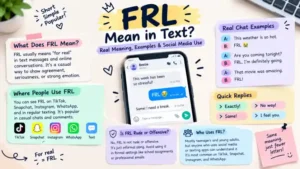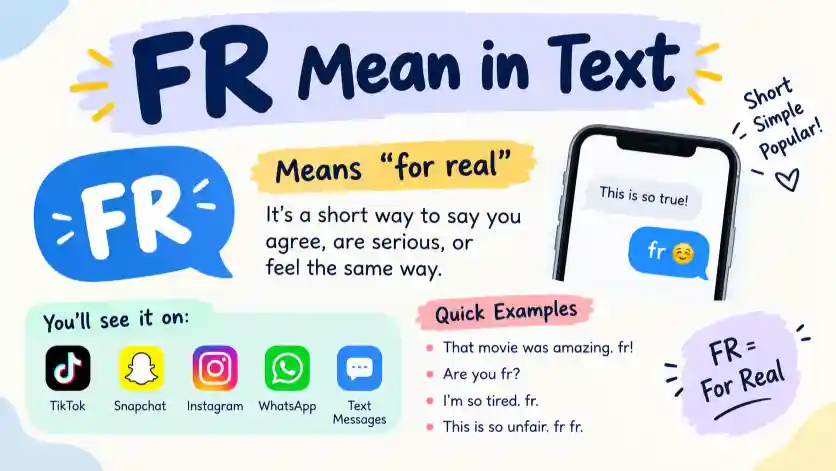
FR means “for real” in text messages and online conversations. People use it to show that they are being serious, agreeing with someone, or strongly relating to what they said.
You may see fr on TikTok, Snapchat, Instagram, WhatsApp, and in regular text messages. It is especially common in casual conversations where people want to respond quickly.
For example, if your friend says, “This week has been exhausting,” you might reply, “fr 😭.” Here, fr means “for real” or “I completely agree.”
People search for fr mean in text because the abbreviation can appear suddenly in a message, comment, or social media post. Understanding it is simple once you know what the two letters stand for.
FR Meaning in Text
FR is a short form of “for real.” It is an internet abbreviation used to express agreement, seriousness, or genuine emotion.
When someone writes fr, they usually mean something like:
- “For real.”
- “Seriously.”
- “I agree.”
- “That is true.”
- “I feel the same way.”
The exact meaning depends on the conversation.
For example:
Person 1: “That movie was actually amazing.”
Person 2: “fr.”
The second person is saying, “For real, I agree.”
FR is not normally used in formal writing. It belongs to casual digital communication, including texting, comments, direct messages, and online conversations.
Is FR an Acronym or Abbreviation?
FR is commonly treated as an internet abbreviation or initialism for “for real.”
Each letter represents the beginning of a word:
- F = For
- R = Real
People often type it in lowercase as fr, but uppercase FR is also common.
There is no major difference between fr and FR in casual texting. Lowercase tends to look more relaxed, while uppercase can sometimes add emphasis.
What Does FR Mean in Everyday Chat?
In everyday conversation, FR often works as a quick agreement.
Imagine your friend says:
“I need coffee before I can talk to anyone.”
You could answer:
“fr 😂”
That means:
“For real. I feel exactly the same.”
It can also be used to emphasize that you are being honest.
“I’m fr tired.”
Here, fr can mean “really” or “seriously.”
Another common use is:
“Are you fr?”
This usually means:
“Are you for real?” or “Are you serious?”
So, FR can work slightly differently depending on its position in a sentence.
Where People Use FR
FR is widely used across informal digital communication. You can find it in short messages, comments, captions, and replies.
FR on TikTok
On TikTok, fr often appears in comments and replies.
Someone might post a video saying:
“Going to work after getting three hours of sleep.”
A commenter might write:
“fr 😭”
This means the commenter relates to the situation.
You may also see combinations such as:
- “fr fr”
- “so fr”
- “that’s fr”
- “are you fr?”
- “fr tho”
“Fr fr” means “for real, for real” and adds extra emphasis.
For example:
“That song is underrated fr fr.”
The person is strongly saying that they genuinely believe the song is underrated.
FR on Snapchat
Snapchat conversations are usually quick and informal, so fr fits naturally.
For example:
Friend: “I forgot my homework again.”
You: “fr?? 😭”
Here, the meaning may be closer to “Seriously?”
Snapchat users may also use FR as a quick response instead of typing a complete sentence.
FR on Instagram
On Instagram, FR can appear in comments, DMs, and replies.
For example:
“This outfit looks so good.”
Someone may reply:
“fr 🔥”
That means:
“For real, it looks great.”
The abbreviation is particularly useful when someone wants to agree without writing a long response.
FR on WhatsApp
FR is also common in casual WhatsApp chats, especially among friends and younger users.
For example:
A: “The traffic today was horrible.”
B: “fr, I was stuck for an hour.”
Here, fr means “for real” and introduces agreement.
FR in SMS
FR can also appear in ordinary SMS messages.
It is not limited to social media. Anyone familiar with internet-style texting may use it in a casual message.
For example:
“You’re actually coming tomorrow fr?”
This means:
“Are you really coming tomorrow?”
In SMS, the meaning is usually understood from the surrounding words.
10 Real Chat Examples of FR
The easiest way to understand internet slang is to see it in normal conversations.
Example 1: Agreeing With a Friend
A: This weather is way too hot today.
B: fr 😭
A: I can barely go outside.
Here, fr means “for real” and shows agreement.
Example 2: Talking About Food
A: That pizza was incredible.
B: fr, I need to go back there.
A: Same!
FR means “for real” and confirms that B agrees.
Example 3: Showing Strong Agreement
A: Mondays should not exist.
B: fr fr 😂
A: We need a three-day weekend.
Fr fr adds extra emphasis to the agreement.
Example 4: Asking If Someone Is Serious
A: I might quit my job tomorrow.
B: Are you fr?
A: I honestly am.
Here, are you fr? means “Are you serious?”
Example 5: Relating to Someone
A: I opened my laptop to study and ended up watching videos for two hours.
B: fr 😭
A: I got absolutely nothing done.
B is saying they understand and have probably experienced the same thing.
Example 6: Instagram Comment
A: This is the best movie I’ve watched all year.
B: fr 🔥
A: Finally someone agrees!
Here, FR is simply a quick agreement.
Example 7: Talking About Sleep
A: I slept for four hours last night.
B: fr?
A: Yeah, I couldn’t fall asleep.
In this situation, FR works like “really?” or “seriously?”
Example 8: Complimenting Something
A: Your new profile picture looks great.
B: fr? Thanks 😂
A: Yeah, it looks really good.
Here, B uses FR to ask if A genuinely means the compliment.
Example 9: School Conversation
A: We have three assignments due tomorrow.
B: fr 😭
A: I haven’t even started one.
The abbreviation shows agreement and frustration.
Example 10: Casual WhatsApp Chat
A: I think I’m going to order pizza tonight.
B: Fr, I’m hungry too.
A: What toppings do you want?
Here, FR means “For real” and smoothly leads into the next part of the conversation.
How to Reply When Someone Says “FR”
Your reply depends on what the other person means.
Sometimes FR is agreement.It is a question. Sometimes it is simply an emotional reaction.
Funny Replies
If the conversation is playful, you can respond with humor.
- “FR fr 😂”
- “Finally, someone gets it.”
- “You said it, not me 😂”
- “Facts.”
- “Exactly! 😂”
- “No lies detected.”
For example:
Friend: “We need a vacation immediately.”
You: “FR. My suitcase is already packed 😂”
Casual Replies
For a normal conversation, keep your response simple.
- “Exactly.”
- “I know, right?”
- “Same.”
- “Definitely.”
- “Honestly.”
- “Yeah, seriously.”
Example:
Friend: “That test was so hard.”
You: “Honestly, fr.”
Friendly Replies
When someone is sharing an opinion or feeling, a friendly response works well.
- “I feel the same.”
- “I totally agree.”
- “You’re right.”
- “Same here.”
- “I get you.”
- “Exactly what I was thinking.”
For example:
Friend: “I really need a break.”
You: “I feel you. You definitely deserve one.”
Neutral Replies
If you do not want to use slang, you can simply respond naturally.
Instead of:
“fr”
You can write:
“I agree.”
Or:
“Yes, exactly.”
If they ask:
“Are you fr?”
You can answer:
“Yes, I’m serious.”
This is useful when you want your message to be clear rather than informal.
Is FR Rude or Offensive?
FR is generally not rude or offensive. It is a casual abbreviation for “for real.”
The word itself does not contain an insult or offensive meaning in ordinary texting.
However, tone matters.
For example:
“Are you fr?”
can sound playful between friends, but it can also sound annoyed depending on the situation.
Similarly:
“You fr?”
might be interpreted as questioning someone’s judgment.
That does not make FR offensive. It simply shows how short messages can sometimes sound different from what the writer intended.
Is FR Safe to Use?
In casual communication, FR is generally fine.
It can be used with:
- Friends
- Classmates
- Online friends
- Social media followers
- People you regularly text
The main thing to remember is that FR is informal.
Can You Use FR at School?
In a casual message to a friend or classmate, it is usually fine.
However, avoid relying on slang in formal school work.
For example, an essay should say:
“I strongly agree with this point.”
rather than:
“fr.”
The same idea applies to presentations, assignments, and formal emails.
Can You Use FR at Work?
FR may be acceptable in a casual workplace chat if the team regularly uses informal language.
Still, it is safer to write complete words in formal communication.
Instead of:
“FR, that meeting was long.”
you could write:
“I agree, that meeting was quite long.”
Your relationship with the person and the communication style of the workplace matter.
Who Uses FR?
FR is most familiar among people who regularly use texting and social media.
Younger Internet Users
Teenagers and young adults commonly encounter abbreviations such as FR because they are frequently exposed to short-form online communication.
However, FR is not restricted to one age group.
Adults who use social media, messaging apps, gaming chats, or online communities may also understand and use it.
Gen Z Usage
FR is strongly associated with modern internet and texting culture, including Gen Z communication.
It works well in fast conversations because two letters can replace an entire phrase.
Instead of typing:
“For real, I completely agree with you.”
someone can simply type:
“fr.”
Common Platforms
You may encounter FR on:
- TikTok
- Snapchat
- Discord
- Text messages
- YouTube comments
- Online forums
- Gaming chats
The meaning usually stays the same, although the tone can change depending on the conversation.
How Often Does FR Appear Online?
FR is a familiar piece of internet shorthand, especially in casual conversations.
It is not a formal English word. Its frequency depends heavily on the platform, community, age group, and type of conversation.
A formal business discussion will naturally contain less slang than a group chat between friends.
Origin of FR
The exact moment when people began using FR as a common internet abbreviation is difficult to identify.
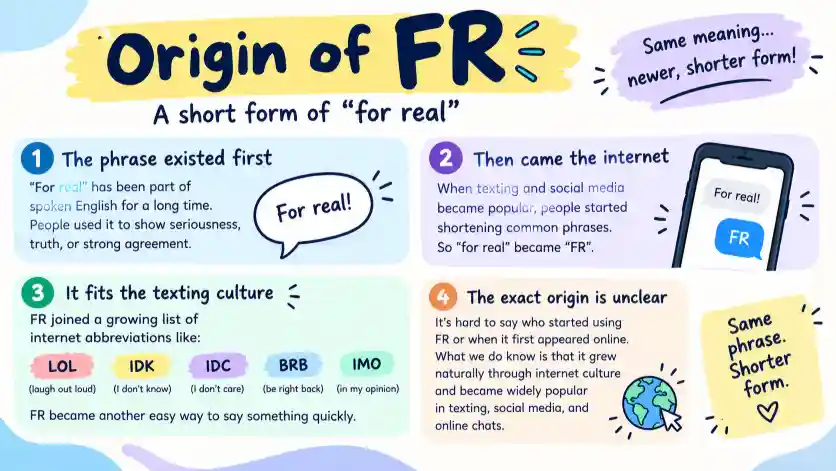
The phrase “for real” existed in spoken English long before texting and social media. People have used it to express seriousness, truth, or strong agreement.
Digital communication shortened the phrase into FR, following a broader pattern of creating quick abbreviations for frequently used expressions.
Internet users already had abbreviations such as:
- LOL =laugh out loud
- IDK = I don’t know
- IDC =I don’t care
- BRB =be right back
- IMO =in my opinion
FR developed naturally within this culture of fast online communication.
The exact origin of the abbreviation is therefore less clear than its meaning. It is best understood as a shortened form of an already familiar phrase rather than a slang word with one clearly documented inventor.
FR vs. IDK vs. IDC vs. IMO vs. BRB
These abbreviations are all common in digital communication, but they serve different purposes.
| Term | Meaning | Type | Usage | Popularity |
| FR | For real | Internet abbreviation | Agreement, seriousness, emphasis | Common |
| IDK | I don’t know | Internet abbreviation | Uncertainty or lack of information | Very common |
| IDC | I don’t care | Internet abbreviation | Indifference or lack of concern | Common |
| IMO | In my opinion | Internet abbreviation | Giving a personal opinion | Common |
| BRB | Be right back | Internet abbreviation | Temporarily leaving a conversation | Common |
The important difference is what each abbreviation communicates.
FR is usually about agreement or seriousness.
IDK expresses uncertainty.
IDC expresses indifference.
IMO introduces a personal opinion.
BRB tells someone that you are temporarily stepping away.
For example:
“FR, that was funny.”
means:
“For real, that was funny.”
But:
“IDK what happened.”
means:
“I don’t know what happened.”
And:
“IMO, the first movie was better.”
means:
“In my opinion, the first movie was better.”
Knowing the individual meanings makes online conversations much easier to understand.
Real World Usage Example
Imagine two friends are sitting together after school and texting each other about an upcoming exam.
One friend sends:
“This exam is going to be so difficult.”
The other replies:
“fr 😭”
Even though they are physically in the same place, they may still use texting language because it is quick and natural for them.
Another situation could happen in a group chat.
Someone writes:
“We need to stop staying up until 2 a.m.”
Another person replies:
“fr.”
The response means:
“For real. I completely agree.”
FR can therefore move easily between online and everyday communication. The abbreviation is digital, but the phrase behind it“for real”is ordinary conversational English.
FR Can Have Different Meanings in Other Contexts
Although “for real” is the common meaning in texting, abbreviations can sometimes have different meanings in specialized settings.
For example, two letters may represent something completely different in medicine, business, gaming, education, or another technical field.
That is why context matters.
If you see:
“fr 😂”
in an Instagram comment, “for real” is a natural interpretation.
If FR appears in a technical document, you should not automatically assume it means “for real.”
For slang and texting questions, the surrounding words usually make the intended meaning clear.
FR, FR FR, and “For Real”
You may notice several related forms online.
FR
This is the shortest form.
“That was hard fr.”
Meaning:
“That was really hard.”
FR FR
Repeating the abbreviation adds emphasis.
“That restaurant is amazing fr fr.”
This means the person strongly believes what they are saying.
For Real
Some people simply write the complete phrase.
“For real, I was so tired.”
There is no major difference in the basic idea. The shorter versions are simply more typical of quick digital communication.
Frequently Asked Questions
What does FR mean in text messages?
FR usually means “for real.” It can show agreement, seriousness, or genuine emotion in a casual conversation.
What does FR mean on TikTok?
On TikTok, FR usually means “for real.” People often use it in comments to agree with a video, statement, or another person’s comment.
Is FR slang?
FR is commonly used as internet slang or texting shorthand. More precisely, it is an abbreviation or initialism for “for real.”
Is FR rude or offensive?
No. FR is generally not rude or offensive. However, phrases such as “Are you fr?” can sound annoyed depending on the context and tone.
How should you reply to FR?
If someone uses FR to agree with you, you can reply with “Exactly,” “Same,” “I know, right?” or another natural response. If they ask “Are you fr?”, answer based on if you are serious.
Conclusion
FR means “for real” in text and online conversations. People use it to show agreement, emphasize a statement, or ask if someone is being serious.
You can see it on TikTok, Snapchat, Instagram, WhatsApp, Discord, and in regular text messages. You may also see fr fr, which adds extra emphasis.
FR is perfectly natural in casual conversations, especially when talking with friends or people who regularly use internet slang. For school assignments, formal emails, professional messages, and other formal writing, it is better to write the complete phrase or use standard English.
Once you understand the context, FR is one of the simpler texting abbreviations to recognize: it usually just means “for real.”
Read More:
- FR Slang Meaning: What Does FR Mean in Text?
- FT Slang :Meaning in Text, Chat & Social Media
- TNT Meaning Slang: Decoding This Three-Letter Text in 2026

Hi, I’m Olivia Carter. I enjoy researching English slang, online expressions, and everyday vocabulary. I write clear, beginner-friendly guides with simple definitions and practical examples to make modern English easier to understand.