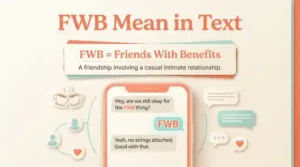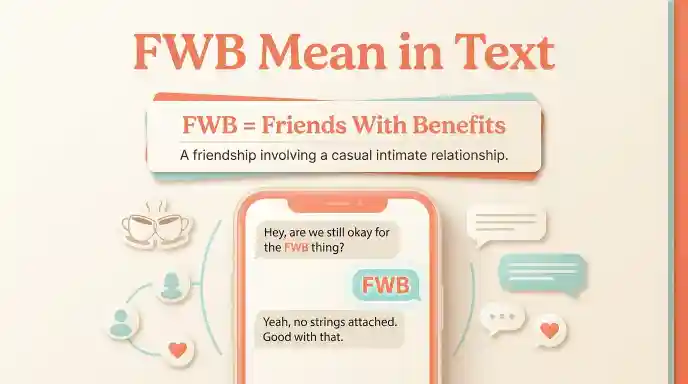
FWB means “friends with benefits” in text messages. It usually describes two people who are friends and have a sexual relationship without being in a traditional committed romantic relationship.
You may see FWB in texting, TikTok comments, Snapchat conversations, Instagram posts, WhatsApp chats, and dating related discussions. Someone might use it when talking about their relationship status or asking what another person wants from a relationship.
The term can be confusing because “benefits” does not refer to money, work benefits, or a reward. In internet slang, it usually refers to physical or sexual intimacy between people who consider themselves friends rather than a conventional couple.
People often search for FWB meaning in text because the abbreviation can appear suddenly in a message. Understanding the context helps you know what the other person is talking about before you respond.
FWB Meaning in Text
FWB is an abbreviation for “friends with benefits.”
In everyday texting, it normally describes a relationship in which two people have a friendship while also having sexual or physical intimacy. The important part is that the arrangement is generally not presented as a traditional romantic relationship with the same expectations as dating or being a committed couple.
For example, someone might text:
“We’re not dating. We’re just FWB.”
This means the two people have a physical relationship but do not consider themselves a conventional boyfriend and girlfriend or boyfriend and boyfriend/girlfriend and girlfriend couple.
FWB is therefore best described as internet and relationship slang expressed as an acronym. It is not a normal dictionary style word like “friend” or “partner.” Instead, the first letters of the phrase are combined to create a shorter expression.
What Does “Friends With Benefits” Actually Mean?
The word friends refers to the social relationship between the people involved.
The word benefits is the part that can be confusing. In this expression, it usually means physical or sexual intimacy.
So, in simple terms:
FWB = friends + physical or sexual intimacy without a traditional committed relationship.
The exact boundaries can differ from one situation to another. Some people may expect emotional distance, while others may still spend a lot of time together or have feelings for each other.
Because of that, the abbreviation itself does not explain every detail of the relationship.
Is FWB the Same as Dating?
Not necessarily.
Dating often involves romantic interest and may eventually lead to a committed relationship. An FWB arrangement usually emphasizes friendship and physical intimacy without automatically implying romantic commitment.
For example:
Dating:
“We’re seeing each other and trying to build a relationship.”
FWB:
“We’re friends, but we also have a physical relationship.”
However, real relationships are not always so clearly divided. Two people might start as FWB and later develop romantic feelings. Others may decide to stop the arrangement because it becomes complicated.
Does FWB Mean Boyfriend or Girlfriend?
No.
FWB does not normally mean boyfriend or girlfriend.
If someone says, “She’s my FWB,” they are usually saying that the person is a friend with whom they have a physical or sexual relationship.
The phrase does not automatically indicate that they are a romantic couple.
Where People Use FWB
FWB can appear on almost any platform where people discuss friendships, dating, relationships, or personal situations.
The meaning usually stays the same, but the surrounding conversation provides important context.
FWB on TikTok
On TikTok, people may use FWB in captions, comments, videos, or discussions about modern relationships.
For example:
“POV: Your FWB catches feelings.”
Here, the creator is talking about a situation in which a person in an FWB arrangement begins developing romantic emotions.
You may also see phrases such as:
- “FWB situation”
- “FWB turned relationship”
- “FWB boundaries”
- “My FWB texted me”
- “When your FWB gets jealous”
TikTok discussions can be humorous, serious, educational, or personal, so the surrounding video or caption matters.
FWB on Snapchat
Snapchat users may use FWB in private messages when talking about relationships or personal situations.
For example:
“Are you two dating?”
“Nah, we’re FWB.”
Because Snapchat conversations are often short and informal, abbreviations such as FWB make it easier to communicate the idea quickly.
FWB on Instagram
On Instagram, FWB can appear in comments, captions, direct messages, memes, and relationship related posts.
Someone might write:
“When your FWB starts acting like your partner…”
The abbreviation saves space and is easily understood by people familiar with online relationship language.
FWB on WhatsApp
WhatsApp conversations can be more personal, so FWB may appear when someone is discussing their relationship with a friend.
For example:
“He asked if I wanted to be FWB.”
The recipient can understand that the person is talking about a proposed friends with benefits arrangement.
FWB in SMS Texting
FWB is also used in ordinary phone messages.
A short conversation might look like this:
“So what are you two?”
“We’re FWB.”
In this situation, the abbreviation is simply a quicker way to say “friends with benefits.”
Real Chat Examples of FWB
The easiest way to understand an abbreviation is to see how people actually use it.
Here are ten realistic examples.
Example 1: Explaining a Relationship
A: Are you and Jake dating?
B: Not exactly. We’re FWB.
A: Oh, okay. Got it.
Here, B uses FWB to explain that the relationship is not traditional dating.
Example 2: Asking What FWB Means
A: She said she wants us to be FWB.
B: Do you know what that means?
A: Yeah, friends with benefits.
This is a common situation where someone may search for the abbreviation before responding.
Example 3: Setting Boundaries
A: Are you looking for a relationship?
B: Not right now. I’d rather keep things FWB.
A: Thanks for being clear.
Here, the person is using FWB to describe the type of relationship they want.
Example 4: Talking About Feelings
A: I think my FWB is catching feelings.
B: Did they say something?
A: Not directly, but they’ve been acting differently.
The phrase can be used when discussing emotional changes within an arrangement.
Example 5: Casual Conversation
A: Who was that guy you were with?
B: He’s my FWB.
A: Ah, that explains it.
The abbreviation gives a short explanation without going into details.
Example 6: Asking for Clarification
A: He said we could be FWB.
B: Wait, what does FWB mean?
A: Friends with benefits.
This is especially realistic for someone who has never encountered the acronym before.
Example 7: Discussing Expectations
A: Are you okay with being FWB?
B: Maybe, but I think we’d need clear boundaries.
A: That’s fair.
Here, the conversation focuses on expectations rather than simply using the slang.
Example 8: Social Media Conversation
A: Did you see that FWB video I sent you?
B: Yeah 😂
A: That situation was way too relatable.
The abbreviation can appear naturally when friends share relationship related content.
Example 9: Ending an Arrangement
A: Are you still FWB with Sam?
B: No, we decided to stop.
A: Probably for the best if it was getting complicated.
FWB can describe an arrangement that existed in the past as well as one that is currently happening.
Example 10: Simple Text Question
A: What are you looking for right now?
B: Honestly, maybe FWB.
A: Thanks for being honest.
Here, FWB is being used to communicate relationship expectations directly.
How to Reply When Someone Says “FWB”
Your response depends on the situation and what you want.
If someone sends FWB and you do not know what they mean, there is nothing wrong with asking.
You can simply say:
“What do you mean by FWB?”
Or:
“Do you mean friends with benefits?”
If you already understand the meaning, your reply can depend on the tone of the conversation.
Funny Replies
If the conversation is clearly playful, you could respond with humor:
“Okay, acronym expert 😂”
“You really skipped straight to the abbreviations.”
“I had to Google that one 😂”
Humor works best when you already know the person and understand that they are comfortable joking about the subject.
Casual Replies
For a relaxed conversation, you could say:
“Oh, I get you.”
“Okay, thanks for explaining.”
“Got it. What are you looking for exactly?”
These responses keep the conversation natural without making assumptions.
Friendly Replies
If you want to keep the conversation respectful and open:
“Thanks for being honest with me.”
“I understand. What would that look like for you?”
“I appreciate you explaining it.”
These replies can help start a clearer conversation about expectations.
Neutral Replies
If you are unsure how you feel, a neutral response is useful:
“What does that mean for you?”
“I’d need to think about that.”
“I’m not sure that’s what I’m looking for.”
“Can we talk about what you mean?”
You do not have to immediately agree or reject the idea simply because someone uses the abbreviation.
Is FWB Rude or Offensive?
FWB is not automatically a rude or offensive abbreviation. It is a common informal term for a type of relationship involving sexual or physical intimacy.
However, the subject itself is personal. That means the appropriateness of the term depends heavily on the audience and situation.
For example, using FWB in a private conversation between adults is different from using it in a classroom discussion or professional email.
Is FWB Safe to Use in Casual Conversation?
It can be appropriate in casual conversations when everyone involved understands the meaning and is comfortable discussing the subject.
If you are speaking with someone you do not know well, however, it may be better to use clearer wording or wait for the context to make the meaning appropriate.
Can You Use FWB at School?
This depends on the situation.
FWB is not generally appropriate as casual slang in a classroom or school conversation because it refers to an adult relationship involving sexual intimacy.
If the subject is being discussed for an educational reason, it is usually clearer to use direct and age appropriate language rather than relying on slang.
Can You Use FWB at Work?
FWB is generally not suitable for ordinary professional communication.
You would not normally put “FWB” in a work email, business report, application, or formal message.
If a workplace conversation genuinely requires discussion of relationships or personal matters, clear and professional wording is usually better.
Is FWB a Bad Word?
No.
FWB is not a swear word. It is an abbreviation describing a relationship arrangement.
Still, not being a swear word does not mean it is appropriate for every audience. Context matters.
Who Uses This Term?
FWB is most commonly seen among people familiar with modern online relationship language.
The abbreviation is particularly common in informal digital communication, dating conversations, social media discussions, and online communities.
Do Gen Z Users Say FWB?
Yes, Gen Z users may use FWB in online conversations, particularly when discussing dating and relationship arrangements.
However, FWB is not exclusive to Gen Z. Older adults who use texting, dating apps, social media, or online communities may also recognize and use the abbreviation.
The important point is that FWB is an internet friendly abbreviation rather than a term belonging to one exact age group.
Where Is FWB Most Common?
You may encounter it in:
- Text messages
- Dating conversations
- TikTok
- Snapchat
- Dating apps
- Online forums
- Relationship discussions
- Social media comments
Its frequency can vary significantly depending on the platform and the type of conversation.
Why Do People Use the Short Form?
The main reason is convenience.
Writing FWB takes three letters instead of repeatedly writing friends with benefits.
Internet users often shorten phrases when the intended audience already understands the abbreviation.
This is similar to other texting expressions such as IDK, IDC, IMO, and BRB.
Origin of the Term
The exact origin of FWB as an abbreviation is not always easy to trace to one specific person or one specific online platform.
The full phrase “friends with benefits” became widely recognized as a description of relationships in modern popular culture, while the shortened form FWB became convenient for texting and online communication.
Internet culture helped abbreviations like FWB spread because online conversations favor short, recognizable expressions.
The phrase also appeared in discussions of dating, relationships, entertainment, and popular media, which helped make it familiar to a wider audience.
Why Is the Origin Difficult to Pin Down?
Many slang expressions develop gradually.
A phrase may first be used in ordinary speech, then appear in books, movies, magazines, online forums, social media, and text messages. The shortened version may emerge later without a single documented creator.
That appears to be the case with FWB. Rather than having one universally accepted inventor, the abbreviation developed as a practical shorthand for an already familiar phrase.
So it is more accurate to describe its origin as uncertain and connected to the broader development of modern relationship language and internet communication.
FWB vs IDK vs IDC vs IMO vs BRB
FWB belongs to a much larger group of internet abbreviations.
However, these terms have very different meanings and are used in different situations.
| Term | Meaning | Type | Usage | Popularity |
| FWB | Friends with benefits | Relationship acronym | Dating and personal conversations | Common in relationship discussions |
| IDK | I don’t know | Texting abbreviation | Everyday chats and messages | Very common |
| IDC | I don’t care | Texting abbreviation | Casual conversations and replies | Very common |
| IMO | In my opinion | Texting abbreviation | Opinions, comments, and discussions | Very common |
| BRB | Be right back | Texting abbreviation | Temporary pauses in chats | Widely recognized |
The biggest difference is the subject.
IDK, IDC, IMO, and BRB are general texting expressions. They can appear in everyday conversations about almost anything.
FWB, on the other hand, is specifically associated with relationships and physical intimacy.
For example:
“IDK what to do.”
This simply means:
“I don’t know what to do.”
But:
“We’re FWB.”
describes a particular type of relationship.
Real World Usage Example
Imagine two adults who have been friends for several months.
They enjoy spending time together and have a close friendship. At some point, they decide to have a physical relationship but do not want to call themselves a romantic couple.
One person might explain the situation to a friend by saying:
“We’re not officially dating. We’re FWB.”
The friend understands that the two people have a friendship along with physical intimacy, but they are not describing themselves as a traditional committed couple.
In real life, the details can vary. Some people may establish clear boundaries and keep the relationship casual. Others may spend more time together or develop romantic feelings.
That is why the abbreviation tells you the general type of arrangement, but it does not tell you everything about the people involved.
If someone uses FWB in a conversation, it is better not to assume additional details. Ask for clarification if those details matter.
Why Context Matters With FWB
Short internet abbreviations can sometimes be misunderstood.
For example, someone might use FWB while discussing a movie, a dating situation, a personal story, or a joke. The surrounding words usually make the intended meaning clear.
If someone writes:
“My FWB just texted me.”
the relationship meaning is obvious.
But if you only see:
“FWB?”
without any context, you may need to ask what the person means.
This is one reason people search for slang definitions online. A short abbreviation can carry a lot of meaning even though it contains only three letters.
FWB Does Not Explain the Whole Relationship
It is important to remember that labels are shortcuts.
Two people who describe themselves as FWB may have very different expectations.
For one pair, it might be a short term arrangement. For another, it might continue for a long time. One person might want strict boundaries, while another might eventually want a romantic relationship.
The abbreviation itself does not tell you:
- How long the relationship has existed
- How often the people see each other
- Whether they are exclusive
- Whether they have romantic feelings
- What boundaries they have agreed on
- Whether they plan to continue the arrangement
Those details have to come from the people involved.
Common Misunderstandings About FWB
A few misunderstandings appear frequently when people first encounter the term.
FWB Does Not Mean “Best Friend”
Someone might incorrectly assume that FWB simply means a very close friendship.
It does not.
The “benefits” part gives the phrase its relationship related meaning.
FWB Does Not Automatically Mean a Romantic Relationship
An FWB arrangement may involve closeness, affection, or friendship, but the acronym does not automatically mean the people are romantically committed.
FWB Is Not a Workplace Benefit
The word “benefits” can sound like employment language.
In this slang expression, it has nothing to do with health insurance, paid leave, salary, or employee benefits.
FWB Is Not Always Permanent
People can stop an FWB arrangement at any time. The term describes the type of relationship rather than guaranteeing how long it will last.
How to Understand FWB From Context
When you see FWB in a message, look at the words around it.
If the conversation includes dating, relationships, attraction, hookups, or romantic situations, friends with benefits is almost certainly the intended meaning.
For example:
“Are you two together?”
“No, we’re FWB.”
The context makes the meaning clear.
If the abbreviation appears somewhere unusual, asking for clarification is the safest approach.
You can simply say:
“Do you mean friends with benefits?”
That avoids guessing.
Frequently Asked Questions
What does FWB mean in text messages?
FWB means “friends with benefits.” It usually describes friends who have a physical or sexual relationship without describing themselves as a traditional committed romantic couple.
What does FWB mean on TikTok?
On TikTok, FWB usually has the same meaning: friends with benefits. It commonly appears in videos, captions, comments, and discussions about dating or relationships.
Is FWB slang?
Yes. FWB is an informal relationship acronym commonly used in texting and online communication. It is a shortened form of “friends with benefits.”
Is FWB rude or offensive?
FWB is not a swear word or automatically offensive. However, it refers to a personal and sexual type of relationship, so it may not be appropriate for school, professional settings, children, or formal communication.
How should you reply to FWB?
If you do not understand it, ask, “Do you mean friends with benefits?” If you understand the meaning, respond according to your own comfort and the context of the conversation.
Conclusion
FWB means “friends with benefits” in text. It is an informal acronym used to describe a friendship that also includes physical or sexual intimacy without automatically describing the people as a committed romantic couple.
You may see FWB in text messages, TikTok videos, Snapchat chats, Instagram posts, WhatsApp conversations, dating discussions, and other online spaces.
The abbreviation is easy to understand once you know what the three letters represent, but the exact relationship behind the term can vary from person to person.
Because FWB refers to a personal relationship, context is important. It can be fine in casual conversations where the subject is appropriate, but it is generally not suitable for formal school or workplace communication.
If someone sends you “FWB” and you are unsure what they mean, the simplest response is to ask. A short clarification can prevent a misunderstanding and make the conversation much clearer.
Read More:
- FW Mean in Text: What Does FW Mean in Texting in 2026?
- FYE Mean in Text: Uses, Examples, and Meaning in 2026
- FS Mean in Text: What Does “FS” Stand For?

Hi, I’m Olivia Carter. I enjoy researching English slang, online expressions, and everyday vocabulary. I write clear, beginner-friendly guides with simple definitions and practical examples to make modern English easier to understand.