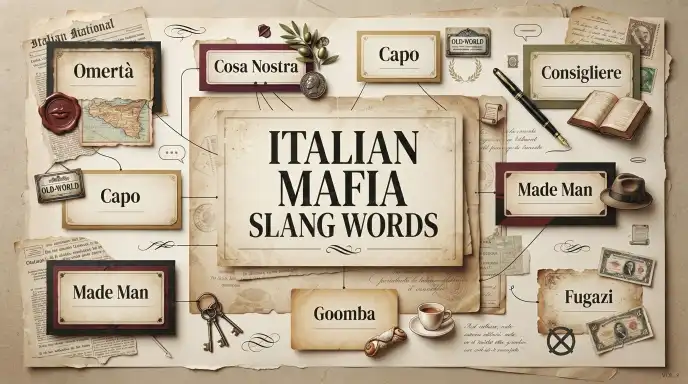
Italian Mafia Slang Words refers to the coded vocabulary used within organized crime culture like “omertà” (the code of silence) and “goombah” (a friend or associate) blending Italian dialects with American street slang.
This language developed in neighborhoods where Italian immigrants mixed their native dialects with English street talk, creating a unique vocabulary tied to loyalty, business, and power.
Some words were genuine underworld code words developed to avoid police wiretaps, while others became widely recognized through mafia movies and pop culture, even among people unfamiliar with real organized crime.
In this guide, you’ll learn popular Italian mafia slang terms, their meanings, and the cultural history behind this iconic vocabulary purely from an educational and pop-culture perspective.
Quick Answer
Italian Mafia slang words are informal or specialized terms linked to the Italian Mafia and Italian-American organized crime. Some describe roles, while others describe ideas, relationships, or criminal acts.
Word at a Glance
| Feature | Details |
| Topic | Italian Mafia slang |
| Language | Italian, Sicilian, and Italian-American English |
| Common Contexts | History, films, books, journalism, pop culture |
| Tone | Informal or historical |
| Common Terms | Capo, Don, consigliere, soldato, omertà |
| Formal Use | Depends on context |
What Are Italian Mafia Slang Words?
Italian Mafia slang words are terms used to describe people, roles, customs, relationships, and activities connected with Mafia culture.
Not every word associated with the Mafia is actually slang. Some are normal Italian words that gained a special meaning in discussions about organized crime.
For example:
Capo simply means “head” or “chief” in Italian. In Mafia contexts, it can refer to a leader or boss.
Likewise, soldato normally means “soldier.” In Mafia language, it can describe a lower-ranking inducted member.
This difference is important when learning Mafia-related vocabulary.
Cosa Nostra
Cosa Nostra is one of the most famous terms associated with the Sicilian Mafia.
It literally means:
“Our thing.”
The expression is strongly associated with the Sicilian Mafia and is also widely used in English-language discussions of organized crime.
Example
“The book explores the history of Cosa Nostra.”
Here, Cosa Nostra refers to the Sicilian Mafia rather than the literal meaning “our thing.”
Capo
Capo means “head” or “chief” in Italian.
In Mafia-related language, it can refer to a leader or person in charge of a group.
You may also hear capo in terms such as:
caporegime
This refers to a person who leads a group of Mafia members in traditional descriptions of the American Mafia.
Example
“The film portrays him as a capo.”
The term here describes his position within the fictional crime organization.
Don
Don is a title used before a man’s name in some Italian and Italian-American contexts.
In Mafia stories, Don is often used for a boss or senior Mafia figure.
For example:
“Don Carlo”
The title does not literally mean “Mafia boss.” It is a form of address that became strongly associated with Mafia characters in popular culture.
Because of movies and television, Don is now one of the most recognizable Mafia-related terms.
Consigliere
Consigliere means “adviser” or “counselor.”
In descriptions of Mafia organizations, a consigliere is usually portrayed as a trusted adviser to the boss.
The word comes from Italian and is not exclusively a Mafia slang word.
Example
“The boss asked his consigliere for advice.”
The term is often used in books, films, and discussions about Mafia history.
Soldato
Soldato is the Italian word for “soldier.”
In Mafia-related language, it can describe an inducted lower-ranking member of a Mafia organization.
The plural is:
soldati
Example
“The story follows a young soldato.”
Here, the word describes the character’s role within the fictional organization.
Omertà
Omertà is a famous term connected with the Sicilian Mafia.
It generally refers to a code of silence and the refusal to cooperate with authorities.
The word is strongly associated with Mafia culture and organized crime, although its history and use are more complex than the simple definition often given in movies.
Example
“The documentary discusses omertà and its role in Mafia history.”
The term is often used when discussing secrecy and silence around organized crime.
Made Man
Made man is mainly an Italian-American Mafia term, rather than standard Italian slang.
It traditionally refers to a person who has been formally inducted into a Mafia organization.
The phrase became widely known through American Mafia stories and popular culture.
Example
“The movie describes him as a made man.”
The term is usually associated with the American Mafia.
Associate
An associate is someone who works with members of a Mafia organization but is not an inducted member.
This word is common in discussions of organized crime in the United States.
An associate may have connections with members of a crime group without holding the same status as an inducted member.
Family
In Mafia-related language, family can refer to an organized crime group.
It does not necessarily mean a group of biological relatives.
For example:
“He joined the crime family.”
This means he became connected with a particular organized-crime group.
The term became especially common in descriptions of the Italian-American Mafia.
Wiseguy
Wiseguy is an informal American term associated with Mafia members and organized crime.
It can also simply mean a person who makes smart or sarcastic comments, so context matters.
In Mafia-related stories, however, wiseguy may refer to a person involved with the organization.
Example
“The movie follows several wiseguys.”
Here, the word refers to Mafia-connected characters.
Hit
Hit is criminal slang for a planned killing.
It is not an Italian word. It is mainly associated with English-language organized-crime slang.
You may see it in movies, books, and news reports about organized crime.
Example
“The detective was investigating a suspected hit.”
This means the detective was investigating a planned killing.
Whack
Whack is American crime slang meaning to kill someone.
It became strongly associated with Mafia stories and American organized-crime culture.
The term is informal and should not be confused with standard Italian vocabulary.
Example
“The character threatened to whack his rival.”
This is mainly the kind of usage found in fictional or crime-related contexts.
Caporegime
Caporegime, often shortened to capo, is a term used in descriptions of the Italian-American Mafia.
A caporegime is traditionally described as a person who leads a group of members within a crime family.
The word combines capo, meaning “head” or “chief,” with a term related to rank or leadership.
Example
“The film portrays him as a capo.”
Here, capo refers to a Mafia leader.
Underboss
Underboss is mainly an English-language Mafia term.
It describes a senior person who usually serves as the boss’s second-in-command.
People strongly associate this word with descriptions of the American Mafia.
Example
“The underboss met with the family’s leader.”
This term is more common in English than in everyday Italian.
Boss
Boss is another common English term used in Mafia stories.
It refers to the leader of a crime family or organization.
In Italian-American Mafia discussions, the leader may also be called a Don.
Example
“The boss controlled the organization.”
The word itself is not uniquely Mafia slang. It is simply given a specific meaning in organized-crime discussions.
Mob
Mob is an informal English word for an organized criminal group.
It is often used when talking about the Italian-American Mafia, although the term can describe other criminal groups too.
Example
“The movie is about an old mob family.”
The word mob is more common in American English than in Italian.
Gangster
Gangster means a person involved in organized crime or a gang.
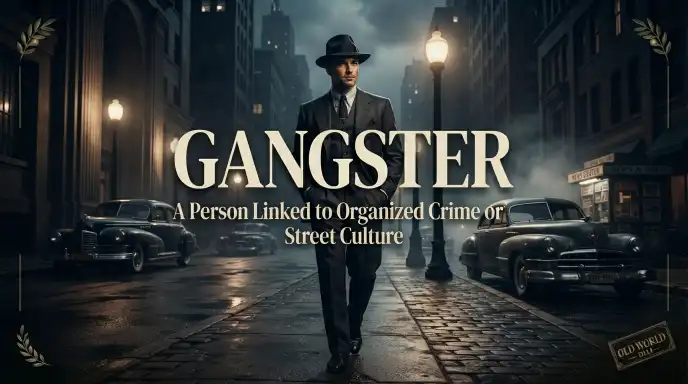
It is not specifically Italian Mafia slang, but it is strongly connected with Mafia-related movies, books, and popular culture.
Example
“The story follows a young gangster.”
The term can describe criminals from many different backgrounds.
Goomba
Goomba is an Italian-American slang term that became associated with Mafia and street culture.
It comes from an Italian-American pronunciation related to compare, a word that can mean friend, companion, or godfather in certain southern Italian dialect contexts.
In American popular culture, people use “goomba” in different ways, and it can sometimes reinforce a stereotype.
Because of this, people should use the term carefully.
Gabagool
Gabagool is an Italian-American pronunciation of capocollo, a type of cured pork.
It is not actually Mafia slang, even though movies and television helped connect the word with Italian-American characters and Mafia culture.
You may hear it in jokes about Italian-American speech.
Example
“The character orders gabagool at the deli.”
The word refers to food, not a Mafia rank or secret code.
Fugazi
“Fugazi” is an Italian-American slang term for something fake, worthless, or not genuine.
The word became popular in American street and crime culture, but people still debate its exact origin.
Example
“That deal is fugazi.”
Meaning:
“That deal is fake.”
It is not a standard Italian Mafia term.
Paisan
Paisan is an Italian-American form related to the Italian word paesano, meaning countryman or fellow Italian.
In some contexts, it can be a friendly way to refer to another Italian or Italian-American person.
The tone depends on who uses the term and how they say it.
Example
“Hey, paisan!”
This can mean something like:
“Hey, fellow Italian!”
It is not specifically a Mafia term.
Mobster
“Mobster” describes a person who belongs to an organized criminal group.
News reports, books, films, and Mafia discussions commonly use this term.
Example
“The film follows a young mobster.”
The word does not identify a specific Mafia rank.
Snitch
Snitch is American slang for a person who gives information about someone to authorities or other people.
It is not an Italian word, but it appears often in crime and Mafia-related stories.
Example
People accused the character of being a snitch.
The word is informal and can be insulting.
Rat
Rat is another English slang term for someone who betrays others or gives information to authorities.
Mafia movies and crime stories often use this term.
Example
“They believed he was a rat.”
Here, rat does not refer to the animal. It means a person accused of betrayal or informing.
Informant
Informant is a more neutral term than snitch or rat.
It describes someone who provides information to law enforcement or another authority.
Example
“The police relied on an informant during the investigation.”
Unlike “rat,” people can use this word in formal reports.
Italian vs. Italian-American Mafia Slang
It is important not to mix all these terms together.
| Term | Italian/Sicilian Connection | Common in American Mafia Culture |
| Cosa Nostra | Yes | Yes |
| Capo | Yes | Yes |
| Consigliere | Italian word | Yes |
| Soldato | Italian word | Yes |
| Omertà | Strong Sicilian connection | Yes |
| Don | Italian title | Yes |
| Made man | No | Yes |
| Wiseguy | No | Yes |
| Underboss | No | Yes |
| Mobster | No | Yes |
| Gabagool | Italian-American pronunciation | Yes |
| Snitch | No | Yes |
This distinction helps readers understand that Italian Mafia language and Italian-American Mafia slang are not exactly the same thing.
Common Misunderstandings
1. Every Italian Slang Word Is Mafia Slang
No. Italian has many regional slang words that have nothing to do with organized crime.
2. Gabagool Is a Secret Mafia Word
No. Gabagool refers to capocollo, a type of cured meat. Its Mafia connection mostly comes from Italian-American popular culture.
3. Don Means Mafia Boss in Italian
Not exactly. Don is a title of respect. Mafia stories made its association with crime bosses especially famous.
4. Consigliere Means Criminal
No. Consigliere simply means an adviser or counselor. Its Mafia meaning comes from its use as a role within organized-crime stories and organizations.
5. All Mafia Slang Comes From Italy
No. Many well-known Mafia terms in English come from Italian-American culture, not directly from Italian or Sicilian.
Frequently Asked Questions
1. What are Italian Mafia slang words?
They are words and expressions connected with Mafia culture, organized crime, Italian-American crime groups, or fictional Mafia stories.
2. What does Cosa Nostra mean?
Cosa Nostra literally means “our thing.” The term refers to the Sicilian Mafia.
3. What does capo mean in Mafia slang?
Capo means leader or chief in Mafia-related contexts. It is also a normal Italian word meaning “head.”
4. What does consigliere mean?
A consigliere serves as a trusted adviser to the boss in Mafia organizations.
5. What does omertà mean?
Omertà means a code of silence. The Sicilian Mafia strongly follows this code.
6. What is a made man?
In Italian-American Mafia culture, people call someone a “made man” after the Mafia formally inducts him into the organization.
7. Is gabagool Mafia slang?
No. Gabagool is an Italian-American pronunciation of capocollo, a cured meat. It became associated with Mafia culture through popular entertainment.
8. What does wiseguy mean?
In Mafia-related American slang, wiseguy can refer to a Mafia member or associate. In other situations, it can simply mean a person who makes sarcastic remarks.
Conclusion
Italian Mafia slang words include a mix of Italian, Sicilian, Italian-American, and English expressions. Terms such as Cosa Nostra, capo, consigliere, soldato, and omertà have strong connections to Mafia history and culture.
Other words, such as made man, wiseguy, underboss, mobster, and snitch, are mainly part of American organized-crime vocabulary.
It is also important to separate real historical terms from words popularized by movies and television. Not every Italian word used in a Mafia movie is actually Mafia slang.
Read More:
- What Is PTSO Slang: Confused by This Comment? Read This
- Coffee in Spanish Slang: What Do People Call Coffee?
- Rail Slang: Sound Like a True Railroad Insider

Hi, I’m Sophia Turner, a writer at SlangRise with 7 years of experience researching English slang, internet abbreviations, and modern vocabulary.