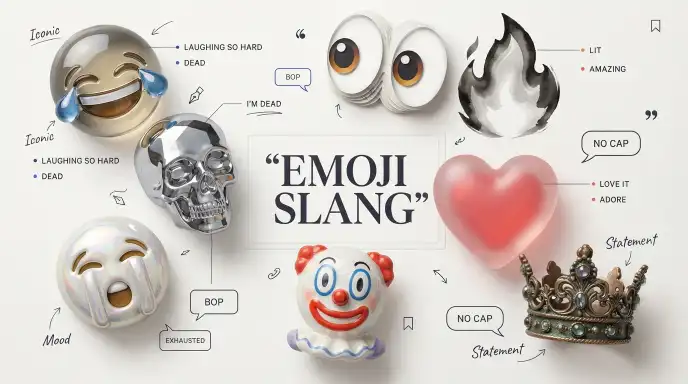
Emoji Slang refers to the hidden or evolved meanings behind common emojis like 💀 (meaning “I’m dead/dying of laughter”) or 👀 (meaning “watching closely” or suggestive interest) that go beyond their literal appearance.
As texting and social media evolved, certain emojis took on entirely new meanings shaped by internet culture, memes, and generational slang trends.
Understanding this hidden language helps you accurately interpret texts, comments, and captions, especially when chatting with younger generations like Gen Z.
In this guide, you’ll learn the true meanings behind popular emoji slang, how they evolved, and how to use them correctly in everyday conversations.
Quick Answer
Emoji slang means using emojis in casual or online communication to express meanings beyond their basic symbols. The same emoji can have different meanings depending on the message, relationship, and context.
Word at a Glance
| Feature | Details |
| Term | Emoji Slang |
| Meaning | Informal meanings given to emojis |
| Type | Internet slang |
| Common Contexts | Texting, social media, gaming, chats |
| Tone | Casual |
| Popular Platforms | TikTok, Instagram, Snapchat, Discord |
| Formal Use | Limited |
What Does Emoji Slang Mean?
Emoji slang refers to the informal ways people use emojis in digital conversations.
An emoji can communicate an idea without using words. Sometimes people also use an emoji in a way that is different from its official or literal meaning.
For example:
“That test was so hard 💀”
The 💀 emoji does not mean someone literally died. Here, it can mean:
“That was so funny, shocking, or overwhelming that I’m ‘dead.’”
Another example:
“You really did that 😭”
The 😭 emoji may show strong laughter, emotion, disbelief, or dramatic reaction.
The surrounding words help explain the intended meaning.
Why Do People Use Emoji Slang?
Emojis make online conversations faster and more expressive.
To Show Emotion
An emoji can add emotion that plain text may not show clearly.
“Okay 😂”
The emoji changes the feeling of the message.
To Make Jokes Clear
A funny emoji can show that a statement is not serious.
“I’m never doing that again 💀”
To React Quickly
Instead of writing a full sentence, someone can respond with one emoji.
“🔥”
This may mean something is excellent, exciting, or impressive.
To Add Personality
People often choose emojis that match their personal texting style.
Common Emoji Slang Meanings
Some emojis have developed popular informal meanings online.
| Emoji | Common Slang Meaning |
| 😂 | Something is very funny |
| 💀 | Something is extremely funny or shocking |
| 😭 | Strong emotion, laughter, or disbelief |
| 🔥 | Excellent, impressive, or attractive |
| 👀 | Interest, curiosity, or “I’m watching” |
| 🗿 | Unbothered, emotionless, or deadpan reaction |
| 🤡 | Someone acted foolishly |
| 🧢 | Lying or exaggerating |
| 🚩 | Warning sign or bad behavior |
| 💅 | Confidence, attitude, or feeling proud |
| 🤨 | Doubt or suspicion |
| 🥶 | Impressive, intense, or “cold” |
| ❤️ | Love, support, or strong approval |
| 👍 | Agreement or approval |
These meanings are informal. They can change based on the conversation.
What Does 😂 Mean in Slang?
The 😂 emoji is commonly called the face with tears of joy emoji.
In casual texting, it usually means:
“That is really funny.”
Example:
“He fell off the chair 😂”
The emoji shows that the speaker finds the situation funny.
People may also use 😂 to soften a playful comment.
What Does 💀 Mean in Slang?
The 💀 emoji is often used to mean:
“I’m dead from laughing.”
It can also show shock, disbelief, embarrassment, or an extreme reaction.
Example:
“He really sent that message to his boss 💀”
The speaker is not talking about actual death. The emoji shows a strong reaction.
What Does 😭 Mean in Slang?
The 😭 emoji officially represents a person crying, but online it has several informal uses.
It can mean:
- I’m laughing so hard
- I’m overwhelmed
- I can’t believe this
- I’m very emotional
- This is too funny
Example:
“Why did he say that 😭”
The exact meaning depends on the conversation.
What Does 🔥 Mean in Slang?
🔥 is often used to say that something is excellent, exciting, attractive, or impressive.
Examples:
“That song is 🔥.”
Meaning:
“That song is really good.”
It can also describe clothing:
“That outfit is 🔥.”
Meaning:
“That outfit looks amazing.”
What Does 👀 Mean in Slang?
👀 often means interest, curiosity, attention, or suspicion.
Example:
“So you two are dating now? 👀”
The emoji suggests:
“I’m interested in this information.”
It can also mean:
“I’m watching.”
What Does 🧢 Mean in Slang?
🧢 can mean a lie or something that is not true.
This comes from the slang use of cap, which means a lie.
Example:
“You said you got 100%? 🧢”
Meaning:
“I don’t believe you.”
The opposite expression is often “no cap,” meaning “I’m telling the truth.”
What Does 💅 Mean in Slang?
💅 can represent confidence, attitude, pride, or a stylish feeling.
Example:
“I finished my work before everyone else 💅”
The emoji adds a confident or playful tone.
It does not always relate to actual nail polish.
What Does 🚩 Mean in Slang?
🚩 is commonly used as a warning sign.
People often use it when talking about behavior they consider problematic.
Example:
“He never respects anyone’s time 🚩”
Meaning:
“That’s a warning sign.”
The emoji is especially common in conversations about dating, friendships, and relationships.
Can Emoji Slang Have Different Meanings?
Yes. Context is very important.
For example, 😭 can mean actual sadness in one message:
“I miss my family 😭”
But it can show laughter or disbelief in another:
“He really wore that to the party 😭”
The same emoji can communicate very different emotions.
That is why you should read the whole message, not just the emoji.
How Emoji Slang Changes Meaning
Emoji meanings can change based on the words around them. The same emoji may express different emotions in different conversations.
For example:
“I can’t believe you did that 😭”
Here, 😭 may show shock or disbelief.
But:
“That video is so funny 😭”
Here, 😭 may mean laughing very hard.
The relationship between the people also matters. Friends may use emojis in playful ways that strangers could misunderstand.
Popular Emoji Slang Examples
Here are more emojis that often have informal meanings online.
| Emoji | Slang Meaning | Example |
| 😭 | Laughing, overwhelmed, or emotional | “That was wild 😭” |
| 💀 | Extremely funny or shocking | “He actually said that 💀” |
| 🤡 | Foolish behavior | “I trusted him again 🤡” |
| 👀 | Interest or curiosity | “You like her? 👀” |
| 🤨 | Doubt or suspicion | “Are you serious? 🤨” |
| 🥶 | Impressive or intense | “That comeback was 🥶” |
| 💅 | Confidence or attitude | “I knew I could do it 💅” |
| 🔥 | Excellent or attractive | “This song is 🔥” |
| 🚩 | Warning sign | “He lies all the time 🚩” |
| 🫠 | Overwhelmed or embarrassed | “I forgot my own name 🫠” |
| 🤝 | Agreement or support | “We got this 🤝” |
| 🗿 | Unbothered or deadpan | “He didn’t react at all 🗿” |
These are informal uses. They are not fixed definitions.
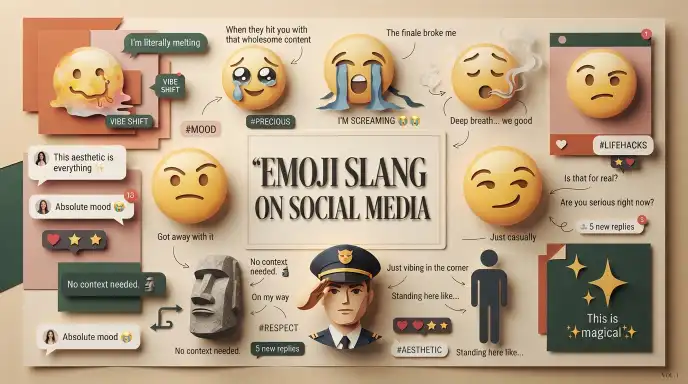
Emoji Slang on Social Media
Emoji slang is especially common on social media because users often communicate through short comments and reactions.
TikTok
Users may combine emojis with slang words to react to videos.
“Bro really did that 💀”
Emojis often appear in comments about fashion, photos, music, and relationships.
“This look 🔥🔥”
Snapchat
Friends may use emojis as quick reactions to messages and stories.
“You really posted that 😂”
Discord
Gaming communities often use emojis to show excitement, frustration, humor, or sarcasm.
“That was a inexplicable play 🔥”
Emoji Combinations and Their Meanings
People often combine emojis to create a stronger message.
😂💀
This combination often means:
“That is extremely funny.”
Example:
“He fell asleep during the movie 😂💀”
👀☕️
This can suggest:
“I’m watching the drama” or “Tell me the gossip.”
🔥🔥
Repeated fire emojis usually add emphasis.
“That new song 🔥🔥”
Meaning:
“That song is extremely good.”
🚩🚩🚩
Several red flags can emphasize serious concerns.
“He checks your phone without asking 🚩🚩🚩”
Is Emoji Slang the Same Everywhere?
No. Emoji meanings can change across cultures, age groups, and online communities.
An emoji that seems funny to one person may seem serious to another. Some emojis can also have meanings that are common in one online group but unfamiliar elsewhere.
For this reason, context is more important than the emoji alone.
When Should You Avoid Emoji Slang?
Emoji slang works best in casual communication.
Avoid relying on it in:
- School assignments
- Formal reports
- Business documents
- Job applications
- Legal writing
- Professional complaints
- Academic work
For example, instead of:
“Your idea is 🔥.”
In a professional message, write:
“Your idea is excellent.”
This makes your meaning clear to everyone.
Common Misunderstandings
1. Every Emoji Has One Meaning
No. Many emojis have several meanings depending on context.
2. Emoji Slang Is Universal
No. Different communities can use the same emoji in different ways.
3. 💀 Means Actual Death
Not always. In slang, 💀 often means “I’m dead” from laughter, shock, or embarrassment.
4. 😭 Always Means Sadness
No. Online, 😭 can also show laughter, disbelief, excitement, or being overwhelmed.
5. 🔥 Always Refers to Fire
No. In slang, 🔥 often means excellent, impressive, exciting, or attractive.
6. 🧢 Means a Hat Only
The literal meaning is a cap or hat. In slang, 🧢 can also mean a lie or exaggeration.
Frequently Asked Questions
1. What is emoji slang?
Emoji slang means using emojis in informal ways to express ideas, reactions, emotions, or meanings beyond their basic symbols.
2. What does 💀 mean in texting?
💀 often means something is extremely funny, shocking, or embarrassing. It can be a slang version of saying, “I’m dead.”
3. What does 😭 mean in slang?
😭 can mean laughing hard, disbelief, being overwhelmed, or strong emotion. The context determines the meaning.
4. What does 🔥 mean in slang?
🔥 usually means excellent, impressive, attractive, or exciting.
5. What does 👀 mean in texting?
👀 often shows interest, curiosity, suspicion, or attention.
6. What does 🧢 mean in slang?
🧢 can mean “cap,” or a lie. It may suggest that someone is not telling the truth.
7. Is emoji slang appropriate at work?
It depends on the workplace and message. In formal communication, clear words are safer than slang-heavy emoji use.
8. Can emojis be misunderstood?
Yes. An emoji can have different meanings depending on the person, culture, platform, and conversation.
Conclusion
Emoji slang gives ordinary emojis new meanings in texting and online conversations. Emojis such as 😂, 💀, 😭, 🔥, 👀, 🧢, 💅, and 🚩 can express ideas that go beyond their literal symbols.
The most important rule is to check the context. An emoji does not always mean the same thing in every message.
Emoji slang is useful for casual chats and social media, but clear words are better for formal or professional communication.
Read More:
- Ate Mean Slang: Slaying, Serving & Everything Between
- MMS Meaning Slang: Multimedia Message or “Made Me Smile”?
- OMS Slang Meaning: Emotion, Honesty, or Both?

Hi, I’m Sophia Turner, a writer at SlangRise with 7 years of experience researching English slang, internet abbreviations, and modern vocabulary.