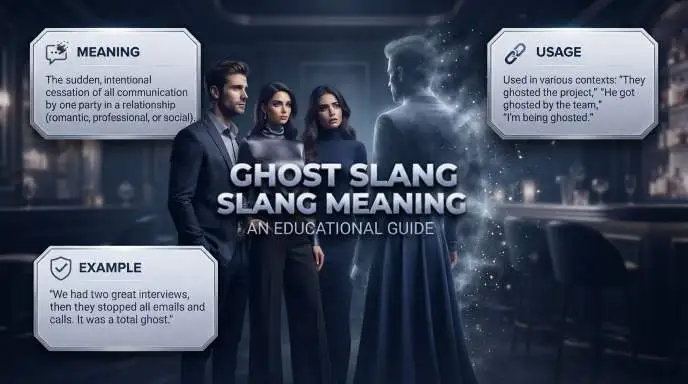
Ghost is slang meaning to suddenly cut off all communication with someone without explanation usually in dating, friendships, or online conversations.
This term became especially popular in modern dating culture, describing the abrupt disappearance of someone who simply stops replying to texts or calls.
Being “ghosted” can leave the other person confused and hurt, since there’s typically no closure, explanation, or warning before the silence begins.
In this guide, you’ll learn the true meaning of “ghosting,” why people do it, and how it’s commonly used in today’s dating and social conversations.
Quick Answer
In slang, ghost means to suddenly cut off communication with someone without giving an explanation. It is often used when a person stops answering texts, calls, or messages and does not say why.
Word at a Glance
| Feature | Details |
| Word | Ghost |
| Slang Meaning | To suddenly stop communicating |
| Part of Speech | Verb |
| Pronunciation | US: /ɡoʊst/ • UK: /ɡəʊst/ |
| Related Forms | Ghosted, ghosting |
| Tone | Informal |
| Common Contexts | Dating, texting, friendships, social media |
| Formal Use | Usually avoid |
What Does Ghost Mean in Slang?
The ghost slang meaning is to end communication by disappearing without telling the other person.
For example, imagine you are texting someone every day. Suddenly, they stop answering your messages. You send another message, but there is still no reply. If they continue avoiding communication without explaining, you might say:
“I think she ghosted me.”
The word can describe both online and offline communication. It is not limited to romantic relationships.
Ghost as a Verb
When ghost is used as a verb, it means to disappear from someone’s communication.
Examples:
- “He ghosted me after our first date.”
- “Why did you ghost her?”
- “She ghosted everyone after the argument.”
Ghosted
Ghosted is the past-tense form.
Examples:
- “I got ghosted last week.”
- “He ghosted me after we exchanged numbers.”
Ghosting
Ghosting describes the act or behavior of suddenly ending communication.
Examples:
- “Ghosting can hurt friendships.”
- “She thinks ghosting is rude.”
Full Meaning of Ghost
Ghost is not an abbreviation. It is a normal English word that gained a popular slang meaning.
The ordinary word ghost refers to a spirit or the supposed appearance of a dead person. The slang use is different.
In slang, the word uses the idea of disappearing like a ghost to describe someone who suddenly disappears from communication.
Different Meanings of Ghost
The word ghost can have different meanings depending on the context.
| Meaning | Context | Example |
| Spirit or supernatural being | Traditional English | “They saw a ghost.” |
| Stop communicating suddenly | Slang | “He ghosted me.” |
| Leave or disappear quietly | Informal use | “I’m going to ghost this party.” |
| Avoid someone online | Social media | “She ghosted my messages.” |
The slang meaning is usually clear when the word appears with someone, texting, dating, messaging, or communication.
Where Is Ghost Commonly Used?
Texting
Ghost is very common in text conversations.
“He stopped replying. I think he ghosted me.”
Dating
The term is often used when someone suddenly stops communicating after a date or while talking online.
“We went on two dates, then she ghosted me.”
Social Media
People may use ghost when someone stops responding to direct messages or comments.
Instagram and Snapchat
Users may describe someone as ghosting when they read or receive messages but stop engaging.
Friendship
Ghosting can happen between friends too.
“My old friend ghosted me after we moved to different cities.”
Workplace Communication
The term may appear informally when someone stops replying to messages or emails. However, ghost is usually too casual for formal workplace writing.
Is Ghost Slang Rude, Offensive, or Harmless?
Ghost is not a swear word or offensive term. However, ghosting someone can be hurtful or frustrating, especially when the person expected an answer.
Calling someone a ghost or saying they ghosted you is usually not offensive. It simply describes their behavior.
The situation matters, though. A person may stop responding because they feel unsafe, overwhelmed, or need space. Not every period of silence is automatically ghosting.
Real-Life Examples
Text Message
Mia: “Did Jake reply?”
Sam: “No. He ghosted me after I asked him about the weekend.”
Dating
Alex: “How did your date go?”
Emma: “It went well, but he ghosted me two days later.”
Friendship
Tom: “Have you talked to Chris?”
Ben: “Not lately. He kind of ghosted everyone.”
“She watched my story but never replied. I think she’s ghosting me.”
Snapchat
“We used to snap every day, and then he just ghosted.”
Workplace Chat
“I sent three messages about the project, but he hasn’t replied.”
In a professional setting, it is better to say “He hasn’t responded” rather than “He ghosted me.”
Origin and History
The slang use of ghost comes from the idea of someone disappearing like a ghost.
The verb became especially common in discussions about dating and relationships during the 2000s and 2010s. Online dating and messaging made it easier for people to stop communicating without having a face-to-face conversation.
The term later spread into wider internet culture. Today, people can ghost friends, coworkers, businesses, recruiters, or other people they communicate with online.
The exact first use of ghost as this type of slang is difficult to pin down. So, it is safer to describe its rise in modern dating and online communication rather than claim one exact creator or date.
Similar Slang or Related Terms
| Term | Meaning |
| Ghost | Suddenly stop communicating |
| Ghosting | The act of suddenly ending communication |
| Ghosted | Suddenly stopped communicating with |
| Left on read | A message was read but not answered |
| Ignore | Choose not to respond |
| Cut off | End contact with someone |
| Soft ghosting | Giving very limited responses instead of fully disappearing |
These terms are related, but they are not identical.
For example, being left on read once does not always mean someone is ghosting you. Ghosting usually suggests a pattern of disappearing or avoiding further communication.
When Should You Avoid Using Ghost?
The word is fine in casual conversations, but avoid it when a more professional phrase is needed.
Avoid phrases like “You ghosted me” in:
- Formal emails
- Job applications
- Business letters
- School assignments
- Professional complaints
- Serious workplace discussions
Instead, use clear phrases such as:
- “You stopped responding.”
- “I haven’t received a response.”
- “I haven’t heard back from you.”
- “Could you please confirm if you received my message?”
This keeps your message polite and clear.
Polite Alternatives
If you want to describe the situation without sounding accusing, choose a softer phrase.
| Instead of | Try |
| “You ghosted me.” | “I haven’t heard back from you.” |
| “Why are you ghosting me?” | “Is everything okay?” |
| “He ghosted the client.” | “He stopped responding to the client.” |
| “She ghosted my messages.” | “She hasn’t replied to my messages.” |
These alternatives work better when the situation is serious or professional.
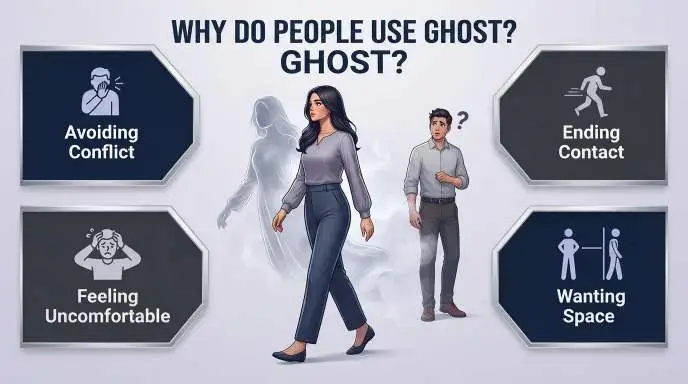
Why Do People Use Ghost?
People use ghost because it is short and easy to understand.
It Describes Sudden Silence
Instead of saying someone suddenly stopped communicating, one word can describe the behavior.
It Is Common in Dating
Dating apps and online messaging made the term especially useful for describing people who disappear after talking or meeting.
It Works Beyond Dating
People also use ghost for friendships, work contacts, online communities, and customer communication.
It Makes Online Behavior Easy to Describe
A sentence like “He ghosted me” quickly tells others that communication stopped without a clear explanation.
Common Misunderstandings
1. Ghosting Always Means Ignoring One Message
Not necessarily. A person missing one message does not automatically mean they are ghosting.
2. Ghosting Only Happens in Dating
No. People can ghost friends, coworkers, recruiters, customers, or online contacts.
3. Ghosting Is Always Intentional
Not always. Sometimes someone may stop responding because of stress, personal problems, safety concerns, or other reasons.
4. Left on Read and Ghosting Mean the Same Thing
Not exactly. Left on read usually describes a message that has been seen but not answered. Ghosting normally suggests a broader or continued lack of communication.
5. Ghost Is a Bad Word
No. Ghost is not profanity. It is a common informal term.
Frequently Asked Questions
1. What does ghost mean in slang?
Ghost means to suddenly stop communicating with someone without explaining why. It is common in dating, texting, friendships, and social media.
2. What does “I got ghosted” mean?
“I got ghosted” means someone suddenly stopped communicating with you without giving an explanation.
3. Is ghosting rude?
It can be seen as rude or hurtful, especially when someone disappears after an ongoing relationship or conversation. However, people may also stop communicating for personal or safety reasons.
4. What is the difference between ghosting and ignoring?
Ignoring can mean not responding to a particular message or situation. Ghosting usually means repeatedly or completely stopping communication with someone.
5. Can you ghost a friend?
Yes. Ghosting is not limited to dating. Someone can ghost a friend by suddenly stopping calls, texts, or other communication.
6. Can ghost be used at work?
The word may be understood in casual workplace conversations, but it is better to use professional phrases such as “stopped responding” or “hasn’t replied.”
Conclusion
The ghost slang meaning is to suddenly stop communicating with someone without giving an explanation. It is commonly used in dating, texting, friendships, and social media.
The words ghost, ghosted, and ghosting all describe this idea in slightly different forms. Still, not every unanswered message is ghosting. Look for a clear pattern of disappearing or avoiding communication before using the term.
For casual conversations, ghost is simple and widely understood. In professional situations, a phrase like “hasn’t responded” is usually a better choice.
Read More:
- BOA Meaning Slang: Definition, Uses, and Examples
- Slang Terms for Meth: Common Names and Meanings
- Choch Slang: The Meaning Behind This Slang Term

Hi, I’m Olivia Carter. I enjoy researching English slang, online expressions, and everyday vocabulary. I write clear, beginner-friendly guides with simple definitions and practical examples to make modern English easier to understand.