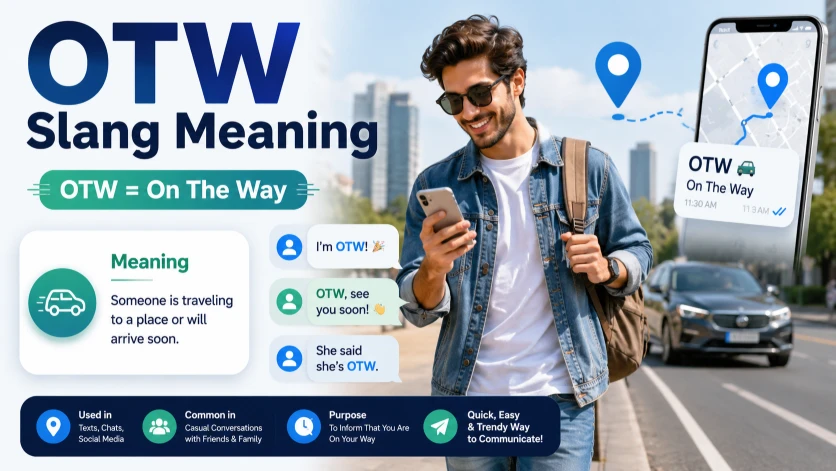
OTW means “On The Way.” People use this short abbreviation in text messages, Snapchat, Instagram, Discord, TikTok, and other online chats when they are heading somewhere or coming to meet someone.
You may see OTW when a friend says they are coming, a package is being delivered, or someone is heading to a meeting.
The meaning is simple, but the way people use it can change with the context.
Many people search for OTW slang because they see it in a message and want to know what it means.
This guide explains the OTW meaning, full form, common uses, examples, and the difference between OTW and OMW.
Quick Answer: OTW Slang
OTW means “On The Way.” People use it in texts, chats, and social media to say they are heading somewhere or coming to meet someone. It is a common, informal, and harmless abbreviation.
Example:
“I’m OTW. See you in 10 minutes!”
| Word | Details |
|---|---|
| OTW | On The Way |
| Meaning | Heading somewhere or coming to a place |
| Type | Texting abbreviation / slang |
| Tone | Casual and friendly |
| Common Contexts | Texting, Snapchat, Instagram, Discord, gaming |
| Example | “I’m OTW to your house.” |
What Does OTW Mean in Text
OTW means “On The Way” in text messages. It tells someone that you are heading to a place or coming to meet them.
People use OTW because it is faster than typing “I’m on my way.” You may see it when someone is traveling to your house, going to a meeting, joining friends, or waiting for a delivery.
Examples:
- “I’m OTW.”
- “OTW to your house.”
- “Food is OTW.”
- “OTW now. See you in 10!”
The exact situation can change, but the basic meaning stays the same: someone or something is on the way.
Is section mein ye line remove karo:
“At its core, OTW simply means “On The Way.”” typing a full sentence.
Full Form of OTW
The full form of OTW is “On The Way.” It means that a person or something is heading toward a destination.
| Abbreviation | Full Form | Meaning |
|---|---|---|
| OTW | On The Way | Heading toward a place or destination |
Example:
“I’m OTW to the store.”
Here, the person is telling you that they are already heading to the store.
Where Is OTW Commonly Used?
OTW is common in casual online conversations. People use it when they want to quickly tell someone they are heading somewhere or that something is on the way.
Text Messages
Texting is one of the most common places to see OTW.
Example:
“Where are you?”
“OTW! I’ll be there soon.”
Snapchat and Instagram
Friends may use OTW in direct messages, Stories, or chats when they are heading to an event or meeting someone.
Example:
“OTW to the party!”
Discord and Gaming
Gamers can use OTW to tell teammates that they are coming to a location or joining the game.
Example:
“OTW to the lobby.”
Workplace Chat
OTW can work in casual workplace chats when coworkers are heading to a meeting or another part of the office.
Example:
“OTW to Conference Room B.”
Deliveries and Orders
You may also see OTW in delivery updates.
Example:
“Your order is OTW.”
Important
TikTok ko bhi yahan mention kar sakti ho, lekin separate heading ki zaroorat nahi. Ek sentence enough hai:
OTW can also appear in TikTok comments, captions, and messages when people are talking about going somewhere.
OTW in Different Chat Contexts
The meaning of OTW stays the same across most chats: “On The Way.” However, people may use it in slightly different situations.
OTW Meaning in Tagalog Chat
In Tagalog chats, OTW commonly means “on the way.” Friends may use it in casual messages when they are traveling to meet someone or going to a place.
Example:
“OTW na ako.”
“I’m on the way now.”
You may also find searches such as “OTW meaning in chat Tagalog” or “OTW meaning Tagalog slang.” In most cases, they refer to the same basic meaning.
OTW on Urban Dictionary
People may also search for OTW on Urban Dictionary to see informal user-created definitions. These explanations can vary, but the common meaning of OTW is still “On The Way.”
What About OTWD or OTWS?
OTWD and OTWS are not standard alternatives to OTW. If you see either form online, check the surrounding message because the meaning may depend on the specific community or context.
Different Ways People Use OTW
OTW usually has one main meaning: “On The Way.” The phrase can be used for a person, item, order, or delivery.
When a Person Is Traveling
Someone can use OTW to say they are heading to a place.
Example:
“I’m OTW to your house.”
When Food Is Coming
OTW can describe a food order that is being delivered.
Example:
“Pizza is OTW.”
When a Package Is Being Delivered
A delivery update may use OTW to show that a package is on its way.
Example:
“Your package is OTW.”
When Someone Is Going to a Meeting
A person can use OTW when they are heading to a meeting or another location.
Example:
“OTW to the office now.”
When a Gamer Is Coming
In gaming chats, OTW can tell teammates that a player is moving toward their location.
Example:
“Need help?”
“OTW!”
Is OTW Rude, Offensive, or Harmless?
OTW is harmless and not offensive. It is a casual abbreviation used in everyday texts, chats, and social media.
However, using OTW can cause confusion if you say it before you have actually started traveling. Someone may think you are already on the way and expect you to arrive soon.
Is OTW Appropriate?
| Situation | Appropriate? |
|---|---|
| Friends | ✅ Yes |
| Family chats | ✅ Yes |
| School friends | ✅ Yes |
| Gaming | ✅ Yes |
| Social media | ✅ Yes |
| Casual workplace chat | ✅ Usually |
| Formal email | ❌ Better to avoid |
| Academic writing | ❌ No |
Simple rule: Use OTW for casual communication. In formal situations, write “I’m on my way” instead.
Real-Life Examples of OTW Slang
Here are simple examples of how people use OTW in everyday conversations.
With Friends
Alex: Are you close?
Jamie: Yep, OTW!
Family Chat
Mom: Dinner is ready.
You: OTW!
Snapchat or Instagram
Friend: Are you coming to the event?
You: OTW now!
Gaming
Player 1: Need backup!
Player 2: OTW!
Food Delivery
Friend: Did you order the pizza?
You: Yes, it’s OTW.
Workplace Chat
Coworker: The meeting has started.
You: OTW. I’ll be there in two minutes.
School
Friend: Class starts in five minutes.
You: OTW now.
Package Delivery
Message: Your package is OTW.
OTW can describe a person, food, a package, or anything else that is moving toward a destination. The meaning comes from the context.
Origin and History of OTW
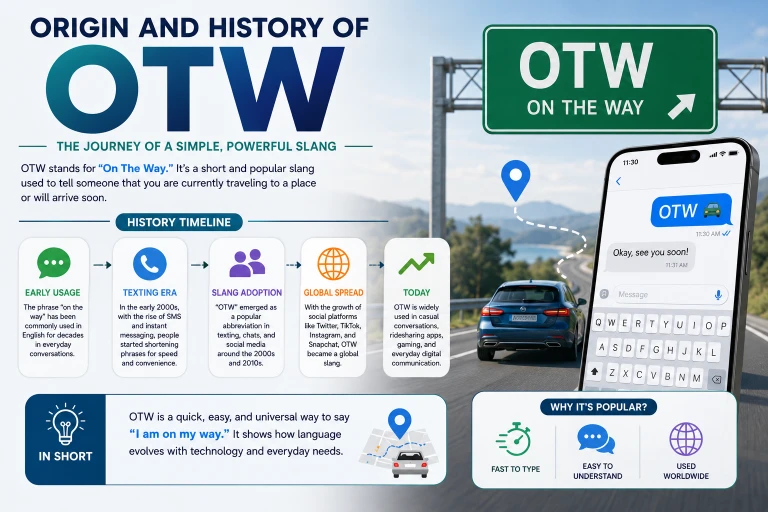
The phrase “on the way” has been used in English for a long time. OTW became popular later as people began using shorter forms in text messages, SMS, online chats, and instant messaging.
As digital communication grew, people started shortening common phrases to save time and space. Abbreviations such as OTW, BRB, BTW, and FYI became familiar parts of casual online communication.
OTW has remained useful because its meaning is simple and easy to understand. Today, you can still see it in text messages, social media chats, gaming conversations, and workplace messaging.
Why Do People Use OTW?
People use OTW because it is short, quick, and easy to understand. It lets someone know that a person or item is heading toward a destination without typing a full sentence.
People commonly use OTW because it is:
- Fast to type
- Easy to understand
- Common in online chats
- Useful for quick updates
- Friendly and informal
For example, instead of writing:
“I have already left and I am traveling to your location.”
Someone can simply write:
“OTW.”
This makes the message faster while keeping the meaning clear.
Similar Slang and Related Terms
OTW is often used alongside other common texting abbreviations. Here are a few terms you may see in the same conversations:
| Abbreviation | Full Form | Meaning |
|---|---|---|
| OMW | On My Way | I am heading somewhere |
| ETA | Estimated Time of Arrival | Expected arrival time |
| BRB | Be Right Back | I will return soon |
| ASAP | As Soon As Possible | As quickly as possible |
| LMK | Let Me Know | Tell me or update me |
| BTW | By The Way | Used to add another point |
These abbreviations often appear in the same conversations as OTW.
OTW vs OMW
OTW and OMW are the closest terms in meaning. Both can tell someone that a person is heading somewhere.
Example:
“I’m OTW to your house.”
“I’m OMW to your house.”
Both messages tell the person that you are heading to their house.
ETA is different: it tells someone when you expect to arrive, not simply that you are traveling.
When Should You Avoid Using OTW?
OTW is best for casual communication. In formal or important situations, writing the full phrase can make your message clearer.
Avoid using OTW in:
- Formal business emails
- Academic papers
- Official reports
- Formal applications
- Messages to people who may not know texting abbreviations
- Situations where exact timing or clear details matter
Instead of:
“OTW.”
You can write:
“I’m on my way and should arrive shortly.”
Use OTW when the conversation is casual. Use “I’m on my way” when you want your message to sound clearer or more professional.
Can You Use OTW at Work?
Yes. OTW can be used in casual workplace chats when your coworkers already use texting abbreviations.
For example:
“OTW to the meeting.”
“OTW upstairs.”
“OTW to Conference Room B.”
However, formal emails, client messages, and official communication usually sound better with the full phrase.
Instead of:
“OTW to the meeting.”
You can write:
“I’m on my way to the meeting.”
Simple Rule
Casual team chat → OTW is fine.
Formal communication → Use “on my way.”
Common Misunderstandings
OTW Does Not Always Mean “Almost There”
Someone can be OTW even if they are still far from the destination. It simply means they are traveling or heading toward a place.
OTW Does Not Give an Exact Arrival Time
OTW tells you that someone has started traveling. It does not tell you exactly when they will arrive.
Example:
“I’m OTW.”
This does not mean the person will arrive in five minutes.
OTW Is Different From ETA
OTW tells you that someone or something is on the way.
ETA tells you when they are expected to arrive.
Example:
“I’m OTW. My ETA is 10 minutes.”
OTW Is Not Always Personal
OTW does not always mean “I’m on my way.” It can also describe another person, food, a package, or a delivery.
Examples:
“The driver is OTW.”
“Your order is OTW.”
OTW vs OMW: What Is the Difference?
OTW and OMW have very similar meanings, but they are used in slightly different ways.
| Term | Full Form | Meaning | Example |
|---|---|---|---|
| OTW | On The Way | Someone or something is heading somewhere | “The package is OTW.” |
| OMW | On My Way | I am personally heading somewhere | “I’m OMW to your house.” |
Key Difference
OMW is personal. It usually means “I am on my way.”
OTW is more general. It can describe a person, a package, food, a delivery, or anything else moving toward a destination.
Examples
“I’m OMW to your house.”
“Your food is OTW.”
When talking about yourself, OMW is often the clearer choice. When talking about something else, OTW is usually more natural.
Frequently Asked Questions
What does OTW mean in texting?
OTW means “On The Way.” It tells someone that you or something is heading toward a destination.
What is the full form of OTW?
The full form of OTW is “On The Way.”
Is OTW slang?
Yes. OTW is a common internet slang abbreviation used in texting, social media, and online chats.
What does OTW mean on Snapchat?
On Snapchat, OTW usually means “On The Way.” People use it when they are heading somewhere or coming to meet someone.
Is OTW used on Instagram?
Yes. People may use OTW in Instagram direct messages, Stories, captions, and chats when they are heading somewhere.
What does OTW mean in chat?
In chat, OTW usually means “On The Way.” It tells someone that a person or thing is heading toward a destination.
Is OTW professional?
OTW can be fine in casual workplace chats. For formal emails or professional communication, writing “I’m on my way” is usually better.
Is OTW still popular?
Yes. OTW is still widely used because it is short, simple, and easy to understand.
Conclusion
OTW slang stands for “On The Way.” It is a simple, friendly abbreviation used to let someone know you have already started traveling. You’ll often see it in text messages, gaming chats, social media, and workplace messaging apps.
Because OTW is clear, harmless, and widely recognized, it remains one of the most useful texting abbreviations today. Just remember to match your language to the situation. OTW works perfectly in casual conversations, while writing the full phrase is usually the better choice for formal communication.
- Read More:DD Slang Meaning : Simple Guide with Examples
- Read More:OMD Meaning Slang: Surprise, Shock & Everything in Between
- Read More:SFS Meaning Slang: Decoding This Viral Social Media Term

Hi, I’m Olivia Carter. I enjoy researching English slang, online expressions, and everyday vocabulary. I write clear, beginner-friendly guides with simple definitions and practical examples to make modern English easier to understand.