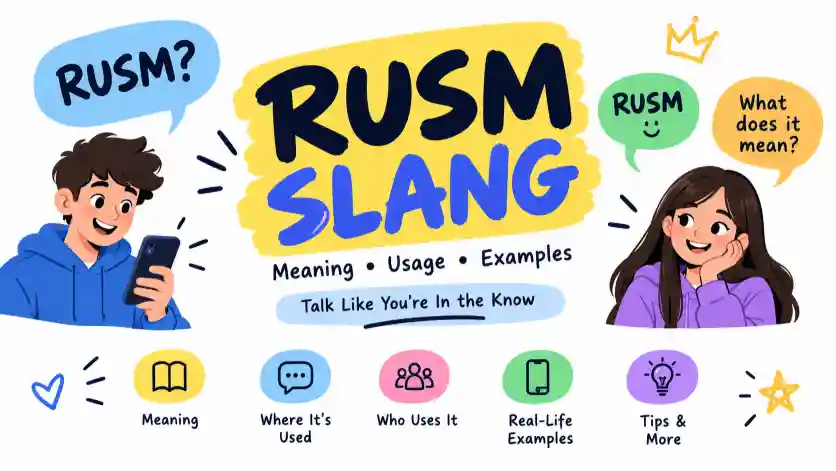
Have you ever received a text that says “RUSM?” and wondered what the letters mean? RUSM is a short internet and texting acronym that means “Are you shitting me?”
People use it when they cannot believe what someone has just said or done.
For example, if a friend tells you that a simple task took five hours, you might reply, “RUSM?” The message shows surprise or disbelief.
It is close to saying “Are you kidding me?”, “Seriously?”, or “You’re joking, right?”
RUSM is mainly a casual expression. You may see it in texts, online chats, comments, gaming conversations, or other informal spaces.
A current slang reference lists RUSM as a text-messaging abbreviation, while another slang entry explains it as a way to ask if someone is kidding.
The important thing is the tone. RUSM can sound funny between friends, but it can also sound annoyed or rude because the expanded phrase contains profanity.
Quick Answer
| Question | Answer |
| Meaning | “Are you shitting me?” |
| Simple meaning | “Are you kidding me?” / “Seriously?” |
| Tone | Shocked, doubtful, annoyed, or joking |
| Used by | People in casual texting and online chats |
| Common use | Texts, chats, comments, gaming, social media |
| Offensive? | It can be, because the full phrase contains profanity |
| Formality | Very informal |
The key nuance is that RUSM does not always show anger. The same acronym can show surprise, disbelief, or playful shock. Context and punctuation matter. “RUSM 😂” may sound playful, while “RUSM?!” can sound much more frustrated.
What Does RUSM Mean in Slang?
RUSM is slang for “Are you shitting me?” It is used to show shock, disbelief, or surprise. In simple words, it means something like “Are you kidding me?” or “Seriously?” Because the full phrase contains profanity, RUSM is casual and can sound rude in formal settings.
RUSM means “Are you shitting me?”
The phrase is a strong way to question something that seems unbelievable. In everyday language, a cleaner version would be:
- “Are you kidding me?”
- “Seriously?”
- “You’re joking, right?”
- “No way!”
- “Is that true?”
The letters come from the words in the phrase:
R U S M → Are You Shitting Me
Here, R represents “are,” U represents “you,” and S M represents the remaining words. This type of letter-based shorthand is common in texting because it makes a longer phrase much shorter.
RUSM in simple words
If someone texts:
“RUSM? You got tickets for free?”
They are basically saying:
“Are you kidding me? You got tickets for free?”
The speaker does not necessarily think the other person is literally lying. The phrase is often an emotional reaction to surprising news.
How Do You Pronounce RUSM?
RUSM is normally read as individual letters:
R-U-S-M
You can say:
“Are you shitting me?”
when reading the full meaning aloud.
Because RUSM is an acronym, there is no strong need to pronounce it as one word. In a conversation, most people would simply say the full phrase or use a cleaner alternative such as “Are you kidding me?”
What Does RUSM Mean in Text Messages?
In text messages, RUSM usually shows disbelief or surprise.
For example:
Maya: I just found out we have another test tomorrow.
Noah: RUSM?!
Noah is not asking a serious question about if Maya is telling the truth. He is reacting to the bad news.
Another example:
Ari: They canceled the concert five minutes before it started.
Zoe: RUSM 😭
Here, the acronym expresses disbelief and frustration.
The meaning becomes clearer when you look at the message around it. RUSM can be playful, shocked, annoyed, or sarcastic depending on the situation.
Where Is RUSM Used?
RUSM is best understood as casual internet and texting slang, rather than a formal English expression. A current slang dictionary lists it under text-messaging terms, and slang references also connect it with the meaning “Are you kidding me?”
| Platform | How It May Be Used | Example |
| Text messages | Quick reaction to surprising news | “RUSM? That really happened?” |
| TikTok comments | Reaction to an unbelievable video | “RUSM 😂” |
| Casual reaction to a friend’s post | “RUSM?! You won?” | |
| Discord | Reaction during a chat or game | “RUSM bro?” |
| Informal reaction to a surprising story | “RUSM, that is wild.” | |
| Gaming chats | Reaction to an unexpected event | “RUSM? How did that happen?” |
These uses are not separate meanings. The basic idea stays the same: the writer is showing disbelief or strong surprise.
Why Do People Use RUSM?
People use RUSM because it is short and emotionally strong.
Typing “Are you shitting me?” takes much longer than typing four letters. In a fast conversation, RUSM lets someone react quickly.
It can also add emotion to a message:
- RUSM?! → strong disbelief
- RUSM 😂 → playful disbelief
- RUSM 😭 → shocked or overwhelmed reaction
- RUSM lol → surprised but joking
- RUSM… → doubtful or annoyed
The surrounding words, punctuation, and emoji help show the intended mood.
Is RUSM Positive or Negative?
RUSM is neither strictly positive nor strictly negative.
It mainly expresses a reaction.
It can be negative when someone is angry:
“RUSM? You deleted the whole file?”
It can be positive when someone receives exciting news:
“RUSM?! You actually won the contest?”
It can also be humorous:
“RUSM 😂 You ate the entire pizza?”
So, the emotion comes from the situation, not from the acronym alone.
Is RUSM Rude or Offensive?
It can be.
The full expression contains profanity, so RUSM is not a good choice for formal or professional communication.
Avoid it in places such as:
- Job applications
- Formal emails
- School assignments
- Professional reports
- Customer-service messages
- Serious business conversations
With close friends, the same acronym may feel normal or funny.
A safer choice is “Are you kidding me?” if you are not sure how the other person will react.
RUSM vs. Similar Slang
It is easy to confuse with other expressions of surprise or disbelief.
| Expression | Meaning | Tone |
| RUSM | Are you shitting me? | Strong, casual, profane |
| RUKM | Are you kidding me? | Casual, less profane |
| AYKM | Are you kidding me? | Casual |
| WTF | Strong reaction to something shocking | Profane |
| Seriously? | Shows doubt or surprise | Neutral to casual |
| No way! | Shows strong surprise | Casual, clean |
| Are you kidding me? | Questions something unbelievable | Casual |
RUSM and RUKM are especially close, but RUSM is more profane because of the wording behind the acronym. A text-messaging slang reference lists both abbreviations separately.
RUSM vs. RUKM
The difference is simple:
RUSM = Are you shitting me?
RUKM = Are you kidding me?
Both can show disbelief.
The main difference is language strength.
| RUSM | RUKM |
| Contains profanity | No profanity |
| Stronger expression | Softer expression |
| Very casual | Casual |
| Better with close friends | Safer in more situations |
| Can sound rude | Usually less offensive |
If you want to show surprise without sounding too harsh, RUKM or “Are you kidding me?” is usually safer.
Real-Life Examples of RUSM
Text Message
Leah: They gave us a surprise test today.
Marcus: RUSM?!
Here, Marcus is shocked by the unexpected test. The acronym is an emotional reaction.
TikTok Comment
“RUSM 😂 She really did that?”
The commenter is reacting to something surprising or funny in the video.
Discord Chat
Evan: I accidentally deleted the game save.
Jordan: RUSM bro 😭
Jordan is showing shock and frustration. The word “bro” and crying emoji make the message sound more like an emotional reaction than a serious insult.
Gaming Chat
Nora: The boss dropped the rare item on my first try.
Caleb: RUSM?! No way!
Here, RUSM shows excited disbelief.
School Conversation
Sofia: Our teacher moved the exam to Monday.
Daniel: RUSM? We just found out about it!
This use is understandable between friends, but the cleaner phrase “Are you serious?” would work better around teachers.
Workplace Chat
Aiden: The meeting was moved to 7 a.m.
Priya: Seriously?!
In a workplace, “Seriously?” is a better choice than RUSM. The point is the same, but the wording is more professional.
What Does RUSM Mean With Emojis?
An emoji can change the feeling of RUSM.
| RUSM + Emoji | Likely Feeling |
| RUSM 😂 | Funny disbelief |
| RUSM 😭 | Shock or overwhelmed reaction |
| RUSM 😳 | Surprise |
| RUSM 🤯 | Extreme disbelief |
| RUSM 🙄 | Annoyance or sarcasm |
| RUSM?! | Strong shock |
The emoji does not create a new dictionary meaning. It simply gives the reader more information about the writer’s mood.
Is RUSM Still Used?
RUSM is still listed in current slang and text-messaging dictionaries, so the acronym has not disappeared completely. Slang.net currently includes RUSM among its slang entries and its recent additions.
However, that does not mean it is one of the most common expressions used by everyone today.
Its use can depend on the person’s age, online community, and writing style. Many people may choose clearer expressions such as “Are you kidding me?”, “Seriously?”, or “No way!”
So, if you see RUSM in an old message, forum post, game chat, or social-media comment, the intended meaning is still understandable from the context.
Is RUSM a New Slang Word?
No clear modern invention date can be given with confidence.
A user-generated Urban Dictionary entry for RUSM dates to 2011, showing that the acronym was already being used online at that time.
That date should not be treated as the exact birth of the expression. Online slang can exist in private chats, forums, gaming communities, and other spaces before it appears in a public dictionary.
The safest conclusion is that RUSM belongs to the family of internet and text-message abbreviations built from the first letters of a longer phrase.
Common Mistakes With RUSM
1. Thinking RUSM means something positive
RUSM does not automatically mean something good.
It is mainly a reaction to something surprising, unbelievable, annoying, or funny.
2. Using it in formal writing
RUSM is casual slang. The full phrase contains profanity.
Use “Are you serious?” or “Are you kidding me?” in formal situations.
3. Assuming it always means anger
Someone can use RUSM because they are excited or amused.
Look at the context before deciding what emotion the writer has.
4. Confusing RUSM with RUKM
These are similar but not identical.
RUSM contains profanity.
RUKM means “Are you kidding me?”
5. Taking it literally
RUSM is usually not a literal question.
When someone writes “RUSM?”, they normally mean something like “Seriously?” or “Are you kidding me?”
Key Takeaways
RUSM means “Are you shitting me?”
- It shows disbelief, shock, surprise, or annoyance.
- It is mainly used in casual texting and online communication.
- The tone can be funny, shocked, excited, or frustrated.
- It contains profanity, so avoid it in formal situations.
- RUKM and “Are you kidding me?” are softer alternatives.
FAQs About RUSM Slang
What does RUSM stand for?
RUSM stands for “Are you shitting me?” It is a short texting acronym used when someone finds something hard to believe. In simpler language, it can mean “Are you kidding me?”, “Seriously?”, or “You’re joking, right?” The exact feeling depends on the situation and the words around it.
What does RUSM mean in a text?
In a text, RUSM usually shows disbelief or surprise. Someone might send “RUSM?!” after hearing unexpected news. It can also be used as a joke between friends. The acronym is casual and contains profanity in its full form, so it is best kept for informal conversations.
Is RUSM a bad word?
RUSM itself is an acronym, but its expanded phrase contains profanity. That makes it unsuitable for many formal situations. It may be fine among friends who are comfortable with strong language. If you are unsure, use “Are you kidding me?”, “Seriously?”, or “No way!” instead.
Is RUSM the same as RUKM?
No. They have almost the same purpose but different wording. RUSM means “Are you shitting me?”, while RUKM means “Are you kidding me?” RUSM is stronger because it uses profanity. RUKM is usually the safer option when you want to show surprise without using a swear word.
Can RUSM be used as a joke?
Yes. RUSM can be playful when used with close friends. An emoji such as 😂 or 😭 can make the message feel humorous rather than angry. For example, “RUSM 😂 You ate the whole cake?” sounds like playful disbelief. Still, the phrase behind RUSM contains profanity, so the audience matters.
Is RUSM rude?
RUSM can sound rude because the full expression contains profanity. It may be normal in a casual chat between friends but inappropriate in a school, workplace, or formal conversation. If you want to avoid sounding rude, choose “Are you serious?” or “Are you kidding me?”
What is a cleaner alternative to RUSM?
Good clean alternatives include “Are you kidding me?”, “Seriously?”, “No way!”, “You’re joking!”, and “Is this real?” These expressions can show surprise without the profanity found in the full version of RUSM.
How do I know what emotion RUSM shows?
Look at the context, punctuation, and emoji. “RUSM?!” may show strong shock. It 😂” can be playful. “RUSM 🙄” may show annoyance. The acronym itself does not tell you exactly how the person feels, so the surrounding message is important.
Conclusion
RUSM is a short texting acronym that means “Are you shitting me?” People use it when something seems unbelievable, surprising, funny, or frustrating. In simple English, it is close to “Are you kidding me?”, “Seriously?”, or “No way!”
The main thing to remember is its tone. RUSM is very casual, and the full phrase contains profanity. That makes it more suitable for relaxed conversations than school, work, or other formal settings.
You may see RUSM in texts, online chats, gaming conversations, comments, and social-media posts. If you are unsure how someone means it, read the surrounding message and look at the punctuation or emoji.
For a cleaner option, use “Are you kidding me?” or “Are you serious?” Those phrases carry the same basic reaction without the stronger language.
Related Articles:
- OML Slang: The Reaction Word Still Trending in 2026
- TIL Slang: The Story Behind Every “Today I Learned” Post
- YW Slang Meaning: Small Letters, Same Polite Meaning

Hi, I’m Olivia Carter. I enjoy researching English slang, online expressions, and everyday vocabulary. I write clear, beginner-friendly guides with simple definitions and practical examples to make modern English easier to understand.