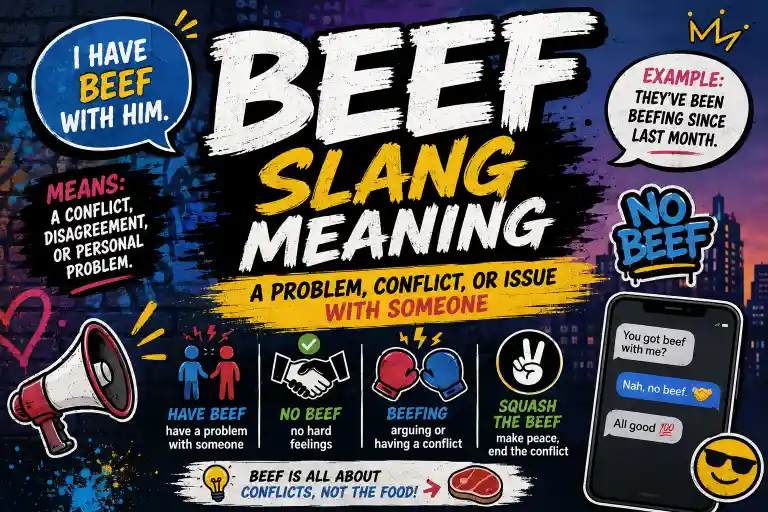
Beef Slang Meaning refers to using “beef” to describe an ongoing conflict, grudge, or rivalry between two people as in “they have beef” or “let’s squash the beef.”
The slang usage dates back to the 19th century, with theories linking its origin to old expressions about complaints or, alternatively, to boxing culture where fighters were compared to “beefy” tough contenders.
Today, the term is especially common in hip-hop culture to describe rapper rivalries, though it applies just as easily to celebrity drama, friend group conflicts, or everyday arguments.
In this guide, you’ll learn the origin of “beef” as slang for conflict, how it’s used in music and pop culture, and what it means to “squash the beef” heading into 2026.
Quick Answer
Beef slang means a conflict, disagreement, grudge, or problem between people.
For example:
“Why do you have beef with Jake?”
This means:
“Why do you have a problem with Jake?”
The word is informal, so it works best in casual speech, texts, social media, and online conversations.
What Does Beef Slang Mean?
In slang, beef usually means a personal problem or conflict.
It can describe tension between two people, groups, friends, celebrities, gamers, or even online communities.
For example:
- “I have beef with my neighbor.”
- “Those two have been beefing for weeks.”
- “No beef. We are good.”
- “Why is there so much beef in the comments?”
Beef can be used as both a noun and a verb.
As a noun:
“They have beef.”
As a verb:
“They are beefing.”
The meaning stays connected to conflict or disagreement.
Beef Slang Meaning in Simple Words
| Phrase | Simple Meaning |
| Have beef | Have a problem with someone |
| Got beef | Have a conflict or issue |
| No beef | No hard feelings |
| Beefing | Arguing or having a conflict |
| Same beef | Having the same complaint |
| Squash the beef | End the conflict |
| Beefy | Muscular or bulky |
| Beefcake | A muscular, attractive man |
How Do You Pronounce Beef?
Beef is pronounced like the regular food word beef.
It rhymes with words such as leaf and chief.
There is no different pronunciation for the slang meaning. The surrounding sentence tells you if someone means the food or a conflict.
Where Did Beef Slang Come From?
The slang meaning of beef is older than modern social media.
Historical language records show that beef was used as a slang verb meaning “to complain” in American English by 1888. The noun sense connected with a complaint or grievance appeared soon after. The exact origin is not completely settled.
Over time, the meaning moved from a complaint to a disagreement or argument.
Later, the word became strongly connected with public rivalries in music and hip-hop culture. From there, it became common in everyday speech and online conversations.
So, the modern meaning did not suddenly appear with TikTok or texting. It developed over a much longer period.
How Is Beef Used Today?
Today, beef can appear almost anywhere people have casual conversations.
You may see it in:
- Text messages
- TikTok comments
- Instagram captions
- YouTube comments
- X posts
- Discord chats
- Gaming conversations
- Sports discussions
- Music discussions
- Celebrity news
Someone may use beef for a serious disagreement or for something much smaller.
For example:
“We had some beef over the group project.”
This does not always mean a major fight. It may simply mean the two people had an issue.
Have Beef Slang Meaning
Have beef means to have a problem, grudge, or conflict with someone.
It often suggests that the problem has not been fully resolved.
Example:
“I think Mia has beef with her old roommate.”
This means Mia still has an issue with her old roommate.
Another example:
“Why do you have beef with me?”
This asks why someone is upset or has a problem with the speaker.
Got Beef Slang Meaning
Got beef is a more casual way to ask if someone has a problem.
You may hear:
“You got beef with me?”
It can sound serious, playful, or confrontational depending on the tone.
Online, people may also use it jokingly:
“You got beef with my favorite team?”
Here, the speaker may simply be teasing someone.
No Beef Slang Meaning
No beef means there is no conflict or hard feeling.
Someone may say it after an argument to show that they are ready to move on.
Example:
“We disagreed yesterday, but no beef.”
This means:
“We had a disagreement, but I am not holding a grudge.”
It can also be used before a disagreement gets serious:
“No beef, but I think your idea needs work.”
Same Beef Slang Meaning
Same beef means you have the same complaint or problem.
This use does not always involve a personal feud.
For example:
“This app keeps crashing.”
Someone might reply:
“Same beef.”
That means:
“I have the same problem.”
It can also be used when several people dislike the same situation.
What Does Beefing Mean in Slang?
Beefing means actively arguing, fighting, or having an ongoing conflict.
It is the verb form of the slang.
For example:
“They have been beefing since last month.”
This means they have had an ongoing conflict since last month.
You may also see it in online conversations:
“Why are those two always beefing?”
This means they are always arguing or having problems with each other.
Beef vs Fight: What Is the Difference?
Beef and fight are related, but they are not always the same.
A fight can mean a physical fight or a direct argument.
Beef usually focuses on the ongoing problem or tension.
For example:
“They had a fight last night.”
This sounds like one specific event.
“They have beef.”
This suggests an ongoing issue between them.
So, someone can have beef without actually getting into a physical fight.
Beef vs Drama
Drama is a wider word.
It can describe rumors, tension, arguments, gossip, or messy situations.
Beef is more focused on a conflict between people or groups.
For example:
“There is drama in the group chat.”
This could mean many things.
“There is beef between Sam and Alex.”
This clearly points to a conflict between Sam and Alex.
What Does Beef Mean in Texting?
In texting, beef is often short and casual.
You might receive:
“Do they have beef?”
Meaning:
“Are they having a problem with each other?”
Or:
“No beef lol.”
Meaning:
“No hard feelings.”
People may also shorten their messages:
- “u got beef?”
- “no beef”
- “still beefing?”
- “why the beef?”
- “we squashed it”
The exact tone depends on the conversation.
Beef Slang Meaning on Social Media
On social media, beef often describes a public disagreement.
For example, two creators may argue through posts or videos. People watching the situation may call it online beef.
You may see comments such as:
“What started their beef?”
or:
“I didn’t know they had beef.”
The term is also common when people discuss celebrity arguments, creator disputes, sports rivalries, and online drama.
Beef Slang Meaning in Gen Z Conversations
Gen Z uses beef in many of the same ways as older generations.
The main difference is where you may see it.
You are more likely to encounter it in:
- Group chats
- TikTok comments
- Discord
- Gaming chats
- Memes
- Short videos
For example:
“Why does everyone have beef in this server?”
This means:
“Why is everyone arguing or having problems in this server?”
The word is casual and can be serious or humorous depending on the situation.
Beef Slang in Gaming
Gamers also use beef to describe conflict between players or teams.
For example:
“Those two players have beef.”
This means they have a personal issue or rivalry.
But gamers may also use it jokingly:
“No beef, you just got lucky.”
Here, the speaker is probably not describing a serious personal conflict.
What Does “Squash the Beef” Mean?
Squash the beef means to end a conflict and make peace.
For example:
“They finally squashed the beef.”
This means the two sides resolved their problem.
You can also say:
“Let’s squash the beef and move on.”
This means:
“Let’s stop arguing and leave the problem behind.”
Beefy Slang Meaning
Beefy has a different meaning from beef when talking about someone’s appearance.
In casual language, beefy can mean muscular, strong, bulky, or physically large.
For example:
“He got really beefy after working out.”
This means the person became more muscular.
It does not mean that the person is involved in an argument.
Beefcake Slang Meaning
Beefcake is another related word, but it has a different meaning.
It usually describes a muscular and attractive man.
For example:
“The movie turned him into a Hollywood beefcake.”
This is about his muscular appearance, not a conflict.
So remember:
Beef = conflict
Beefy = muscular or bulky
Beefcake = muscular, attractive man
Beef Slang Meaning in Urban Dictionary
If you search for beef on Urban Dictionary or other crowdsourced slang sites, you may find several user-written definitions.
The main slang idea is still a conflict, grudge, argument, or problem between people.
Because crowdsourced dictionaries allow users to submit their own definitions, wording and examples can differ from one entry to another.
For everyday use, context is more important than one specific online definition.
Roast Beef Slang Meaning
Roast beef normally refers to the food made from roasted beef.
It does not have one clear, universal modern slang meaning.
So if you see roast beef in a normal food conversation, it usually means the dish.
Do not automatically assume that every phrase containing beef is slang.
Beefing vs Beefing Up
These two expressions are easy to confuse.
Beefing means arguing or having a conflict.
“They are beefing again.”
Beefing up means making something stronger, bigger, or more effective.
“We need to beef up security.”
These are completely different uses.
Examples of Beef Slang in Conversation
Here are some natural examples:
- “Why do you have beef with him?”
- “I don’t have any beef with her.”
- “Those two have been beefing all week.”
- “No beef, but I disagree.”
- “They finally squashed the beef.”
- “Why is there so much beef online?”
- “I think they still have beef.”
- “You got beef with my brother?”
- “Same beef. That website never works.”
- “There is no beef between us.”
Beef Slang Text Examples
In a text, you might see:
“u got beef w him?”
Meaning:
“Do you have a problem with him?”
Another example:
“nah no beef lol”
Meaning:
“No, there are no hard feelings.”
Or:
“they’re still beefing 😭”
Meaning:
“They are still arguing.”
Social Media Examples
People may use beef in captions and comments like these:
TikTok:
“POV: your friend has beef with everyone.”
Instagram:
“No beef, just good vibes.”
X:
“Why is there always beef in the replies?”
Discord:
“No beef, just competitive.”
YouTube:
“What started their beef?”
These examples show how flexible the word can be.
Is Beef Positive or Negative?
Beef is usually negative because it describes conflict or tension.
For example:
“They have beef.”
suggests a problem.
But no beef has a friendly meaning because it tells someone there are no hard feelings.
The word can also be used jokingly between friends.
For example:
“You took my last cookie. Now we have beef.”
This sounds playful, not like a serious conflict.
Tone and context matter.
Who Uses Beef Slang?
Beef is widely understood in casual English.
You may hear it from:
- Teens
- Young adults
- Gamers
- Music fans
- Sports fans
- Social media users
- Friends and coworkers
Older speakers may also use phrases such as have beef or no beef because the slang has been around for decades.
Common Mistakes With Beef Slang
1. Thinking beef always means food
If someone says:
“I have beef with him.”
They are not talking about meat.
They mean they have a problem with him.
2. Confusing beefing with beefing up
Beefing = arguing.
Beefing up = strengthening or increasing something.
3. Thinking beef always means a physical fight
Beef can be an argument, grudge, disagreement, or ongoing tension. It does not have to become physical.
4. Assuming every use is serious
Friends sometimes use beef as a joke.
“You ate my fries. We have beef now.”
The relationship and tone tell you how serious it is.
5. Using it in formal writing
Beef is casual slang.
For formal writing, words such as conflict, disagreement, dispute, or grievance are usually better.
Similar Slang Words
| Slang | Meaning |
| Drama | Conflict or a messy situation |
| Feud | A long-running conflict |
| Rivalry | Competition between people or groups |
| Friction | Tension between people |
| Issues | Problems or disagreements |
| Bad blood | Strong negative feelings |
| Beefing | Actively arguing |
| No beef | No hard feelings |
Opposite of Beef
Some phrases express the opposite of having beef:
- No beef no conflict
- All good everything is fine
- No hard feelings no lasting anger
- Cool with each other friendly relationship
- On good terms peaceful relationship
- Squashed the beef conflict has ended
Did You Know?
The slang meaning of beef is much older than modern social media.
Historical sources record the verb beef meaning “to complain” in American English in 1888, while the noun meaning a complaint appeared soon after. The meaning connected with an argument developed later.
This is why beef is not simply a new internet word. It has been part of informal English for a long time.
Quick Facts About Beef Slang
- Beef can be a noun or verb.
- Have beef means to have a problem.
- Beefing means actively arguing.
- No beef means no hard feelings.
- Same beef can mean the same complaint.
- Squash the beef means resolve the conflict.
- Beefy can mean muscular or bulky.
- Beefcake can describe a muscular, attractive man.
- The slang meaning is older than modern social media.
- The exact origin of the slang sense is still debated.
Frequently Asked Questions
What is beef in Gen Z slang?
In Gen Z slang, beef means a conflict, disagreement, or problem between people. It is common in texts, group chats, TikTok, gaming, and other online conversations.
What does beef mean on social media?
On social media, beef usually means a public disagreement or feud. It may involve creators, celebrities, gamers, sports fans, or ordinary users.
What does “no beef” mean?
No beef means there is no conflict or hard feeling. It can also mean that someone is ready to move past an earlier disagreement.
What does “got beef” mean?
Got beef means “do you have a problem or conflict?” For example, “You got beef with me?” asks if someone is upset with the speaker.
What does “same beef” mean?
Same beef means having the same complaint or frustration. It can be used for personal problems or everyday annoyances.
What does beefing mean?
Beefing means arguing, feuding, or having an active conflict with someone.
What does beefy mean in slang?
Beefy can mean muscular, bulky, strong, or physically large. It is different from the conflict meaning of beef.
What does beefcake mean in slang?
Beefcake usually describes a muscular and attractive man. It is not related to having an argument.
What does “squash the beef” mean?
It means to end a conflict and make peace.
Is beef a bad word?
Beef is not normally considered a swear word. It is informal slang, so it is better suited to casual conversations than formal writing.
Conclusion
Beef slang means a conflict, disagreement, grudge, or ongoing problem between people.
You may see it in phrases like have beef, got beef, no beef, beefing, and squash the beef.
Online, people use the word in texts, gaming chats, TikTok comments, social media posts, and casual conversations. It can describe a serious feud or a small problem between friends.
Just remember that beefy and beefcake have different meanings. And if someone says “no beef,” they usually mean there are no hard feelings.
Once you understand the context, beef slang is easy to recognize.
Related Articles:
- Mule Slang: The Animal Insult That’s 200 Years Old
- PU Slang: One Abbreviation, Still Three Definitions in 2026
- Nymph Meaning Slang: Why This Word Trended in 2026

Hi, I’m Sophia Turner, a writer at SlangRise with 7 years of experience researching English slang, internet abbreviations, and modern vocabulary.