Boston slang words are informal terms and phrases linked to Boston, Massachusetts, and the wider New England area.
Some expressions are strongly tied to Boston, while others are regional words shared with nearby states.
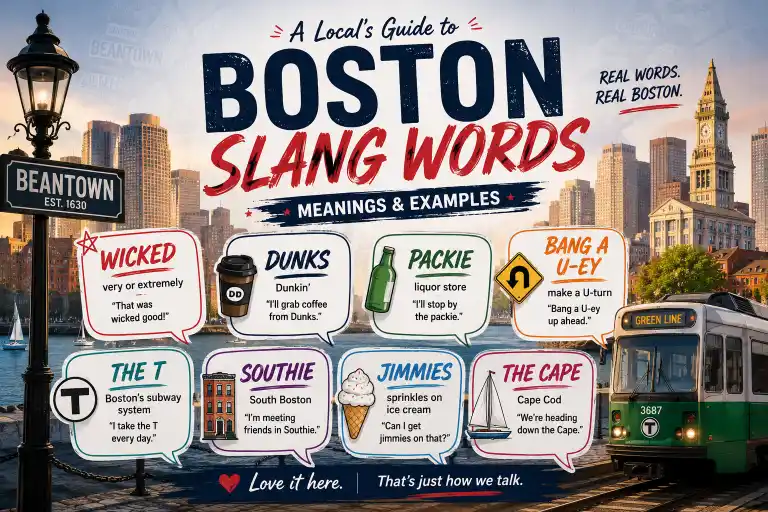
If you hear someone say “wicked good,” “bang a U-ey,” “packie,” or “Dunks,” you may be hearing Boston-area slang.
Other terms, such as “bubbler” or “grinder,” are used more widely across New England.
This guide explains common Boston slang words in simple English. You will learn what they mean, how people use them, which ones are still common, and which terms are more regional or old-fashioned.
We will also look at Boston neighborhoods, food, sports, pronunciation, and expressions you may hear in everyday conversation.
Quick Answer: What Are Boston Slang Words?
Boston slang words are informal expressions associated with Boston and the surrounding New England region. Common examples include wicked for “very,” packie for a liquor store, Dunks for Dunkin’, and bang a U-ey for making a U-turn.
What Does Boston Slang Mean?
Boston slang refers to words, shortened names, phrases, and local expressions used in Boston-area speech.
Some words are easy to identify as Boston expressions. Others are used throughout Massachusetts or New England.
For example:
“That pizza was wicked good.”
Here, wicked means very or extremely.
Another example:
“Bang a U-ey at the next light.”
This means:
“Make a U-turn at the next light.”
Boston speech is also famous for its accent. However, Boston slang and the Boston accent are not the same thing.
Slang is about the words people use. An accent is about how they pronounce those words.
50 Boston Slang Words and Phrases
Below are common Boston-area expressions, including local vocabulary, neighborhood names, food terms, sports references, and phrases associated with Boston speech.
1. Wicked
Meaning: Very or extremely.
“That movie was wicked good.”
“It’s wicked cold outside.”
This is one of the best-known Boston-area expressions.
2. Dunks
Meaning: A casual name for Dunkin’.
“I’m stopping at Dunks.”
“Want coffee from Dunks?”
The shortened name is especially familiar in Massachusetts and New England.
3. Packie
Meaning: A liquor store.
“I’ll stop at the packie.”
“There’s a packie near the station.”
This is a regional Massachusetts and New England term.
4. Bang a U-ey
Meaning: Make a U-turn.
“Bang a U-ey at the next street.”
“We missed the exit, so we had to bang a U-ey.”
5. The T
Meaning: Boston’s public transportation system.
“I’ll take the T downtown.”
“The T was crowded this morning.”
6. Greenie
Meaning: A casual name for a Green Line train.
“Take the Greenie to the next stop.”
“The Greenie was running late.”
7. Rotary
Meaning: A traffic circle.
“Take the rotary after the bridge.”
“Traffic is heavy around the rotary.”
8. Jimmies
Meaning: Ice-cream sprinkles.
“Can I get chocolate jimmies?”
“She ordered ice cream with jimmies.”
The word is used in parts of New England and is not exclusive to Boston.
9. Bubbler
Meaning: A drinking fountain.
“Is there a bubbler nearby?”
“The kids stopped at the bubbler.”
This term is found in several parts of New England.
10. Clicker
Meaning: A remote control.
“Where’s the clicker?”
“Pass me the clicker, please.”
11. Carriage
Meaning: A shopping cart.
“Grab a carriage.”
“I couldn’t find an empty carriage.”
This is another regional New England word.
12. Bang a Left
Meaning: Turn left.
“Bang a left after the store.”
“Bang a left at the next light.”
13. Bang a Right
Meaning: Turn right.
“Bang a right after the bridge.”
“Just bang a right here.”
14. Down the Cape
Meaning: Toward Cape Cod.
“We’re heading down the Cape.”
“They go down the Cape every summer.”
15. The Cape
Meaning: Cape Cod.
“We’re spending the weekend on the Cape.”
“My cousins live near the Cape.”
16. Beantown
Meaning: A nickname for Boston.
“Welcome to Beantown.”
“He moved to Beantown years ago.”
The nickname is famous, although locals do not necessarily use it every day.
17. The Hub
Meaning: Boston.
“She’s working in the Hub today.”
“We drove into the Hub.”
This nickname comes from Boston’s long-standing reputation as a major regional center.
18. Southie
Meaning: South Boston.
“My friend lives in Southie.”
“We’re going to Southie tonight.”
19. Eastie
Meaning: East Boston.
“They moved to Eastie.”
“Let’s meet in Eastie.”
20. Dot
Meaning: Dorchester.
“He grew up in Dot.”
“We’re heading over to Dot.”
21. JP
Meaning: Jamaica Plain.
“She lives in JP.”
“Let’s meet in JP.”
22. The Green Monster
Meaning: Fenway Park’s famous left-field wall.
“The ball hit the Green Monster.”
“We sat close to the Green Monster.”
23. Fenway
Meaning: Fenway Park or the surrounding area.
“We’re going to Fenway tonight.”
“The streets around Fenway are busy.”
24. Sox
Meaning: The Boston Red Sox.
“The Sox won last night.”
“We’re watching the Sox game.”
25. Pats
Meaning: The New England Patriots.
“The Pats play Sunday.”
“He’s been a Pats fan for years.”
26. Celts
Meaning: The Boston Celtics.
“The Celts played well tonight.”
“We’re watching the Celts.”
27. Bruins
Meaning: The Boston Bruins.
“The Bruins are playing tonight.”
“She’s a longtime Bruins fan.”
28. Wicked Pissah
Meaning: Something extremely good or impressive.
“That concert was wicked pissah.”
“That’s a wicked pissah car.”
This phrase is strongly associated with stereotypical Boston speech and may sound humorous or exaggerated outside the area.
29. Pissah
Meaning: Excellent or impressive.
“That was a pissah game.”
“Your new bike is a pissah.”
It is informal and strongly regional in flavor.
30. Smaht
Meaning: A Boston-style pronunciation of “smart.”
“He’s a smaht kid.”
“That was a smaht move.”
This is mainly an example of Boston pronunciation rather than a separate vocabulary word.
31. Habah
Meaning: A Boston-style pronunciation of “harbor.”
“The boats are down by the habah.”
“We walked near the habah.”
32. Bawstin
Meaning: A pronunciation spelling of “Boston.”
“Welcome to Bawstin.”
“He grew up around Bawstin.”
This spelling is usually used to imitate or represent a Boston accent.
33. Pockabook
Meaning: A purse or pocketbook.
“She left her pockabook in the car.”
“Where’s my pockabook?”
This is an older regional pronunciation or spelling associated with New England speech.
34. Cellah
Meaning: Basement.
“The boxes are down in the cellah.”
“He keeps his tools in the cellah.”
This represents the Boston-style pronunciation of cellar.
35. Comm Ave
Meaning: Commonwealth Avenue.
“I take the bus along Comm Ave.”
“They’re living near Comm Ave.”
This shortened form is common in Boston-area conversation.
36. The Garden
Meaning: TD Garden, Boston’s major indoor sports and entertainment arena.
“We’re going to the Garden tonight.”
“The game is at the Garden.”
The meaning is usually clear from the Boston context.
37. The Pru
Meaning: The Prudential Center.
“Let’s meet at the Pru.”
“We went shopping at the Pru.”
This is a local shortening of the center’s name.
38. Frappe
Meaning: A thick blended drink made with ice cream, milk, and flavoring.
“I’ll have a chocolate frappe.”
“That diner makes a great frappe.”
In Massachusetts, frappe has a different meaning from the coffee drink many people associate with the word elsewhere.
39. Dungarees
Meaning: Jeans.
“He wore his old dungarees.”
“I need a new pair of dungarees.”
This is an older word and is not unique to Boston, but it has been part of older regional speech.
40. Grinder
Meaning: A submarine-style sandwich.
“I’ll have an Italian grinder.”
“We picked up grinders for lunch.”
The term is used in several parts of New England.
41. Hoodsie
Meaning: A small packaged ice-cream cup.
“The kids wanted Hoodsies.”
“We had Hoodsies after dinner.”
The name comes from Hood ice cream products.
42. Regular Coffee
Meaning: Traditionally, coffee ordered with cream and sugar.
“I’ll have a regular coffee.”
“He ordered a regular coffee at the counter.”
The exact recipe can vary by restaurant, so it is smart to ask if you are unsure.
43. Cabinet
Meaning: A milkshake in some New England usage.
“She ordered a chocolate cabinet.”
“That shop makes good cabinets.”
This word is more strongly linked with parts of New England than Boston alone.
44. Wicked Smart
Meaning: Very intelligent.
“She’s wicked smart.”
“That kid is wicked smart.”
This combines the common Boston use of wicked with smart.
45. Wicked Cold
Meaning: Extremely cold.
“It’s wicked cold this morning.”
“The wind makes it wicked cold.”
46. Wicked Fast
Meaning: Very fast.
“That car is wicked fast.”
“He runs wicked fast.”
47. Wicked Good
Meaning: Very good.
“The food was wicked good.”
“We had a wicked good time.”
48. Townie
Meaning: A person strongly connected to a local Boston community or neighborhood.
“He’s a longtime townie.”
“The place is popular with townies.”
The word can carry different tones depending on who says it.
49. Masshole
Meaning: A humorous or insulting nickname for someone from Massachusetts.
“He jokingly calls himself a Masshole.”
“That driver was acting like a Masshole.”
This can be insulting, so it is best used carefully.
50. Taxachusetts
Meaning: A humorous or critical nickname for Massachusetts.
“People online were complaining about Taxachusetts.”
“He jokingly calls the state Taxachusetts.”
The expression is usually used in a critical or joking way about taxes.
More Boston Slang Words You May Hear
The 50 terms above cover many of the best-known expressions, but Boston speech has even more local vocabulary.
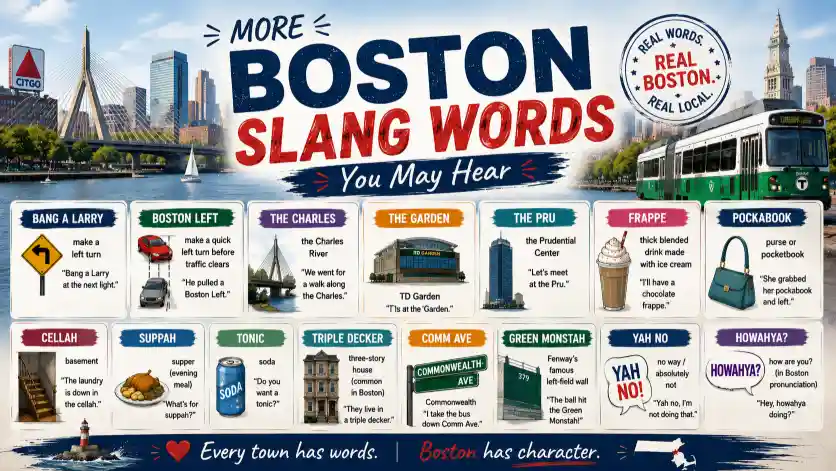
Boston Left
Boston Left refers to making a left turn, often before oncoming traffic has fully cleared.
“He pulled a Boston Left.”
“That was a risky Boston Left.”
The phrase is more about local driving culture than traditional slang.
Bang a Larry
It is another Boston-area expression for making a left turn.
“Bang a Larry at the next intersection.”
“We had to bang a Larry to get there.”
Not every Boston resident uses this phrase, so it should be treated as informal local vocabulary rather than universal Boston speech.
Scorchah
Scorchah is a pronunciation-style spelling of scorcher, used for something extremely hot.
“It’s a scorchah today.”
“This summer has been a scorchah.”
Stick-ah
Stick-ah represents the Boston-style pronunciation of sticker, often referring to a vehicle inspection sticker.
“I need to renew my stick-ah.”
“His stick-ah expires soon.”
Suppah
Suppah is a pronunciation spelling of supper.
“We’re having suppah at six.”
“What are we having for suppah?”
Tonic
Tonic can mean soda in older or regional New England usage.
“Do you want a tonic?”
“He ordered a bottle of tonic.”
Outside New England, many people may understand tonic differently.
Triple Decker
A triple decker is a three-story residential building, especially associated with older Boston-area neighborhoods.
“They bought a triple decker.”
“Her family lives in a triple decker.”
This is a description of a common housing style as well as a regional term.
Green Monstah
Green Monstah is an accent-style spelling of Green Monster, the famous wall at Fenway Park.
“The ball went over the Green Monstah.”
“We sat near the Green Monstah.”
OFD
OFD can stand for Originally From Dorchester.
“His profile says OFD.”
“She’s OFD and still lives nearby.”
The abbreviation is much more niche than common terms like Dot.
Howahya?
Howahya? is a pronunciation-style spelling of “How are you?”
“Hey, howahya?”
“Howahya doing?”
It is generally used to imitate Boston pronunciation rather than as a standard spelling.
The Charles
The Charles refers to the Charles River.
“We walked along the Charles.”
“They were rowing on the Charles.”
This is normal local shorthand rather than slang in the strict sense.
Boston Slang for Food and Drinks
Food vocabulary is one of the easiest ways to notice regional differences.
Some Boston and New England terms include:
| Boston-area term | Meaning |
| Dunks | Dunkin’ |
| Jimmies | Ice-cream sprinkles |
| Frappe | Thick ice-cream-based blended drink |
| Grinder | Submarine sandwich |
| Hoodsie | Packaged ice cream |
| Regular coffee | Traditionally coffee with cream and sugar |
| Tonic | Soda in some regional usage |
| Cabinet | Milkshake in some New England usage |
Not all of these are uniquely Boston. Some belong to broader New England vocabulary.
Boston Slang for Neighborhoods and Places
Boston residents often shorten neighborhood names.
| Short Name | Full Name |
| Southie | South Boston |
| Eastie | East Boston |
| Dot | Dorchester |
| JP | Jamaica Plain |
| The Cape | Cape Cod |
| The Pru | Prudential Center |
| The Garden | TD Garden |
| Comm Ave | Commonwealth Avenue |
| The Charles | Charles River |
These shortened names are useful because locals may use them without explaining them.
Boston Sports Slang
Boston sports culture is a major part of local conversation.
You may hear:
- Sox Boston Red Sox
- Pats New England Patriots
- Celts Boston Celtics
- Bruins Boston Bruins
- Fenway Fenway Park or the surrounding area
- The Garden TD Garden
- Green Monster Fenway’s famous left-field wall
A person might say:
“Are you going to Fenway?”
The speaker could mean the baseball park or an event in the surrounding area, depending on context.
Boston Slang vs. Boston Accent
Boston slang and the Boston accent are closely associated, but they are different things.
Slang includes expressions such as:
- Wicked
- Packie
- Dunks
- Bang a U-ey
- Southie
Accent features include pronunciation spellings such as:
- Bawstin → Boston
- Habah → harbor
- Cellah → cellar
- Smaht → smart
- Pahk the cah → park the car
The famous dropped or softened r sound is one feature often associated with traditional Boston accents.
However, not every Boston resident has the same accent.
Why Does Boston Have Unique Slang?
Boston’s vocabulary has developed through local history, neighborhoods, immigration, regional speech, sports, food culture, and generations of speakers.
Boston is also part of New England, so some words that people call “Boston slang” are actually shared with nearby communities.
That is why terms such as bubbler, grinder, carriage, and cabinet should not automatically be described as Boston-only words.
This regional difference is important when learning local vocabulary.
Is Boston Slang Still Used Today?
Yes, but usage varies from one term to another.
Words such as wicked, Dunks, Southie, Dot, the T, packie, and Comm Ave are still recognizable in modern Boston-area speech.
Other expressions may sound:
- Old-fashioned
- Humorous
- Strongly regional
- Exaggerated
- Like an imitation of a Boston accent
For example, wicked remains familiar, while something like wicked pissah may sound more like a playful Boston stereotype.
Are Boston Slang Words Rude?
Most Boston slang is not rude.
Words such as wicked, Dunks, Southie, and the T are generally harmless.
However, some expressions can be insulting depending on how they are used.
For example:
Masshole can be humorous among friends but insulting when directed at someone.
Some pronunciation spellings can also sound like a stereotype if used to mock someone’s accent.
Context matters.
Is Boston Slang Appropriate at Work?
Most Boston slang is better for casual conversation than formal writing.
For example:
Casual:
“That was wicked good.”
Professional:
“That was excellent.”
Similarly, you would usually write:
“Please make a U-turn.”
instead of:
“Bang a U-ey.”
Regional slang can be useful in dialogue, marketing aimed at local audiences, or informal conversation. It is less suitable for formal reports, academic writing, or professional documents.
When Should You Avoid Boston Slang?
Avoid regional slang when:
- Writing a formal report
- Applying for a job
- Writing an academic assignment
- Sending a formal business email
- Speaking to people who may not understand the term
- Trying to make a serious accusation
- Imitating an accent in a way that could mock someone
If the meaning matters, use clear standard English.
Common Mistakes With Boston Slang
Assuming Every Term Is Unique to Boston
Many words are actually used across New England.
Bubbler, grinder, and carriage are good examples.
Confusing Slang With Accent
Wicked is vocabulary.
Bawstin is a pronunciation-style spelling.
They are not the same thing.
Thinking Every Bostonian Uses the Same Words
Boston has many neighborhoods and communities. People of different ages and backgrounds do not all speak the same way.
Treating Stereotypes as Everyday Speech
Some expressions are strongly associated with exaggerated Boston characters in movies and comedy.
That does not mean every local person says them.
Frequently Asked Questions
What are the most famous Boston slang words?
Some of the best-known are wicked, Dunks, packie, bang a U-ey, Southie, the T, jimmies, Dot, and wicked pissah.
What does “wicked” mean in Boston slang?
Wicked often means very or extremely.
For example, “wicked cold” means very cold.
What does “Dunks” mean?
Dunks is a casual name for Dunkin’.
What does “packie” mean in Boston?
A packie is a liquor store.
What does “bang a U-ey” mean?
It means make a U-turn.
What does “Southie” mean?
Southie is a nickname for South Boston.
What does “Dot” mean in Boston?
Dot is a common nickname for Dorchester.
What is “the T” in Boston?
The T refers to Boston’s public transportation system.
What does “wicked pissah” mean?
It is a strongly Boston-associated expression meaning very good, impressive, or excellent.
What does “jimmies” mean?
Jimmies can mean ice-cream sprinkles in New England usage.
What is a Boston Left?
A Boston Left refers to making a left turn in a way associated with Boston driving culture, often before oncoming traffic has completely cleared.
What does “frappe” mean in Massachusetts?
In Massachusetts, a frappe is generally a thick blended drink made with ice cream and milk. It is different from the coffee drink called a frappe in many other places.
What does “triple decker” mean?
A triple decker is a three-story residential building commonly associated with older Boston-area neighborhoods.
Is “Beantown” actually used by Bostonians?
Beantown is a famous nickname for Boston, but many locals do not use it regularly in everyday speech.
Is Boston slang the same as New England slang?
No. Boston has its own expressions, but many regional words are shared across New England.
Conclusion
Boston slang words give you a useful look at the city’s local speech and culture. Terms such as wicked, Dunks, packie, Southie, Dot, the T, and bang a U-ey are among the expressions most closely connected with Boston.
At the same time, some words often labeled as Boston slang are actually used across New England. Understanding that difference makes it easier to use these terms accurately.
Boston also has a distinctive accent, so you may see playful spellings such as Bawstin, habah, smaht, and cellah. These represent pronunciation rather than separate slang words.
The best rule is simple: learn the local meaning, check the context, and do not assume every Bostonian uses every expression.
You may also like
- Old Slang Phrases: Why These Deserve a 2026 Comeback
- Hebrew Slang: Everyday Words Every Traveler Needs (2026)
- Lemon Slang: The 2026 Guide to This Classic Consumer Term
Hi, I’m Sophia Turner, a writer at SlangRise with 7 years of experience researching English slang, internet abbreviations, and modern vocabulary.