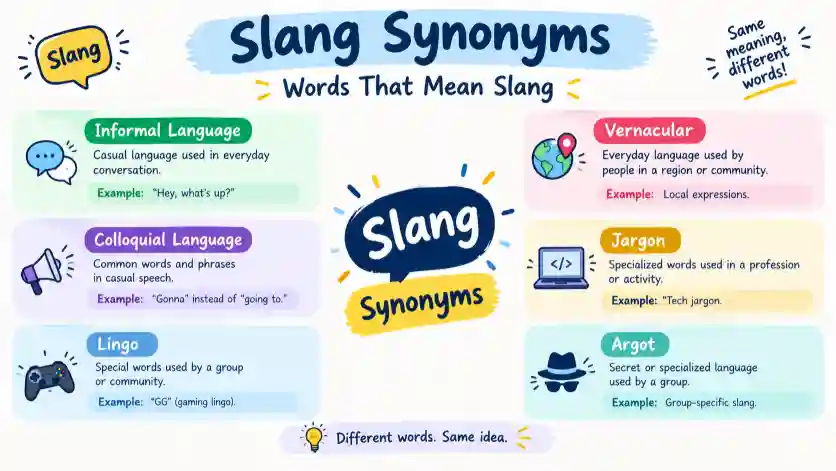
Slang synonyms are words and phrases that describe language used in casual, informal, or group specific communication.
Common alternatives include informal language, colloquial language, lingo, vernacular, jargon, argot, and street language.
The exact synonym depends on the type of language you mean. Some words are close in meaning, while others describe a more specific kind of slang.
Quick Answer
The most common slang synonyms include:
| Slang Synonym | Simple Meaning |
| Informal language | Casual language used in everyday conversation |
| Colloquial language | Words and phrases common in casual speech |
| Lingo | Special words used by a group or community |
| Vernacular | Everyday language used by ordinary speakers |
| Jargon | Specialized words used by a profession or group |
| Argot | Secret or specialized language used by a particular group |
| Street language | Informal language associated with street or urban culture |
| Expressions | Words or phrases used to express an idea or feeling |
| Patter | A particular style of informal talk |
| Terminology | Words used for a specific subject or field |
Not every word in this list is a perfect synonym. The context matters.
What Does Slang Mean?
Slang refers to informal words, phrases, or expressions that people use in casual communication.
Slang can develop within many different groups. It may come from young people, online communities, music, gaming, workplaces, regions, or social groups.
For example:
- Cool = fashionable or impressive
- Bro = friend or male person
- Lit = exciting or excellent
- Ghosting = suddenly stopping communication
- Flex = show off
- Ate = did something extremely well
Slang can change quickly. A word that is popular today may become less common later.
Slang Synonyms in Simple English
Different words can be used instead of slang, but they do not all have exactly the same meaning.
Informal Language
Informal language is one of the closest general alternatives to slang.
It describes language used in relaxed situations instead of formal writing or speech.
Example:
“Hey, what’s up?”
This is informal language. It can also contain slang, but informal language is a broader term.
Colloquial Language
Colloquial language means words and expressions commonly used in everyday conversation.
For example:
“Gonna” instead of “going to”
“Kids” instead of “children”
Colloquial language can sound natural and conversational without being strong slang.
Lingo
Lingo usually means the special words or expressions used by a particular group.
For example:
- Gaming lingo
- Internet lingo
- Teen lingo
- Business lingo
- Sports lingo
Example:
“GG” is common gaming lingo.
Lingo is often used as an easy, casual synonym for a group’s special vocabulary.
Vernacular
Vernacular refers to the everyday language spoken by people in a particular place, community, or social group.
For example, someone may describe a regional way of speaking as local vernacular.
Vernacular is broader than slang because it can include ordinary words, pronunciation, grammar, and expressions.
Jargon
Jargon means specialized words used by a particular profession, activity, or group.
Examples include:
- Medical jargon
- Legal jargon
- Computer jargon
- Business jargon
- Gaming jargon
For example:
“404” is a common technical term people may encounter online.
Jargon is not always slang. It is usually connected to a specific subject or group.
Argot
Argot is a specialized vocabulary associated with a particular group.
The word can describe language that outsiders may not easily understand.
For example, a group may develop its own words and expressions that make sense mainly to members of that group.
Argot is more formal than the word slang, so it is less common in everyday conversation.
Slang vs Informal Language
These terms are related, but they are not identical.
Informal language covers casual communication in general. Slang is a more specific type of informal language.
For example:
“I’m gonna head home.”
This is informal.
“That movie was fire!”
This is informal and also slang.
So, all slang is generally informal, but not all informal language is slang.
Slang vs Colloquial Language
Colloquial language is commonly used in everyday speech.
Slang tends to be more informal, expressive, or connected to a particular group or period.
Compare:
Colloquial:
“I’m gonna grab some food.”
Slang:
“I’m gonna grab some grub.”
Both are casual, but grub is more slang like.
Slang vs Lingo
The word lingo usually focuses on language used by a particular group.
For example:
“I don’t understand all this gaming lingo.”
Slang can also belong to a group, but it can spread far beyond that group.
For example, internet slang can start in a small online community and later become widely known.
Slang vs Jargon
This is another common point of confusion.
Jargon usually helps people within a profession or specialized field communicate efficiently.
Slang is usually more casual and expressive.
| Slang | Jargon |
| Casual | Specialized |
| Often expressive | Often technical |
| Common in social settings | Common in professional settings |
| Can change quickly | Often tied to a field |
| Example: “lit” | Example: “bandwidth” in networking |
Some words can overlap. A term may be slang in one community and jargon in another.
Other Words Related to Slang
Besides direct synonyms, several words are closely related to slang.
Expressions
An expression is a word or phrase used to communicate an idea, feeling, or meaning.
Example:
“No worries” is a common informal expression.
Not every expression is slang.
Street Language
Street language is sometimes used to describe informal language associated with urban or street culture.
The term can cover slang, local expressions, and other casual speech.
It should be used carefully because different communities use different language.
Patter
Patter can mean a particular way of talking, especially language associated with a certain group, activity, or style.
For example:
“I couldn’t understand the local patter.”
This word is especially useful when talking about regional or community speech.
Vocabulary
Vocabulary means the collection of words used by a person, language, subject, or group.
Slang can be part of someone’s vocabulary, but vocabulary itself is much broader.
Types of Slang
Slang can appear in many forms.
Internet Slang
Internet slang is common in online communication.
Examples include:
- LOL
- FR
- TBH
- DM
- BTW
These expressions are often seen in texts, comments, and social media posts.
Texting Slang
Texting slang helps people communicate quickly.
Examples include:
- BRB
- IDK
- TTYL
- OMG
- IMO
Some texting terms are abbreviations rather than traditional slang words.
Gaming Slang
Gamers often develop their own vocabulary.
Examples include:
- Noob
- GG
- AFK
- NPC
- OP
Some gaming terms have moved into everyday online language.
Regional Slang
Regional slang is connected to a particular location.
For example, American cities, Australian communities, Scottish speakers, and different parts of England can all have their own slang expressions.
Regional slang can help show where a speaker comes from or which community they are part of.
Teen and Youth Slang
Young people often create, adapt, and spread new expressions.
Examples can include words such as:
- Sus
- Rizz
- Bet
- Fire
- Slay
Some become mainstream, while others disappear quickly.
Why Are There So Many Words for Slang?
People use different terms because slang covers many kinds of informal language.
A word used by gamers may be called gaming lingo.
A professional term may be called jargon.
A local expression may be called vernacular.
A casual everyday phrase may be called colloquial language.
A highly informal group expression may simply be called slang.
The words overlap, but their focus can be different.
How to Choose the Right Slang Synonym
Use the word that best matches the situation.
Use “informal language” for general casual communication.
“colloquial language” use for everyday conversational speech.
Use “lingo” for language used by a particular group.
Use “jargon” for technical or professional vocabulary.
“vernacular” use for everyday or regional language.
Use “argot” for specialized group vocabulary, especially when it is difficult for outsiders to understand.
Use “slang” when you mean informal words or expressions that are often associated with a particular culture, group, age, or period.
Examples of Slang Synonyms in Sentences
Here are some natural examples:
Slang
“That word is popular slang among teenagers.”
Informal language
“The writer used informal language in the message.”
Colloquial language
“The article explains several common colloquial expressions.”
Lingo
“I had to learn the gaming lingo before joining the group.”
Jargon
“The doctor explained the medical jargon in simple words.”
Vernacular
“The character speaks in local vernacular.”
Argot
“The group developed its own argot.”
Are Slang and Colloquial the Same?
No. They are closely related, but they are not exactly the same.
Colloquial usually describes ordinary conversational language.
Slang is generally more informal and may be strongly linked to a particular group, culture, age group, or trend.
For example, “kids” is a common colloquial word for children. A newer internet expression may be considered slang.
Are Slang and Jargon the Same?
No.
Slang is usually casual and social.
Jargon is specialized language used in a particular field or activity.
A programmer, doctor, lawyer, or gamer may use jargon to discuss ideas that are familiar to people in that field.
Slang, on the other hand, is often used to sound casual, humorous, expressive, or socially connected.
When Should You Avoid Slang?
Slang is natural in casual communication, but it may not fit every situation.
You may want to avoid heavy slang in:
- Formal letters
- Academic writing
- Job applications
- Professional reports
- Official documents
- Business communication
- Messages to people who may not know the expression
For example, instead of:
“That idea is fire!”
A formal message could say:
“That is an excellent idea.”
The best choice depends on the audience and situation.
Slang Synonyms: Quick Comparison
| Word | Best Used For |
| Slang | Informal words and expressions |
| Informal language | Casual communication |
| Colloquial language | Everyday conversation |
| Lingo | Group specific language |
| Vernacular | Local or everyday language |
| Jargon | Professional or technical language |
| Argot | Specialized group vocabulary |
| Street language | Informal urban or street expressions |
| Patter | A particular style of informal talk |
| Expression | A phrase that communicates an idea or feeling |
FAQs About Slang Synonyms
What is another word for slang?
Common alternatives include informal language, colloquial language, lingo, vernacular, jargon, and argot. The best choice depends on the context.
What is a synonym for slang words?
You can use terms such as informal words, colloquial expressions, casual expressions, lingo, or informal vocabulary.
Is lingo the same as slang?
Lingo and slang can overlap. Lingo usually refers to the special language of a particular group, while slang generally means informal expressions.
Is jargon a type of slang?
Jargon and slang are related but different. Jargon is specialized language used by a profession or group, while slang is usually informal and expressive.
What is the opposite of slang?
There is no single perfect opposite. Depending on the context, formal language, standard language, or formal vocabulary can work as contrasts to slang.
Is vernacular the same as slang?
Not exactly. Vernacular means the everyday language of a person, community, or region. Slang is a more specific form of informal language.
What are examples of informal language?
Examples include gonna, wanna, kids, cool, and no worries. Some are colloquial rather than slang.
Conclusion
Slang synonyms include informal language, colloquial language, lingo, vernacular, jargon, and argot. However, these words are not always interchangeable.
If you mean casual words used in everyday communication, informal language or colloquial language may fit best. If you mean specialized language used by a group, lingo or jargon may be more accurate.
Understanding these differences makes it easier to describe the kind of language people use in texts, conversations, social media, gaming, workplaces, and local communities.
Read More:
- Paisa Mexican Slang: More Than Just “Paisano” (2026)
- TNT Meaning Slang: Decoding This Three-Letter Text in 2026
- FT Slang :Meaning in Text, Chat & Social Media

Hi, I’m Sophia Turner, a writer at SlangRise with 7 years of experience researching English slang, internet abbreviations, and modern vocabulary.