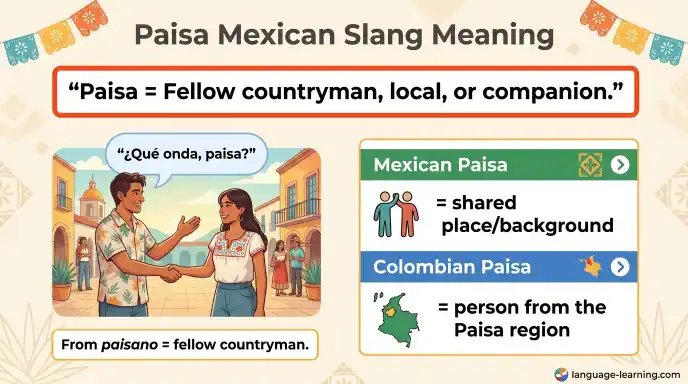
Paisa Mexican slang usually means a fellow countryman, person from the same place, or someone from the same region.
It comes from the Spanish word paisano, which has the sense of a fellow countryman or someone from the same area.
In Mexican Spanish, paisa can also be used informally for a close friend or companion.
For example, someone might say “Ese paisa es de mi pueblo”, meaning “That guy is from my hometown.”
The word is casual and can express familiarity, shared roots, or a sense of connection.
Quick Answer
| Term | Meaning | Tone | Used By | Common Contexts | Offensive? |
| Paisa | Fellow countryman or person from the same place | Casual / friendly | Spanish speakers, especially in Mexican contexts | Conversation, communities, casual speech | Usually no |
| Paisa | Close friend or companion | Friendly | Mexican Spanish speakers | Casual conversations | Usually no |
| Paisano | Fellow countryman / person from the same place | Neutral | Spanish speakers | Formal and informal Spanish | No |
Word at a Glance
| Word | Usage | Part of Speech | Pronunciation | Common Meaning | Tone | Common Contexts | Related Words |
| Paisa | Mexican slang / informal Spanish | Noun | pie-sah | Fellow countryman or local | Casual / friendly | Mexican Spanish, communities, casual speech | paisano, compatriota, amigo |
| Paisano | Standard Spanish | Noun | pie-sah-no | Fellow countryman or person from the same place | Neutral | Spanish conversation | paisa, compatriota |
| Paisa | Regional Latin American usage | Noun | pie-sah | Meaning varies by country | Regional | Latin America | local, countryman |
What Does Paisa Mean in Mexican Slang?
In Mexican Spanish, paisa is an informal shortening of paisano.
It can refer to:
- Someone from the same place
- A fellow Mexican
- Someone from the same region
- A person with shared local roots
- In some contexts, a close friend or companion
The Academia Mexicana de la Lengua defines paisa in Mexican Spanish as a paisano or coterráneo, meaning a person from the same land, region, or population.
For example:
“Ese paisa es de mi pueblo.”
This can mean:
“That guy is from my hometown.”
The word creates a sense of shared background or belonging.
Where Does “Paisa” Come From?
Paisa comes from paisano.
The longer word paisano can refer to a fellow countryman or someone who comes from the same place.
Over time, paisa developed as a shorter, more informal form.
The Spanish-language Association of Academies also identifies paisa as an abbreviation of paisano and records its Mexican use for someone from the same place.
So the basic connection is:
Paisano → Paisa
This is why the word can carry a sense of shared origin, community, or familiarity.
What Does Paisa Mean in Mexico?
In Mexico, paisa generally has a regional or community-based meaning.
It can describe someone who is from the same:
- Country
- Region
- Town
- Local community
- Cultural background
For example:
“Es paisa como nosotros.”
This can communicate:
“He’s from the same place as us.”
The exact English translation can change depending on the conversation. Fellow countryman, local, compatriot, or someone from back home may all capture part of the meaning.
Does Paisa Mean “Friend” in Mexican Spanish?
It can.
The Spanish-language Association of Academies records another Mexican use of paisa meaning a close friend or inseparable companion.
For example:
“¿Qué onda, paisa?”
Depending on the speakers and situation, this can work like:
“What’s up, buddy?”
or:
“What’s up, my friend?”
This use emphasizes familiarity rather than simply where someone comes from.
Is Paisa a Mexican Slang Word?
Paisa is an informal regional word used in Mexican Spanish.
It is not slang in the same way as an internet abbreviation such as “FR” or “LOL.” Instead, it is a colloquial Spanish term with a specific regional meaning.
That distinction is useful because paisa has a long history in Spanish-speaking communities and is not simply a recent social-media expression.
Is Paisa the Same as Paisano?
They are closely related.
Paisano is the longer, standard Spanish form.
Paisa is a shortened, more informal form.
| Word | Meaning | Style |
| Paisano | Fellow countryman / person from the same place | Standard / neutral |
| Paisa | Fellow countryman / person from the same place | Informal |
| Compatriota | Fellow citizen / compatriot | More formal |
So if someone says “mi paisa,” the word can sound more casual and familiar than “mi paisano.”
What Does “Mi Paisa” Mean?
“Mi paisa” literally carries the idea of “my fellow countryman” or “my fellow local.”
Depending on context, it can also sound like:
- My fellow Mexican
- My local friend
- My buddy from back home
- My fellow countryman
For example:
“Mi paisa me ayudó con el trabajo.”
The speaker could mean:
“My fellow countryman helped me with the work.”
or, in a more familiar context:
“My buddy helped me with the work.”
The surrounding conversation determines the best translation.
What Does “Qué Onda, Paisa?” Mean?
“Qué onda” is a common informal Mexican expression meaning something like “What’s up?”
So:
“¿Qué onda, paisa?”
can be understood as:
“What’s up, buddy?”
or:
“What’s up, my fellow?”
The word paisa adds a sense of familiarity or shared connection.
It is casual and would normally appear in relaxed conversation rather than formal communication.
Is Paisa Positive or Negative?
Paisa is usually neutral or friendly in Mexican usage.
It can express:
- Familiarity
- Shared roots
- Community
- Friendship
- Cultural connection
However, tone always matters.
A friendly speaker may use paisa warmly, while someone else could use a regional label in a teasing or dismissive way.
The word itself is not automatically offensive.
Is Paisa Offensive?
In its ordinary Mexican meaning, paisa is not inherently offensive.
It can be a friendly way to refer to someone who shares your background or comes from the same place.
Still, regional labels can take on different meanings in different communities. If you are not familiar with the speakers or their relationship, it is better to understand the context before using the word yourself.
Paisa Meaning in Mexican-American Communities
You may also encounter paisa among Mexican and Mexican-American communities outside Mexico.
In these settings, the word can emphasize shared Mexican roots or a connection to home.
For example, someone might use it when talking about another Mexican person from a similar hometown or background.
This use can carry a strong sense of:
- Community
- Shared culture
- Familiarity
- Hometown connection
- Mexican identity
However, the meaning can vary by community, so it should not be treated as having one fixed meaning everywhere.
Is Paisa the Same as the Colombian “Paisa”?
No.
This is one of the most important points about the word.
In Colombia, “Paisa” commonly refers to a person from the Paisa region, especially Antioquia and areas culturally connected to it. The Colombian usage is a regional identity.
In Mexico, the word can mean a fellow countryman, person from the same place, or close companion.
So:
Mexican paisa ≠ Colombian Paisa
The spelling is the same, but the regional meanings are different.
Mexican Paisa vs. Colombian Paisa
| Term | Region | Common Meaning |
| Paisa | Mexico | Fellow countryman, local, or companion |
| Paisa | Colombia | Person from the Paisa region, especially Antioquia |
| Paisano | Mexico / Spanish | Fellow countryman or person from the same place |
| Compatriota | Spanish-speaking regions | Fellow citizen / compatriot |
Context and country are essential when interpreting the word.
What Does Paisa Mean in a Conversation?
Consider this example:
Luis: “¿De dónde eres?”
Carlos: “Soy de Guadalajara.”
Luis: “Ah, eres paisa.”
Here, the speaker may be using paisa to express that Carlos is from the same country or a shared regional background.
Another example:
Juan: “¿Qué onda, paisa?”
Here, it may simply be a friendly greeting between people who share a cultural or regional connection.
The exact translation depends on the relationship and context.
Real-Life Examples of Paisa Slang
Example 1: Same Hometown
“Ese paisa es de mi pueblo.”
Meaning:
“That guy is from my hometown.”
Example 2: Friendly Greeting
“¿Qué onda, paisa?”
Meaning:
“What’s up, buddy?”
Example 3: Shared Background
“Somos paisas, venimos del mismo lugar.”
Meaning:
“We’re from the same place.”
Example 4: Fellow Mexican
“Hay muchos paisas viviendo aquí.”
Meaning:
“There are many fellow Mexicans living here.”
Example 5: Friendly Reference
“Mi paisa me ayudó ayer.”
Meaning:
“My friend/fellow countryman helped me yesterday.”
Example 6: Community Context
“Ese paisa conoce a toda la gente del barrio.”
Meaning:
“That guy knows everyone in the neighborhood.”
The best English translation depends on the context.
How Is Paisa Used on Social Media?
Paisa can appear online when people discuss Mexican culture, regional identity, family roots, or community.
You may see it in:
- Social media comments
- Mexican-American communities
- Casual messages
- Cultural posts
- Memes
- Videos
- Community discussions
For example:
“Saludos a todos mis paisas.”
This can express:
“Greetings to all my fellow people/countrymen.”
The phrase emphasizes shared identity or background.
Does Paisa Mean “Country Person”?
Sometimes.
Because paisa comes from paisano, and the word can refer to someone from the same land or community, English translations may sometimes use expressions such as:
- Countryman
- Fellow local
- Fellow Mexican
- Person from back home
- Rural/local person
However, “country person” is not a perfect translation in every Mexican context.
It is better to focus on the idea of shared origin or community.
Does Paisa Mean Rural Person in Mexico?
The word can sometimes be associated with a rural or local background in broader Latin American usage, but this should not be treated as the main Mexican definition.
The strongest Mexican dictionary definition is based on being from the same place or region.
So, if you see paisa in Mexican Spanish, do not automatically translate it as “rural person.”
Look at the surrounding conversation.
Common Mistakes With Paisa
Mistake 1: Assuming Paisa Always Means Colombian
Paisa has a specific Colombian regional meaning, but Mexican Spanish uses the word differently.
Mistake 2: Translating Paisa Only as “Friend”
Friend can be a suitable translation in some contexts, but the word can also refer to shared origin or being from the same place.
Mistake 3: Assuming It Is Always Slang
Paisa is informal and colloquial, but it is also a documented regional Spanish word.
Mistake 4: Ignoring Context
The same word can emphasize nationality, hometown, region, or friendship.
Mistake 5: Confusing It With the South Asian Currency Term
Paisa is also the name of a small monetary unit used in countries such as India, Pakistan, and Nepal. That meaning has a completely different origin from the Spanish word.
Paisa vs. Compatriota
Both words can refer to someone from the same country, but their style is different.
| Word | Meaning | Tone |
| Paisa | Fellow countryman/local | Informal |
| Paisano | Fellow countryman/person from same place | Neutral |
| Compatriota | Fellow citizen | More formal |
| Amigo | Friend | General |
Paisa feels more conversational and familiar.
Paisa vs. Amigo
These words can overlap in some contexts, but they are not exact synonyms.
Amigo simply means friend.
Paisa can indicate a friend or companion, but it can also communicate shared roots or origin.
For example:
“Mi amigo.”
means:
“My friend.”
While:
“Mi paisa.”
can carry the additional idea of:
“My fellow/local/person from my background.”
Is Paisa Formal or Informal?
Paisa is informal and conversational.
It works naturally in:
- Casual conversations
- Community conversations
- Friendly greetings
- Informal messages
- Cultural discussions
For formal writing, terms such as compatriota or a direct description of someone’s origin may be clearer.
How to Use Paisa Respectfully
If you want to use paisa naturally, pay attention to the community and context.
Good situations include:
- Talking with someone who uses the term themselves
- Friendly conversations
- Discussing shared hometowns
- Talking about cultural roots
- Casual community settings
Avoid using it as a stereotype for all Mexicans or all Spanish speakers.
The word is regional, and its meaning can change across countries.
Other Meanings of Paisa
The word paisa has several meanings across the Spanish-speaking world.
Colombian Meaning
In Colombia, Paisa commonly identifies someone from the Paisa cultural region, particularly Antioquia.
Mexican Meaning
In Mexico, it can mean a fellow countryman, person from the same place, or close companion.
Other Latin American Uses
Other countries have their own regional meanings for paisa, so translating it without considering the country can lead to confusion. ASALE records several country-specific uses.
South Asian Meaning
In South Asia, paisa refers to a monetary unit. This is unrelated to the Spanish slang word.
Key Takeaways
- Paisa in Mexican slang comes from paisano.
- It can mean a fellow countryman or someone from the same place.
- In some Mexican contexts, it can also mean a close friend or companion.
- The word is generally casual and friendly.
- It is not automatically offensive.
- Mexican paisa and Colombian Paisa have different meanings.
- Context and region are important when translating the word.
- Paisa is different from the South Asian monetary term paisa.
- Paisano is the longer related Spanish word.
- In formal situations, compatriota may be a clearer alternative.
FAQs About Paisa Mexican Slang
1. What does paisa mean in Mexican slang?
In Mexican Spanish, paisa can mean a fellow countryman, someone from the same place or region, or a person who shares the speaker’s local background. In some contexts, it can also mean a close friend or companion.
2. Is paisa a Mexican word?
Paisa is a Spanish word used in several Latin American countries. In Mexico, it has a documented informal meaning connected to paisano, especially someone from the same place or region.
3. What does paisa mean in Mexico?
In Mexico, paisa can mean fellow countryman, local, or person from the same region. It can also be used as a familiar term for a close friend or companion.
4. Is paisa the same as paisano?
They are closely related. Paisa is a shortened, informal form connected to paisano. Paisano is the longer standard Spanish word for a fellow countryman or person from the same place.
5. Is paisa a compliment?
It can be friendly and positive when used to express shared roots or familiarity. However, the tone depends on the speaker and situation, so it is not automatically a compliment.
6. Is paisa offensive in Mexico?
Paisa is not inherently offensive in Mexican Spanish. It is commonly used as an informal term connected with shared origin or familiarity. Still, context and tone can affect how any regional label is received.
7. Does paisa mean friend?
It can. Mexican Spanish dictionaries also record paisa as a term for a close friend or companion. However, the word can also refer to someone from the same place or country.
8. Does paisa mean Colombian?
Not always. In Colombia, Paisa commonly refers to someone from the Paisa region, especially Antioquia. In Mexico, the word has a different meaning connected to paisano and shared origin.
Conclusion
Paisa Mexican slang usually refers to a fellow countryman, person from the same place, or someone who shares a regional background.
The word comes from paisano and is used informally in Mexican Spanish. In some contexts, it can also be a friendly way to refer to a close companion.
If you see paisa in a Mexican conversation, the best translation depends on the context. It may mean fellow Mexican, local, person from back home, or buddy. Understanding the surrounding conversation will give you the most accurate meaning.
Read More:
- TNT Meaning Slang: Decoding This Three-Letter Text in 2026
- Eating Slang Meaning: What Does Eating Mean?
- POS Mean in Slang? 2026 Guide for Parents

Hi, I’m Olivia Carter. I enjoy researching English slang, online expressions, and everyday vocabulary. I write clear, beginner-friendly guides with simple definitions and practical examples to make modern English easier to understand.