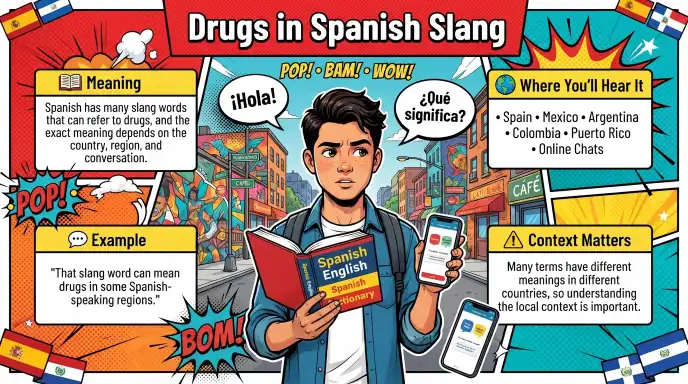
Drugs in Spanish Slang refers to informal, coded words used across Spanish speaking countries and communities to refer to different types of drugs, often heard in movies, music, and media.
This vocabulary has become widely recognized through popular culture, especially crime dramas, narco shows, and Latin music that often reference street language.
Understanding these terms can help language learners, media viewers, and researchers better grasp cultural context and regional variations in Spanish-speaking communities.
In this guide, you’ll explore common Spanish slang terms related to drugs, their meanings, and the cultural context behind their usage purely from an educational and linguistic perspective.
Quick Answer
Drugs in Spanish slang are informal words used to refer to drugs in everyday conversations, music, movies, and online content. Common examples include mota (marijuana), hierba (weed), maría (marijuana), perico (cocaine in some regions), and cristal (methamphetamine in some countries). The meaning often depends on the country and the conversation.
Word at a Glance
| Feature | Details | Usage |
| Word | Drugs (Spanish Slang) | Informal Spanish slang terms |
| Part of Speech | Nouns | Used as slang names for different drugs |
| Pronunciation (US & UK) | Varies by word | Pronunciation depends on the specific slang term |
| Common Meaning | Informal names for drugs | Often heard in music, films, and everyday conversations |
| Tone | Informal and regional | Meanings differ across Spanish-speaking countries |
| Related Words | Mota, Hierba, María, Perico, Cristal | Common Spanish slang terms |
What Does “Drugs” Mean in Spanish Slang?
There is no single Spanish slang word that means drugs. Instead, Spanish speakers use different slang terms depending on the type of drug and the country.
For example, a word that refers to marijuana in Mexico may have a completely different meaning in Spain or Argentina.
Because of these regional differences, it is always important to understand the context before assuming what a slang word means.
Common Spanish Slang Words for Drugs
Note: The following terms are provided for language learning and cultural understanding only. Their meanings can vary by country and community.
Mota
Mota is one of the most common Spanish slang words for marijuana, especially in Mexico.
Example:
“He mentioned ‘mota’ in the song.”
Hierba
Hierba literally means grass or herb, but in slang it often refers to marijuana.
Example:
“The movie character used the word ‘hierba.'”
María
María is another slang name for marijuana used in some Spanish-speaking regions.
Example:
“The article explained that ‘María’ is a regional slang term.”
Perico
In several countries, including parts of Colombia and Mexico, perico is a slang word for cocaine.
However, in standard Spanish, perico also means parakeet, so the context is important.
Example:
“The detective recognized the slang word ‘perico.'”
Coca
Coca is an informal shortened name for cocaine in many Spanish-speaking regions.
Example:
“The documentary mentioned ‘coca’ during the interview.”
Cristal
In some countries, cristal is used as a slang term for methamphetamine because of its crystal-like appearance.
Example:
“Police reports often mention the slang word ‘cristal.'”
Where Are These Slang Words Commonly Used?
Spanish drug slang is most often found in discussions about language, media, and culture.
Music
Some Spanish-language songs include regional slang words to reflect everyday speech or tell a story.
Movies and TV Shows
Crime dramas and historical films sometimes use slang to make conversations sound realistic.
Social Media
People occasionally discuss these terms when explaining Spanish vocabulary, translating lyrics, or talking about popular culture.
Language Learning
Students often learn these expressions to better understand native speakers, books, films, and online content.
Did You Know?
Spanish slang is highly regional. A slang word that refers to a drug in one country may have a completely harmless meaning in another. For example, perico normally means parakeet in standard Spanish, but in some regions it is also used as slang for cocaine. That’s why context is essential when interpreting Spanish slang.
How Drug Slang Differs Across Spanish-Speaking Countries
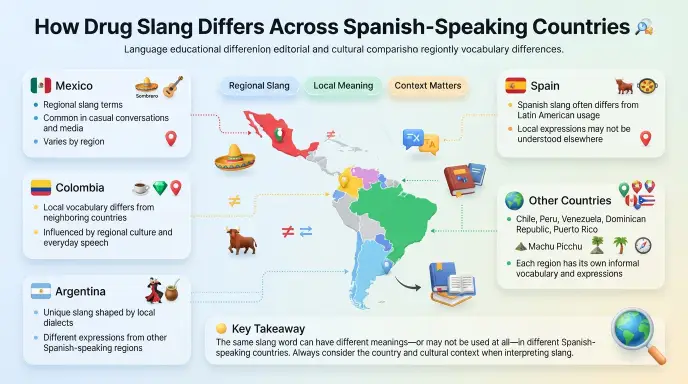
Spanish is spoken in more than 20 countries, so slang is not the same everywhere. A word that is common in one country may be unfamiliaror mean something completely differentin another.
Mexico
In Mexico, words like mota are commonly used as slang for marijuana. You may also hear other regional expressions in music, movies, or everyday conversations.
Spain
People in Spain have their own slang vocabulary, which often differs from Latin American Spanish. Some terms are unique to Spain, while others are understood across several countries.
Colombia
In Colombia, certain slang terms for drugs appear in films, music, and crime-related stories. However, many words have different meanings depending on the region.
Argentina
Argentinian Spanish includes its own local slang. Some drug-related expressions are unique to the country and may not be understood elsewhere.
Other Spanish-Speaking Countries
Countries such as Chile, Peru, Venezuela, Ecuador, and the Dominican Republic also have regional slang. Because meanings vary, it is always best to rely on the context rather than assuming a word has the same meaning everywhere.
Is Drug Slang Rude or Offensive?
Most Spanish drug slang is informal rather than inherently offensive.
However, these words are closely connected with illegal drugs, so they may sound inappropriate in formal settings.
| Context | Appropriate? | Notes |
| Language learning | ✅ Yes | Educational discussions |
| Movies and TV | ✅ Yes | Often used for realistic dialogue |
| Music lyrics | ✅ Yes | Common in some genres |
| Casual conversations | ⚠️ Depends | Meanings vary by region |
| School or work | ❌ Usually No | Better to use standard vocabulary |
Common Mistakes When Learning Spanish Drug Slang
Assuming Every Country Uses the Same Words
Spanish slang changes from one country to another. Always check which country the speaker is from.
Forgetting the Context
Some words have both a standard meaning and a slang meaning.
For example, perico usually means parakeet, but in some regions it can also refer to cocaine.
Using Slang Without Understanding It
Just because you hear a slang word in a song or movie doesn’t mean it’s appropriate to use in everyday conversations.
Real-Life Examples
Movie Dialogue
“The detective explained the meaning of the slang term during the investigation.”
Song Lyrics
“The singer used regional slang that many listeners outside the country didn’t recognize.”
Language Class
Student: “Why does this word have two meanings?”
Teacher: “Because Spanish slang changes from country to country.”
Travel
A traveler may hear a slang word in one country that has a completely different meaning somewhere else.
Frequently Asked Questions
1. What is the most common Spanish slang for marijuana?
Common slang terms include mota, hierba, and maría, depending on the country.
2. Does every Spanish-speaking country use the same drug slang?
No. Drug slang varies widely across Spanish-speaking countries.
3. What does mota mean in Spanish slang?
In many parts of Mexico, mota is a slang term for marijuana.
4. What does perico mean in Spanish slang?
In some countries, perico is slang for cocaine, while in standard Spanish it means parakeet.
5. What does hierba mean?
Hierba literally means grass or herb, but it can also be slang for marijuana in certain contexts.
6. Is Spanish drug slang offensive?
Not necessarily, but it is informal and may be inappropriate in professional or formal settings.
7. Can I use these slang words in everyday conversation?
It’s generally better to understand these terms than to use them, especially if you’re unsure of the regional meaning or context.
8. Why do Spanish slang words change by country?
Each Spanish-speaking country has its own culture, history, and local expressions, so slang naturally develops in different ways.
9. Are these words used in songs and movies?
Yes. Many Spanish-language songs, films, and TV shows use regional slang to make dialogue sound natural.
10. Is it important to learn drug slang in Spanish?
If you’re learning Spanish, recognizing common slang can help you understand conversations, movies, books, and music more accurately.
11. Can one slang word have different meanings?
Yes. Many Spanish slang words have different meanings depending on the country and context.
12. Why is context important?
Context helps you determine the correct meaning of a slang word. Without it, the same word could be misunderstood.
Conclusion
Drugs in Spanish slang include many regional expressions that vary across the Spanish-speaking world. Words such as mota, hierba, maría, perico, and cristal may have different meanings depending on the country and situation. Learning these terms can help you better understand Spanish language music, films, books, and everyday conversations. However, because slang is highly regional, it’s always important to consider the context before interpreting or using any expression.
- The Secret Language of League of Legends Players
- What Does Swag Mean slang? The Word That Defines Confidence
- British Slang for Penis: Common UK Terms Explained

Hi, I’m Olivia Carter. I enjoy researching English slang, online expressions, and everyday vocabulary. I write clear, beginner-friendly guides with simple definitions and practical examples to make modern English easier to understand.