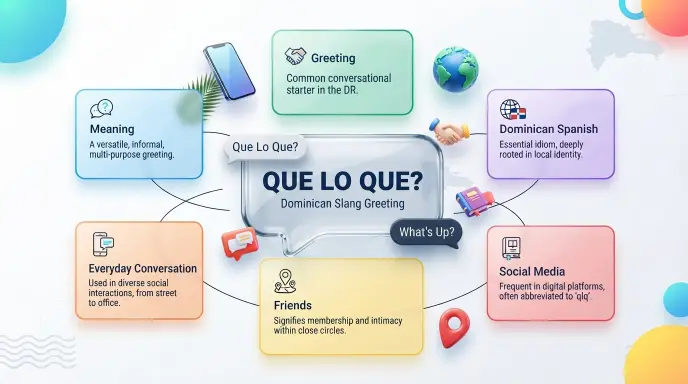
Que Lo Que is Dominican slang meaning “What’s up” or “What’s going on,” commonly used as a casual greeting among friends and family in the Dominican Republic.
This phrase is deeply embedded in everyday Dominican conversation, often shortened even further to “klk” in texting and social media.
The response to “Que Lo Que” is typically light and casual, such as “Aqui, tranquilo” (Here, chilling) or simply “Tato” (all good), reflecting the relaxed nature of Dominican communication.
In this guide, you’ll learn the true meaning of “Que Lo Que,” how to respond naturally, and why it’s such an essential phrase in Dominican slang.
Quick Answer
Que lo que is a Dominican Spanish slang greeting that means “What’s up?”, “What’s going on?”, or “How are things?” It is a friendly, informal expression commonly used in everyday conversations throughout the Dominican Republic and among Dominican communities abroad.
Word at a Glance
| Feature | Details |
| Phrase | Que lo que |
| Slang Meaning | What’s up? / What’s going on? |
| Language | Dominican Spanish |
| Part of Speech | Greeting |
| Pronunciation | keh loh KEH |
| Tone | Friendly, Casual |
| Common Region | Dominican Republic |
| Common Contexts | Conversations, texting, social media |
| Safe for Formal Use? | No |
What Does Que Lo Que Mean in Dominican Slang?
In Dominican slang, que lo que is a casual greeting used to ask how someone is doing or what is happening.
It works much like these English expressions:
- What’s up?
- What’s going on?
- How’s it going?
- What’s new?
Most of the time, people use it simply to start a friendly conversation.
Example:
“¡Que lo que, hermano?”
Meaning:
“What’s up, brother?”
Different Meanings of Que Lo Que
The meaning changes slightly depending on the situation.
| Meaning | Context | Example |
| What’s up? | Greeting a friend | “Que lo que?” |
| What’s going on? | Asking about a situation | “Que lo que por aquí?” |
| How are you? | Casual conversation | “Que lo que, todo bien?” |
The phrase is almost always used as a greeting rather than a literal question.
Where Is Que Lo Que Commonly Used?
You will hear que lo que in many casual settings.
Everyday Conversations
Friends often greet each other with que lo que instead of saying hello.
Text Messages
Many Dominicans begin text conversations with the phrase.
Example:
“Que lo que? What are you doing?”
TikTok
Creators often use que lo que in videos, captions, and comments.
The greeting appears in Stories, captions, and direct messages.
YouTube
Dominican content creators frequently open videos by saying que lo que to welcome viewers.
Is Que Lo Que Rude, Offensive, or Harmless?
Que lo que is generally friendly and harmless.
However, it is very informal.
It is best used with:
- Friends
- Family
- Classmates
- People you know well
Avoid using it:
- In business meetings
- During job interviews
- In formal emails
- When speaking with someone who expects formal Spanish
In formal situations, greetings like Hola, Buenos días, or Buenas tardes are more appropriate.
Real-Life Examples of Que Lo Que
Friendly Greeting
Person 1: “Que lo que?”
Person 2: “Todo bien. ¿Y tú?”
Text Message
“Que lo que? Are you free tonight?”
Family Conversation
“Cousin, que lo que? It’s been a long time!”
Social Media Comment
“Que lo que! That video was hilarious.”
Meeting a Friend
“Que lo que, bro! Good to see you.”
Origin and History
The exact origin of que lo que is uncertain, but the phrase has been part of Dominican Spanish for many years.
Linguists generally agree that it developed naturally in everyday speech as a shortened and more casual greeting. Over time, it became one of the most recognizable expressions in the Dominican Republic.
As Dominican music, especially merengue, bachata, and dembow, gained international popularity, que lo que spread beyond the Dominican Republic. Today, you can hear it in songs, movies, YouTube videos, and social media around the world.
It remains one of the most common greetings in Dominican culture.
Similar Dominican Slang and Greetings
If you hear que lo que, you may also come across these common Dominican expressions.
| Slang | Meaning |
| Dímelo | Tell me / What’s up? |
| Klk | Short form of que lo que |
| ¿Qué hay? | What’s up? |
| ¿Todo bien? | Everything good? |
| Mi loco | My friend / Bro |
| Manín | Buddy / Bro |
| Tigre | Guy, dude (informal) |
Among these, KLK is especially popular in text messages and on social media because it is simply an abbreviation of que lo que.
When Should You Avoid Using Que Lo Que?
Although que lo que is friendly, it is not suitable for every situation.
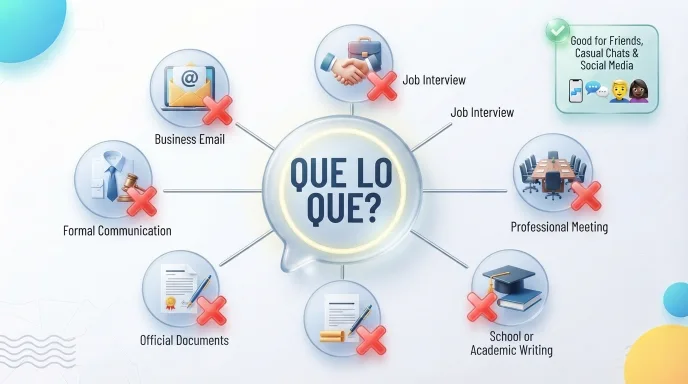
Avoid using it when:
- You are writing a business email.
- You are attending a job interview.
- You are speaking with a teacher or professor in a formal setting.
- You are giving a presentation.
- You are talking to someone who expects formal Spanish.
In these situations, greetings like Hola, Buenos días, or Buenas tardes are more appropriate.
Polite Alternatives
If you need a more formal greeting, these options work better.
| Instead of Que Lo Que | Better Alternative |
| Que lo que | Hola |
| Que lo que | Buenos días |
| Que lo que | Buenas tardes |
| Que lo que | Buenas noches |
| Que lo que | ¿Cómo está? |
| Que lo que | Mucho gusto |
These greetings are suitable for professional and formal conversations.
Why Do People Use Que Lo Que?
People use que lo que because it is quick, friendly, and natural.
To Greet Friends
It is one of the easiest ways to say “What’s up?” in Dominican Spanish.
To Sound Friendly
The phrase creates a relaxed and welcoming tone.
To Show Dominican Identity
Many Dominicans use que lo que as part of their everyday speech and cultural identity.
To Start a Conversation
The greeting often begins a chat without expecting a long answer.
Common Misunderstandings
People who are learning Spanish sometimes misunderstand que lo que.
| Myth | Fact |
| Que lo que is used in every Spanish-speaking country. | ❌ No. It is mainly associated with the Dominican Republic. |
| It has a literal English translation. | ❌ Not exactly. It is best understood as “What’s up?” or “What’s going on?” |
| It is rude. | ❌ No. It is a friendly and informal greeting. |
| KLK has a different meaning. | ❌ No. KLK is simply the shortened form of que lo que. |
| It is appropriate for formal situations. | ❌ No. It is best used with friends and in casual conversations. |
Frequently Asked Questions
1. What does que lo que mean in Dominican slang?
In Dominican slang, que lo que means “What’s up?”, “What’s going on?”, or “How are you?” It is a friendly greeting used in casual conversations.
2. Is que lo que only used in the Dominican Republic?
It is mainly associated with the Dominican Republic, although Dominican communities in other countries also use it regularly.
3. What does KLK mean?
KLK is the text abbreviation for que lo que. It has the same meaning and is very common in text messages and social media.
4. Is que lo que rude?
No. It is generally a friendly and harmless greeting. However, it is too informal for professional or formal situations.
5. Can tourists say que lo que?
Yes. Most Dominicans will understand and appreciate it when used respectfully in casual conversations.
6. Is que lo que the same as hola?
Not exactly. Hola simply means “hello,” while que lo que is closer to saying “What’s up?” or “How’s it going?”
Conclusion
Que lo que Dominican slang is a friendly greeting that means “What’s up?”, “What’s going on?”, or “How are you?” It is one of the best-known expressions in Dominican Spanish and is widely used in everyday conversations, text messages, and social media.
While the phrase is casual rather than formal, understanding its meaning will help you communicate more naturally with Dominican Spanish speakers and better understand Dominican music, videos, and online content.
Read More:
- Cigarette Slang: Understanding the Meaning Behind Each Word
- Sheila Slang: A Term Every Visitor to Australia Hears
- Salvador Slang: Fun Words Every Traveler Should Know

Hi, I’m Sophia Turner, a writer at SlangRise with 7 years of experience researching English slang, internet abbreviations, and modern vocabulary.