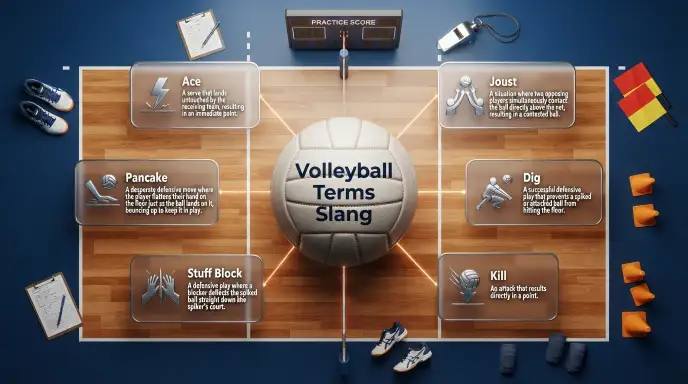
Volleyball Terms Slang refers to the informal words and phrases players, coaches, and fans use on and off the court like “kill,” “dig,” “shank,” and “six-pack” to describe plays, positions, and game situations.
This vocabulary helps speed up communication during fast-paced rallies, allowing teammates to quickly relay information about strategy, positioning, or mistakes.
Whether you’re a new player, a parent learning the game, or a die-hard fan, understanding this slang makes following volleyball much more enjoyable and immersive.
In this guide, you’ll learn the most common volleyball slang terms, what they mean, and how they’re used during games.
Quick Answer
Volleyball terms slang are informal words and phrases used by players and fans to describe volleyball actions, skills, and game moments. Common examples include kill, stuff block, pancake, ace, roof, and tool the block.
What Do Volleyball Terms Slang Mean?
Volleyball slang refers to casual expressions used instead of traditional volleyball language. These terms often come from players who want a quicker way to describe what happens during a match.
For example:
- Kill means a powerful attack that scores a point.
- Ace means a serve that the opponent cannot handle.
- Roof means blocking an opponent’s hit directly back down.
- Pancake means saving the ball with a flat hand under it.
These words are common among volleyball players because they make communication easier during fast-paced games.
Word at a Glance
| Feature | Details |
| Word | Volleyball Terms Slang |
| Part of Speech | Noun Phrase |
| Pronunciation | US: /ˈvɑːliˌbɔːl tɜːrmz slæŋ/ |
| Common Meaning | Informal volleyball expressions used by players and fans |
| Tone | Casual, sporty, and energetic |
| Common Contexts | Volleyball games, practices, sports chats, social media |
| Related Words | Kill, ace, block, dig, spike, set |
Volleyball Terms Slang Full Form / Definition
Volleyball slang does not have one full form because it is a group of informal terms rather than an abbreviation.
Players create and use slang to describe actions quickly during games.
Some popular volleyball slang terms include:
Kill
A kill means an attack that lands successfully and gives the attacking team a point.
Example:
- “That spike was a clean kill.”
Ace
An ace happens when a serve scores directly because the receiving team cannot control the ball.
Example:
- “She got three aces in a row.”
Stuff Block
A stuff block means a strong block that sends the opponent’s attack straight back to the floor.
Example:
- “That was a huge stuff block!”
Pancake
A pancake is a defensive save where a player places their hand flat on the floor to keep the ball from touching the ground.
Example:
- “That pancake save kept the rally alive.”
What Do Volleyball Slang Terms Stand For?
Volleyball slang terms usually describe specific actions or moments during a game.
They help players communicate quickly.
Examples:
- Hit → attacking the ball.
- Dig → defensive save.
- Stuff → strong block.
- Tool → hitting the ball off the opponent’s block.
- Roof → blocking the ball straight down.
These terms are not official replacements for volleyball rules, but they are widely understood among players.
Are Volleyball Slang Terms Rude, Offensive, or Neutral?
Most volleyball slang terms are neutral and sports-related.
They are usually used to celebrate good plays or describe game situations.
Examples:
- “That was a nasty spike.”
- “She got a monster block.”
- “That was a sick save.”
Words like “nasty” or “sick” may sound negative in normal English, but in sports slang they often mean impressive or powerful.
The meaning depends on the sports context.
Where Are Volleyball Slang Terms Commonly Used?
Volleyball slang is common in many places, including:
- Volleyball teams
- School and college sports
- Professional matches
- Coaching sessions
- TikTok volleyball videos
- Instagram sports pages
- Reddit volleyball communities
- Discord gaming and sports groups
Players often use these terms during matches because volleyball moves quickly and communication needs to be simple.
Examples:
- “Watch the line!”
- “Free ball!”
- “Big block!”
- “Nice dig!”
These short phrases help teammates react faster.
Why Do People Use Volleyball Slang?
Players use volleyball slang because it creates a shared language among teams.
Common reasons include:
- Faster communication during games.
- Building team culture.
- Celebrating exciting plays.
- Making sports conversations more natural.
- Showing experience with the game.
Slang also makes volleyball communities feel connected because players understand the same expressions.
Real-Life Examples of Volleyball Terms Slang
Volleyball slang is used in different situations depending on the action happening during a match. Players may use these terms during games, practices, or online discussions. The meaning is usually clear to people who understand volleyball.
Friendly Examples
In friendly volleyball conversations, slang is often used to praise teammates or celebrate great plays.
Examples:
- “That was a monster spike!”
- “You got a clean kill!”
- “Nice dig!”
- “That save was reckless!”
These expressions show excitement and support for a player’s performance.
Casual Examples
Players often use volleyball slang while practicing or chatting with teammates.
Examples:
- “I need to work on my serve.”
- “That block was huge.”
- “She has a powerful arm swing.”
- “That set was perfect.”
These terms make volleyball conversations shorter and easier among players.
Argumentative Examples
Volleyball slang can also appear when players discuss mistakes, strategies, or game decisions.
Examples:
- “That was a bad receive.”
- “You missed the block timing.”
- “The setter made the wrong choice.”
- “We gave them an easy point.”
In these situations, slang helps players explain what happened during the game.
Gaming and Social Media Examples
Volleyball slang is common in online sports communities, especially when people share highlights or discuss matches.
Examples:
- “That spike was a wild kill!”
- “The libero made a pancake save.”
- “That block was a complete roof.”
- “She just tooled the block!”
On platforms like TikTok, Instagram, YouTube, Reddit, and Discord, fans often use these terms when reacting to volleyball clips and game moments.
Origin and Background of Volleyball Slang
Volleyball slang developed naturally as players created shorter and more expressive ways to describe actions during games.
Because volleyball is a fast sport, athletes need quick communication. Short phrases help teammates understand situations without long explanations.
Many slang terms come from:
- Player conversations
- Coaching language
- Professional volleyball culture
- School and college teams
- Sports media
For example, the word kill became popular because players needed a quick way to describe a successful attacking hit that immediately wins a point.
Similarly, terms like pancake and roof became popular because they describe the movement or result of specific plays in a simple and memorable way.
Comparison With Similar Volleyball Terms
Many volleyball slang words are related to official volleyball terms, but they may have a more casual or emotional meaning.
For example:
- Kill means a successful attack.
- Spike describes the action of hitting the ball hard downward.
- Ace means a serve that scores directly.
- Service winner has a similar meaning but sounds more official.
- Roof means a strong block.
Key Differences
| Slang Term | Official Meaning | Common Use |
| Kill | Successful attacking hit | Player conversations |
| Spike | Powerful attacking hit | Coaching and matches |
| Ace | Unreturnable serve | All volleyball settings |
| Roof | Strong blocking play | Casual team talk |
| Pancake | Emergency defensive save | Player slang |
Comparison Table
| Volleyball Slang | Meaning | Example |
| Kill | Attack that scores a point | “That was a perfect kill.” |
| Ace | Serve opponent cannot return | “She got another ace.” |
| Dig | Defensive save | “Great dig!” |
| Roof | Block that stops an attack | “That block was a roof.” |
| Pancake | One-hand floor save | “Amazing pancake save.” |
| Tool | Hitting off the block to score | “He tooled the block.” |
When to Avoid Using Volleyball Slang
Volleyball slang is useful among players, but it may not be clear to everyone.
Avoid using too much slang when:
- Explaining volleyball to beginners.
- Writing formal sports reports.
- Teaching new players without explanations.
- Communicating with people unfamiliar with the sport.
For example, saying:
“She got a nasty roof.”
may confuse someone who does not know volleyball slang.
A clearer explanation would be:
“She made a powerful block that stopped the attack.”
Polite Alternatives for Volleyball Slang
If you need a clearer explanation, you can replace slang with standard terms.
| Volleyball Slang | Clear Alternative |
| Kill | Successful attack |
| Roof | Strong block |
| Pancake | Emergency defensive save |
| Tool the block | Hit off the block to score |
| Monster block | Powerful block |
These alternatives are helpful for beginners, articles, and formal explanations.
Impact of Using Volleyball Slang in Communication
Volleyball slang makes communication faster and helps players feel connected. Teams often develop their own expressions that become part of their culture.
Benefits include:
- Faster teamwork during matches.
- Easier communication between players.
- Stronger team identity.
- More exciting sports conversations.
However, slang can create confusion for new players. Explaining terms clearly helps everyone understand the game better.
Is Volleyball Slang Safe for Social Media?
Yes, volleyball slang is generally safe for social media. These terms are commonly used in sports videos, match discussions, and player communities.

Common places include:
- TikTok volleyball videos
- Instagram sports pages
- YouTube highlights
- Reddit volleyball discussions
- Discord sports groups
Examples:
- “That was a wild kill!”
- “What a pancake save!”
- “Huge block at the net!”
These expressions are usually positive and show excitement about volleyball skills.
FAQs About Volleyball Terms Slang
1. What are volleyball terms slang?
Volleyball terms slang are informal words players and fans use to describe volleyball actions, skills, and moments during a game. Examples include kill, ace, pancake, roof, and dig.
2. What does kill mean in volleyball slang?
In volleyball slang, a kill means a successful attack that lands on the opponent’s side and earns a point. It is usually used to describe a powerful and effective hit.
3. What does ace mean in volleyball slang?
An ace means a serve that the opposing team cannot successfully receive, giving the serving team an immediate point.
4. What does pancake mean in volleyball?
A pancake is a defensive save where a player places their hand flat on the floor to stop the ball from touching the ground.
5. Are volleyball slang terms used by professional players?
Yes. Many volleyball slang terms are used by professional players, coaches, and fans. These expressions are common in training sessions, matches, and sports discussions.
6. Why do volleyball players use slang?
Players use volleyball slang because it makes communication faster during games. These terms help teammates quickly understand plays, strategies, and reactions.
Conclusion
Volleyball terms slang are an important part of volleyball culture. Words like kill, ace, dig, pancake, roof, and tool the block help players describe actions quickly and express excitement during games.
These terms are commonly used by athletes, coaches, fans, and online sports communities. While some slang words may sound unusual to beginners, they become easy to understand once you learn the game’s language.
Whether you are watching a match, joining a volleyball team, or following volleyball content online, knowing these slang terms helps you understand conversations and enjoy the sport more.
Read More:
- Function Slang Meaning: Small Gathering, Big Reputation
- Sheila Slang: A Term Every Visitor to Australia Hears
- Salvador Slang: Fun Words Every Traveler Should Know

Hi, I’m Olivia Carter. I enjoy researching English slang, online expressions, and everyday vocabulary. I write clear, beginner-friendly guides with simple definitions and practical examples to make modern English easier to understand.