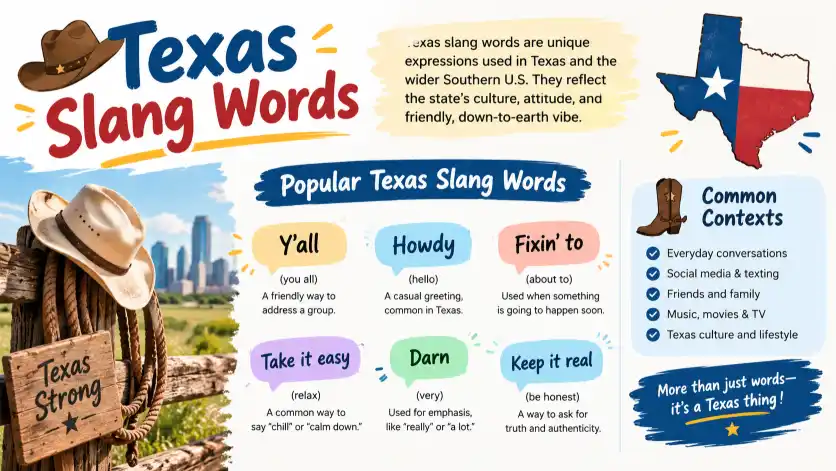
If you have ever heard someone say “y’all,” “fixin’ to,” “howdy,” or “all hat and no cattle,” you have probably heard Texas-style slang.
These words and phrases can sound different from standard American English, but they often have simple meanings.
Texas slang words reflect more than one culture. Texas speech has been shaped by Southern English, cowboy traditions, Mexican American communities, and the many people who have made Texas home.
Some expressions are old. Others still appear in casual conversations, country music, social media, and everyday life.
One important thing to remember is that not every phrase on a “Texas slang” list is used only in Texas. Some are common across the South or other parts of the United States. This guide points out those differences so you can understand what people actually mean.
If you are visiting Texas, writing dialogue, studying American English, or simply trying to understand a Texan friend, these Texas slang words can help.
Quick Answer: What Are Texas Slang Words?
Texas slang words are informal words and phrases associated with Texas speech and culture. They can describe people, places, actions, feelings, or situations. Some are widely used across Texas, while others are more strongly tied to rural areas, cowboy culture, or Southern speech.
| Question | Answer |
| What are Texas slang words? | Informal words and phrases linked with Texas speech and culture |
| Who uses them? | Texans and people familiar with Texas culture |
| Common examples | Y’all, howdy, fixin’ to, reckon, yonder |
| Tone | Casual, friendly, humorous, or regional |
| Are they all Texas-only? | No |
| Where are they heard? | Conversation, country culture, media, social media, and local communities |
The interesting part is that Texas does not have just one way of speaking. Someone from Houston may sound different from someone from West Texas or the Rio Grande Valley. Age, family background, location, and community can all affect which expressions a person uses.
50 Texas Slang Words and Their Meanings
Here are 50 words and phrases that you may hear in Texas or strongly associate with Texas culture.
1. Y’all
Part of speech: Pronoun
Pronunciation: yawl
Meaning: A casual way to say “you all.”
Example 1: “Are y’all coming with us?”
Example 2: “Y’all have a good night.”
Y’all is common throughout the Southern United States, not just Texas. Still, it is one of the most recognizable features of Southern and Texan speech.
2. Howdy
Part of speech: Greeting
Pronunciation: HOW-dee
Meaning: A friendly way to say hello.
Example 1: “Howdy, neighbor!”
Example 2: “Howdy! How are you doing?”
The word has a strong Western and cowboy image and is especially associated with Texas culture.
3. Fixin’ to
Part of speech: Phrase
Pronunciation: FIX-in too
Meaning: About to do something.
Example 1: “I’m fixin’ to leave.”
Example 2: “We’re fixin’ to eat.”
This phrase is common in Southern American English. In Texas, it is often heard in casual speech.
4. Reckon
Part of speech: Verb
Pronunciation: REK-un
Meaning: To think, believe, or suppose.
Example 1: “I reckon we should go.”
Example 2: “Do you reckon he’ll come?”
It gives speech a relaxed Southern or rural feel.
5. Yonder
Part of speech: Adverb
Pronunciation: YON-der
Meaning: A place over there, usually some distance away.
Example 1: “The barn is over yonder.”
Example 2: “Look over yonder.”
It is an older regional word that can still appear in Southern and rural speech.
6. All hat, no cattle
Part of speech: Idiom
Pronunciation: awl hat, noh CAT-ul
Meaning: Someone talks big but has little experience or ability.
Example 1: “He talks like a cowboy, but he’s all hat, no cattle.”
Example 2: “Don’t be fooled. He’s all hat, no cattle.”
This phrase is strongly associated with Texas and cowboy culture.
7. Texas-sized
Part of speech: Adjective
Pronunciation: TEK-sus sized
Meaning: Extremely large.
Example 1: “They served us a Texas-sized steak.”
Example 2: “That was a Texas-sized storm.”
It often plays on the popular image of Texas as a place where everything is big.
8. Big ol’
Part of speech: Phrase
Pronunciation: big ol
Meaning: A casual way to describe something large or noticeable.
Example 1: “That’s a big ol’ truck.”
Example 2: “He brought a big ol’ cooler.”
This expression is common in Southern speech and fits naturally into Texan conversation.
9. Ain’t
Part of speech: Verb
Pronunciation: aynt
Meaning: An informal form used instead of “is not,” “are not,” or similar forms.
Example 1: “That ain’t right.”
Example 2: “We ain’t ready yet.”
Ain’t is used in many English-speaking regions and is not unique to Texas.
10. Y’all’d’ve
Part of speech: Contraction
Pronunciation: yawl-duv
Meaning: A playful spoken contraction meaning “you all would have.”
Example 1: “Y’all’d’ve loved that concert.”
Example 2: “Y’all’d’ve laughed if you saw it.”
This form is very informal and is more often heard or written for humor than used in formal English.
Did You Know?
Texas has a huge geographic area and a wide mix of communities. That means there is no single “Texas accent” or vocabulary list that every Texan uses.
Texas speech can contain Southern expressions, Western terms, Spanish-influenced words, cowboy language, and local expressions.
That is why Texas slang words are best understood as a mix of regional language and culture rather than a fixed dictionary.
11. Pardner
Part of speech: Noun
Pronunciation: PARD-ner
Meaning: A casual form of “partner.”
Example 1: “Howdy, pardner!”
Example 2: “Thanks for helping, pardner.”
It is strongly connected with Western and cowboy speech.
12. Cowpoke
Part of speech: Noun
Pronunciation: COW-poke
Meaning: A cowboy or ranch worker.
Example 1: “The old cowpoke rode into town.”
Example 2: “He dressed like a real cowpoke.”
The word is strongly tied to Western culture.
13. Buckaroo
Part of speech: Noun
Pronunciation: BUCK-uh-roo
Meaning: A cowboy or ranch worker.
Example 1: “That buckaroo knows his horses.”
Example 2: “The young buckaroo worked on the ranch.”
The word has roots connected to Spanish-influenced Western language.
14. Ranch
Part of speech: Noun
Pronunciation: ranch
Meaning: A large farm used mainly for raising animals.
Example 1: “My uncle works on a ranch.”
Example 2: “They moved to a ranch outside town.”
The word is standard English, but ranch culture has a major place in Texas identity.
15. Blue norther
Part of speech: Noun
Pronunciation: bloo NOR-ther
Meaning: A sudden cold weather event caused by a strong cold front.
Example 1: “A blue norther is coming tonight.”
Example 2: “That blue norther dropped the temperature fast.”
The term is strongly associated with Texas and other parts of the Southern Plains.
16. Druthers
Part of speech: Noun
Pronunciation: DRUTH-ers
Meaning: What someone would prefer.
Example 1: “If I had my druthers, I’d stay home.”
Example 2: “Given my druthers, we’d leave early.”
It comes from the older phrase “would rather” and is used in regional American English.
17. Might could
Part of speech: Phrase
Pronunciation: mite kood
Meaning: Might be able to do something.
Example 1: “I might could help tomorrow.”
Example 2: “We might could finish by noon.”
This double-modal construction appears in some Southern dialects.
18. Cattywampus
Part of speech: Adjective/adverb
Pronunciation: KAT-ee-wom-pus
Meaning: Crooked, messy, or out of order.
Example 1: “That picture is hanging cattywampus.”
Example 2: “The boxes are all cattywampus.”
It is used in several Southern and regional American varieties, not only Texas.
19. Hissy fit
Part of speech: Noun
Pronunciation: HIS-ee fit
Meaning: An angry or dramatic outburst.
Example 1: “The child threw a hissy fit.”
Example 2: “Don’t have a hissy fit over it.”
This phrase is common in Southern American English.
20. Bless your heart
Part of speech: Phrase
Pronunciation: bless yer heart
Meaning: A phrase that can show sympathy, affection, pity, or mild criticism.
Example 1: “Bless your heart, you tried your best.”
Example 2: “Bless his heart, he really thought that would work.”
Context matters. It can sound kind or sarcastic.
Texas Slang Comparison Table
| Texas-associated term | Simple meaning | Is it Texas-only? |
| Y’all | You all | No |
| Howdy | Hello | No |
| Fixin’ to | About to | No |
| Reckon | Think/suppose | No |
| All hat, no cattle | Talks big without substance | Strong Texas link |
| Texas-sized | Very large | Strong Texas link |
| Cowpoke | Cowboy | No |
| Blue norther | Sudden cold front | Regional |
| Bless your heart | Sympathy or criticism | No |
| Yonder | Over there | No |
The biggest mistake is treating every Southern word as a Texas-only word. Texas shares a lot of language with neighboring states and other Southern regions.
21. Going to town
Part of speech: Phrase
Pronunciation: GO-ing tuh town
Meaning: Going into town, or sometimes doing something with great energy.
Example 1: “We’re going to town for groceries.”
Example 2: “She went to town decorating the house.”
The exact meaning depends on context.
22. Come hell or high water
Part of speech: Idiom
Pronunciation: kum hel or high WAW-ter
Meaning: No matter what problems happen.
Example 1: “I’ll be there come hell or high water.”
Example 2: “We’re finishing this come hell or high water.”
It is a broad American idiom with strong Southern and Western associations.
23. All fired up
Part of speech: Adjective phrase
Pronunciation: awl fired up
Meaning: Very excited, angry, or energetic.
Example 1: “The fans were all fired up.”
Example 2: “He got all fired up about the game.”
24. Madder than a wet hen
Part of speech: Idiom
Pronunciation: MAD-er than a wet hen
Meaning: Very angry.
Example 1: “Dad was madder than a wet hen.”
Example 2: “She was madder than a wet hen after the delay.”
This is a colorful Southern expression.
25. Rode hard and put up wet
Part of speech: Idiom
Pronunciation: rohd hard and put up wet
Meaning: Looking extremely tired or worn out.
Example 1: “After that trip, I look rode hard and put up wet.”
Example 2: “He looked rode hard and put up wet after the long shift.”
It comes from horse and ranch imagery.
26. Come to Jesus
Part of speech: Idiom
Pronunciation: kum tuh JEE-zus
Meaning: A serious talk meant to correct a problem.
Example 1: “We need to have a come-to-Jesus meeting.”
Example 2: “The coach had a come-to-Jesus talk with the team.”
This expression is used beyond Texas too.
27. Hold your horses
Part of speech: Idiom
Pronunciation: hohld yer HOR-siz
Meaning: Wait or slow down.
Example 1: “Hold your horses. We’re not ready.”
Example 2: “Hold your horses before you make a decision.”
Its horse imagery gives it a strong Western flavor.
28. Get a wiggle on
Part of speech: Phrase
Pronunciation: get uh WIG-ul on
Meaning: Hurry up.
Example 1: “Get a wiggle on or we’ll be late.”
Example 2: “Come on, get a wiggle on!”
It is an older informal expression heard in regional speech.
29. Over yonder
Part of speech: Phrase
Pronunciation: OH-ver YON-der
Meaning: Over there, usually at some distance.
Example 1: “The truck is over yonder.”
Example 2: “Your shoes are over yonder by the door.”
30. Tarnation
Part of speech: Interjection
Pronunciation: tar-NAY-shun
Meaning: A mild old-fashioned way to show surprise or annoyance.
Example 1: “What in tarnation happened?”
Example 2: “Where in tarnation did he go?”
It has a playful old Western feel today.
31. What in the Sam Hill?
Part of speech: Phrase
Pronunciation: what in the sam hill
Meaning: A mild way to show surprise or confusion.
Example 1: “What in the Sam Hill is going on?”
Example 2: “What in the Sam Hill happened here?”
It is old-fashioned and humorous rather than modern internet slang.
32. Git
Part of speech: Verb
Pronunciation: git
Meaning: A nonstandard pronunciation or spelling of “get.”
Example 1: “Git over here!”
Example 2: “Git yourself some water.”
It often appears in playful Western-style writing.
33. Doggone
Part of speech: Adjective/interjection
Pronunciation: DOG-gon
Meaning: A mild substitute for a stronger swear word.
Example 1: “That doggone truck won’t start.”
Example 2: “Doggone it!”
It is old-fashioned and not Texas-only.
34. Dang
Part of speech: Interjection
Pronunciation: dang
Meaning: A mild word showing surprise, frustration, or emphasis.
Example 1: “Dang, that was close.”
Example 2: “Dang, it’s hot today.”
35. Yippee ki yay
Part of speech: Expression
Pronunciation: YIP-ee kye yay
Meaning: A playful Western-style expression of excitement.
Example 1: “Yippee ki yay! We finally made it.”
Example 2: “The kids shouted, ‘Yippee ki yay!’”
It is strongly linked to Western imagery but is not everyday Texas slang for everyone.
36. Lone Star
Part of speech: Noun/adjective
Pronunciation: lone star
Meaning: A reference to Texas, known as the Lone Star State.
Example 1: “She is proud of her Lone Star roots.”
Example 2: “The Lone Star flag flew outside.”
37. Six-shooter
Part of speech: Noun
Pronunciation: six SHOOT-er
Meaning: A six-shot revolver.
Example 1: “The Western story featured a six-shooter.”
Example 2: “The character carried a six-shooter.”
This is more Western vocabulary than everyday modern slang.
38. Longhorn
Part of speech: Noun
Pronunciation: LONG-horn
Meaning: A cattle breed with very long horns; also a strong Texas symbol.
Example 1: “Longhorn cattle are easy to recognize.”
Example 2: “The longhorn has become a Texas icon.”
39. Boots
Part of speech: Noun
Pronunciation: boots
Meaning: Western-style footwear, often linked with cowboy culture.
Example 1: “He wore his old cowboy boots.”
Example 2: “Those boots are made for ranch work.”
The word itself is standard English, but boots have a strong cultural role in Texas.
40. Bluebonnet
Part of speech: Noun
Pronunciation: BLOO-bon-it
Meaning: A blue wildflower strongly associated with Texas.
Example 1: “The fields were full of bluebonnets.”
Example 2: “We stopped to photograph the bluebonnets.”
It is more of a Texas cultural term than slang.
Modern Texas Slang vs. Old Texas Expressions
Not every Texas-associated term sounds modern.
Some expressions are still heard in everyday conversation, while others are mostly used for humor, storytelling, Western themes, or regional flavor.
| More common in casual speech | More old-fashioned or playful |
| Y’all | Tarnation |
| Howdy | Sam Hill |
| Fixin’ to | Doggone |
| Reckon | Get a wiggle on |
| Big ol’ | Yippee ki yay |
| Yonder | Git |
This difference matters if you are writing dialogue. A real modern Texan may say “y’all” naturally but may never say “tarnation.”
41. Texas tea
Part of speech: Noun
Pronunciation: TEK-sus tee
Meaning: A nickname for oil.
Example 1: “The town grew rich from Texas tea.”
Example 2: “Texas tea shaped the region’s history.”
This is a cultural nickname rather than everyday slang.
42. Six flags
Part of speech: Phrase
Pronunciation: six flags
Meaning: A reference to the six nations that have historically controlled parts of Texas.
Example 1: “Texas is known for its six flags history.”
Example 2: “The phrase appears in Texas history discussions.”
It is mainly a cultural and historical reference.
43. Danged
Part of speech: Adjective/interjection
Pronunciation: dangd
Meaning: A playful or mild form used instead of a stronger swear word.
Example 1: “That danged thing broke again.”
Example 2: “This danged heat!”
44. Git-r-done
Part of speech: Phrase
Pronunciation: git-er-dun
Meaning: Get the task done.
Example 1: “We have work to do, so git-r-done.”
Example 2: “Grab your tools and git-r-done.”
The phrase is widely known in American pop culture and is not Texas-only.
45. Good ol’
Part of speech: Phrase
Pronunciation: good ol
Meaning: A friendly or familiar way to describe someone or something.
Example 1: “Good ol’ Texas weather.”
Example 2: “He brought his good ol’ pickup.”
46. Pickup
Part of speech: Noun
Pronunciation: PICK-up
Meaning: A pickup truck.
Example 1: “He drove his pickup to the ranch.”
Example 2: “That old pickup still runs well.”
Pickup is standard American English, but pickup trucks have a strong place in Texas rural culture.
47. Bubba
Part of speech: Noun
Pronunciation: BUB-uh
Meaning: An informal nickname for a brother, friend, or man.
Example 1: “Bubba helped me fix the fence.”
Example 2: “Hey, Bubba, come over here.”
The word is used in different parts of the Southern United States and does not automatically mean someone is from Texas.
48. Little bitty
Part of speech: Adjective phrase
Pronunciation: LIT-ul BIT-ee
Meaning: Very small.
Example 1: “It was a little bitty town.”
Example 2: “She brought a little bitty dog.”
This phrase is common in Southern-style speech.
49. Pretty near
Part of speech: Adverb phrase
Pronunciation: PRIT-ee neer
Meaning: Almost or nearly.
Example 1: “I’m pretty near finished.”
Example 2: “We’re pretty near there.”
It is a regional-style expression rather than a Texas-only term.
50. Texas friendly
Part of speech: Adjective phrase
Pronunciation: TEK-sus FRIEND-lee
Meaning: Warm, welcoming, and friendly in a Texas-style way.
Example 1: “The town gave us a Texas-friendly welcome.”
Example 2: “Everyone was Texas friendly at the event.”
This is better understood as a cultural phrase than a fixed dictionary slang term.
Where Texas Slang Words Are Used
Texas expressions can appear in many settings, but the level of slang changes with the situation.
| Setting | How Texas-style language may appear | Example |
| Everyday conversation | Regional phrases | “Y’all ready?” |
| Ranch life | Cowboy and rural terms | “Howdy, pardner.” |
| Country culture | Western expressions | “Hold your horses.” |
| Social media | Texas jokes and local phrases | “That’s Texas-sized.” |
| Music | Southern and Western language | “I reckon we’re going.” |
| Travel | Friendly local speech | “Howdy!” |
| School | Casual regional speech | “Y’all finished?” |
| Work | Usually lighter slang | “We’re fixin’ to start.” |
The same person may change their language depending on the setting. A Texan might use strong regional expressions with friends but use standard English during a formal meeting.
Texas Slang Pronunciation Tips
Texas speech often changes the sound of words more than the actual vocabulary.
Common examples include:
| Written Form | Approximate Sound |
| Y’all | yawl |
| Fixin’ | FIX-in |
| Reckon | REK-un |
| Yonder | YON-der |
| Howdy | HOW-dee |
| Pardner | PARD-ner |
| Buckaroo | BUCK-uh-roo |
| Cattywampus | KAT-ee-wom-pus |
You do not need to copy a Texas accent to understand these words. Focus on the meaning first.
Texas Slang in Social Media
Modern Texans may use regional words online, but social media has also made Texas slang easy for people outside the state to copy.
You may see:
- Y’all in captions
- Howdy as a joke or greeting
- Texas-sized for something huge
- All hat, no cattle for someone pretending to know something
- Bless your heart as a humorous comment
- Fixin’ to in casual posts
A person using one of these terms online is not necessarily from Texas. People often use regional slang because they like the sound, humor, or culture behind it.
Texas Slang vs. Southern Slang
Texas is part of the South, but Texas speech is not exactly the same as speech in every Southern state.
| Texas-associated expression | Broader Southern use |
| All hat, no cattle | More strongly Texas/Western |
| Y’all | Very common |
| Fixin’ to | Very common |
| Reckon | Common |
| Bless your heart | Common |
| Yonder | Common |
| Howdy | Strong Western/Texas image |
| Blue norther | More regional |
This is why calling every Southern expression “Texas slang” can be misleading.
Are Texas Slang Words Still Used?
Some are very common, while others are old-fashioned or mainly cultural.
Words such as y’all and phrases such as fixin’ to remain recognizable and useful in casual Southern speech. Other expressions, such as tarnation and what in the Sam Hill, sound much more old-fashioned.
Texas also has many younger speakers who mix regional expressions with modern internet language.
So there is no single age group that owns Texas slang.
When Should You Use Texas Slang?
Use it when the setting is relaxed and the people around you understand the expression.
Good places include:
- Casual conversations
- Friendly texts
- Social media
- Country or Western-themed writing
- Informal storytelling
- Dialogue in fiction
If you are writing formal school or work content, standard English is usually better.
You also do not need to force several Texas expressions into one sentence. One natural phrase often sounds more believable than five slang words together.
Real-Life Texas Slang Examples
Casual Conversation
Mason: “Y’all ready to head out?”
Claire: “Yep. I’m fixin’ to grab my bag.”
Here, both speakers use casual Southern-style expressions naturally.
At a Ranch
Dylan: “Howdy, pardner.”
Marcus: “Howdy! Need a hand with that fence?”
The words create a friendly Western tone.
Talking About Someone
Jenna: “He keeps talking like he owns the place.”
Riley: “Sounds like he’s all hat, no cattle.”
The phrase means the person talks big without showing real ability.
Talking About the Weather
Ava: “It was hot yesterday.”
Noah: “Hot? That was Texas-sized heat.”
Here, Texas-sized adds humor and emphasis.
Giving Directions
Caleb: “Where’s the old barn?”
Sophie: “It’s over yonder.”
The phrase simply means “over there.”
Common Mistakes With Texas Slang
1. Thinking every Texan talks like a cowboy
Texas has many accents and speech styles. Not every Texan uses cowboy expressions.
2. Calling every Southern word Texas-only slang
Many expressions are shared across the Southern United States.
3. Overusing the slang
Putting five Texas expressions into one sentence can sound fake.
4. Assuming old expressions are modern slang
Words such as tarnation and Sam Hill have an old-fashioned feel.
5. Ignoring local differences
Houston, Dallas, El Paso, Austin, the Panhandle, and rural areas can have different speech patterns and cultural influences.
6. Using “bless your heart” without understanding the tone
It can be kind, sympathetic, playful, or sarcastic. The situation and voice matter.
7. Thinking slang must be offensive
Most Texas expressions are not insults. Many simply make speech sound friendly, regional, humorous, or informal.
Key Takeaways
- Texas slang words are informal expressions connected with Texas speech and culture.
- Y’all, howdy, fixin’ to, reckon, and yonder are common regional examples.
- All hat, no cattle has a particularly strong Texas and cowboy connection.
- Not every Texas slang term is unique to Texas.
- Some expressions are modern, while others are old-fashioned or mainly cultural.
- Context matters more than simply labeling a word “Texas slang.”
FAQs About Texas Slang Words
What is a famous Texas slang word?
Y’all is one of the most recognizable regional expressions associated with Texas and the broader South. It means “you all” and is used when speaking to two or more people. Other well-known Texas-associated expressions include howdy, reckon, fixin’ to, and all hat, no cattle.
What do Texans say instead of “you guys”?
Many Texans use “y’all” instead of “you guys” when talking to a group. For example, “Are y’all coming?” simply means “Are you all coming?” Y’all is not exclusive to Texas, though. It is widely used across the Southern United States.
What is a Texas word for hello?
Howdy is the classic Texas-associated word for hello. It is friendly and informal. You may hear it in Texas-themed settings, ranch communities, Western culture, or casual conversations. It is not limited to Texas, but it has a strong Texas and Western image.
What does “fixin’ to” mean in Texas?
Fixin’ to means about to do something. If someone says, “I’m fixin’ to leave,” they mean they are about to leave. The phrase is common in Southern American English, so it is not unique to Texas.
What does “all hat, no cattle” mean?
All hat, no cattle describes someone who talks or acts like they have experience but does not have the real knowledge or ability to support it. The phrase uses cowboy imagery and has a particularly strong connection with Texas culture.
Is Texas slang the same as Southern slang?
No. There is a large overlap, but they are not exactly the same. Texas has its own regional history and Western influences. Some expressions are strongly linked with Texas, while others are common throughout the South. Location, age, and community also affect how people speak.
Do young Texans still use slang?
Yes, but they may mix regional expressions with modern internet language. A young Texan might use y’all in the same conversation as current social-media slang. Older expressions such as tarnation are less likely to appear in normal modern conversation.
What is the most Texas-sounding phrase?
There is no single official answer, but “Howdy, y’all!” strongly evokes Texas and Western culture. “All hat, no cattle” is another phrase with a strong Texas identity. Both are recognizable outside Texas, so using them does not prove someone is Texan.
Conclusion
Texas slang words give English a strong regional flavor. Some sound friendly, some humorous, and some come from Texas ranch and cowboy culture. Words such as y’all, howdy, reckon, fixin’ to, and yonder can make everyday speech sound more casual and local.
At the same time, it is important not to treat every Southern expression as Texas-only slang. Many words are shared across the South, while others have roots in Western culture or older regional English. Texas is also a large and diverse state, so people from different areas and backgrounds may use different expressions.
If you want to sound natural, use these terms lightly and understand the context first. “Y’all” may fit almost anywhere in casual conversation, while an expression like “tarnation” can sound playful or old-fashioned.
The best Texas slang is not about using the most words. It is about knowing what they mean and using them naturally.
- Boston Slang Words: 50 Terms,Meanings & Examples
- Spanish Slang for White Girl: The Term That Sparks Debate Online
- Guitar Slang: The Language Behind Every Riff

Hi, I’m Olivia Carter. I enjoy researching English slang, online expressions, and everyday vocabulary. I write clear, beginner-friendly guides with simple definitions and practical examples to make modern English easier to understand.